Posts in Category: Art
Assessing a “new” Leonardo da Vinci: Don’t talk to art historians about art
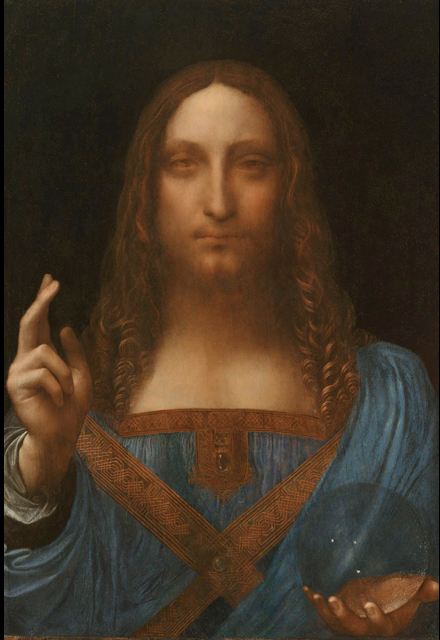
Leonardo da Vinci (1452-1519) Salvator Mundi (c. 1500) Oil on walnut panel. Private collection.
Next month, the National Gallery of London will display a “previously-unknown work by Leonardo da Vinci.” Called Salvator Mundi (i.e. “Savior of the World”), the painting has been compared to surviving, fragmented preparatory drawings and undisputed paintings by da Vinci. As a result, many scholars believe it should be counted among a handful of paintings by the artist. Others doubt. The portrait of Christ will be on display in the exhibition Leonardo da Vinci: Painter at the Court of Milan, opening on November 9 in London, for everyone to compare and opine.
Anticipating certain and divisive scrutiny, Nicholas Penny, the Director of the National Gallery, says he is “pretty sure” it is by da Vinci. He was interviewed by The Sunday Times(London) for a feature in the paper’s magazine titled “Leonardo? Convince Me.”:
“It is a very weird picture.” . . . It shares something, he says, with Leonardo’s portraits The Lady with the Ermine and the Mona Lisa. “They respond, but hold something back. You can’t think about them except in relationship to the viewer. They imply a narrative of which you are a part. That was not true of portraiture before Leonardo. The Salvator Mundi radiates intense presence. But because it’s Leonardo you do wonder if you’re going mad–and you certainly want people whose opinions you respect to look at it.” He pauses. “People can judge for themselves.” (Sunday Times Magazine. 9 OCT 2011.)
Before becoming Director, Mr. Penny was the Clore Curator of Renaissance Art at the National Gallery for ten years. He is a serious scholar; an expert. But, his advice here is nonsense. We may never be able to decisively attribute the painting to da Vinci–it has been over 500 years. But, we can certainly do better than stand in front of it to experience “radiated presence”–whatever that means–or take comfort in an “implied narrative.” It is the kind of non-methodical, relativistic drivel that has made art history and art historians completely irrelevant to public debate in our evidence-based era.
I don’t think Mr. Penny’s advice in this interview is the basis for his opinions; but, he has been trained by a hundred years of art historical practice to talk to the public about art in an imprecise and unhelpful way. The Salvator Mundi painting has been through a host of scientific tests, including carbon dating and comparative chemical testing of pigments used in undisputed da Vinci paintings; and, a series of comparative stylistic studies, such as analysis of stroke and process. These are not the kind of tools available to average museum-goers who Mr. Penny invites to “judge for themselves.” If he were a lawyer, we would expect him to say “Here is the compelling evidence for and against . . . therefore I am pretty sure it is attributable to da Vinci.” not: “I’m pretty sure . . . It’s weird . . . ask someone else.” It is a sign of our times that a trained scholar and Director of one of the world’s great museums would tell people to look at and interpret a Renaissance painting as though it were a 1960s drip painting. It is evidence of the public death of a way of talking about art called the “Morellian Method.”
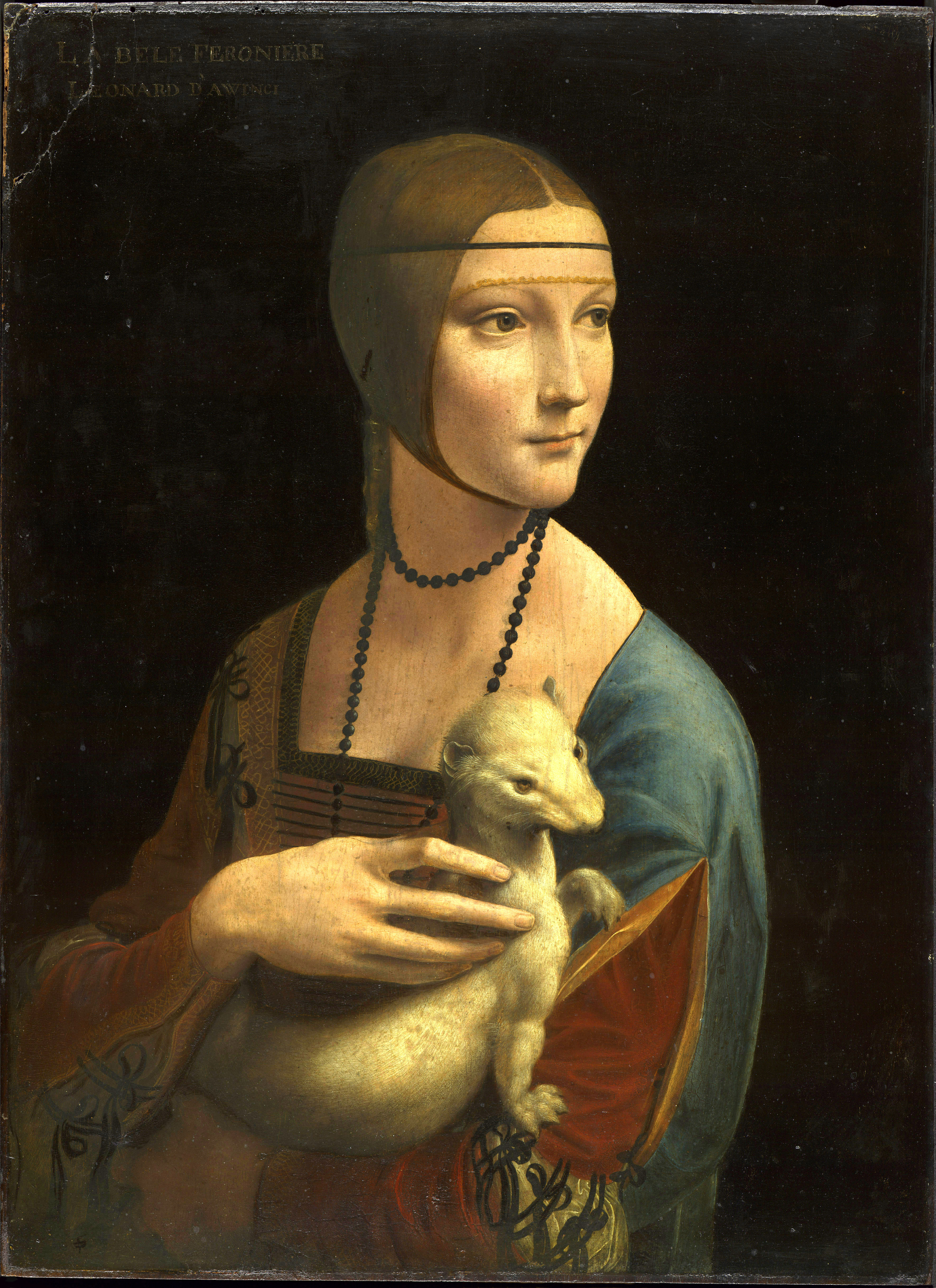
Leonardo da Vinci (1452-1519) Lady with an Ermine (1485) Oil on wood panel. 54 by 39 cm. Czartoryski Museum, Kraków.
Giovanni Morelli (1816-1891) was a trained doctor who had a love of art. During his lifetime, royal and national museums sprung up throughout Europe. Many Old-Master works were placed on public display for the first time, leading to an international public dialogue on art not seen before or since. Competing for attention, these collections–sometimes of dubious origins– were often overzealous and sloppy in attributing works of art to marquee names. Paintings labelled “da Vinci” have since been downgraded to “School of da Vinci” or “Unknown Florentine Artist.” At the time, art historians, critics and collectors were anxious to divide up painters into similar Schools (e.g. Spanish, French, Neopolitan) by observations of subject, palette and, even, size. Morelli had a different approach. He suggested that the same rigorous scientific methods used in medicine (e.g. dissection and observation) be applied to the observation of paintings. In particular, Morelli believed that an artist was best known by the minute and inconsequential parts of a painting: leaves on trees, fingernails, dirt. Artists didn’t reveal themselves in the big things; but, in the mundane areas of their art that were not subject to constant reinvention. He wrote detailed treatises on the varied hand gestures of particular painters, contrasting them with others. Over time, he was considered a kind of Sherlock Holmes of painting.Though some of his attributions were incorrect, Morelli’s object-based method pre-dated many scientific tools that his nineteenth-century philosophy would have embraced.

School of Leonardo da Vinci. Bacchus (c. 1510) Oil on walnut panel transferred to canvas. 177 by 115 cm. Musée du Louvre, Paris.
By the early twentieth century, paintings were interpreted differently. Art was considered mostly through philosophical arguments alone, not craftsmanship combined with philosophy. Morelli was not relevant to Dadaists or Pop Artists. But, it was my belief that thos, like Mr. Penny, who continued to study art in the Classical Tradition, would retain the rigor and language of a scientific method in order to understand, preserve and teach the public about these works. I think Mr. Penny has a deep understanding–many years beyond technical possibilities of Morelli’s era–but his comments appear to indicate his lack of belief public capacity or interest to see paintings in a rigorous way. Maybe that is just my implied narrative.
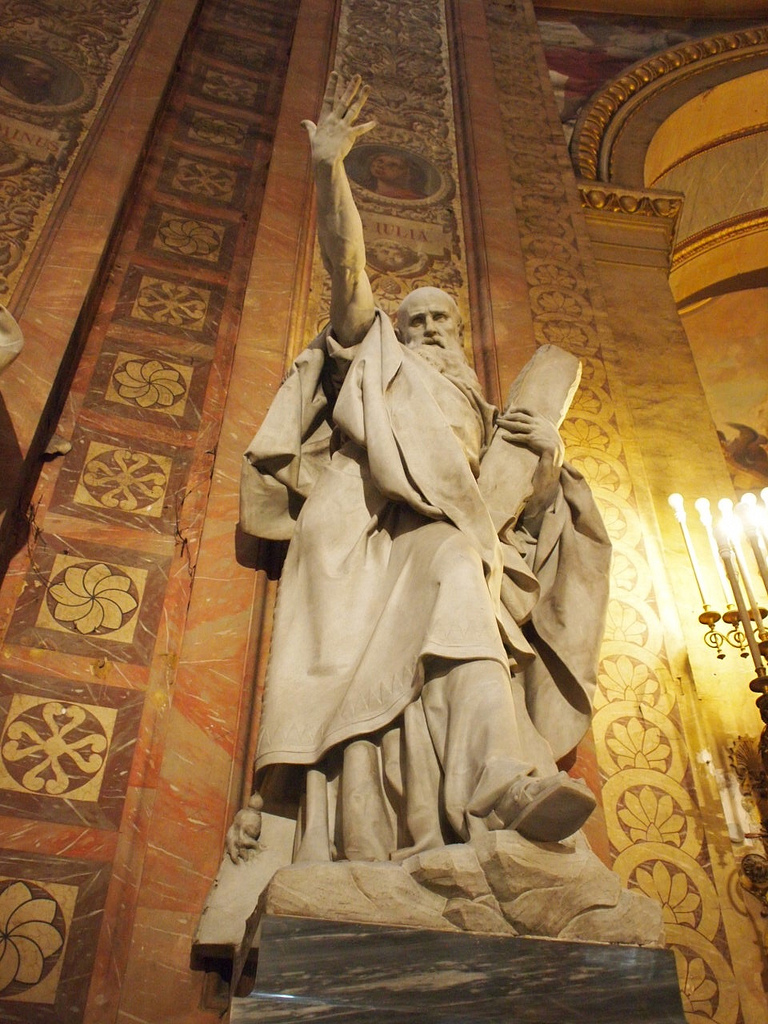
Real Basílica de San Francisco el Grande in Madrid
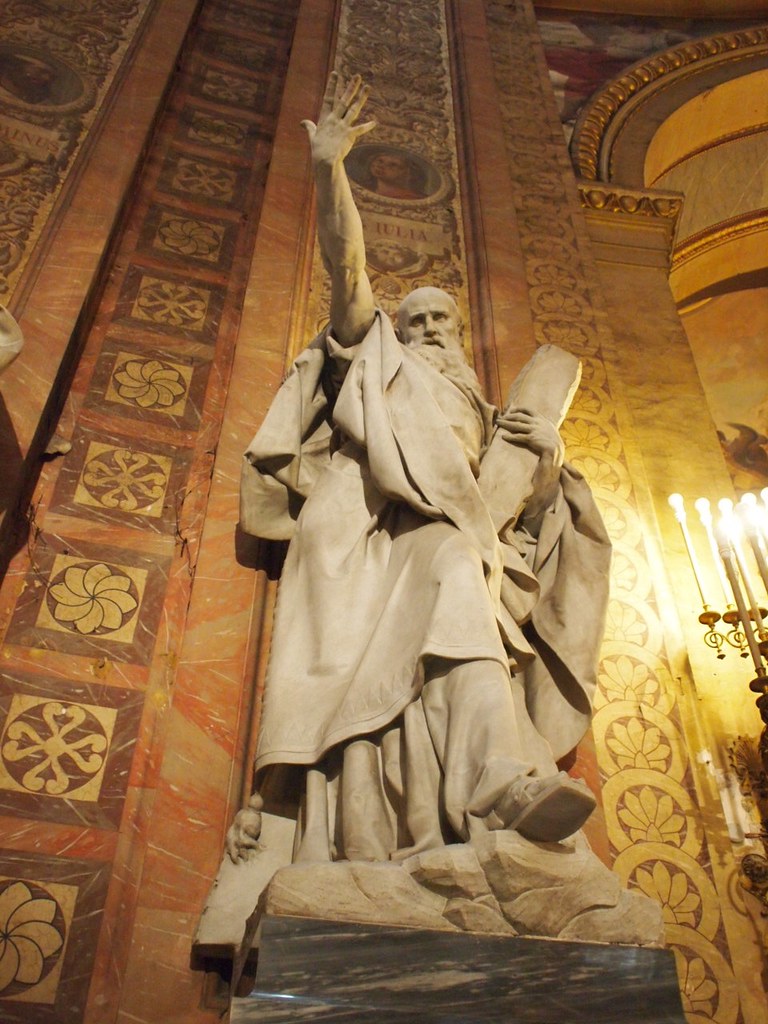
Ricardo Bellver (Madrid, 1845-1924) San Andres (Saint Andrew) Marble. Basilica de San Francisco el Grande, Madrid.
Located a short walk from the Royal Palace, the Basilica de San Francisco el Grande is not on most tourists’ itineraries. It should be. Even when tourist visit, it is to see the Capilla de San Bernardo (Chapel of Saint Bernard) where a large painting by Francisco de Goya y Lucientes (Spanish, 1746-1828) hangs. Goya’s work is worth seeing; but, it is hardly the most impressive in the Basilica.The site for the building was chosen in 1214 by none other than Francis of Asisi (1182-1226). It became the capital’s hub for religious Royal and national events. Several weddings by Bourbon rulers took place there. However, after invading French troops used the Basilica as a military barracks, the building fell into disuse. (Both because of the cost of restoration and its association with the French.) During the last quarter of the nineteenth century, the Spanish government commissioned the country’s best native artists and architects to retore the Basilica. (By the way, a basilica is different from a Cathedral or church in many ways. For one, a Cathedral is dedicated to a particular saint. Basilica’s are dedicated to the Virgin. They also represent different hierarchies within the Catholic Church. A priest says Mass in a church, a Bishop in a Cathedral and the Pope in a basilica.)
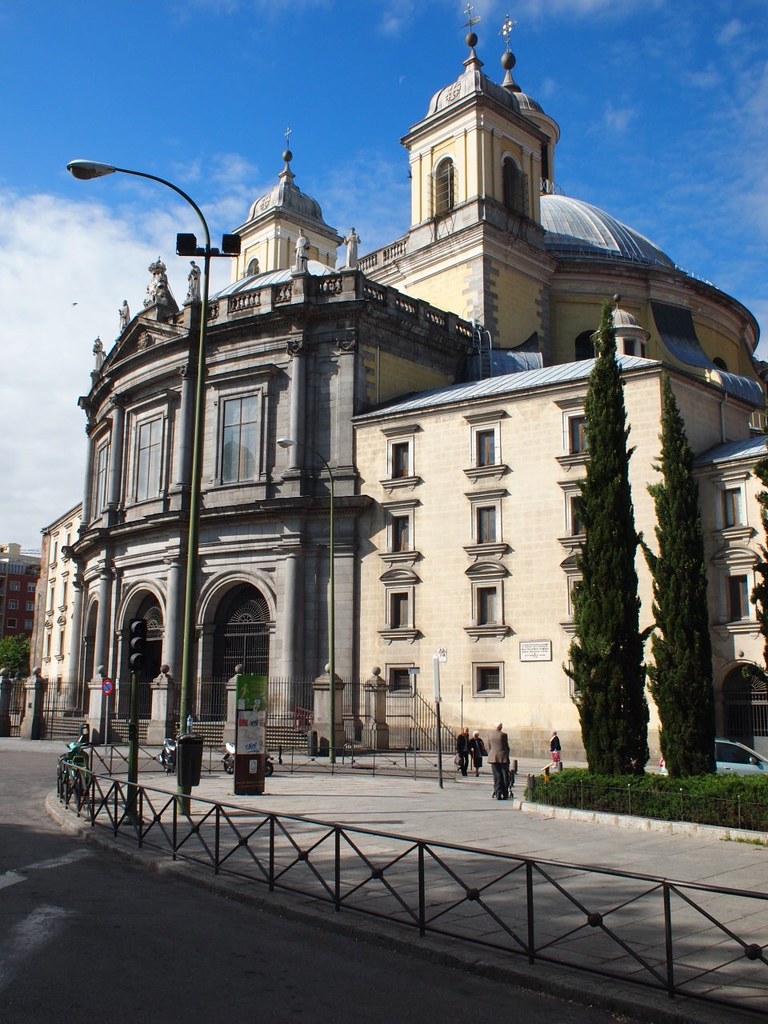
Real Basilica de San Francisco el Grande (Royal Basilica of Saint Francis the Great) Madrid, Spain.
The Basilica’s principal dome–one of the largest in the world–was painted by Casto Plasencia Mayor (). Plasencia had studied in Rome, where he did extensive studies of Raphael’s frescoes in the Pope’s apartments. He also drew inspiration from the eighteenth-century frescoes done by Tiepolo for the Royal Palace, just down the street.
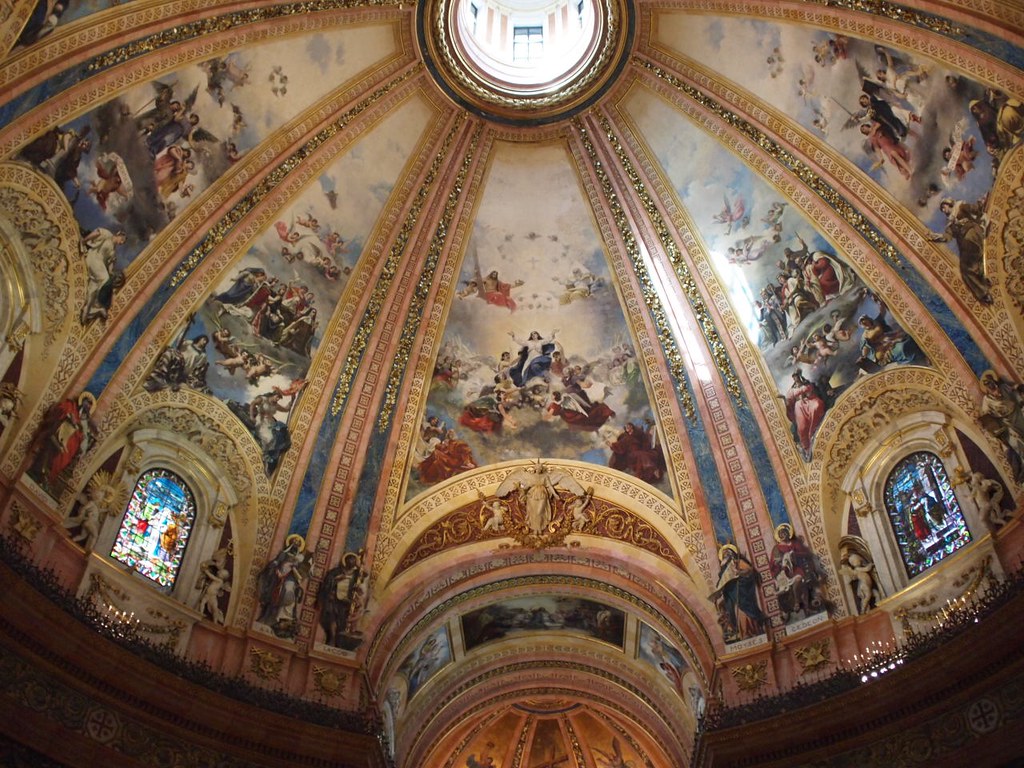
Casto Plasencia Mayor (Spanish, 1846-1890) Cupola for the Basilica de San Francisco el Grande, Madrid
There are six chapels, each dedicated to a different saint and featuring epic-sized paintings. However, my favorite works in the Basilica, by far, are the twelve sculptures along the perimeter of the cupola, representing the original twelve apostles in larger-than-life carera marble. These were done by artists whose names are now forgotten and whose other works are almost all gathering dust in the basement of national and regional museums. (Please excuse my poor photographs. The light conditions in the Basilica are not great.)
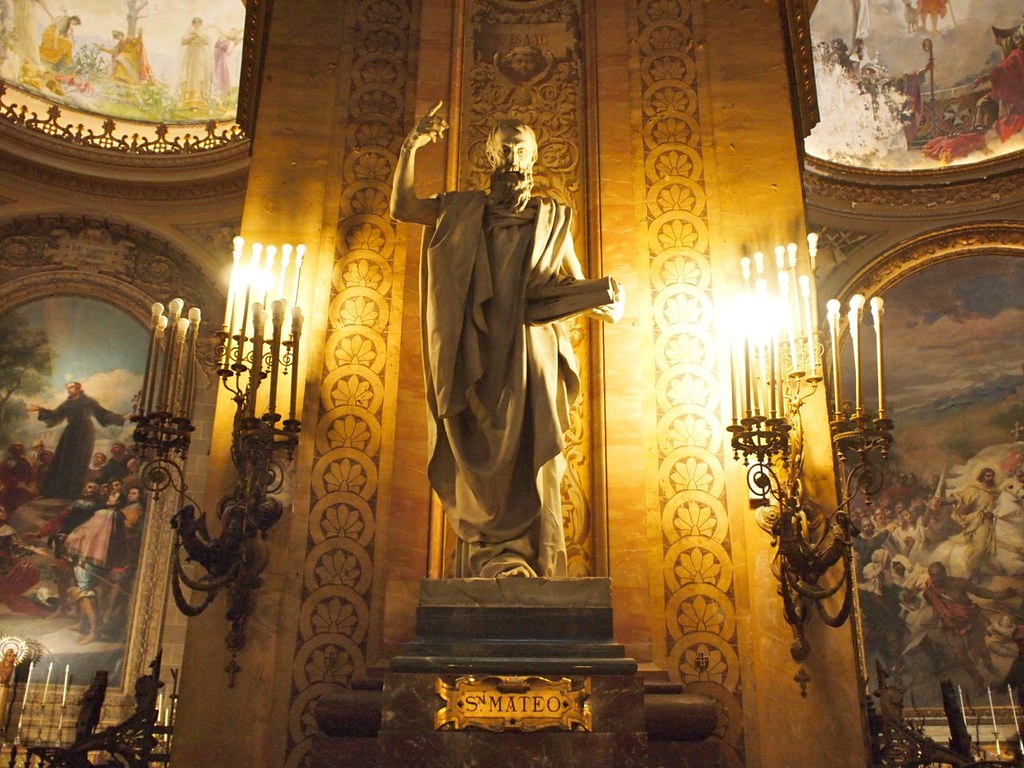
Ricardo Bellver (Spanish, 1845-1924) San Mateo (Saint Matthew) Marble. Basilica de San Francisco el Grande, Madrid.
The Basilica and its artists deserve a great deal more attention. (I hope to write an extensive paper, perhaps a book, on it someday.) For more images, go to this album.
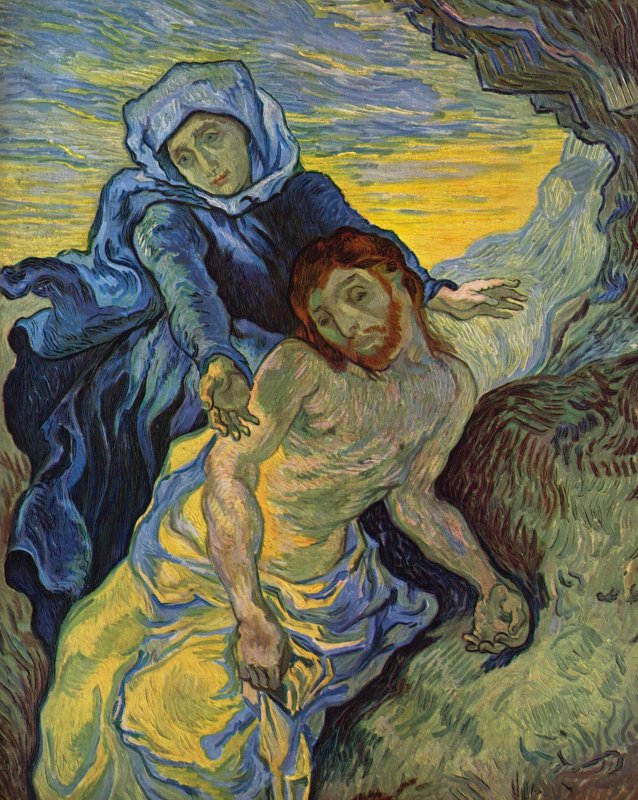
Van Gogh in the Vatican
Vincent Van Gogh (Dutch, 1853 – 1890) Pietà (c. 1880) Oil on canvas. 73 x 60 cm. Vatican Museums, Vatican City.
We do not usually associate the two; but, there it is: a Van Gogh hanging somewhere between one of the world’s largest collections of antiquities and the Sistine Chapel.
More than four million people visited the Vatican Museums last year. I was was one of them. For those who have not made their own pilgrimage, it is difficult to describe the vast, Byzantine compound that holds the Catholic Church’s collections. With objects as diverse as Egyptian artefacts and Sevres porcelains, the “museum” is divided into several exhibitions, conjoined with palaces that make up the Pope’s apartments. Together, they are nearly impossible to see it all in a single day or, even, week. And, if you are like me, mentally exhaustion sets in after an hour. So, it is understandable that most tourists make their way directly to the brightest stars in the collection (e.g. Raphael’s frescoes, Laocoön), without seeing what in other museums would be show stoppers.
The Vatican has a sizable collection of modern and contemporary religious art. These works range from mid-nineteenth-century artists to today and are hung in a series of dimly-lit, basement rooms leading to the Pope’s apartments. Visitors are given the choice of a short cut directly to the Sistine Chapel or a fifteen-minute walk through the rooms where the Modern Collection hangs, sometimes unlabeled. Most choose the direct route. Even those who take the long way end up rushing past works by Auguste Rodin, Pablo Picasso, Salvador Dalí, Giacomo Balla, Otto Dix and many, many others.
It was there I saw Pietà by Vincent Van Gogh. I cannot stop thinking about it. This post is an attempt to figure out why.
I am not nor have I ever been obsessed with Van Gogh. Of course, like many, I feel admiration for his singular way of seeing the world. I feel a shock every time I see one of his works in person. His sculptural use of oil paint and familiar colors combined with acrobatic compositions, makes common places, people and things members of alternate realities. His debilitating solitude, tortured genius and early death make him a rock star of art. (Back in the 90s, two posters, one of Kurt Cobain and the other of Van Gogh, hung above my roomate’s desk.)
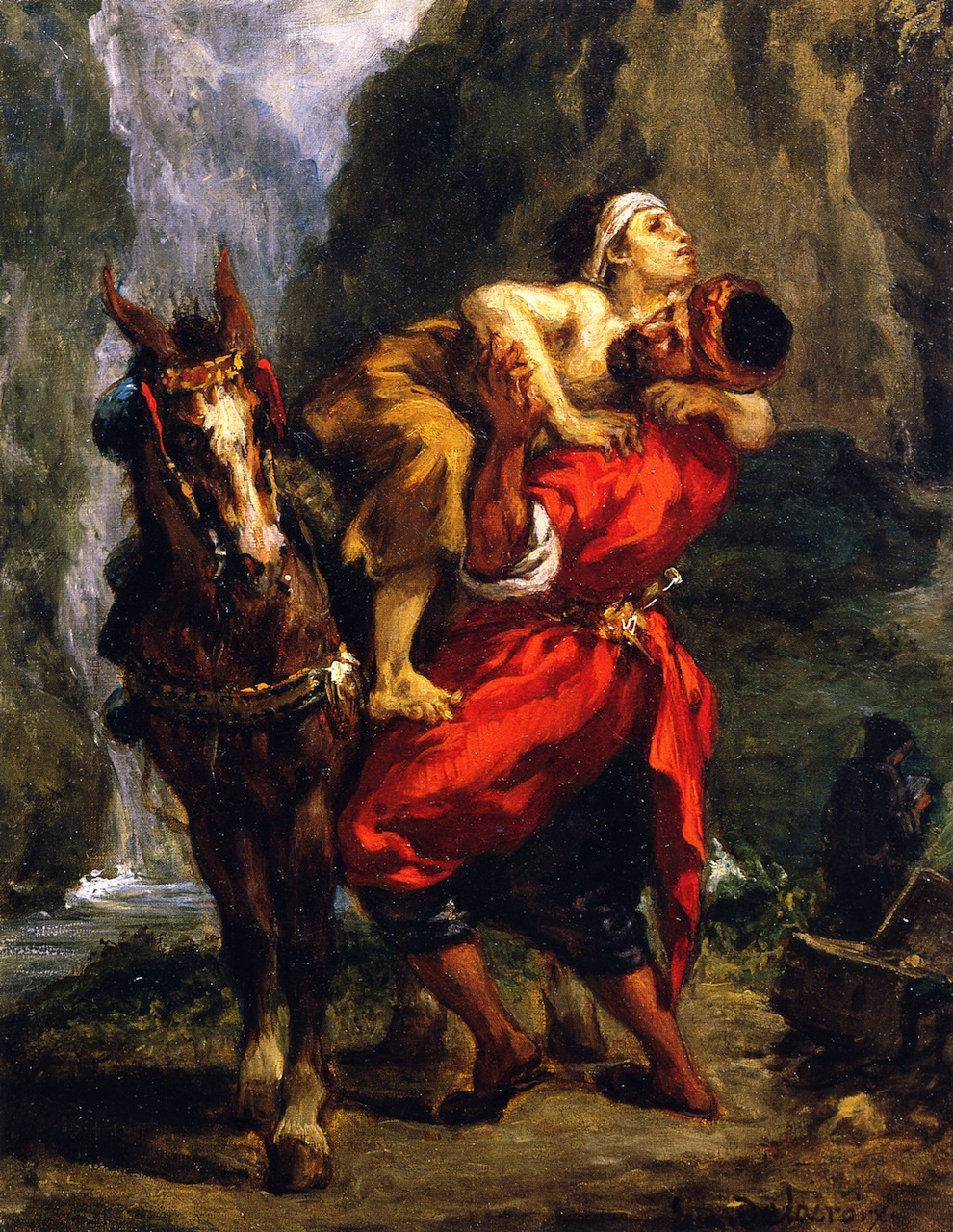
Eugène Delacroix (French, 1798-1863) The Good Samaritan (c. 1848) Oil on canvas. Private Collection.
Some scholars believe that Van Gogh’s Pietà, showing the dead, tortured body of Christ after the Crucifixion, is actually a self-portrait. (Note the red beard.) While in the Hospital of Saint-Rémy, housed in an old monastery,Van Gogh wrote his brother Theo: “I am not indifferent, and pious thoughts often console me in my suffering.” In any case, religious works by Van Gogh are rare. The Pietà is one of two biblical paintings he copied from Delacroix.
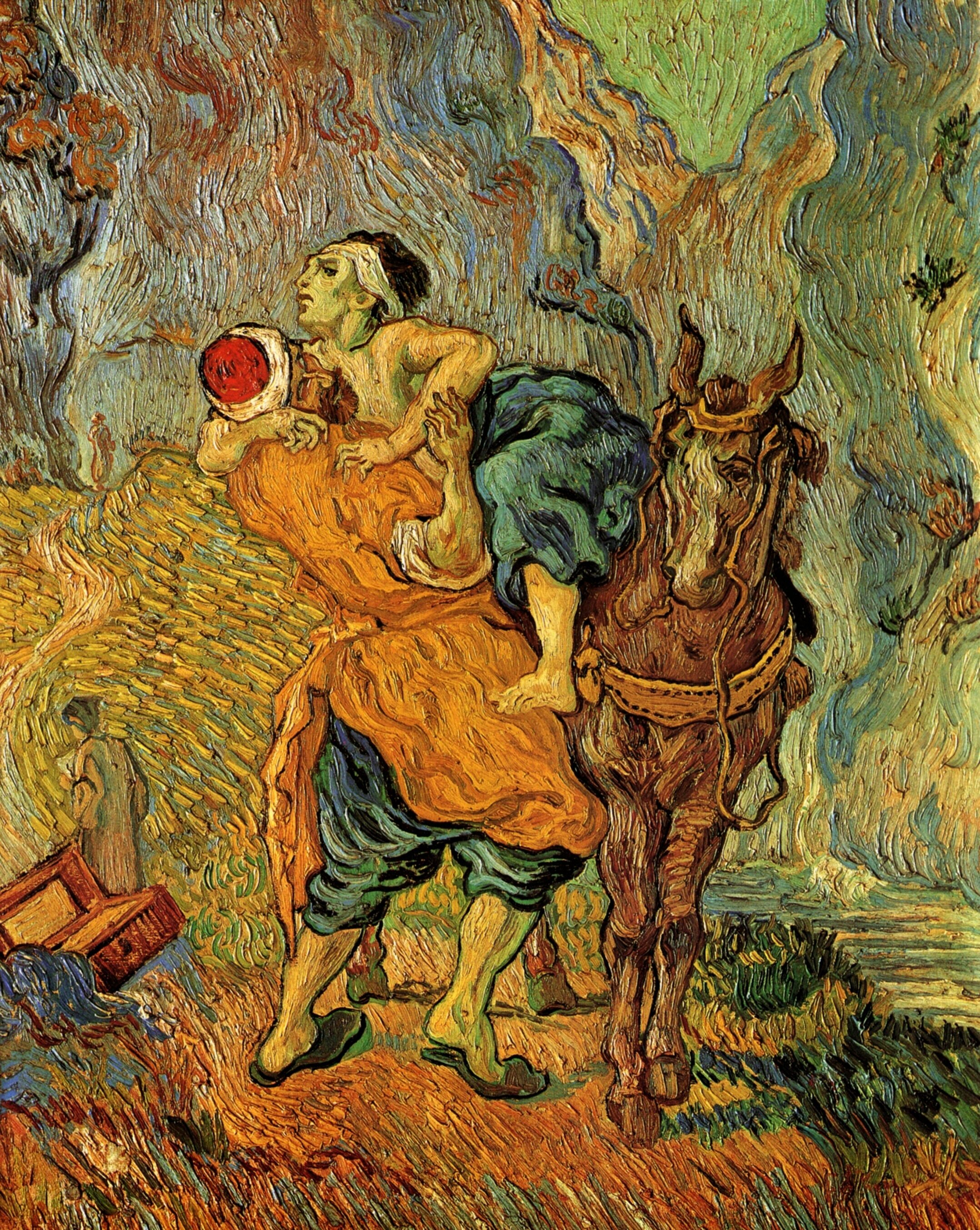
Vincent Van Gogh (1853-1890) The Good Samaritan, after Delacroix. Oil on canvas.
Van Gogh hugely admired Delacroix, mentioning him more than 95 times in personal letters. In particular, he admired Delacroix’s use of bold and vibrant color.
Writing to his brother about Delacroix’s Pietà, which he had in the form of a lithograph, Van Gogh wrote:
The Delacroix lithograph La Pietà, as well as several others, fell into my oils and paints and was damaged. This upset me terribly, and I am now busy making a painting of it, as you will see.
We do not know if he was referring the painting in the Vatican or the other version, hanging in Van Gogh Museum, which some believe to be made late. The Vatican Museum of Modern Art did not purchase its painting. Like many other works, Pietà was a gift from a member of the Church, who donated it his diocese in New York sometime mid-century. Of the two versions, the Vatican’s is much smaller. It is also darker, which is, perhaps, more a result of not being as well cleaned. But, the darker hues, combined with the dim lighting, in my opinion, imbue the work with greater pathos.
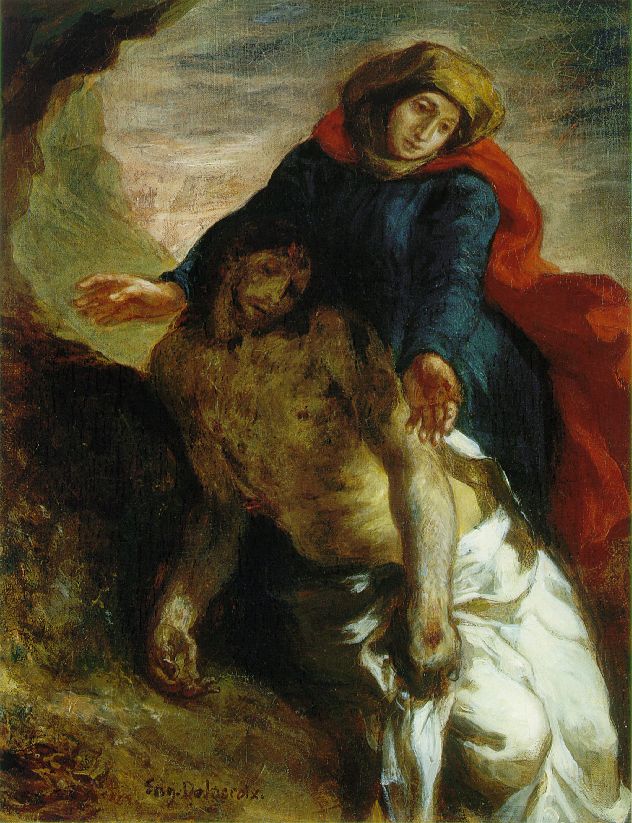
Eugène Delacroix (French, 1798-1863) Pietà (c. 1850) Oil on canvas. Nasjonalgalleriet, Oslo.
We should all be aware by now that most paintings we see in museums were never meant to be hung in a public space, let alone under modern, high-voltage lighting. While I do not know the original context for the work–if there even was a context–the overlooked space on the way to the Sistine Chapel seems a fitting.
Visiting Lisbon’s Museu Nacional de Arte Antiga

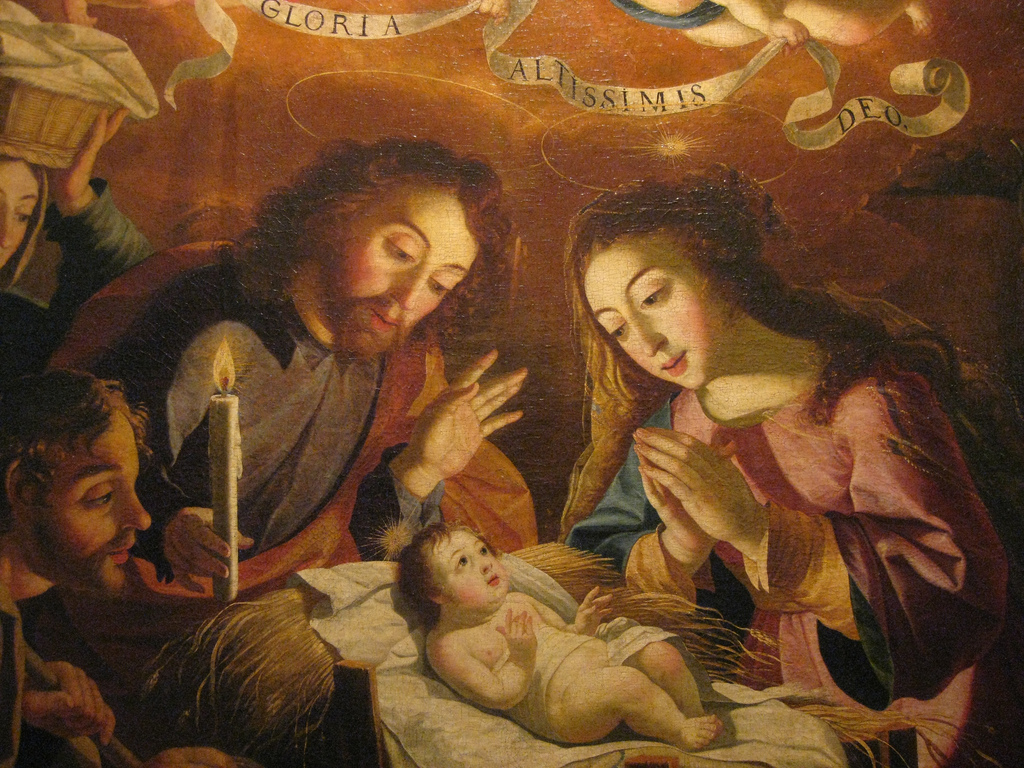
Josefa d’Obidos (Portuguese, 1630-1684) Adoracão dos Pastores OR Adoration of the Shepherds (1669) Oil on canvas. Museum of Ancient Art, Lisbon. (Detail)
With only 36 hours in Lisbon, there was little time to explore Portugal’s capital. I wanted to visit the city’s most well-known art museum. So, when I asked a cab driver to take me to the Museum of Fine Art, I was taken to the Museu Nacional de Arte Antiga. (Roughly translated as the “National Museum of Ancient Art,” the term “ancient” in Portuguese does not have exactly the same meaning in English, which would imply anything from pre-historic to, perhaps, the birth of Christ.)

Unknown Portuguese sculptor. Saint Gabriel (c. 1675) Polychrome statue. Museum of Ancient Art, Lisbon.
The Museum’s collection represents works from the Middle Ages to the mid-nineteenth century. While it is not the only museum of fine art or necessarily the best, it was where I was taken. And, I am forever grateful to the cabbie who took me there.

Hieronymus Bosch (Flemish, 1450-1516) Triptych of the Temptations of St. Anthony Abbot with the Betrayal of Christ and the Way to Calvary (c. 1500) Oil on panel. Museum of Ancient Art, Lisbon.
Not surprisingly, the preponderance of the collection corresponds to the period when Portugal was among the world’s superpowers. It is dominated by masters from the fifteen to seventeenth centuries, when Portugal was made rich discovering and trading with much of the world.

Antonio Pereda y Salgado (Portuguese, 1608-1678) Still life with vegetables and kitchen utensils (1651) Oil on canvas. Museum of Ancient Art, Lisbon. (Detail)
Many of us can name Spanish artists from the same period (e.g. Velázquez, El Greco). But, even though the Portuguese shared the Iberian Peninsula, their artists do not have anywhere near the same esteem or recognition.

Clemente Sanchez (Portuguese, Seventeenth Century) Sao Sebastião or Saint Sebastian (c. 1620) Oil on canvas. Museum of Ancient Art, Lisbon.

Clemente Sanchez (Portuguese, Seventeenth Century) Sao Sebastião or Saint Sebastian (c. 1620) Oil on canvas. Museum of Ancient Art, Lisbon. (Detail)
For example, the artist Clemente Sanchez (Portuguese, Seventeenth Century) demonstrates a remarkable level of training, on par with any artists of the period. Yet, I am unable to find his biography or any work by him online. In Saint Sebastian (c. 1620), Sanchez shows a remarkable arsenal of skills; and, more importantly, represents a different approach that combines both the naturalism of Velázquez and the classical ideal of Poussin, who were both working at the same time. If his work truly represents a unique, Portuguese approach to art, it is worth publishing to a wide audience.

Pieter Brueghel, The Younger (Flemish, a. 1564-1637) Acts of Mercy (c. 1625) Oil on panel. Museum of Ancient Art, Lisbon.
In addition to showcasing regional talent, the Museum features works that cannot be seen any where else by well-known, canonical Flemish, Dutch, Spanish, and Italian artists. The Portuguese were obviously aware of and collecting these artist like any other major European nation. (Even though the Museum has recently undergone a significant renovation, it has not yet put these works online.)
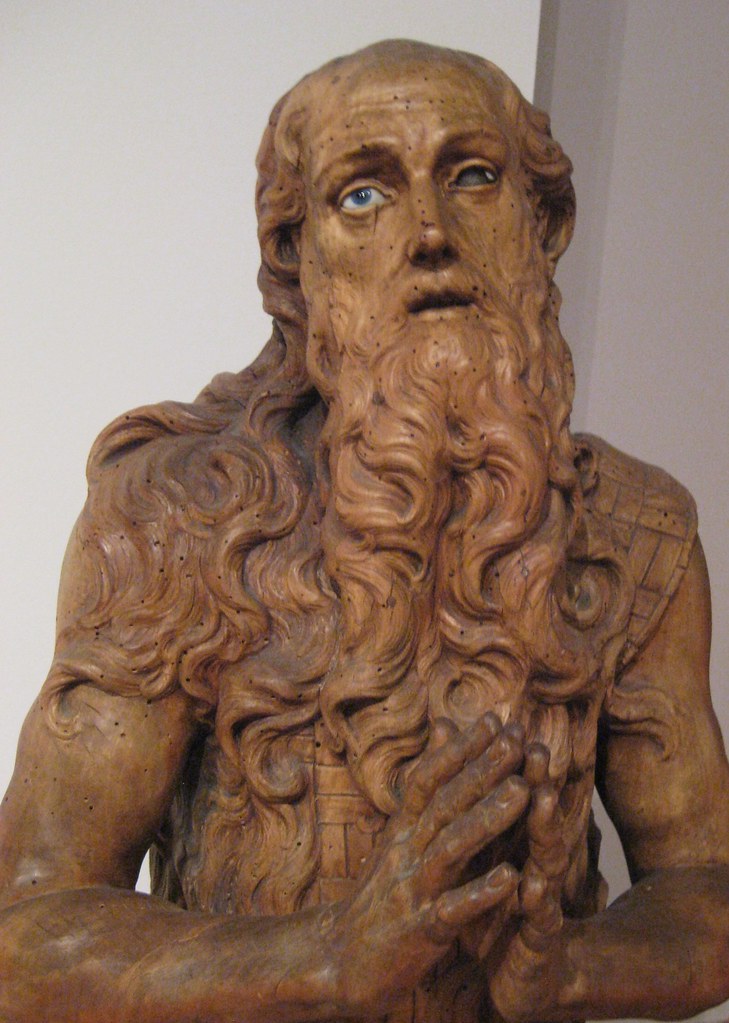
Unknown Portuguese sculptor (Eighteenth Century) Santo Onofre or Saint Onuphrius (Eighteenth century) Wood and glass. Museum of Ancient Art, Lisbon.
On the Wednesday afternoon I visited, there were more guards than visitors. As a result, I had the Museum to myself. Each work of art was mine alone. If you are in Lisbon, it may not be in your tourist guidebook; but, for art lovers, it offers the opportunity to discover remarkable, no-where-else-to-be-seen artworks and level of intimacy with them that is usually reserved for the royalty that commissioned them. (To see all the images I took, visit my Flickr photo set here.)
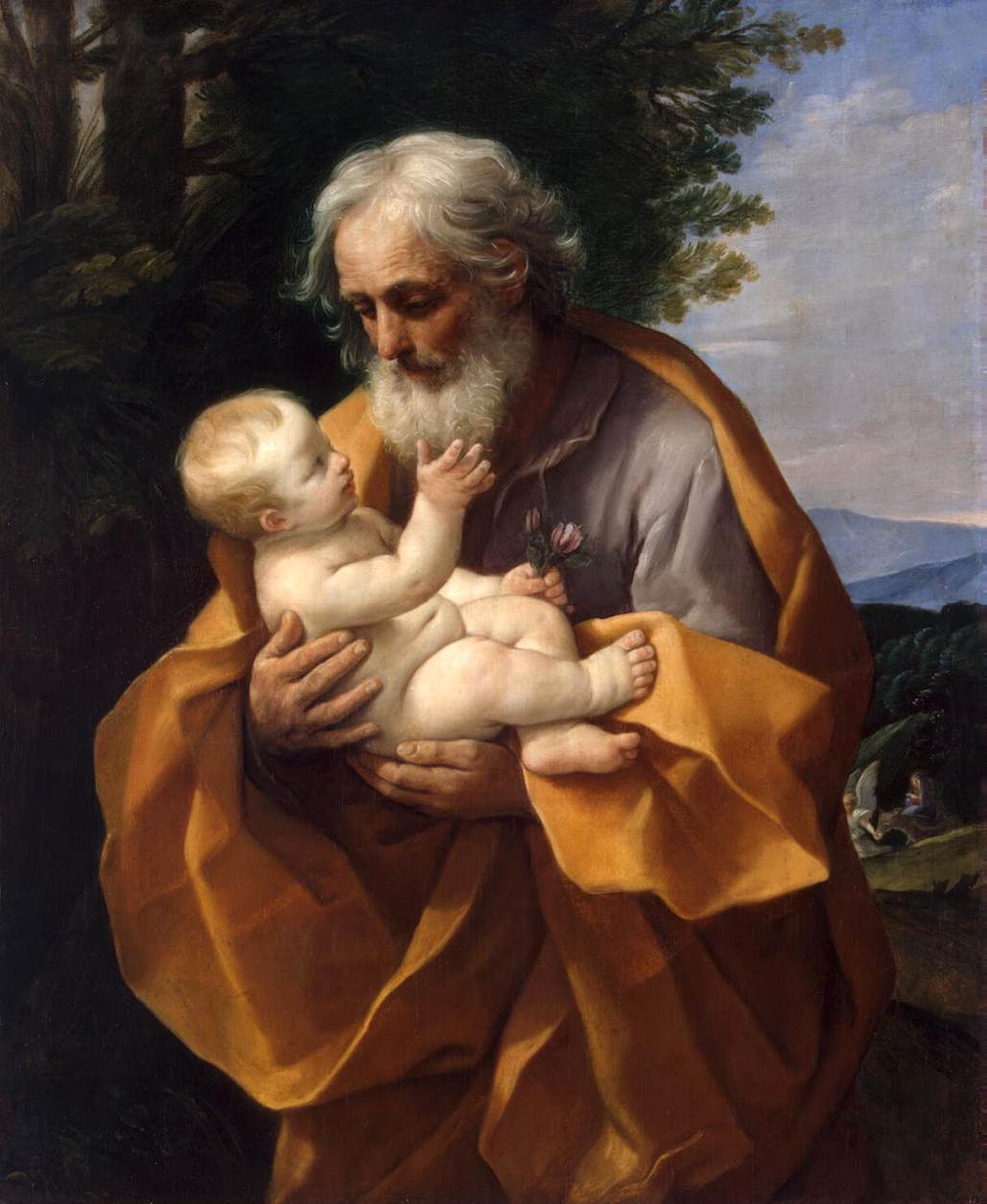
Born this day: Guido Reni (Italian, 1575-1642)
Saint Joseph with the Infant Jesus
Guido Reni (Italian, 1575-1642) is one of the more important figures in the Pantheon of art history. He was born shortly after the Council of Trent, where the Catholic Church proposed sweeping changes to the arts in an attempt combat rising Protestantism. Reni became a leading proponent of a new aesthetic that clearly told stories through the use of large-scale religious and historical figures.
The mid-sixteenth-century Mannerist artists that dominated Catholic tastes exemplified the kind of extravagant pomposity that many Protestants associated with the errors of the Catholic Church. The Council of Trent proposed art become a more popular and personal medium, where average people could understand the subjects. (At a time when less thatn 25 percent of the population was literate, painting was a remarkably effective means for communicating doctrine and propaganda.) The result was a flowering of new artists that looked towards the more-orderly compositional ethic of the high renaissance, in particular Raphael, Titian and Michelangelo. Guido Reni was a student at one of the most successful school of art, the Accademia degli Incamminati, that came to dominate the new artistic climate.
Members of the Accademie championed a new aesthetic of full, heroic-sized figures that filled canvases from top to bottom. By comparison to artists working just decades before, Reni’s paintings seem remarkably bare, usually featuring only one or two figures whose identities are made known through small, symbolic gestures.
A student of the Carracci Brothers, who founded the Accademie, Reni was perhaps the school’s most successful alumnus. In his lifetime, he was patronized by cardinal and popes. In death, his works were among the most widely collected of all the Old Masters, ensuring that his personal aesthetic influenced several successive generations of artists.
Happy Birthday, Maestro.
Happy Halloween: The Vision of Faust & “Acceptable” Nudity in Nineteenth-Century France
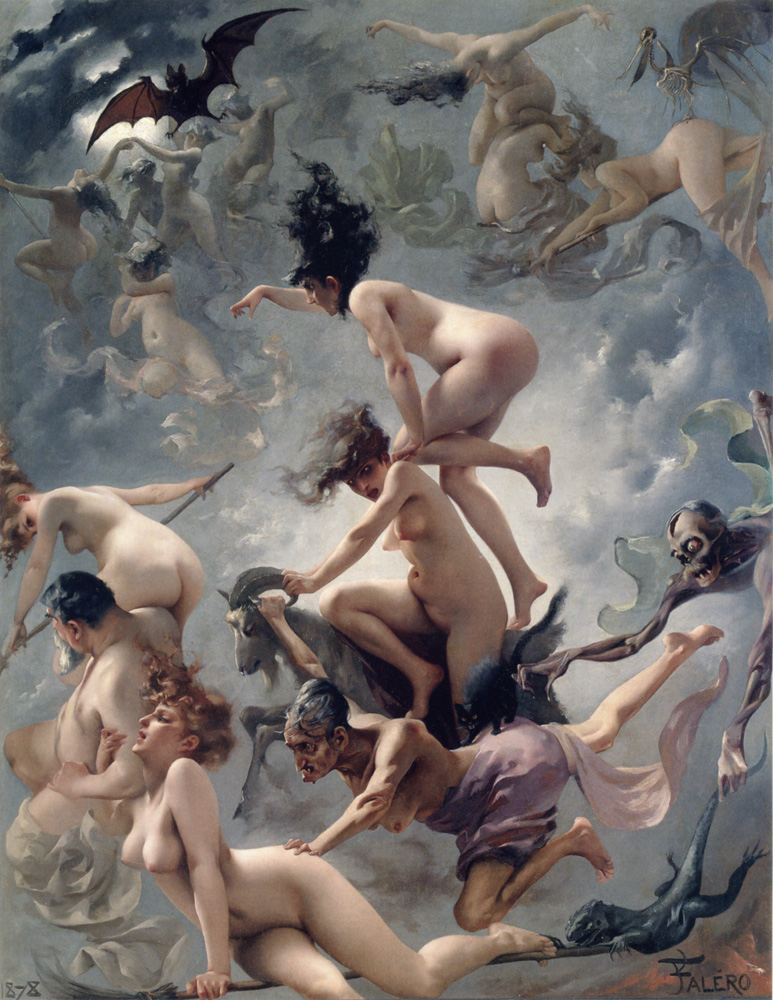
In Goethe’s Faust, Mephistopheles takes Faust to a mountain where he witnesses a Witch’s Sabbath (a.k.a. Witch’s Shabbat). The unholy meeting of demons and humans featured satanic offerings and resulted in plagues. Stories of these gatherings have a long history in European literature. (For more, go here.) The women who attend are traditionally skyclad, a ritual nudity practiced by pagans and witches.
Luis Ricardo Falero (Spanish, 1851-1896) Faust’s Vision (1878) Oil on canvas 57 by 46 1/2 in. Private Collection
This work is scandalous by most people’s sensibilities–including mine–however, it is illustrative of contradictory attitude towards nudity in nineteenth century France and most of western society. At a time when it was shameful to see a woman’s ankles in public, it was somehow acceptable for more-than-suggestive works featuring nudity, as long as the narrative was tied to some redeemable theme.
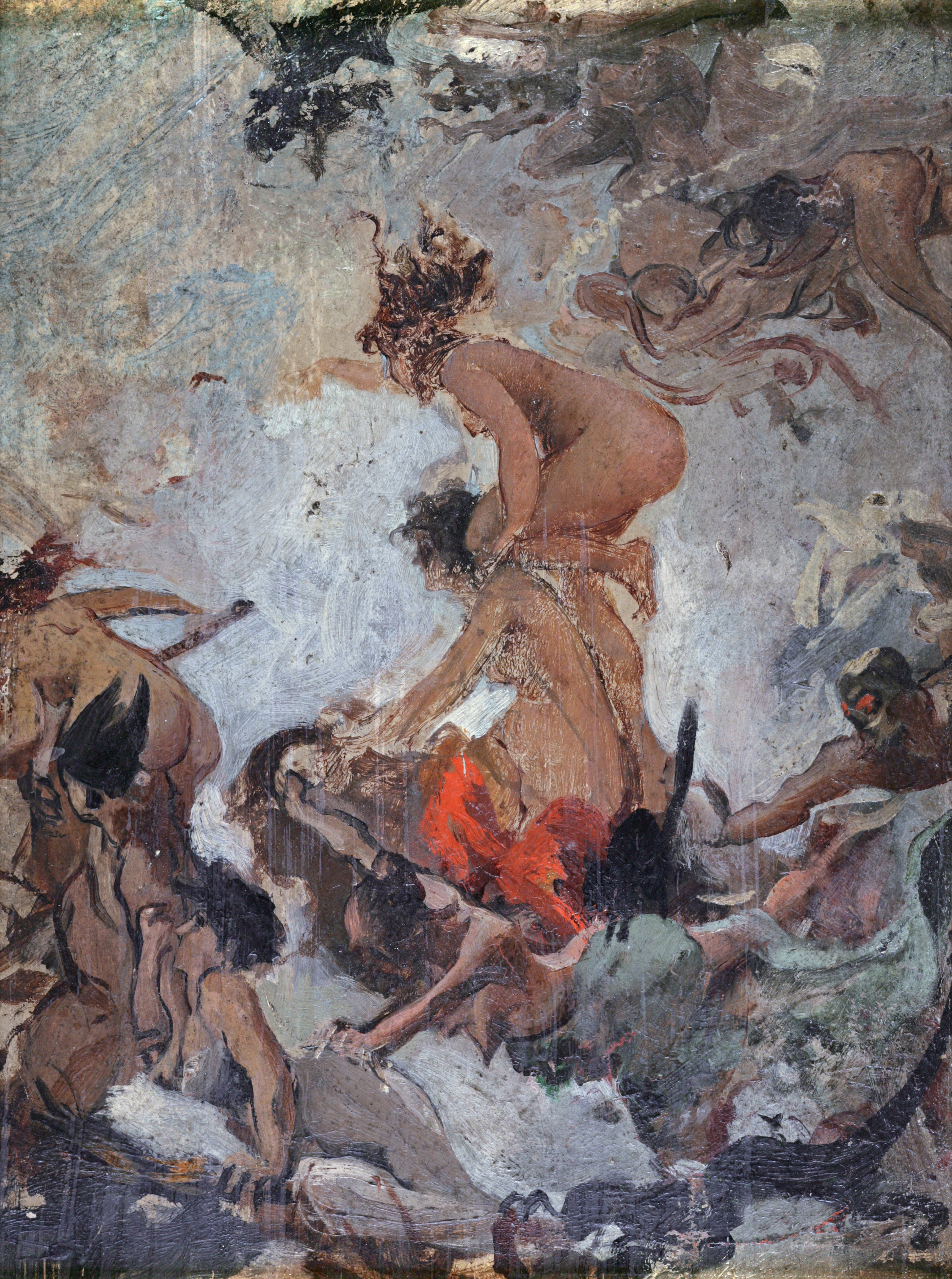
Luis Ricardo Falero (Spanish, 1851-1896) Faust’s Vision, Study (1878) Oil on canvas 57 by 46 1:2 in. Private Collection.
This selective bias bias is perhaps best illustrated in the debate between Alexandre Cabanel’s The Birth of Venus (1863) and Édouard Manet’s Olympia (1863). Both featured nude woman and were accepted to the same national contest where they were exhibited to the public.
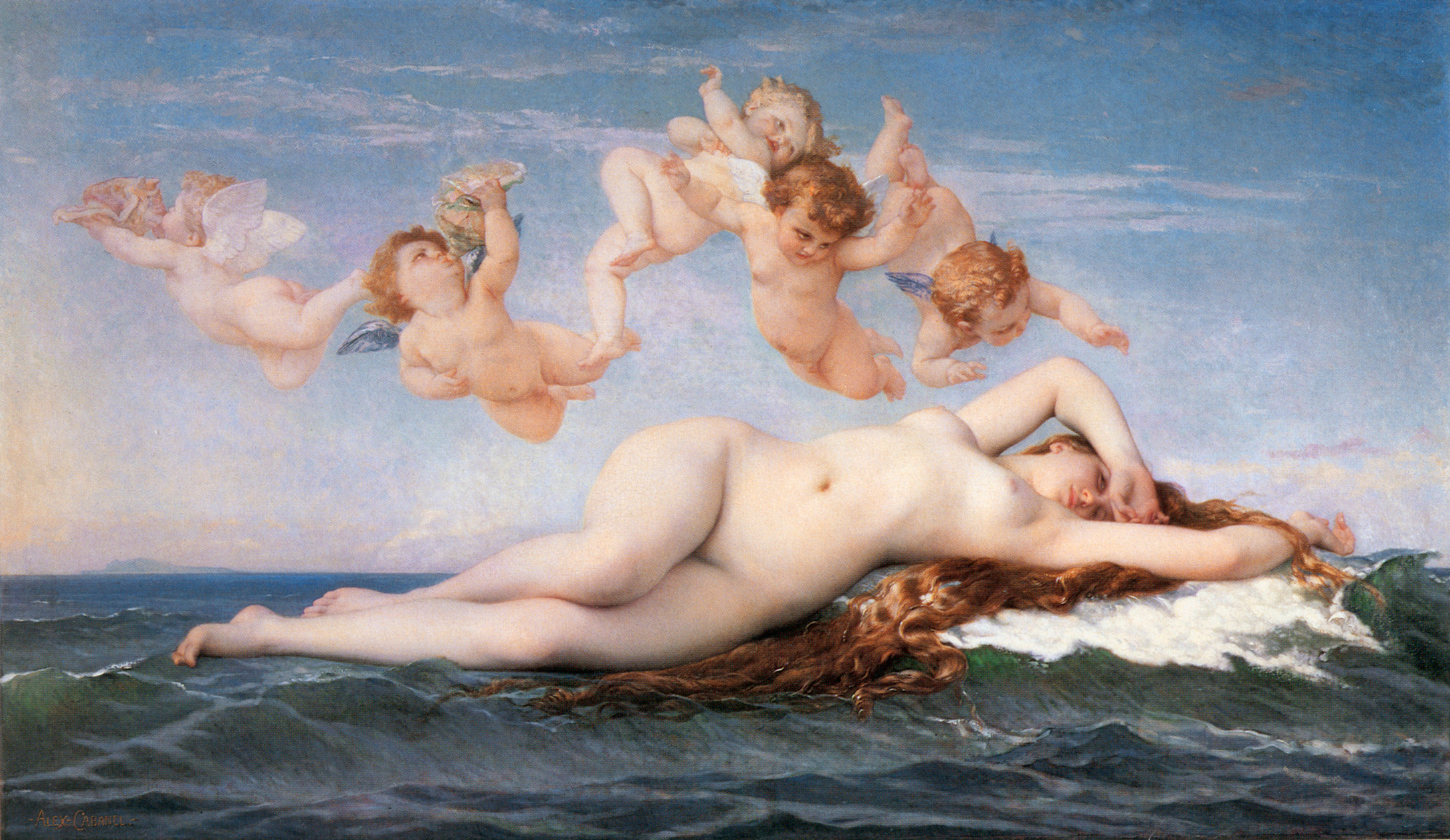
Alexandre Cabanel (French, 1823-1889) The Birth of Venus (1863) Oil on canvas. 51 by 89 in. Metropolitan Museum of Art, New York.
But, while Cabanel’s was considered to be a critical success and continuation of the classical tradition, Manet’s was seen as obscene for its realistic approach to the female nude.
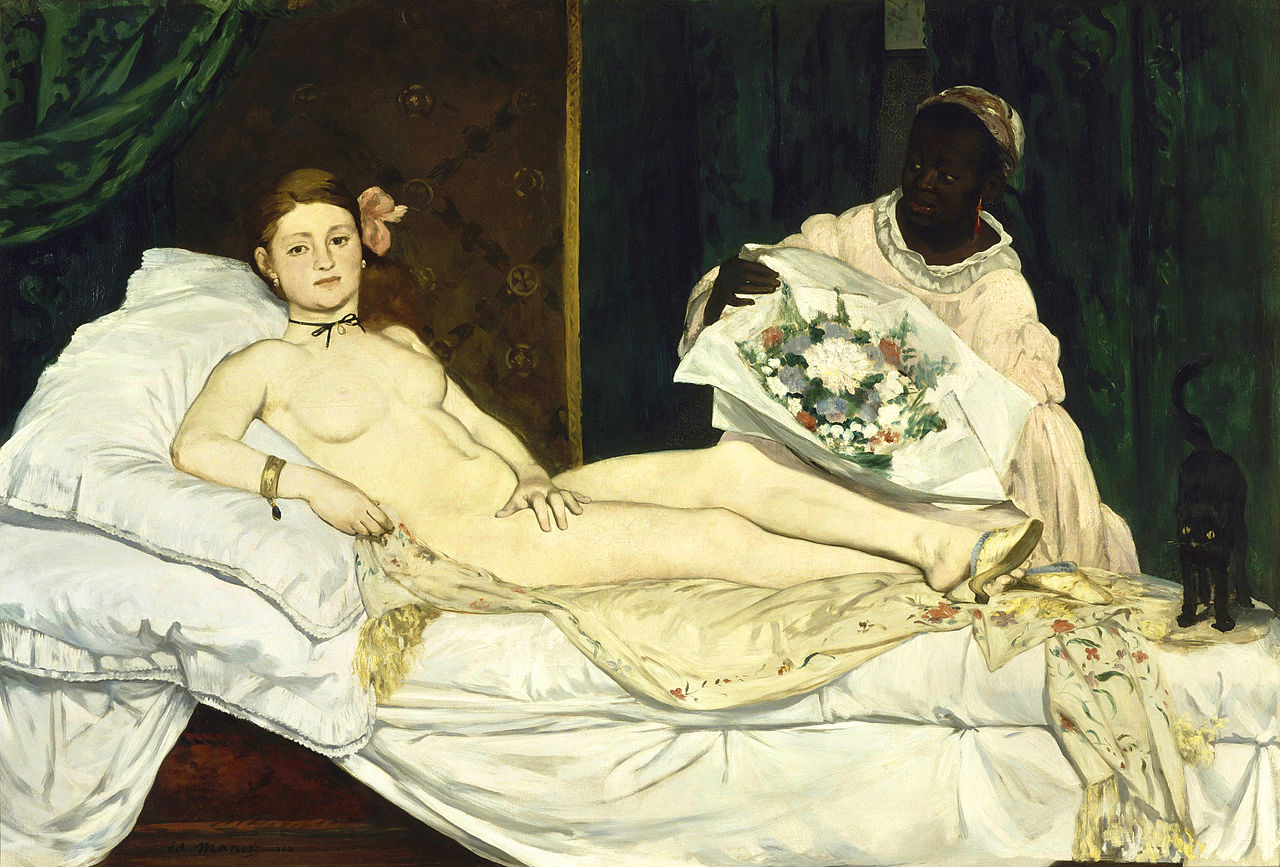
Édouard Manet (French, 1832-1883) Olympia (1863) Oil on canvas. 51 1:2 by 79 in. Musée d’Orsay.
In his day, Luis Ricardo Faléro (Spanish, 1851-1896) was a consumately trained academic painter, whose work fit soundly within the contraditions of his time. His works were prized for their thinly-vieled eroticism. But, collectors could maintain their reputation by pointing to the “merit” of their subjects.
Forgotten Master: Federick Cayley Robinson (British, 1862-1927)
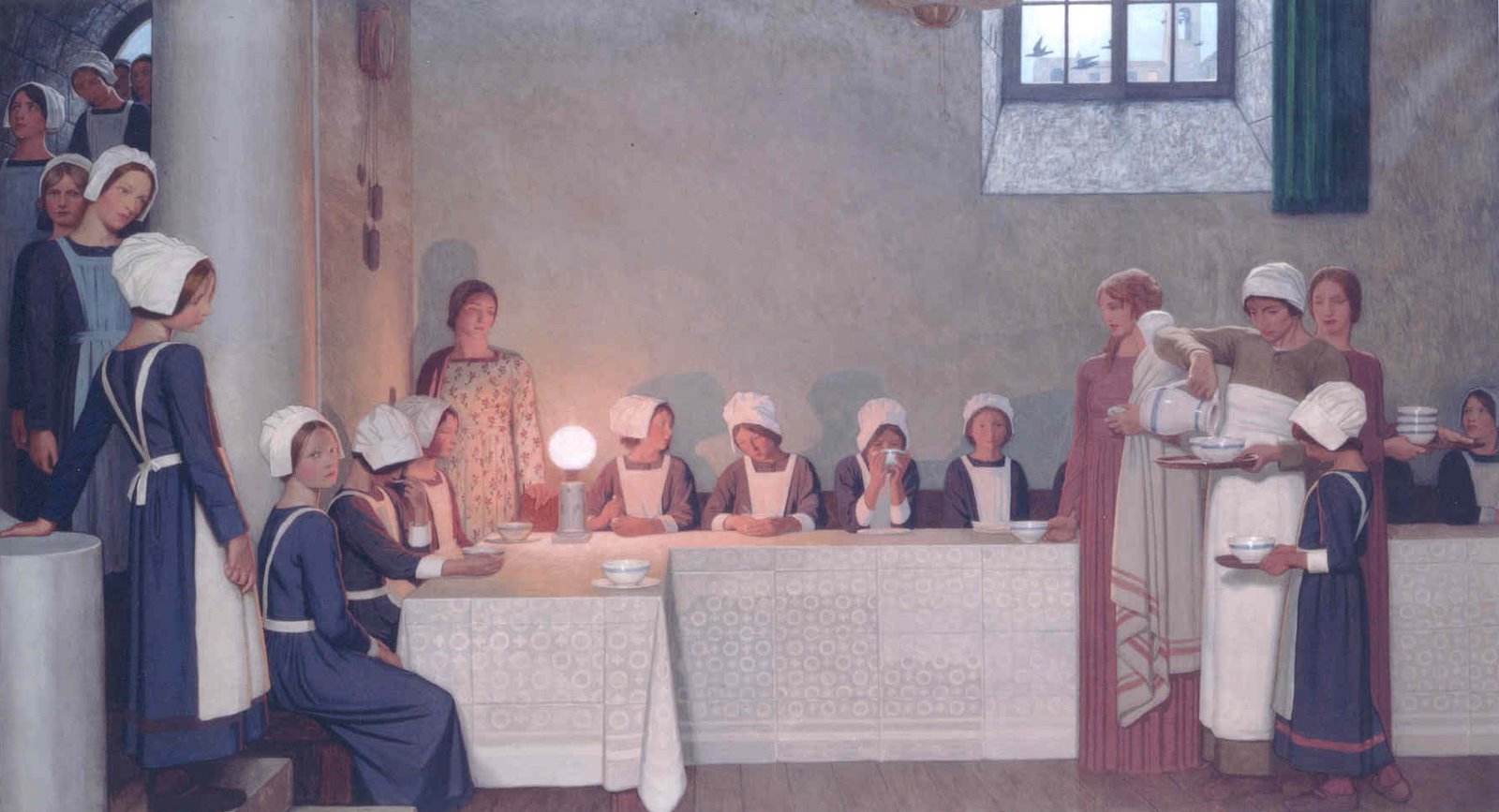
The recent exhibition, Acts of Mercy, at the National Gallery has brought well-deserved attention to Federick Cayley Robinson (British, 1862-1927). Despite his remarkable abilities and relationship with still-celebrated artists, the majority of Robinson’s works are in museum storage or private collections.
Federick Cayley Robinson (British, 1862-1927) Acts of Mercy: Orphans II (c. 1915) Oil on canvas. Wellcome Collection, London.
(Like works reproduced on this blog, these paintings are three dimensional objects. In person the vibrancy of Robinson’s colors and his painterly skills are undeniable and electric.)
Robinson studied at the Academy of St. Johns Wood before being accepted to London’s Royal Academy under Frederic Lord Leighton (British, 1830-1896). He continued to develop his abilities, first at the Academie Julien in France for three years and, then, in Florence.
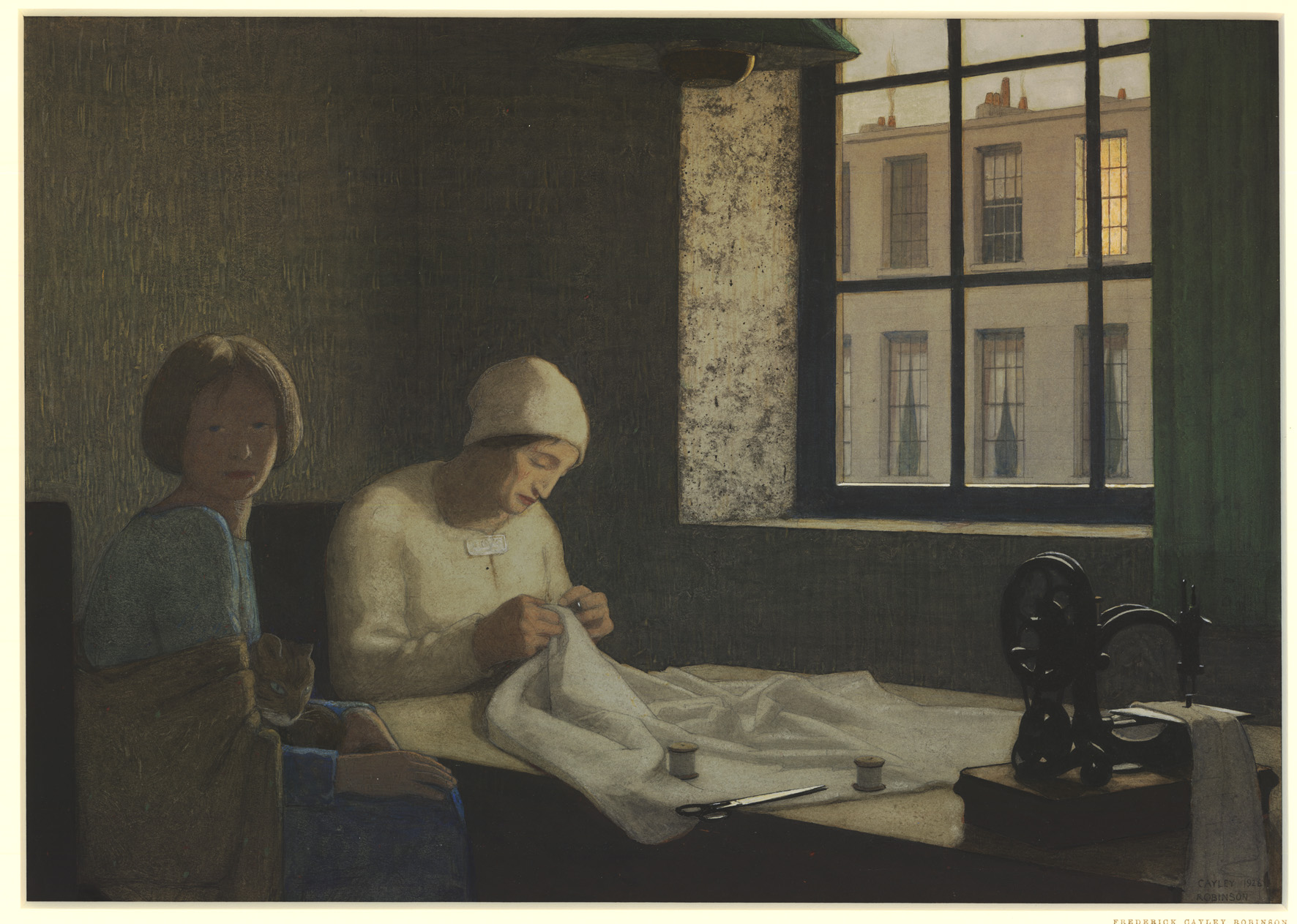
Federick Cayley Robinson (British, 1862-1927) The Old Nurse (1926) Oil on canvas. British Museum, London.
Robinson moved back the UK to take a teaching position at Glasgow University, where he became a friend and collaborator with members of the Glasgow Boys. But, before taking his post, Robinson travelled to Newlyn, England at the peak of Stanhope Forbes’ (British, 1857-1947) career. Like Forbes, Robinson’s work was dominated by fisherman, farmers, and shepherds. But, unlike the Newlyn School, which took inspiration from French Naturalism and Jules Bastien Lepage, in particular, Robinson was heavily influence by the Symbolist Pierre Puvis de Chavannes (French, 1824-1898).
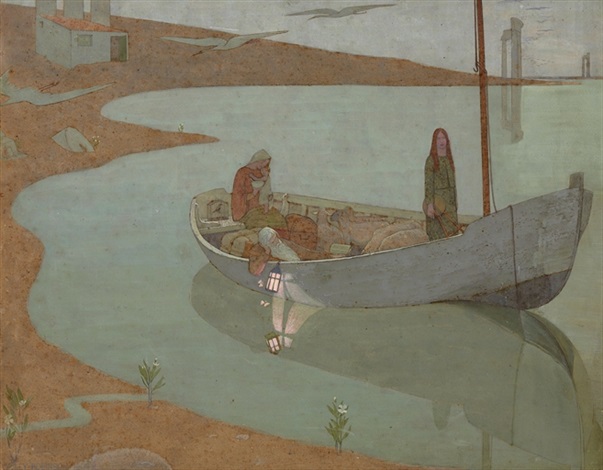
Federick Cayley Robinson (British, 1862-1927) To Pastures New, or Dawn (1904) Watercolor, graphite, and bodycolor on board. 28 by 35 1:2 in.
In To Pastures New, Robinson creates an homage to the French artist by reversing Chanvannes’ composition in The Poor Fisherman.
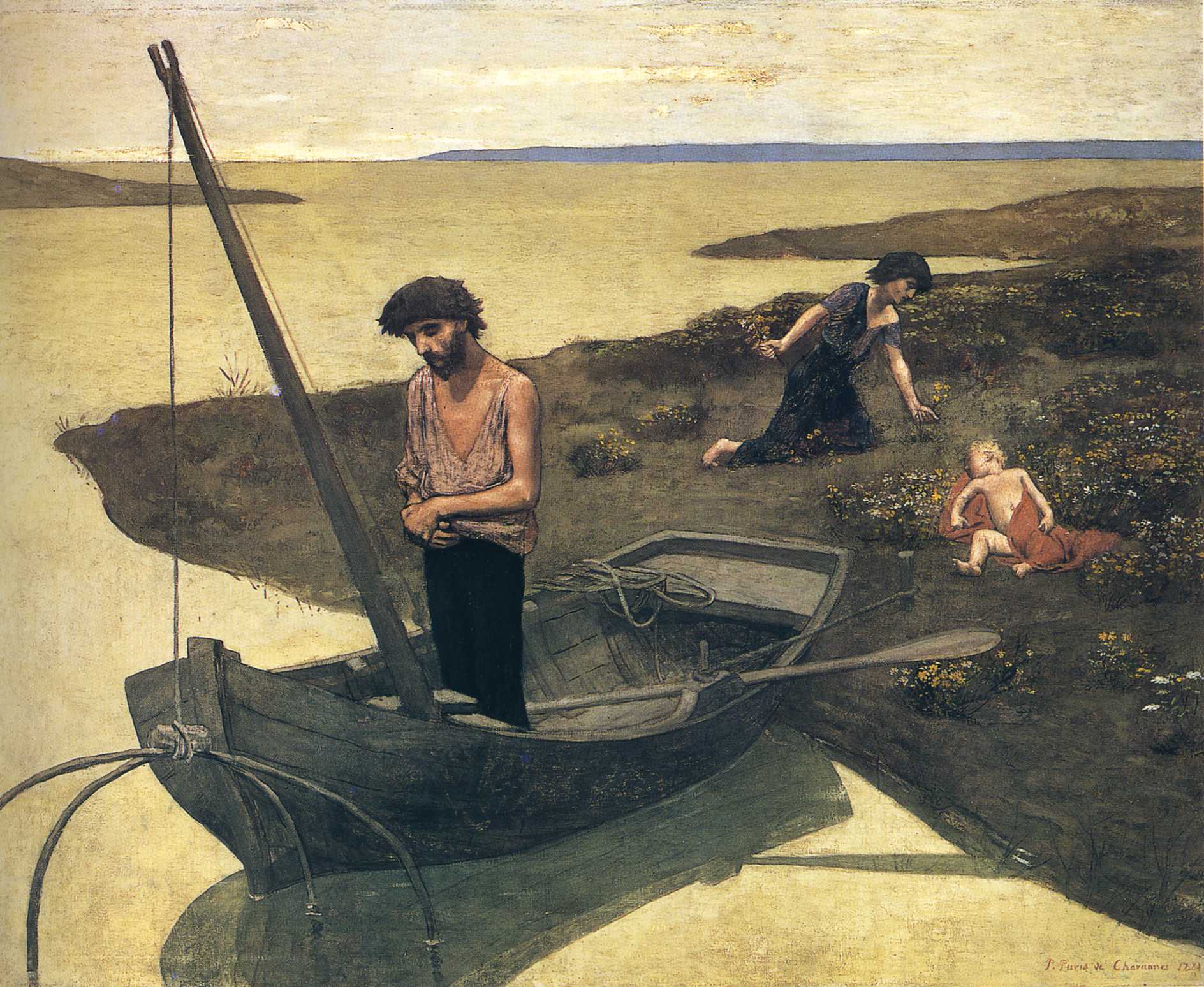
Pierre Puvis de Chavannes (French, 1824-1898) The Poor Fisherman (1881) Oil on canvas 155 by 192.5 cm. Musée d’Orsay, Paris
Robinson’s greatest work was a series of paintings commissioned for the Middlesex Hospital. Spanning more than 15-feet each, the four panels of Acts of Mercy are a tour de force of skill, demonstrating Robinson’s enormous arsenal of skills and classical vocabulary. He combines the sensibilities of a classicist–deriving poses and motifs from greco-roman sculpture and compositions borrowed Giotto’s frescoes–and the subjects from contemporary life. His subjects are orphans and veterans of World War I cared for by the hospital. Aesthetically, it is both contemporary and timeless. A
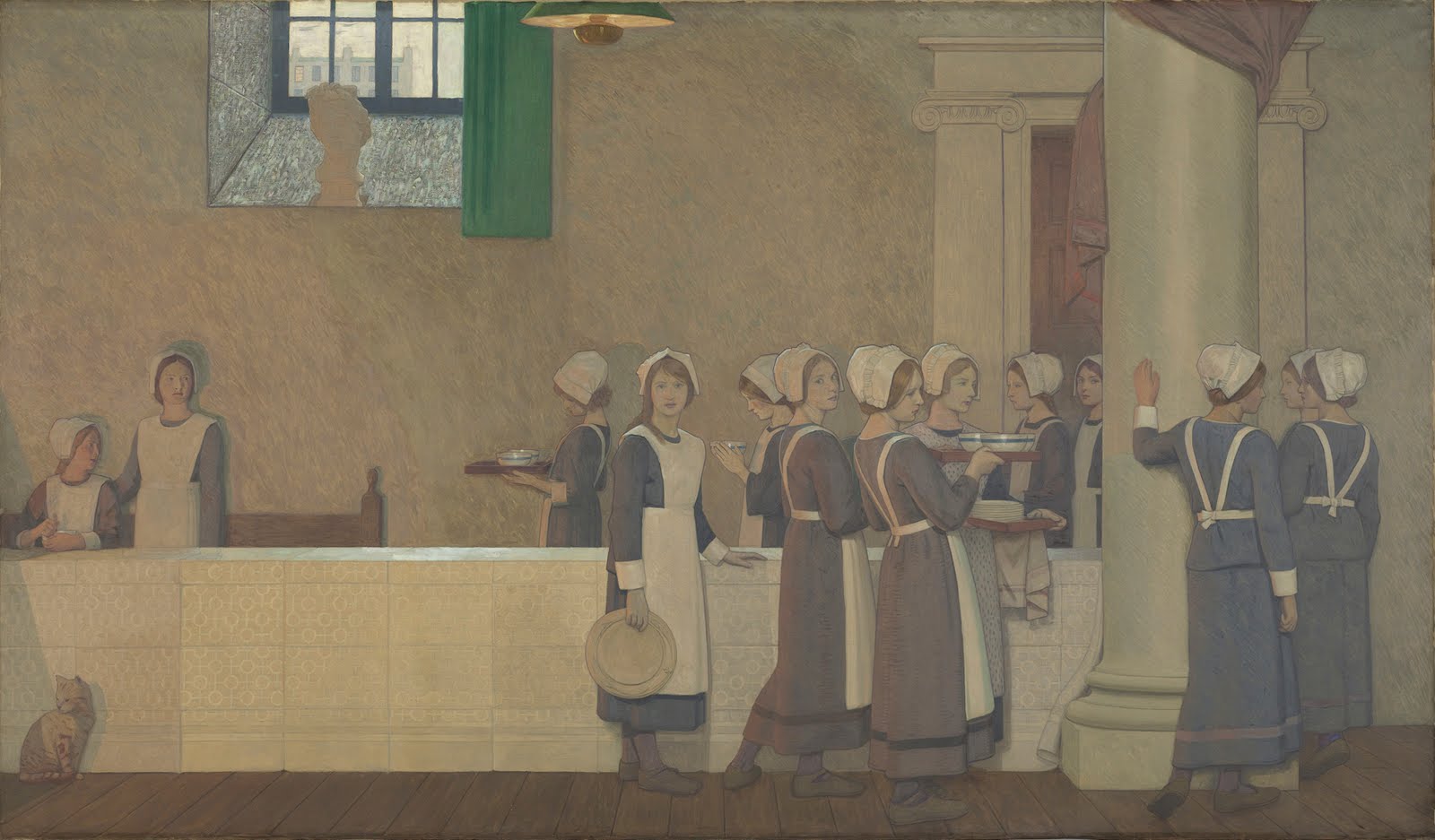
Federick Cayley Robinson (British, 1862-1927) Acts of Mercy, Detail (c. 1915) Oil on canvas. Wellcome Collection, London.
s commentary on charity, Acts of Mercy is, as my friend and mentor Dr. Tom Gretton commented, a masterclass in receiving charity: how it is given and how it is received. Robinson captures a large spectrum of human relationships in this and in all his works I have been able to see. While Middlesex Hospital has been torn down and the show has now ended at the National Gallery, Acts of Mercy has a new home: the Wellcome Collection.
Forgotten Master: Fanny Fleury (French, 1848-1920)
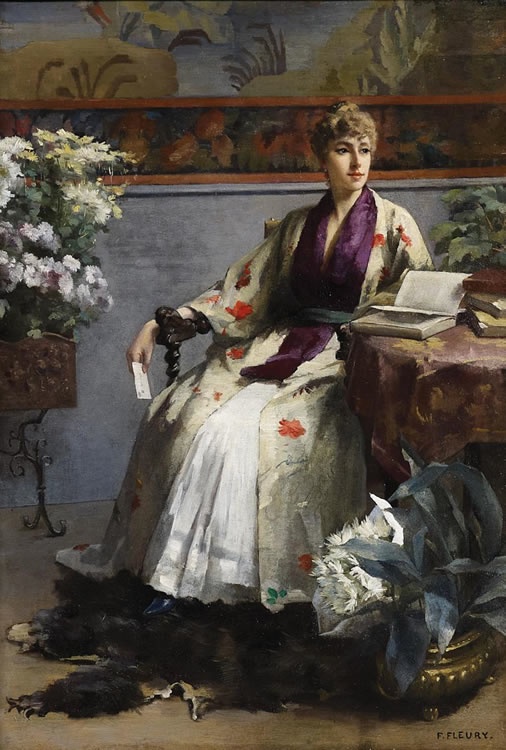
Fanny Fluery (French, 1848-1920) Woman Reading (n.d.) 24 1/4 X 17 1/8 in. Oil on canvas. Private collection.
With art historians earnestly looking for prominent female artists, it is surprising that so little is written about Fanny Fleury (French, 1848-1920). With the exception of Rosa Bonheur (French, 1822-1899), Fleury was perhaps the most successful female exhibitor in the history of the Paris Salon, having works accepted consistently from 1869 to 1882, and in many afterwards. She also exhibited at the Salons of Saint-Etienne and Dijon, and received an honorable mention at the Exposition Universelle of 1889.
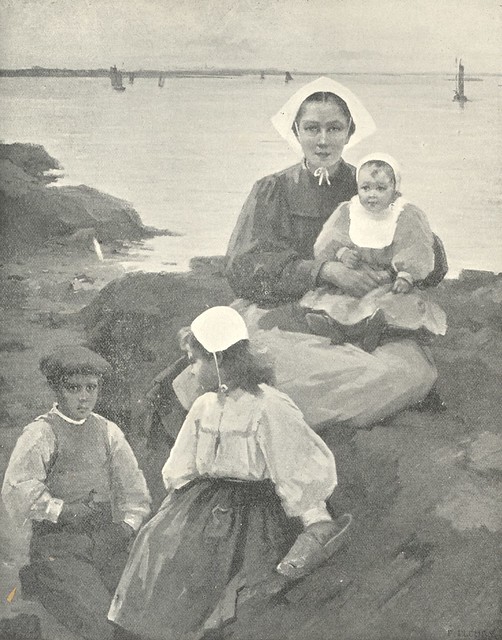
Fanny Fluery (French, 1848-1920) Les Enfents de Jean-Marie (n.d.) Oil on canvas. Unknown Collection. Lithograph reproduction of original.
Fleury’s academic credentials are impeccable. She studied with Jean-Jacques Henner (French, 1829-1905) and was later accepted to the École des Beaux-Arts as a student of Carolus-Duran (French, 1837-1917), where she was a classmate of John Singer Sargent (American, 1856-1925). (Speaking of her work at the 1884 Salon, one critic said Fleury had “equalled her masters,” Henner and Duran.) Highly regarded by her peers, Fluery was elected an Officer of the Academie and an associate of the Société des artistes français.
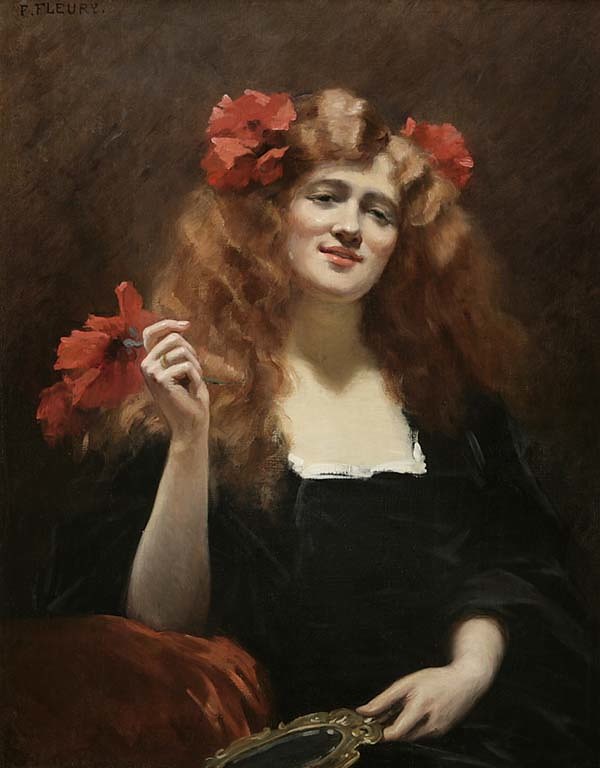
Fanny Fluery (French, 1848-1920) Portrait of an Unknown Woman (n.d.) 32 X 25 3/4 in. Oil on canvas. Private Collection.
Yet, for all her accomplishments in well-documented institutions and events, there is surprisingly little information currently available about the life and work of Fleury. (This is another instance where I am writing about an artists in hopes that it encourages others to contact me with additional information.)
Fleury was born outside Paris in either 1843 or 1848–most sources agree on the latter. It is possible–I stress “possible” for lack of form documentation, yet a great deal of circumstancial evidence–she is the daughter of Joseph Nicolas Robert-Fleury (French, 1797-1890), a successful history painter and on-time director of the École des Beaux-Arts in Paris and Rome; and, his son, the painter Tony Robert-Fleury (French, 1837-1912), who was also successful painter and who replaced Bougeureau as the Director of the Société des artistes français (If anyone can shed additional light, it would be greatly appreciated.) When she married, Fanny Fluery became Fanny Laurent Fleury; but, never included “Laurent” in her signature. So, whether or not there is an actual genetic connection between the three Fluerys, they must have come into contact with one another through the Acadamie.
It has been difficult to piece together a continuum of Fleury’s production with the few works and accounts left to us. It appears that for a time–presumably early in her career–she created a number of still lives.
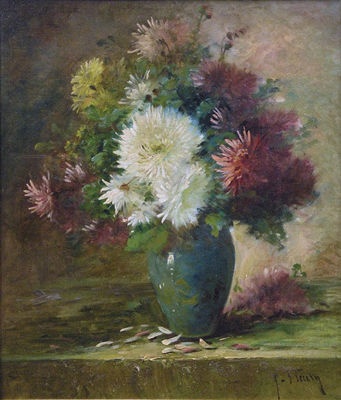
Fanny Fluery (French, 1848-1920) Still Life with Flowers (n.d.) 20 1/2 X 17 1/2 in. Oil on canvas. Private Collection
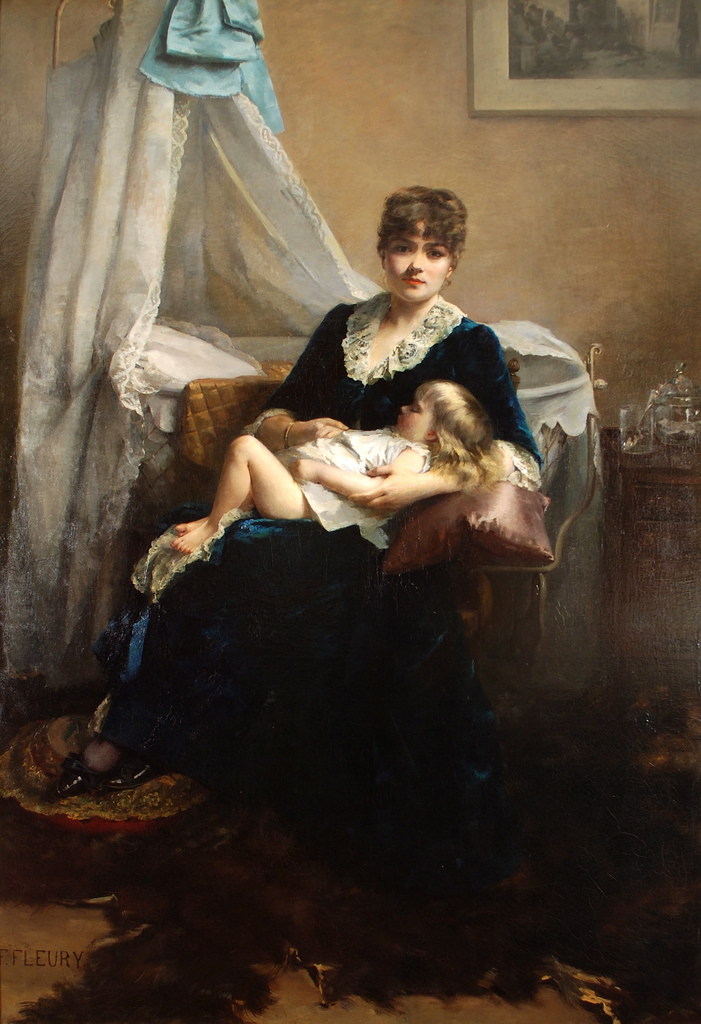
Under Carolus-Duran, Fleury distinguished herself as a portraitist. Her large-scale work Bebe dort (1884) exhibited in the Salon of 1884 along with Madame X by her classmate John Singer Sargent. Both pieces belie the the influence Corolus-Duran, who often combined monumental human figures in contemporary settings.
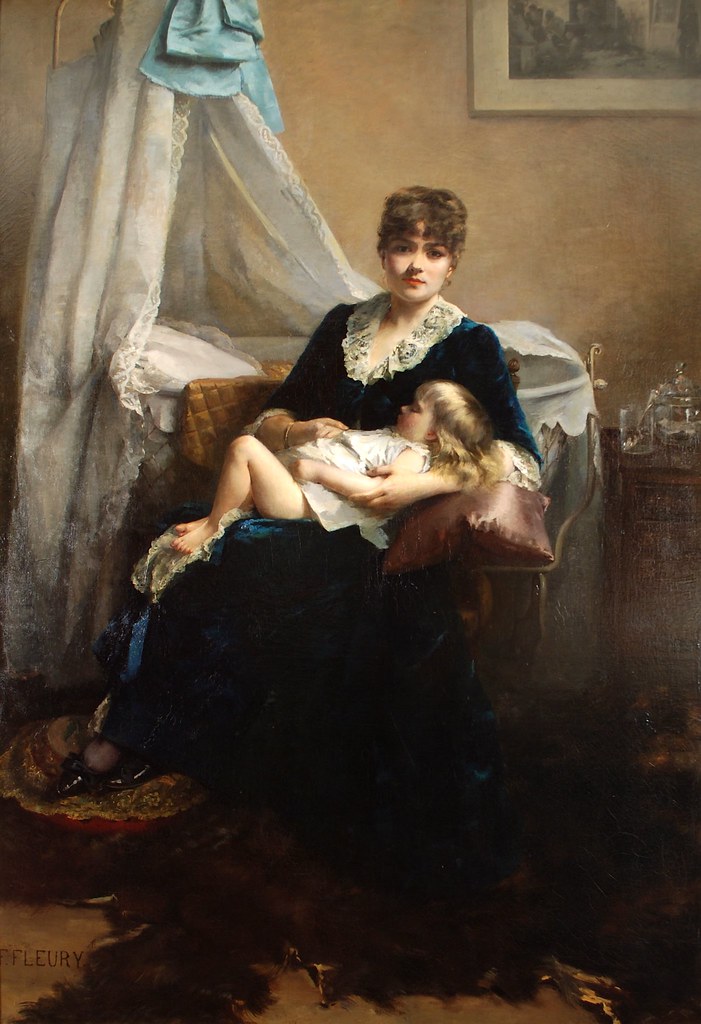
Fanny Fluery (French, 1848-1920) Bebe dort (1884) 83 X 57 in. Oil on canvas. Anthony’s Fine Art, Salt Lake City, UT
In Bebe dort (1884), a mother–perhaps a self-portrait of the artist–cradles her child, sitting together next to a cradle. Behind the figures, on the wall Fluery places a print of a business being ransacked by a mob. No one would imagine that scene actually being hung in a child’s room. It is a clever use of a picture-within-a-picture, used often by Netherlandish painters in the fifteenth and sixteenth centuries, to create greater or multiple meanings within a work. The juxtaposition of the two scenes contrasts security and comfort of home with a threatening world.
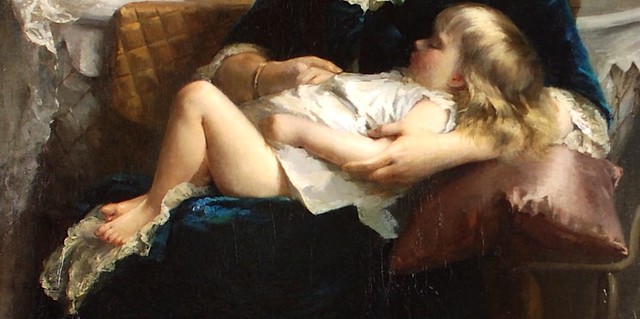
Fanny Fluery (French, 1848-1920) Bebe dort (1884) 83 X 57 in. Oil on canvas. Anthony’s Fine Art, Salt Lake City, UT DETAIL
At some point, Fleury set aside society portraits and dedicated herself to Breton scenes. In 1892, The American Magazine wrote:
Realism has likewise tempted another artists of great talent, Mme. Fanny Fleury. It is to the desolate lands of Lower Brittany that Mmde. Fleury goes for her subjects. She has painted som admirable marine scenes, but excels in depicting types of peasantry . . . every summer she goes to the seacoast, and in some retired cornes, unfrequentd by the tourist, prepares her picture for the next Salon. (The American Magazine, Vol. 34. New York: Frank Leslie Publishing House, 1892; p, 430.)
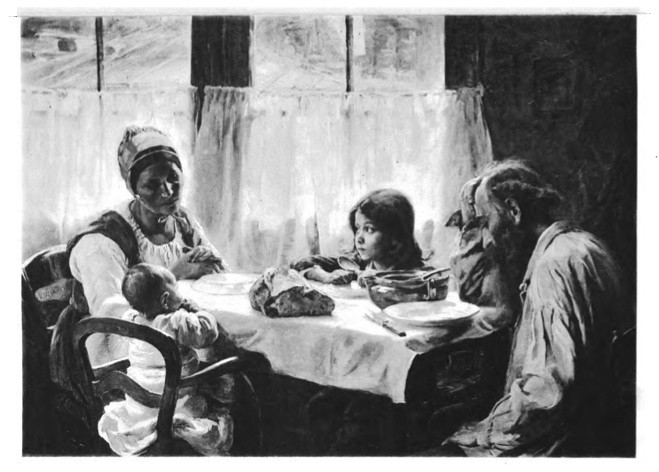
Fanny Fleury (French, 1848-1920) Pour la Chapelle (n.d.) Oil on canvas. Private Collection. Black and white, photograph from Paris-Salon by Louis Enau
The quality of her work combined with her credentials certainly raise questions about the current dearth of readily-available information on Fleury’s life and the location of her works. All signs point to a productive career. From contemporary records, we know that her works were regularly purchased from Salon galleries, and that her works were found in various French and American museum collections–none of which currently list those works in their public inventories.
Whatever the reason for Fanny Fleury’s undeserved, forgotten status, she will only gain prominence as her works are rediscovered.
My Evening with the Late Arnold Friberg
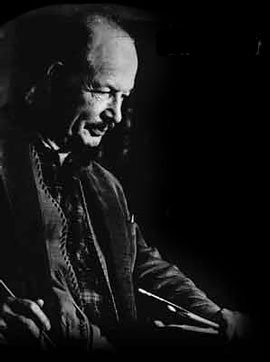
Arnold Friberg (American, December 21, 1913 – July 1, 2010)
Many obituaries have been written since his death four days ago. Rather than repeat the long lists of accomplishments printed in numerous obituaries (NY Times, for example), I’d like to share a personal experience I had with Arnold Friberg five years ago, when he was 91.
My wife and I were invited to have dinner with Arnold and his wife, Heidi, at their home. Heidi cooked. Afterwards, we sat, talked about art, and walked through Arnold’s studio. For a man of any age–let alone 91–Arnold was full of energy. He hopped out of his seat to punctuate a passionate thought about Jean-Auguste Dominique Ingres (French, 1780-1867), whom he felt had been unfairly treated by historical memory. (How appropriate it was when Susan Siegfried’s bookIngres: Painting Reimagined was delivered to my house the same day Friberg died.)

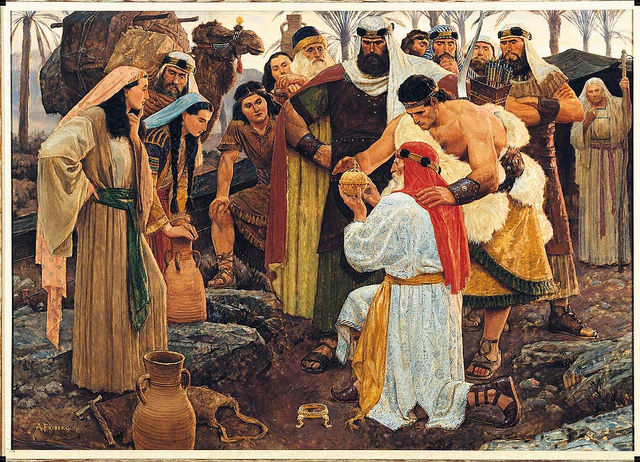
Arnold Friberg (American, December 21, 1913 – July 1, 2010) The Liahona. Oil on canvas.
As we toured his studio, Friberg lifted an original oil painting he had done for a Christmas edition of the Saturday Evening Post. “Unlike my colleagues,” he said “I painted a perfect reindeer.”
“I would look for the perfect antlers on one reindeer, the perfect eyes from another, nose from another; and, then, I combined them. Other artists don’t do that.”
Perhaps knowingly, perhaps not, Friberg’s self-described “perfectionism” was, in practice, akin to the Ideal reached for by Ingres. Friberg was tirelessly detailed. His work often featured elaborate script applied by hand without the use of stencils. Even at his advanced age, Friberg could be found working in his studio, touching and re-touching works, which, in his mind, could always be improved.
We spent several hours looking through his catalogue of works. Any artist would be satisfied to have so many memorable and widely-reproduced works. Yet, Friberg had an air of anxious energy. “I’m happiest when working,” he told me.
Wherever he is now, I’m sure that Arnold Friberg will not sit back and enjoy what will surely be a growing reputation. He is probably sorting through cherubs, looking for which one has the best wings, eyes, lips, etc.
An unpublished work by Sir Lawrence Alma-Tadema
As those of you who follow my tweets (apologies for the shameless Twitter plug) know, I have been traveling for the past three weeks. I was in Spain for eleven days, France for one, and another five in California. To some it might sound like glamorous, Indiana-Jonesing; but, in reality, I spent most days underground in dusty archives looking for undiscovered, art-historical morsels and nights transcribing nineteenth-century handwriting. Along the way, I came across a number of remarkable works of art, some not seen for more than a hundred years. I plan to share some of them.
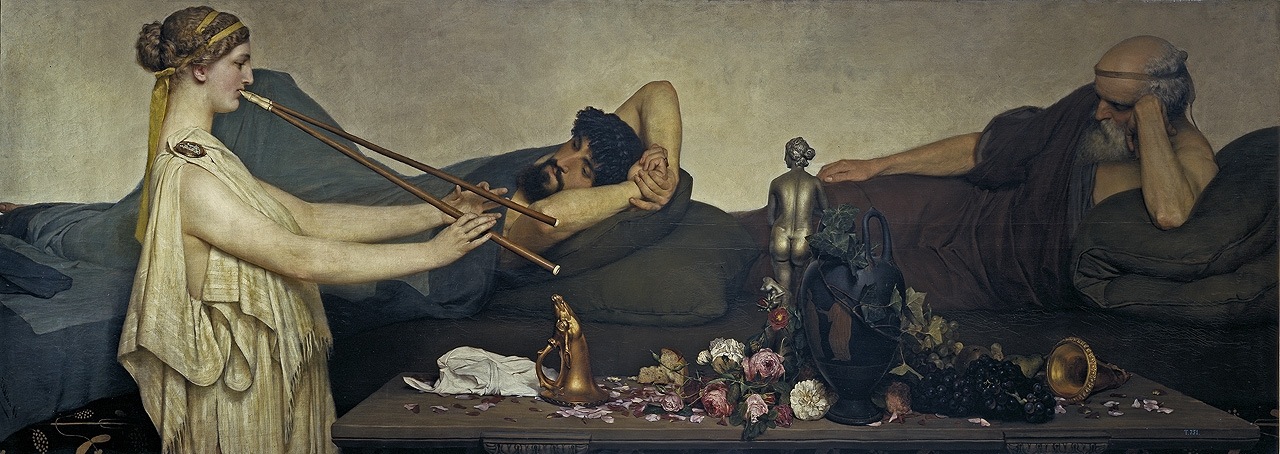
I begin with A Scene from Pompeii (1868), a previously unpublished and little-known work by Sir Lawrence Alma-Tadema (Dutch and British, 1836-1912).
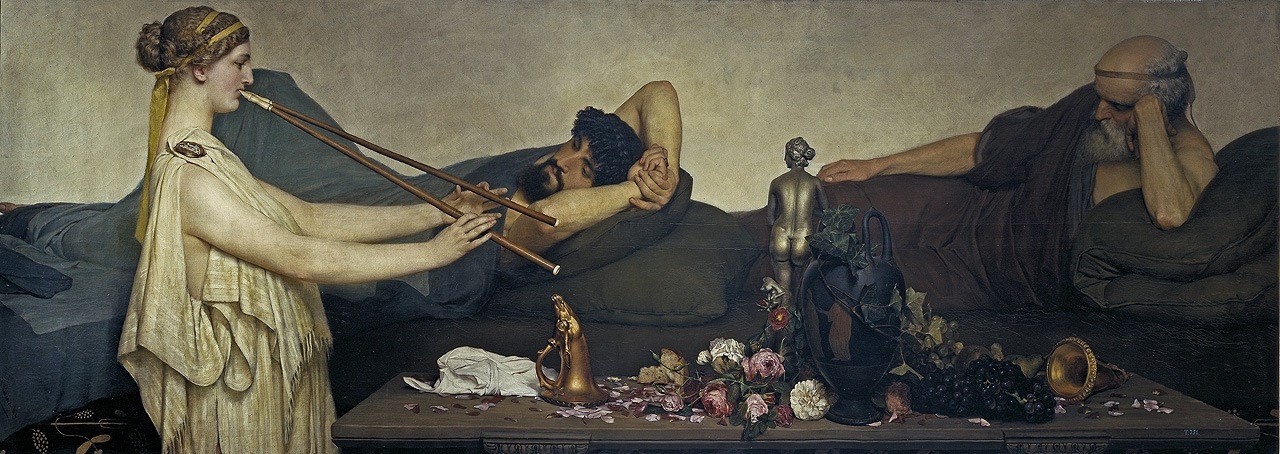
Sir Lawrence Alma-Tadema (Dutch & British, 1836-1912) A Scene from Pompeii (1868) Oil on canvas. 130 X 360 cm. Museo Nacional del Prado, Madrid.
This morning, I spoke with Vern Swanson, a mentor of mine and author of Alma-Tadema’s catalogue raisonné. Dr. Swanson did not include an illustration of the painting in his book–the most definitive on the subject–because A Scene from Pompeii was unavailable until recently. As one of Alma-Tadema’s most ambitious early paintings, it has been in storage at the Museo Nacional del Prado for nearly 100 years. This year A Scene from Pompeii was hung for the first time in the Prado’s new, permanent wing dedicated nineteenth-century painting and sculpture.
Alma-Tadema’s works, famous for Olympian themes that idealized a bygone empire, may seem more at place in France or Great Britain than in Spain. At the Prado, A Scene from Pompeii makes strange bedfellows with a generation of nineteenth-century Spanish artists who sometimes trained in France, but nonetheless venerated classical realists like Diego Velázquez and José de Ribera.
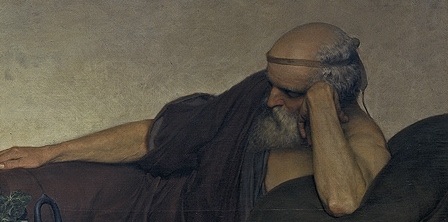
Sir Lawrence Alma-Tadema (Dutch & British, 1836-1912) A Scene from Pompeii (1868) Oil on canvas. 130 X 360 cm. Museo Nacional del Prado, Madrid. Detail.
This painting is one of only a handful of foreign nineteenth-century works in the Prado’s collection. It was donated to the short-lived, Spanish Museo de Arte Moderno in 1887 by Ernesto Gambart, then Spanish Consul to Nice (France). When the Museo de Arte Moderno was absorbed into the Prado a few years later, nearly all of the its collections, including this work by Alma-Tadema, were placed in storage where they have been ever since. Only now, under the leadership of Javier Barón, Director of Nineteenth-Century Painting at the Prado, are these works being fully restored and finally displayed.
A Scene from Pompeii (1868) dates to a happy and prolific period in Alma-Tadema’s life. Five years earlier, he married his first wife, Marie-Pauline Gressin, in Antwerp. Their honeymoon was spent in Florence, Rome, Naples and Pompeii. For the next several years, he absorbed and transmuted his personal experience with the classical tradition into a series of paintings that quoted Greco-Roman architecture and artworks, such as a bronze reproduction of Aphrodite by the Greek sculptor Praxiteles (4th-century BC), in this work.
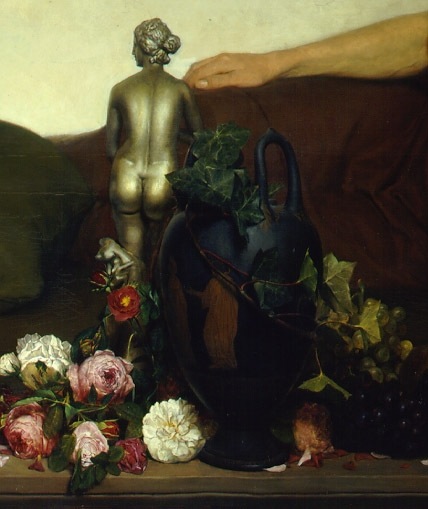
Sir Lawrence Alma-Tadema (Dutch & British, 1836-1912) A Scene from Pompeii (1868) Oil on canvas. 130 X 360 cm. Museo Nacional del Prado, Madrid. Detail.
Alma-Tadema is often remembered for his British works created after the death of his wife in 1869. These exquisitely detailed scenes sometimes feature dozens of figures painted in jewel-like colors. However, before 1869, his works regularly exhibited the same restricted, earth-tone palette of A Scene of Pompeii. While this painting shares the trademark precision Alma-Tadema’s larger oeuvre, its composition is unusual. I am not an expert on Alma-Tadema; but, I am surprised by the Baroque proportions of the figures which, unlike other works by Alma-Tadema, fill the canvas to near capacity.
It is always a pleasure to find new works by an artist as well-known and respected as Sir Alma-Tadema. I am sure that the Prado will have more insightful and important things to say about the painting as the new nineteenth-century wing becomes more public.