Posts in Category: Art
Forgotten Master: Hugues Merle (French, 1823-1881)

Hugues Merle (French, 1823-1881) Romeo & Juliet (1879) Oil on canvas. 67 X 51 in. Anthony's Fine Art, Salt Lake City, UT, USA.
If you saw the above work and thought “Bougeureau,” you could be forgiven. Hugues Merle (French, 1823-1881) is in many ways a forgotten proto-Bougeureau. Merle and William-Adolphe Bougeureau (1825-1905) knew one another well and, for a time, were represented by the same gallery. Born two years apart, both graduated from the École de Beaux-Arts, were members of the French Academy and regulary exhibited at the annual Paris Salon. Their penchant for mythical, allegorical and literary scenes combined with mastery of the monumental human figure, made them competitors for the same pupils, positions, prizes and patrons. While Merle was only two years Bouguereau’s senior, he died nearly a quarter century earlier. A strong argument could be made–and I may tackle it some day–that had Merle lived to Bouguereau’s age, memory of his work would have not suffered such anonymity.
Two years ago, someone I know bought major work by Hugues Merle–Romeo & Juliette (1879). Since then, Merle has become a pet project that has taken me to France, England, Belgium and the United States in search of primary documents and published materials. There is disappointingly little available on public record. By increasing awareness of his work, its my goal to encourage those who have information relating to Merle to raise their hands and help us all piece together the life and work of an artist to has a lot to offer.
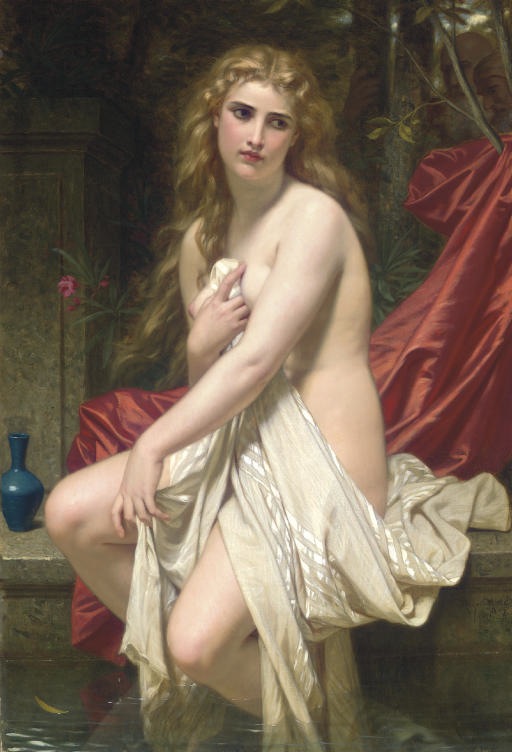
Hugues Merle (French, 1823-1881) Susannah at Her Bath (Date Unknown) 51 1/4 X 35 1/2 in. Private Collection.
There is a precedent for this. Thirty years ago, Damien Bartoli (1947-2009) took up the cause of Bouguereau and worked to produce a catalogue raisonné for the artist. Sadly, Bartoli died last month; but, not before publishing dozens of articles and submitting his final manuscript of Bouguereau’s complete works. (It will be this by the Antique Collectors’ Club in London.) Over the same 30 years, Bougueraeu has experienced a revival. Although it would be hard to establish a causal relationship, since Bartoli picked up his pen Bouguereau has seen a dramatic increase in awareness, appreciation and prices for his work. I’m no Bartoli and Merle is not Bouguereau. But, as Bougeureau’s star continues to rise, I believe it is only a matter of time until Merle’s follows. The two were closely associated in life and deserve to be in death.
Hugues Merle was born in Saint–Marcellin in the region of Isère (i.e. Southeast France). Little is know about his family or upbringing. As a community, Isère was politlcally charge, known for strong Protestant roots and nearly uniform support for the Empire. Early in his career, Merle painting a number of pro-Empire works that may be a reflection of his origins.
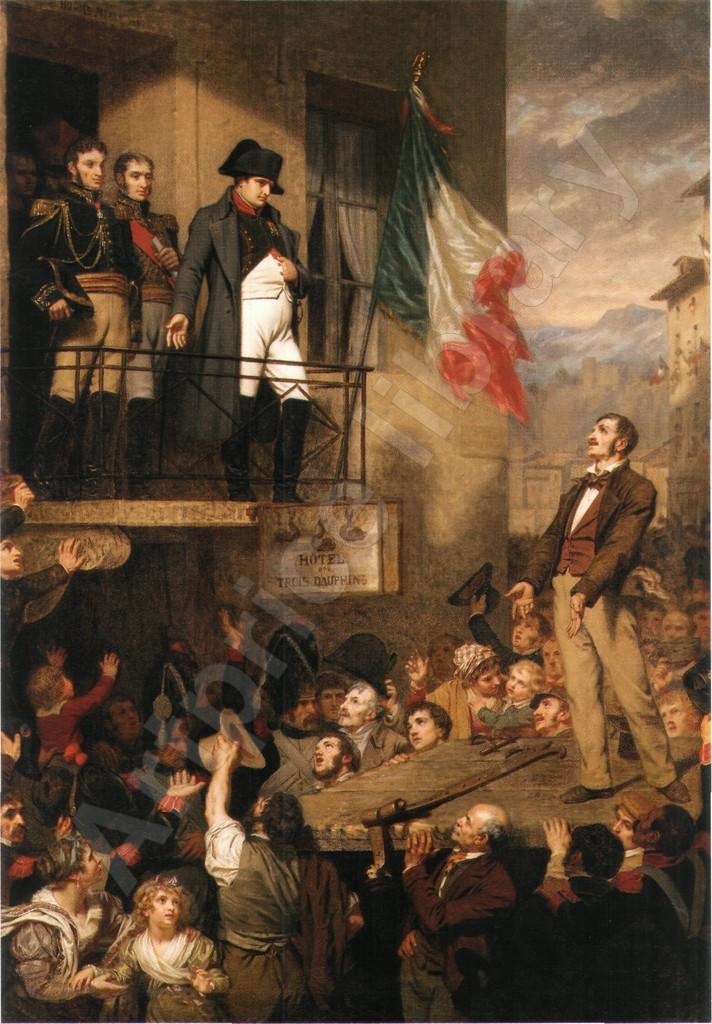
Hugues Merle (French, 1823-1881) The Eagle's Flight (1857) Oil on canvas 51 X 35 1/2 in. Christies, NY 23 APR 2003
Merle was accepted as a student at the École des Beaux-Arts in Paris, the nation’s most prestigious school for aspiring artists. There he enrolled in the studio of Léon Cogniet (1784-1880). Cogniet had studied at the École under Pierre -Narcisse Guérin, at same time as Eugene Delacroix, Ary Scheffer and Theodore Géricault, with whom he maintained life-long friendships. While he distinguished himself by winning the Prix de Rome in 1817, Cogniet is largely remembered as a teacher. Of him, Baudelaire wrote:
If he does not aspire to the level of genius, his is one of those talents which defy criticism by their very completeness within their own moderation. M. Cogniet is as unacquainted with the reckless flights of fantasty as with the rigid systems of the absolutists. To fuse, to mix and combine, while exercising choice, have always been his role and aim; and he has perfectly fulfilled them.
(Charles Baudelarie. The Mirror of Art, rans. and ed. by Jonathan Mayne. New York: 1956, p. 21)
Cogniet students include some of the century’s most respected painters, including Alfred Dehodencq, Jean-Louis Ernest Messonier, Jules Joseph Lefebvre, Léon Bonnat, Raimundo de Madrazo, and Jean Paul Laurens. As a teacher, Cogniet advocated vigorous and rough sketching above meticulous, time-consuming preparation. This became what Albert Boime described as “the sauce Cogniet [that] became a popular epithet to describe the technique of his disciples.” (Art and the Academy, p. 104). This resulted in a fluid naturalism in Cogniet’s own work, which influenced Merle’s approach during the the 1840s and 1850s.
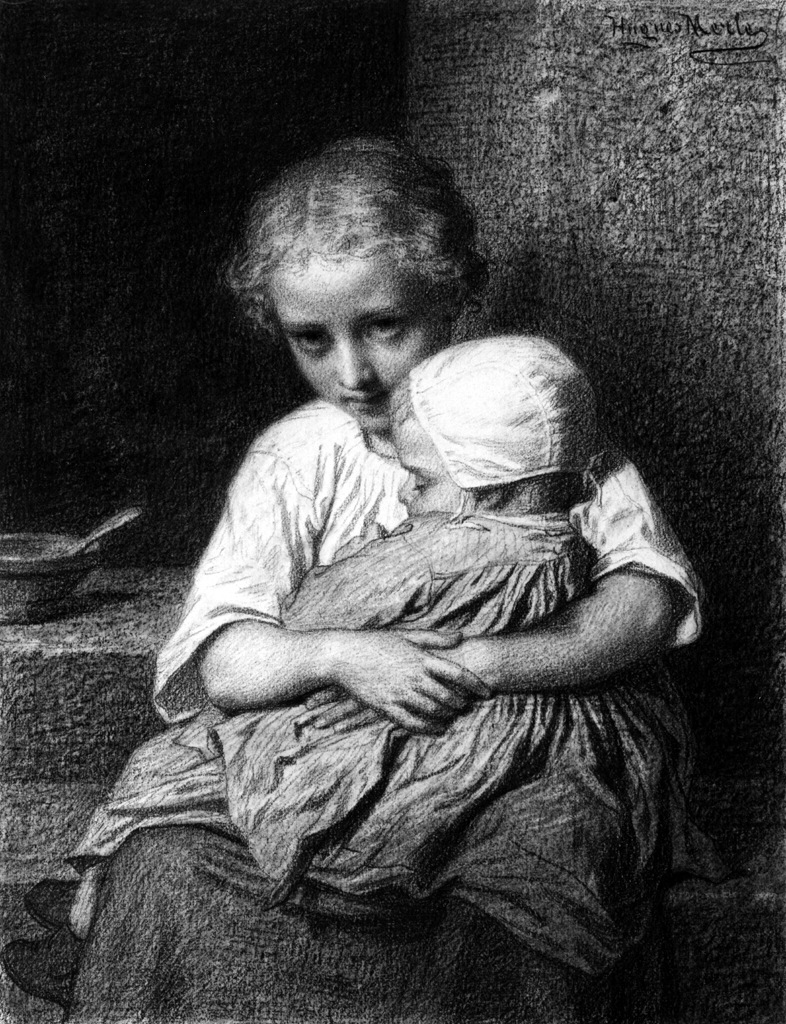
Hugues Merle (French, 1823-1881) The Good Sister (1862) Watercolor on paper. 8 X 5.75 Walter Art Museum, MD, USA.
Having seen nearly 200 of Merle’s works (I have no idea how many he painted yet), ranging from the early 1840s to his death in 1881, I would divide his ouvre into roughly three periods:
- Multifigural History Painting (1840s and 1850s)
- Genre Scenes (1850s and 1860s)
- Monumental Romantic Figures (1860s t0 1881)
1. MULTI-FIGURAL HISTORY PAINTING (1840s and 1850s)
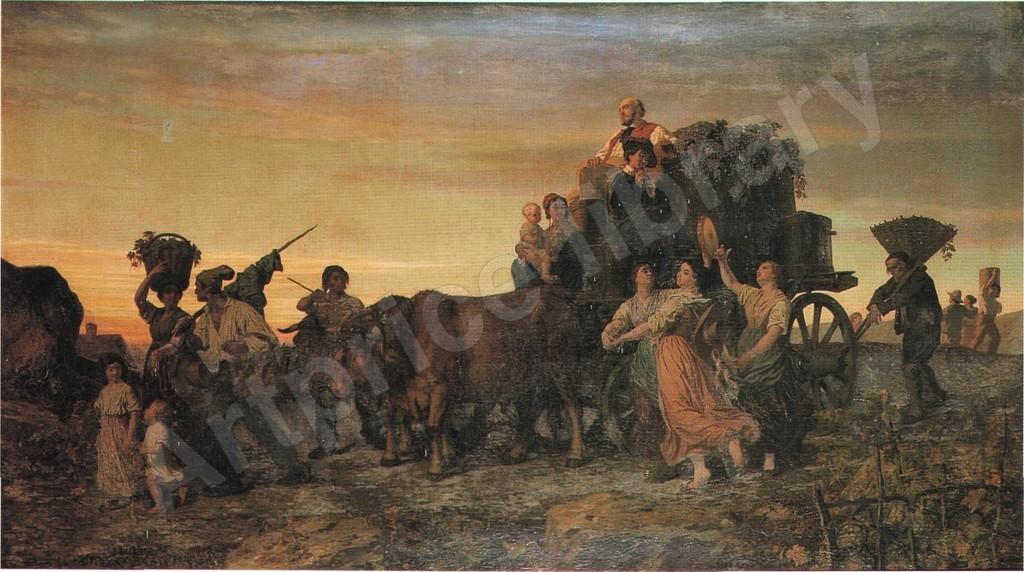
Hugues Merle (French, 1823-1881) Vendangeurs dauphinois dans les environs de Saint-Marcellin (1850) Oil on canvas 42 1/2 X 75 1/2 in. Piasa Auctions, Paris 14 DEC 2001
It is no surprise that works from early in Merle’s career have more in common with Cogniet’s work than his latter works. They are politically-charged or mythological history paintings–the kind that students at the École were trained to produce. Like Cogniet, many of these works are romantic in coloring and stroke. The brushwork is loose and the palette is warm.
2. GENRE SCENES (1850s and 1860s)
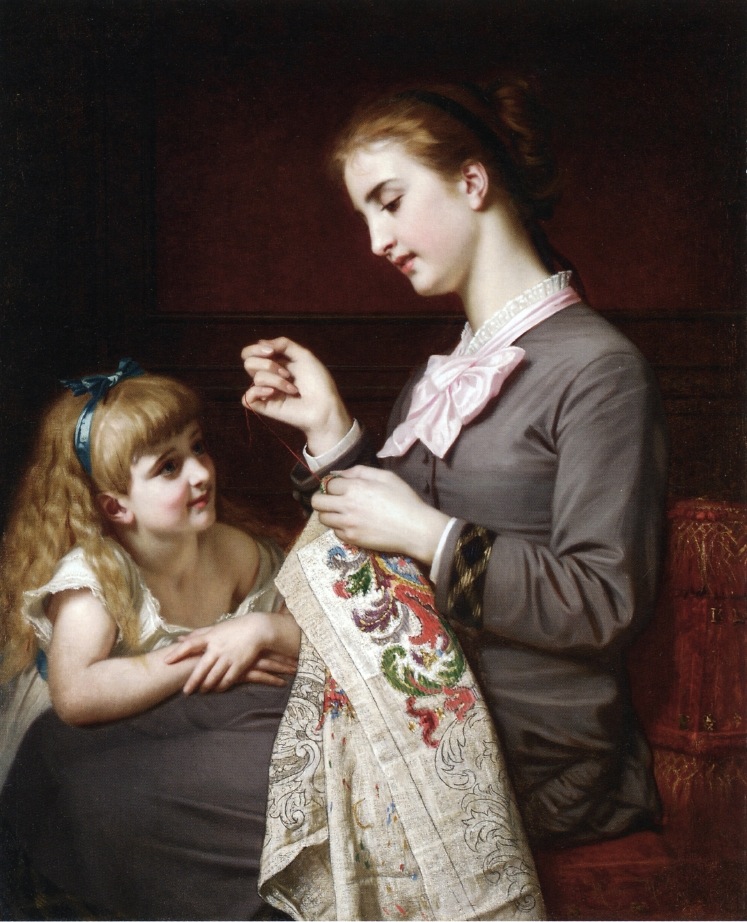
Hugues Merle (French, 1823-1881) The Embroidery Lesson (Date Unknown) Oil on canvas 39 1/4 X 31 5/8 in.
It is my guess that once he had established his academic credibility, Merle had to make a transition into becoming a commercial success. In mid-nineteenth Paris, this meant appealing to the bourgeoisie. Rather than mythological or heroic scenes that appealed to aristocratic tastes or political agendas, the easy sell to the upwardly mobile French middle classes was domestic family life and narratives lionizing traditional French values. Merle painted pictures of mothers and daughters, family gatherings, country scenes and home interiors. According to one source, it during this period Bougeureau and Merle had the same picture dealer, and that dealer encouraged Bougeureau to take up Merle’s successful theme of familial grieving.
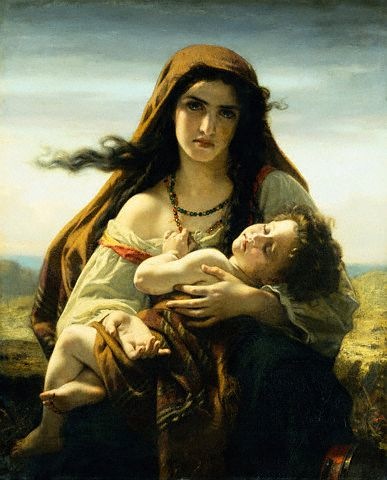
Hugues Merle (French, 1823-1881) The Widow (Date Unknown) Oil on Canvas. Private Collection
In this era, Merle developed his own technical approach that distanced him from Cogniet. He replaced warm colors with a high-contrast, jewel-like palette. His paintings became sparsely populated and the remaining figures grew in proportion to fill the canvas. As the figures grew, they became more idealized with an emphasis on line over color.
3. MONUMENTAL ROMANTIC FIGURES (1860s t0 1881)
Merle’s critical successes in the Salons of the 1860s led gave him international recognition. Like many others, Salon prizes resulted in a lucrative business of painting portraits Brits and Americans. But, it was Merle’s work as an interpreter of major literary romantic figures that set him apart.
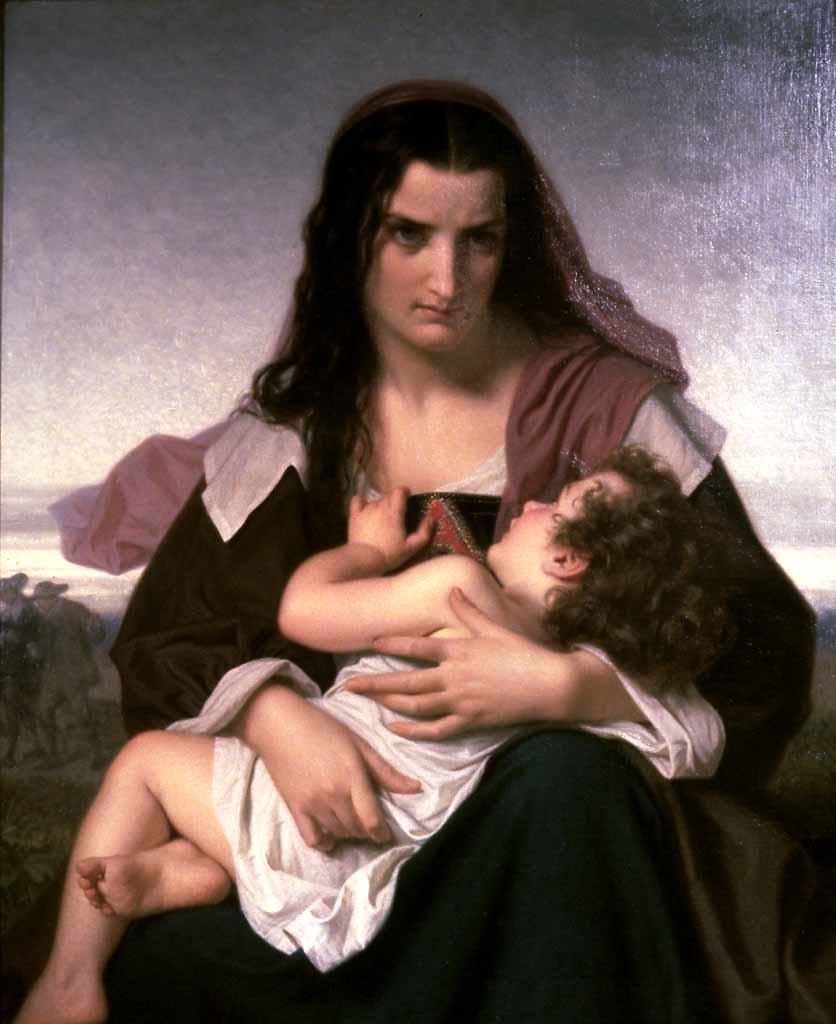
Hugues Merle (1823-1881) The Scarlet Letter (1861) Oil on canvas. 39 5/16 x 31 15/16 in. Walters Art Museum, MD, USA.
Upon seeing a photo of Merle’s interpretation of the Scarlett Letter, Nathaniel Hawthorne is purported to have said: “It is the most true representation of my work I have ever seen.” Merle painted a number of biblical and literary figures, especially romantic couples, including Tristan & Isolde, Benedick & Beatrice, and Romeo & Juliet. These figures were painted as large as life. They dominated the canvas. Merle removed all unnecessary narrative devices, relying on his audience’s familiarity with the subjects.
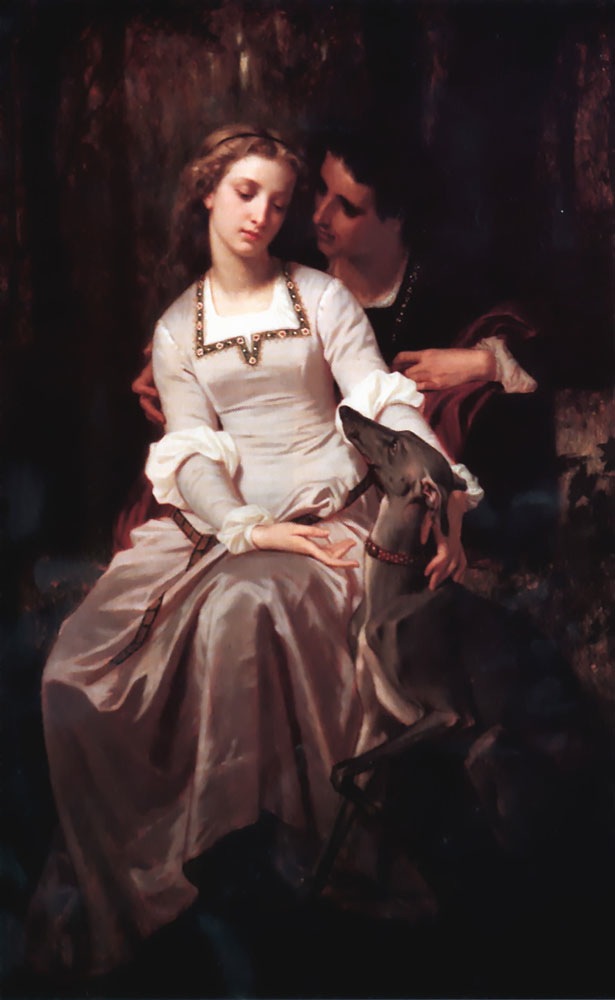
Hugues Merle (French, 1823-1881) Tristan and Isolde (1870) Oil on canvas. Private Collection.
In 1865, François-Victor Hugo (Victor Hugo’s son) had translated the complete works of Shakespeare into French. For the next fifteen years, the French poured over and re-interpreted the Bard’s narratives in ballets, operas, sculptures, and paintings. Merle’s Romeo & Juliette depicts the couple’s first meeting in Act I, Scene V. Here Romeo steals a “pilgrim’s kiss” from Juliet who coyly responds “You kiss by the book.”
The increased sophistication of Merle’s subjects was rising mastery of the human form. While his treatment of the clothed figure indicate his skill level, it is in nude that we are able to see an artist’s true mastery of the figure. Bougeureau’s female nudes leave us in awe of his skill and ensure his immortality. There are accounts of several painting of nude figures by Hugues Merle that have not surfaced in the art market. For me, this is a major omission in his ouvre and one that will continue to dog him if he is to regain stature.
Two Late Bronzes by Jean Léon Gérôme: Les Rameaux & La Fuit en Egypte
(Dear Readers, I am currently on vacation and will be back and posting regularly at the end of September. Have a great summer!)
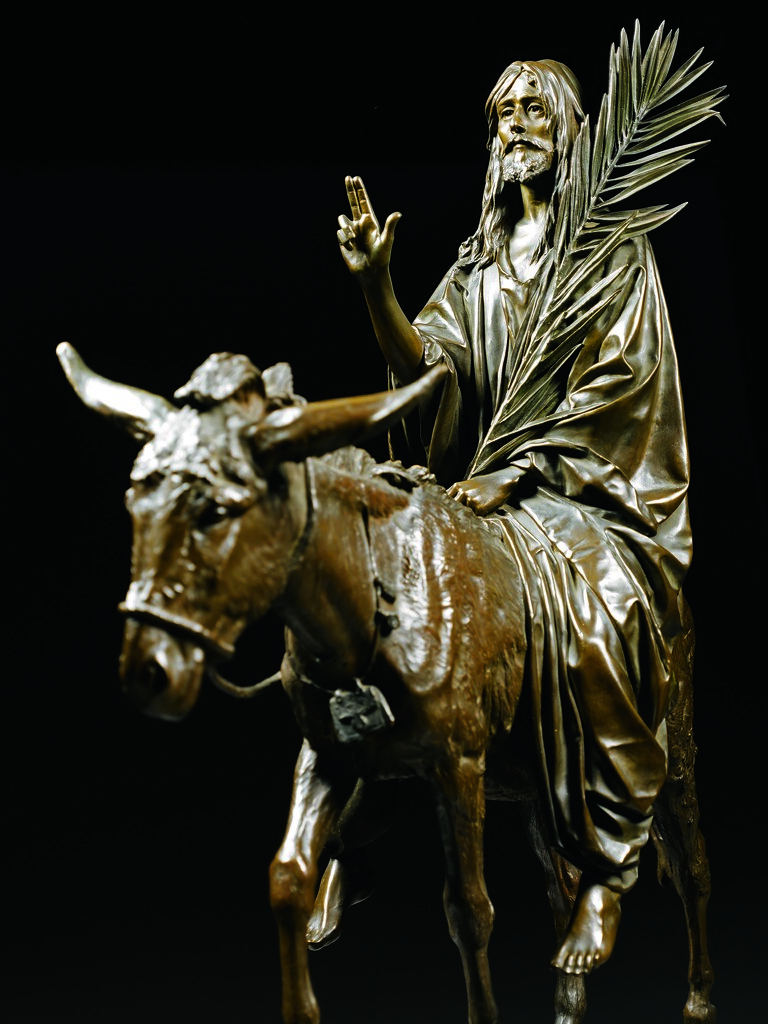
Jean Léon Gérôme (French, 1824-1904) Les Rameaux (Christ Entering Jerusalem) 82 by 64 cm. Bronze patinated with polychrome. Private colletion.
(Note: The following was written for the private collector who owns these two bronzes. I enjoyed my research so much, that I thought I would share it here, with his permission.)
At a time when Paris was the center of the art world Jean-Léon Gérôme (1824-1904) was one of France’s most decorated artists. Principally remembered as a painter, his greatest contribution may well be his work as a sculptor. The works La Fuite en Egypte and Les Rameaux were both made in 1897, near the end of Gérôme’s career and at the height of his ability.
Born on France’s east coast, Gérôme received the reluctant permission of his father, an accomplished goldsmith, to study at the country’s most prestigious art academy, the École des Beaux-Arts in Paris. There he excelled under the direction of Paul Delaroche (1797-1856) and Charles Gleyre (1806-1874). Gleyre’s studio, which placed emphasis on the revival of Greek forms in art, had a lasting affect on his student’s interest in classical subjects and models. Gérôme’s own work would span Classicism, Orientalism and Realism; traces of all three can be found in his later works.
When Gleyre was appointed Director of the French Academie in Rome in 1844, Gérôme followed. There he completed his academic education through close study of Old Master and Greco-Roman works. (Gérôme traveled throughout his career to Greece, Egypt and the Holy Land.) As a result of his studies, his works bore the technical virtuosity of an academic artist combined with personal first-hand knowledge of monuments, foreign landscapes and exotic peoples. La Fuite en Egypte and Les Rameaux directly reflect his study of bedouin costume and animals observed during a visit to the Holy Land.
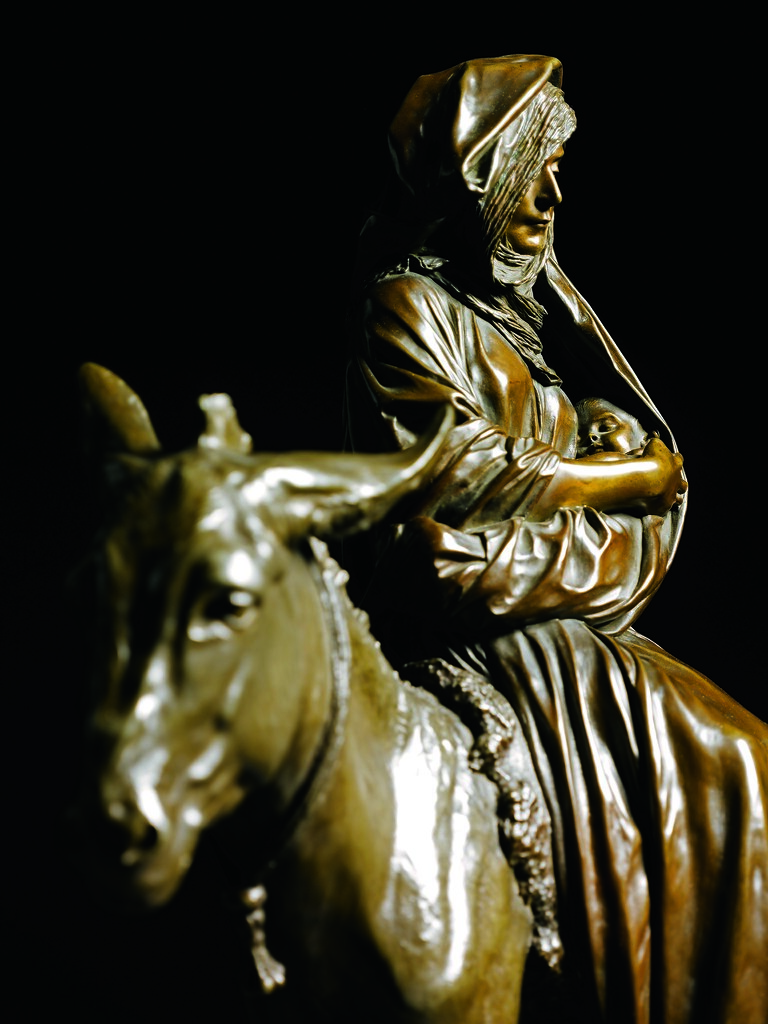
Jean Léon Gérôme (French, 1824-1904) La Fuit en Egypte (Flight into Egypt) 78 by 63 cm. Bronze patinated with polychrome. Private collection.
Returning to France in 1847, Gérôme enjoyed his first of many successes at the highly competitive Salon de la Société des Artistes Français. That year, the eminent French critic Theophile Gautier wrote: “Let us mark with white this lucky year, unto us a painter is born. He is called Gérôme. I tell you his name today, and tomorrow it will be celebrated.” Works by Gérôme were accepted nearly every year from 1847 to 1903. There they inspired popular novels and music. By the end of his life, Gérôme had been made a member of the Institute de France (1865), a knight in the Légion d’honneur (1867), and awarded the Order of the Red Eagle by King Wilhelm I of Prussia.
Such success merited prominent commissions from the state, as a well as a bevy of patrons, including the Empress Eugenie, who became a close friend. Today, his paintings and sculptures are found in many world’s finest museums including the Musée d’Orsay (Paris), National Gallery of Art (London), National Gallery of Art (Washington, D.C.), Hermitage (St. Petersburg), Art Institute of Chicago, and Metropolitan Museum of Art (New York).
Géróme’s high profile had academic currency. He was hired as one of three studio teachers at the prestigious École des Beaux-Arts. There Gérôme fathered a dynasty of academic painters in France and America, among them Thomas Eakins (1844-1916), Frederick Arthur Bridgman (1847-1928), Mary Cassatt (1844-1926), Pascal Dagnan Bourveret (1852-1929), William M. Paxton (1869-1941) and Julian A. Weir (1852-1919). A lifelong tutor to many, he maintained a close relationship with his students beyond their studies.
In 1889, Gérôme travelled to Florence and Padua with two students: Edouard Detaille (1848-1912) and François Flameng (1856-1923) There he studied the equestrian works of Italian Renaissance masters, including Donatello and Verrocchio. The trip was a book end to the studies he began as a young artist and had first seen the works. He later wrote to a friend about the journey:
I went to Florence . . . I had stayed there as a youth and had not returned since. What a deception! What an eye-opener! I saw crumble–I won’t say all–but almost all my youthful heroes.
Rather than arrogance, here Gérôme displayed a genuine sense of disappointment and the honest assessment that then–in his late sixties–he may have moved beyond youthful lessons and on a level with the masters. It is possible this insight led Gérôme to look beyond standard models.
Late-nineteenth-century archeologists discovered color residues on Roman and Greek works, proving that the austere white marble we see today was, in fact, covered in bright blues, reds, greens and precious metals. Gérôme learned of the use of polychrome and incorporated them in his own works, including Les Rameaux and La Fuite en Egypte, which both bear the subtle but unmistakable use of polychrome unique to Gérôme.
The sculptures were produced during the last decade of his life, when Gérôme dramatically increased the amount of time and resources spent on his sculptures. In 1890, Gérôme hired Emile Décorchement to work as a full-time sculpting assistant. He also teamed up with the foundry of Siot-Decauville.
Established in the 1890’s, Siot-Decauville’s innovative ability to scale down large bronze models made their foundry especially attractive to Gérôme, who prided himself on fidelity to reality. The remarkable precision visible in Les Rameaux and La Fuite en Egypte were accomplished by Gérôme working with models twice the size of the finished bronzes. In this way, he was able to add details-the animals’ fur, the wilting leaves of Christ’s palm branch, and the gauzy folds of Mary’s bedouin clothing–with larger tools that would have been ineffective in smaller-scale versions.
In the late-nineteenth-century, table-top bronzes were an popular feature of tasteful interior decor. This pair of Les Rameaux and La Fuite en Egypte were cast in the same year as Gérôme’s painting, La Fuite en Egypte, was submitted to the Salon. According to his standard studio practice, Gérôme’s sculptures, sometimes in unfinished stages, were the inspiration for paintings and vice versa. In this case, it is unknown which work was first.
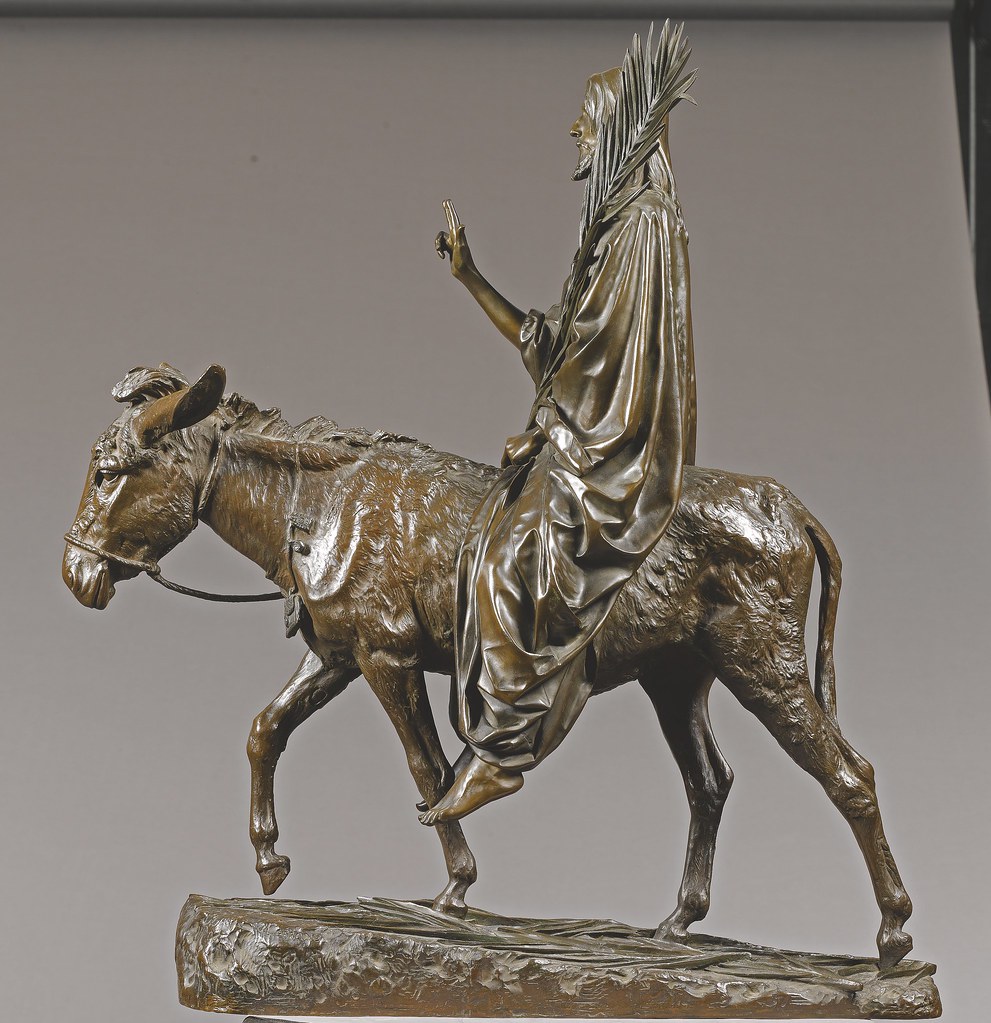
Jean Léon Gérôme (French, 1824-1904) Les Rameaux (Christ Entering Jerusalem) 82 by 64 cm. Bronze patinated with polychrome. Private colletion.
Les Rameaux captures the moment Christ enters Jerusalem (Matthew 21:1-11, Mark 11:7-10; Luke 19:28-44; John 12:12-19), on what is traditionally known as Palm Sunday, hence the branch in Christ’s left hand:
5 Tell ye the daughter of Sion, Behold, thy King cometh unto thee, meek, and sitting upon an ass, and a colt the foal of an ass.
6 And the disciples went, and did as Jesus commanded them,
7 And brought the ass, and the colt, and put on them their clothes, and they set him thereon.
8 And a very great multitude spread their garments in the way; others cut down branches from the trees, and strawed them in the way.
9 And the multitudes that went before, and that followed, cried, saying, Hosanna to the Son of David: Blessed is he that cometh in the name of the Lord; Hosanna in the highest.
10 And when he was come into Jerusalem, all the city was moved, saying, Who is this?
11 And the multitude said, This is Jesus the prophet of Nazareth of Galilee.
Palm Sunday marks the beginning of Holy Week, which ends with Christ’s resurrection on Easter Sunday. Gérôme indicates the journey ahead by placing Christ on a slight incline. As he enters the gate, Christ raises his hand in a sign of blessing, often attributed to Christianity, yet believed to be derived from a bircas kohanim (Jewish priestly blessing).
The juxtaposition of Les Rameaux with La Fuite en Egypte brings attention to details otherwise imperceptible. Christ sits on a femial donkey and Mary on a mael. Christ is on an incline, Mary on unvaried, steady ground.
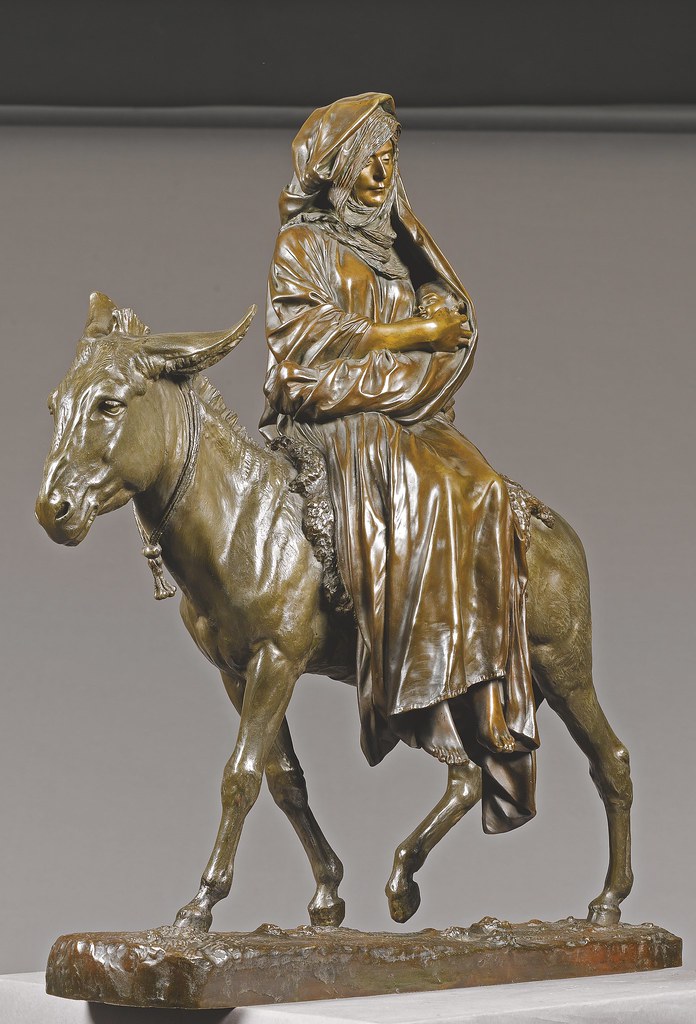
Jean Léon Gérôme (French, 1824-1904) La Fuit en Egypte (Flight into Egypt) 78 by 63 cm. Bronze patinated with polychrome. Private collection.
La Fuite en Egypte depicts a pensive Mary, uprooted from her home and traveling to Egypt with family in tow. According to St. Matthew:
And when they were departed, behold, the angel of the Lord appeareth to Joseph in a dream, saying, Arise, and take the young child and his mother, and flee into Egypt, and be thou there until I bring thee word: for Herod will seek the young child to destroy him.
Despite the tumult inherent in the narratives, Gérôme shows Mary and Christ unfazed by their circumstances. These are not the contorted, pained figures of works often used for public ritual. They are works of private reflection.
When Gérôme created Les Rameaux and La Fuite en Egypte, he was 73. His last seven years were a flurry of activity. On the morning of January 10, 1904, Gérôme was found dead in his studio before a self-portrait of Rembrandt and his own painting Truth. He left a studio full of partially finished and un-cast plasters. Les Rameaux and La Fuite en Egypte were among his last finished works.
According to Ackerman there are at least three sizes of each statue known to have been cast. These were the first and largest versions and, therefore, their production, from start to finish, would have been overseen by Gérôme himself. In addition to their authenticity, Ackerman believed that they were created as a pair and not separate works. These two bronzes have been in the same family for three generations and are believed to have been purchased directly from Siot-Decauville. If true, these represent a rare combination. There is no similar pair known to exist in any public or private collection.
Forgotten Master: Carlos de Haes (Brussels, 1826-Madrid, 1898)
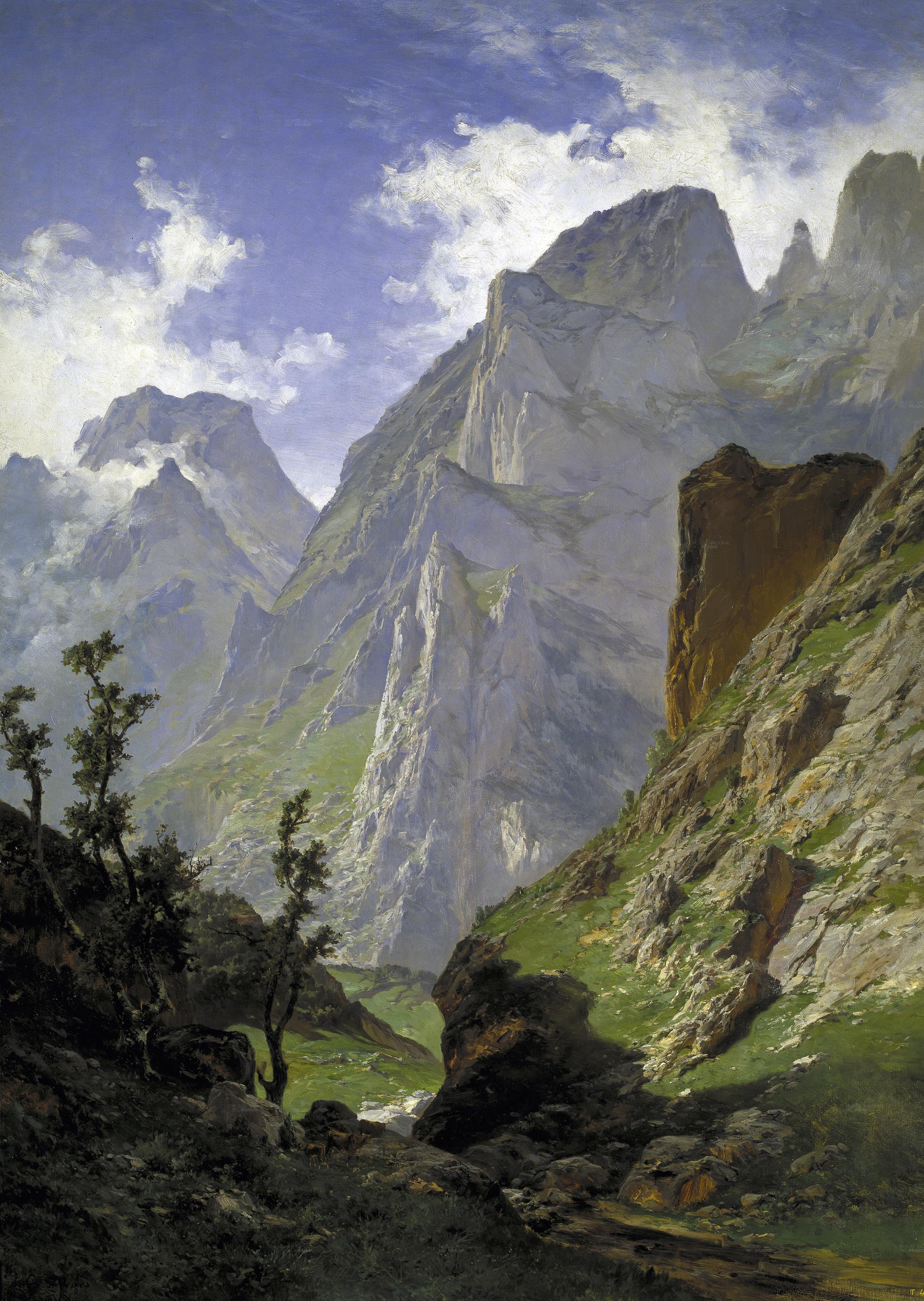
Carlos de Haes (Brussels, 1826-Madrid, 1898) La canal de Mancorbo en los Picos de Europa (1876) Oil on canvas. 168 x 123 cm. Museo Nacional del Prado, Madrid.
While not forgotten in Spain, Carlos de Haes’ work has been little recognized elsewhere. As a teacher and award-winning artists, Haes is perhaps Spain’s greatest landscape painter.

Photograph of Carlos de Haes (Brussels, 1826-1898) c. 1870.
Carlos de Haes (Brussels, 1826-Madrid, 1898) was born in Belguim to Spanish parents. Due to financial troubles, the family was forced to return to Spain in 1835. There, Haes studied with Luis de la Cruz, a Court Painter to King Ferndinand VII and a member of the Academia de Bellas Artes de San Fernando.
In 1850, at the age of 24, Haes traveled back to Brussels to study Flemish landscapes. There he competed and regularly placed in Belgium’s annual Salons. Six years later, Haes returned to Spain.
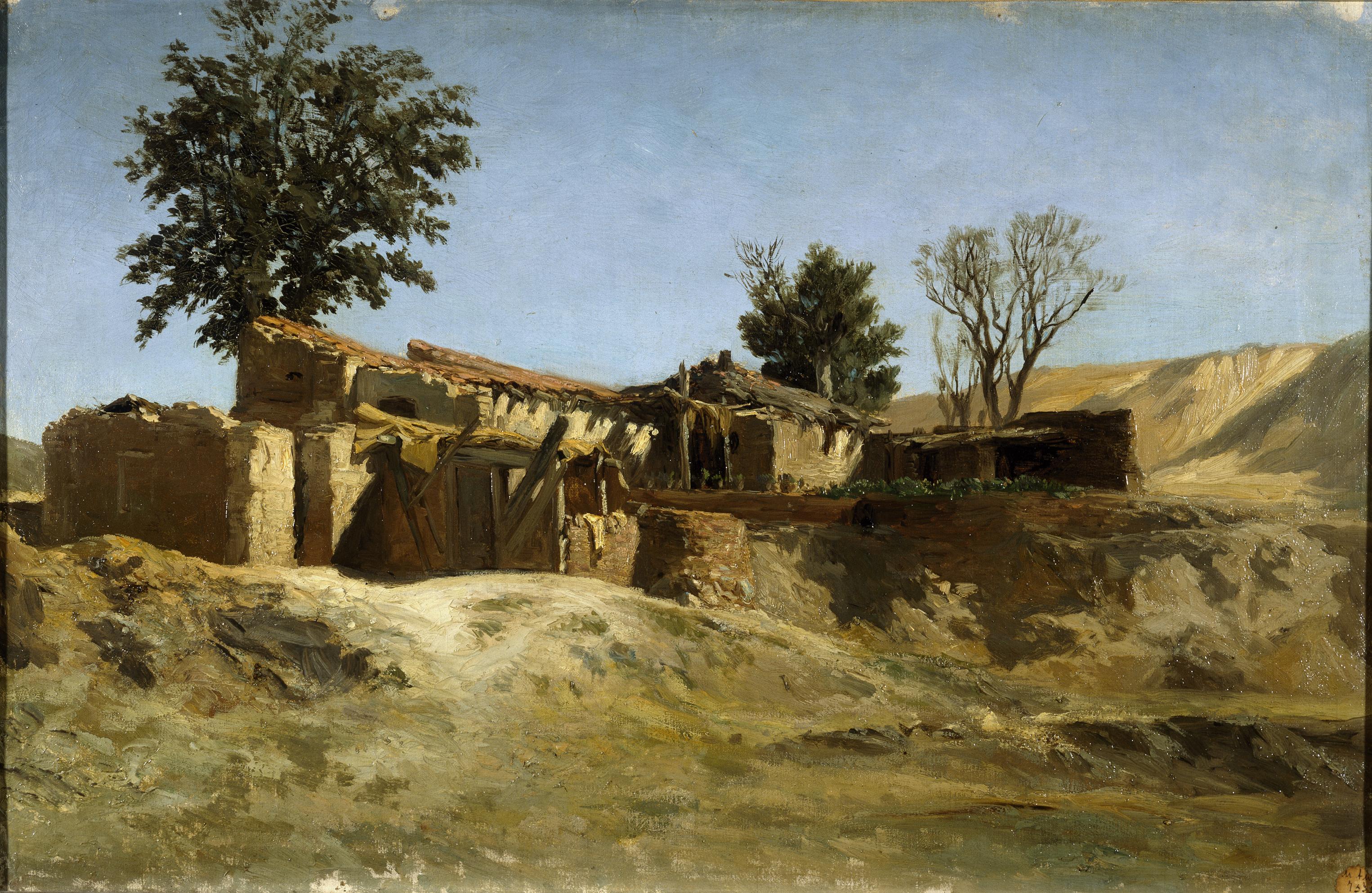
Carlos de Haes (Brussels, 1826-Madrid, 1898) Tejares de la montaña del Príncipe Pío (c. 1872) Oil on canvas. 39.2 x 61 cm. Museo Nacional del Prado, Madrid.
His international experience carried a great deal of currency in Spanish painting circles, and immediately set him apart from his peers who rarely studied beyond Spain and Italy. His dedication to landscape also changed the Spanish Academy’s attitude towards landscape painting.
Despite having been accepted as a major genre in other European countries, during the first half of the nineteenth century, Spain had not widely participated in Romantic and Sublime landscape painting. Instead, landscapes were considered a second-rate genre, a necessary part of an artist’s education insofar as it related to the composition of history painting.
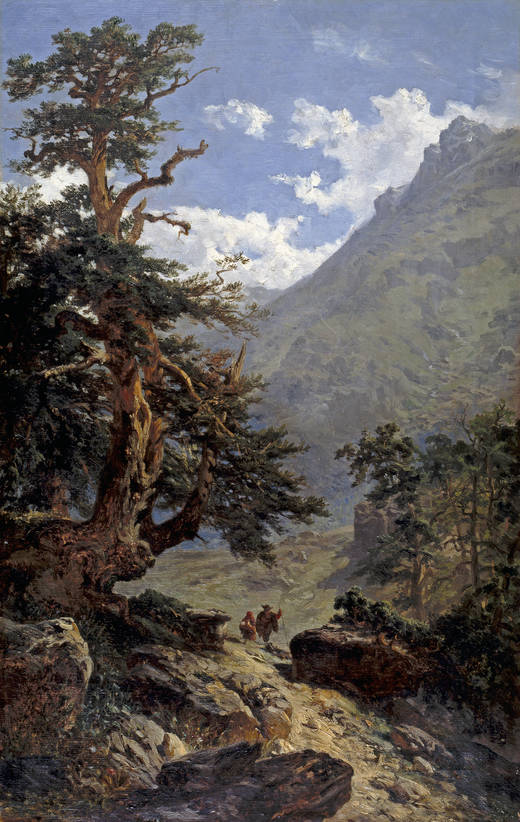
Carlos de Haes (Brussels, 1826-Madrid, 1898) La vereda (1871) Oil on canva. 93.7 x 60.4 cm. Museo Nacional del Prado, Madrid.
Haes’ work Cercanías del moasterio de Piedra (1858) was the first landscape painting to win a First Place medal at the Exposicion Nacional, Spain’s equivalent of the Paris Salon. The award represented a giant leap forward in the estimation of landscape painting as a stand-alone discipline. Shortly afterwards, Haes was made a member of the Academia de Bellas Artes de San Fernando, the nation’s most prestigious art school. His appointment in 1860 to the Academia de San Fernandoand and subsequent teaching there effectively caught Spain up with other schools of landscape painting in Europe. As a teacher, Haes fathered a dynasty of Spanish landscape artists that continues today. Among Haes’s more prominent students are Martín Rico y Ortega (1833-1908), Jaime Morera (1854-1927).
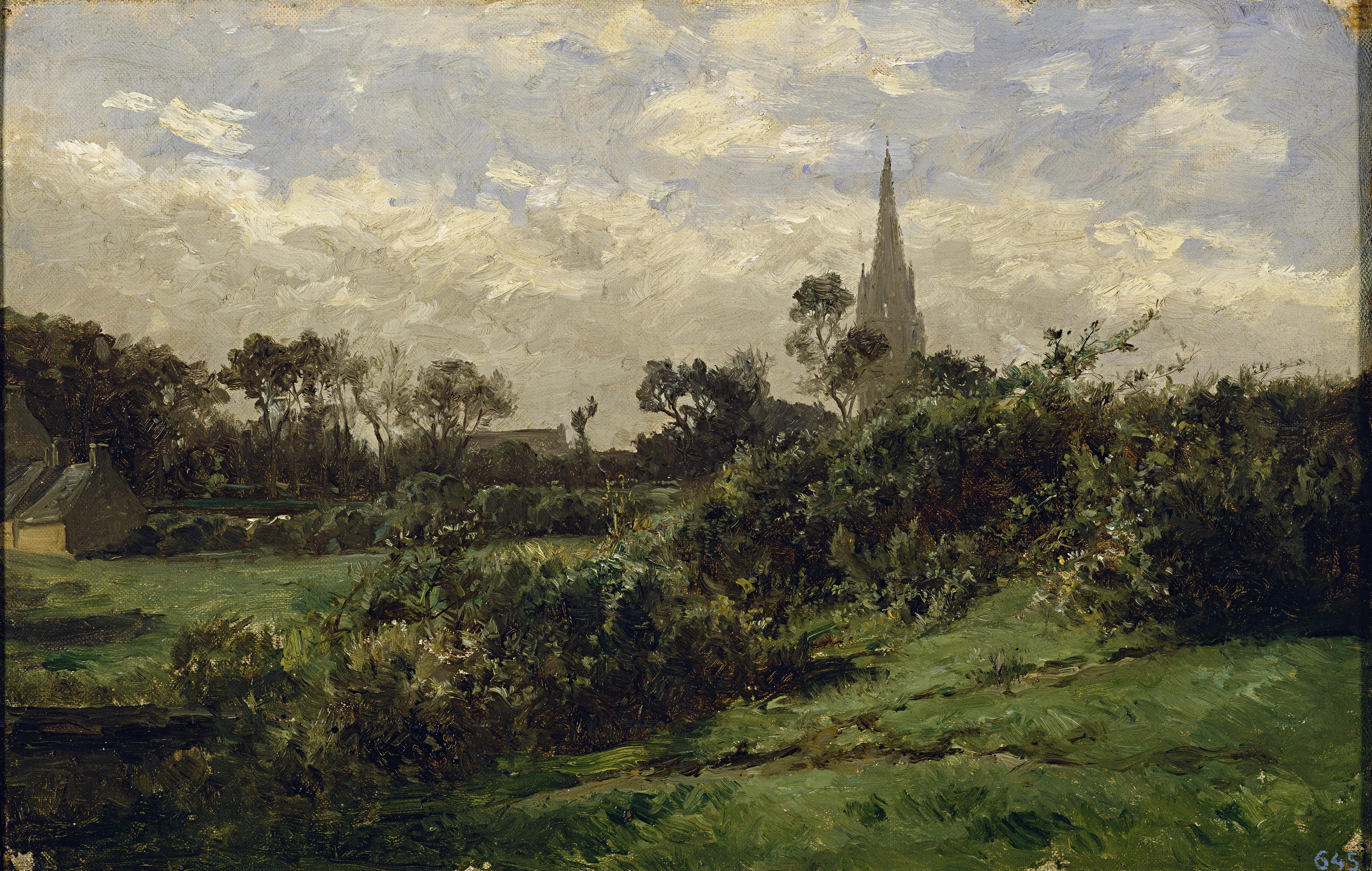
Carlos de Haes (Brussels, 1826-Madrid, 1898) La Torre de Douarnenez (c. 1880) Oil on canvas. 39 by 59 cm. Museo Nacional del Prado, Madrid.
It could be argued that Haes’ one of most important contributions to Spanish painting was with non-landscape painters. Through him, history painters, whose work enjoyed the widest attention at the Exposiciones Nacionales, developed a new appreciation and approach to landscapes, arguably bringing it on par with their figural work. Artists like Francisco Pradilla, José Casado del Alisal, Placenscia Maestro, were required to take Haes’ course at the Academia de San Fernando considered a serious part of their large history paintings, sometimes producing numerous studies devoid of figures.
In particular, Haes brought to Spain an increased emphasis on three aspects of landscape painting: luminosity, porportion and direct observation from nature.

Carlos de Haes (Brussels, 1826-1898) Picos de Europa (c. 1875) Oil on panel. 37 x 59 cm. Museo Nacional del Prado, Madrid.
Traditionally, Spanish artists favored the use of sandy-colored grounds for use in painting. This created a unifying effect in their works, but resulted in the overall dampening of light. While Haes continued to use sand-colored and reddish grounds in his works, he would incorporate large patches of lead white and subdue the quantity of sandy grounds.

Carlos de Haes (Brussels, 1826-Madrid, 1898) Cercanías de Villerville, Normandy (c. 1877) Oil on canvas. 26.2 x 39 cm. Museo Nacional del Prado, Madrid.
Very few of Haes’ works exceed 150 by 200 centimeters. This was at a time when history paintings, often exceeding 6 by 10 meters, were competing for top prizes at Exposiciones Nacionales. Haes’ landscapes, though bold in composition and epic in subject matter, maintained comparatively modest proportions. This set a precedent in landscape painting throughout Spain, which more or less continued throughout the first half of the nineteenth century, even when history paintings became more ambitious in size.
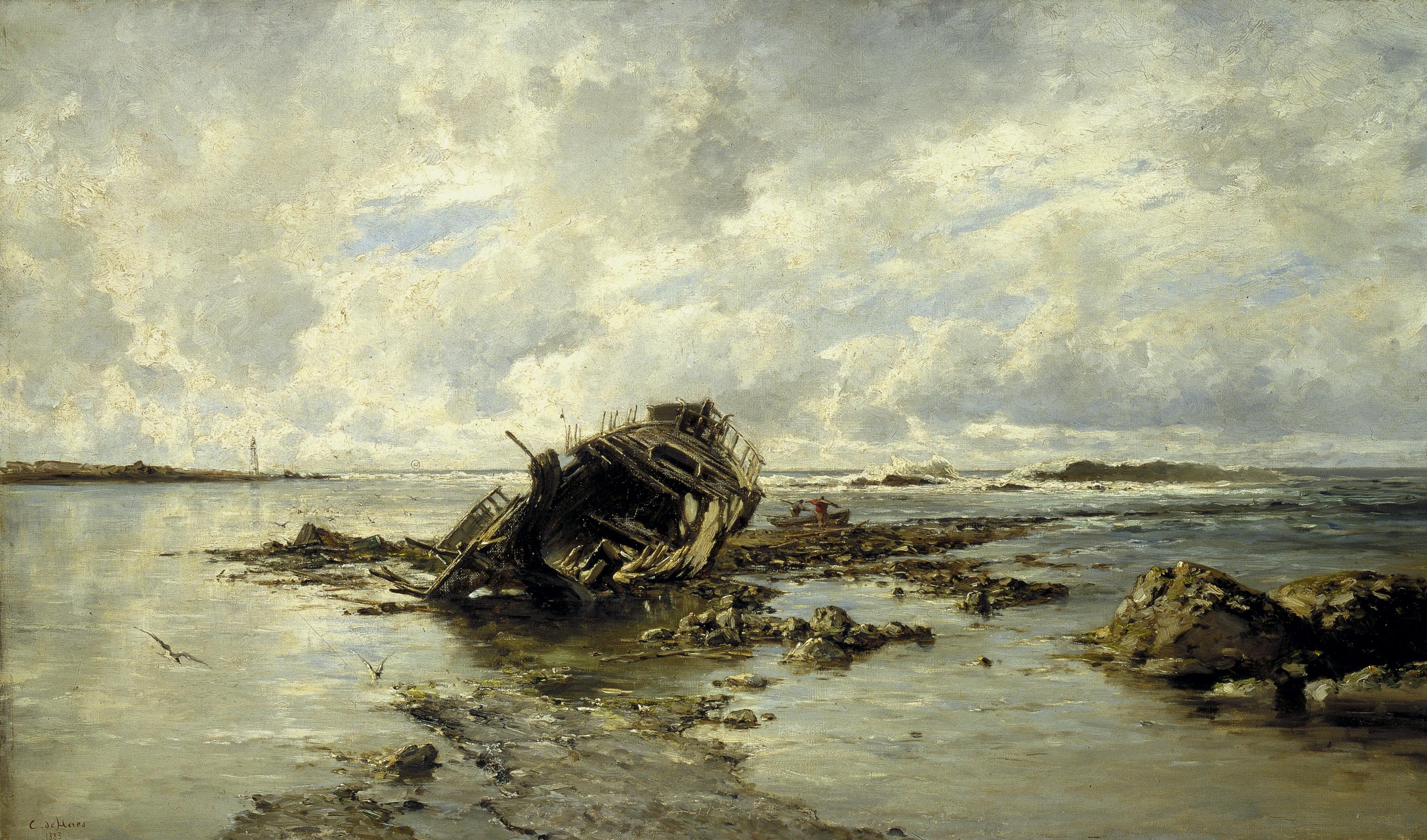
Carlos de Haes (Brussels, 1826-Madrid, 1898) Un bardo naufragado (c. 1883) Oil on canvas. 59 by 101 cm. Museo Nacional del Prado, Madrid.
Finally and perhaps most importantly, Haes was a proponent of direct observation from nature and led several expeditions. This resulted to an almost nationalistic fervor for Spanish landscape painting, that featured Iberian natural wonders.

Carlos de Haes (Brussels, 1826-Madrid, 1898) Desfiladero, Jaraba de Aragón (c. 1872) Oil on canvas. 39 by 60 cm. Museo Nacional del Prado, Madrid.
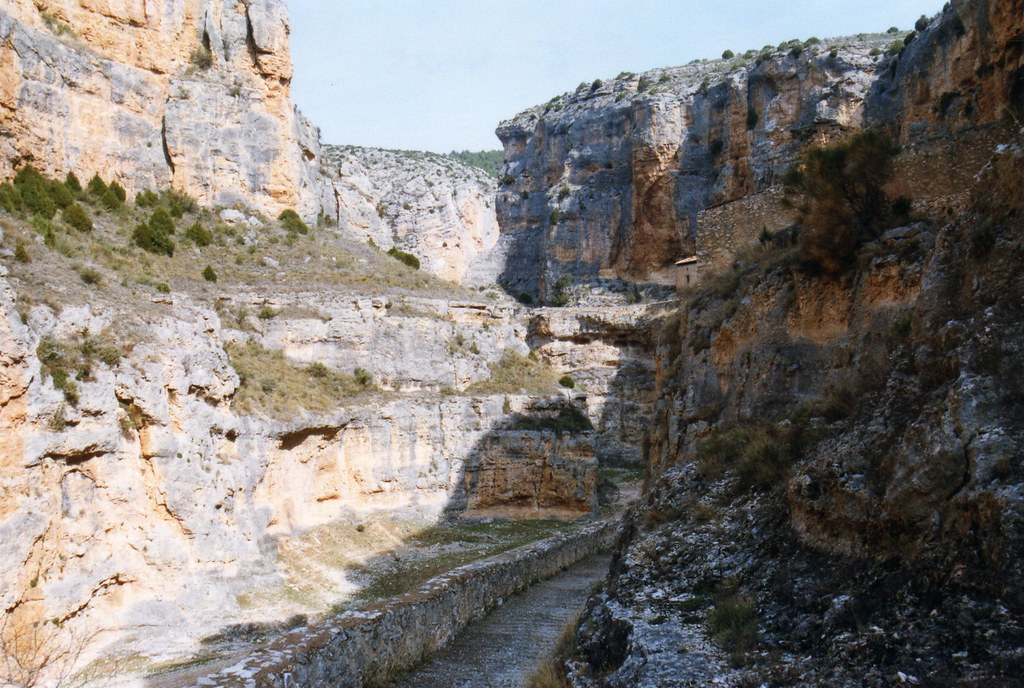
Photograph of Jaraba de Aragón, Spain (2005) by Juan Devis (www.panoramio.com/photo/1599391)
Today, Carlos de Haes’ work can be found in nearly every major Spanish museum. However, the largest body and greatest works from his ouvre are held in the Prado Museum and not currently on display. A new wing of the Prado, dedicated to Spanish nineteenth-century art, is planned to open in 2012.
(Click here for a list of works and biography of Carlos de Haes by the Prado Museum.)
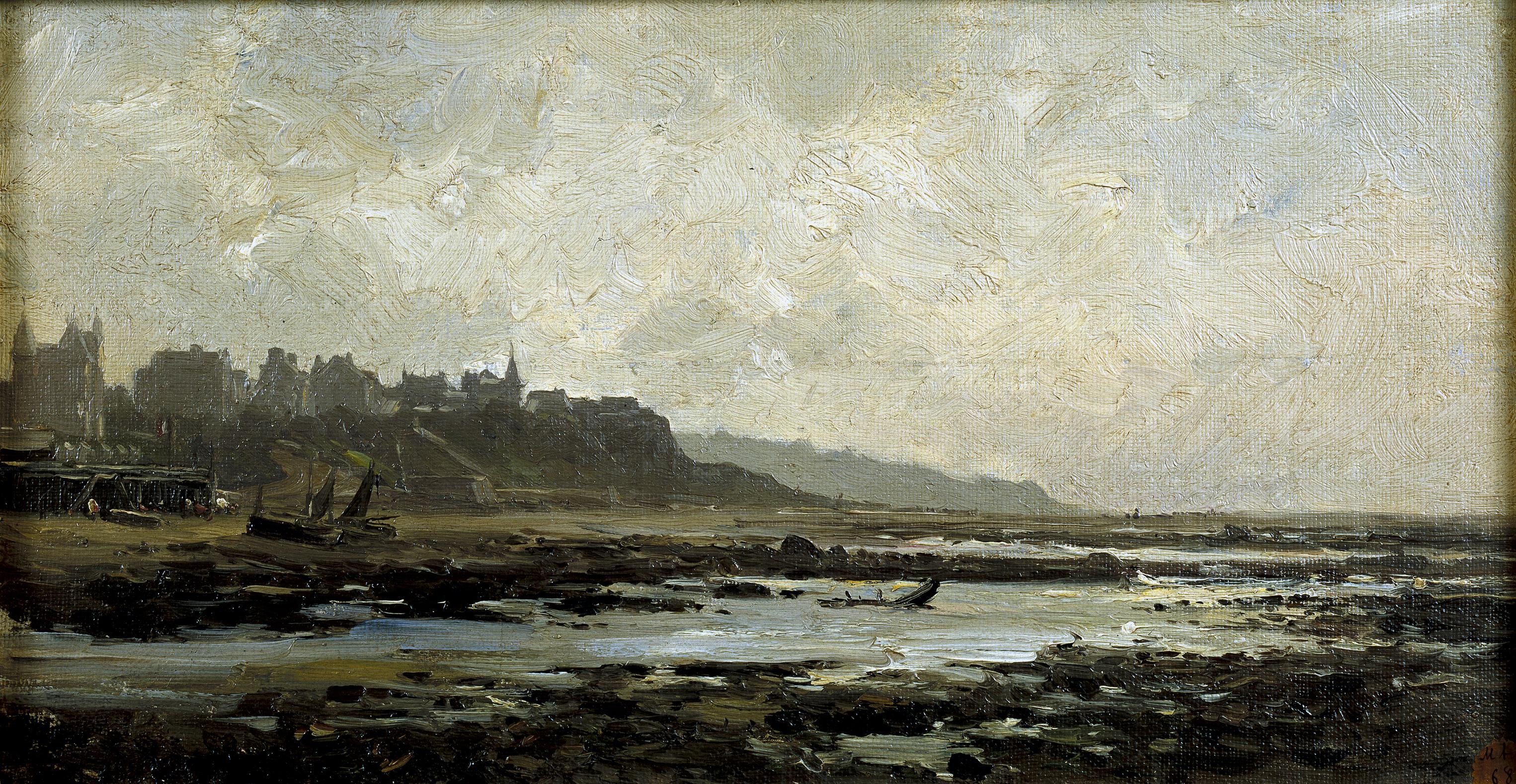
Carlos de Haes (Brussels, 1826-Madrid, 1898) Playa de Villerville, Normandy (c. 1880) Oil on canvas. 22 by 40 cm. Museo Nacional del Prado, Madrid.
Bibliography:
- Carlos de Haes (1826-1898) en el Museo del Prado, cat. exp., Madrid, Museo del Prado, 2002.
- Cid Priego, Carlos, Aportaciones para una monografía del pintor Carlos de Haes, Lérida, Instituto de Estudios Ilerdenses, 1956.
Review: Figures du Corps: Une Leçon d’Anatomie à l’École des Beaux-Arts
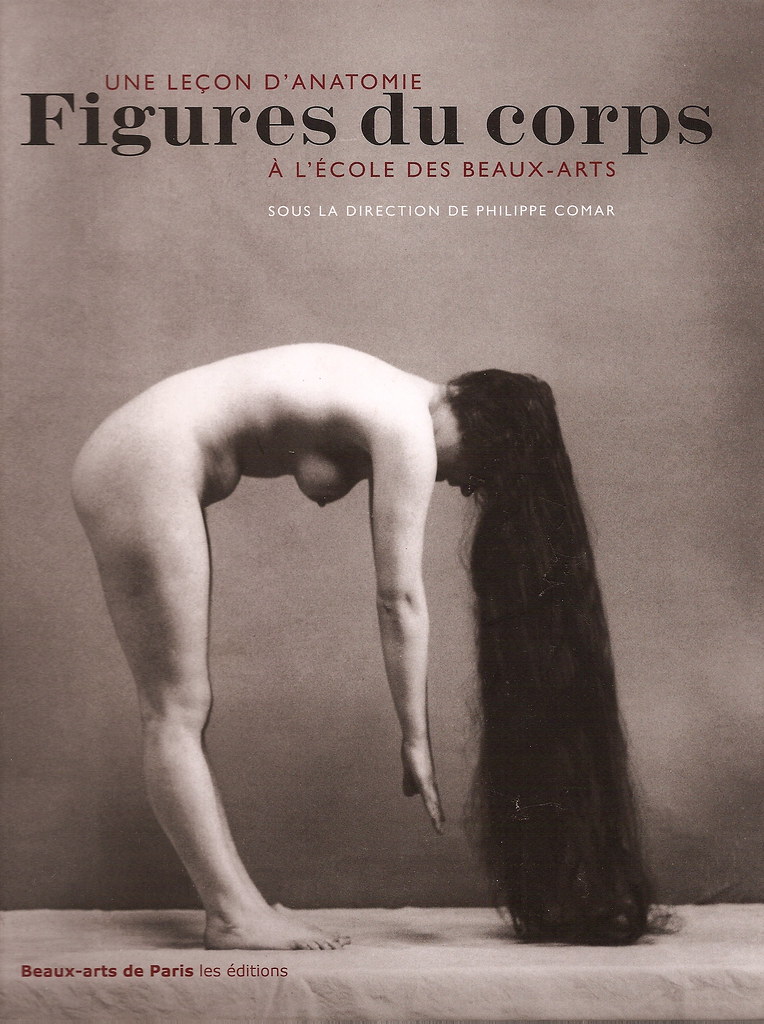
Book Cover of "Figures du Corps" Philippe Comar, ed.
Occasionally, I come across a book that was made with me in mind. Figures du Corps: Une Leçon d’Anatomie à l’École des Beaux-Arts is the catalogue of the exhibition by the same name held from October 21, 2008 to January 4, 2009 at the l’École Nationale Supérieure des Beaux-Arts in Paris. (Painfully, I first learned about the exhibition after seeing this book in a bookshop window in London, which is either a testament to my own ignorance of events like this or a sign that marketing efforts had limited reach.)
The catalogue is an ode to the bewildering and wonderful arsenal of contraptions, tools, plaster casts, photographs, and any other useful aid created to assist artists in the study of human and animal figures.
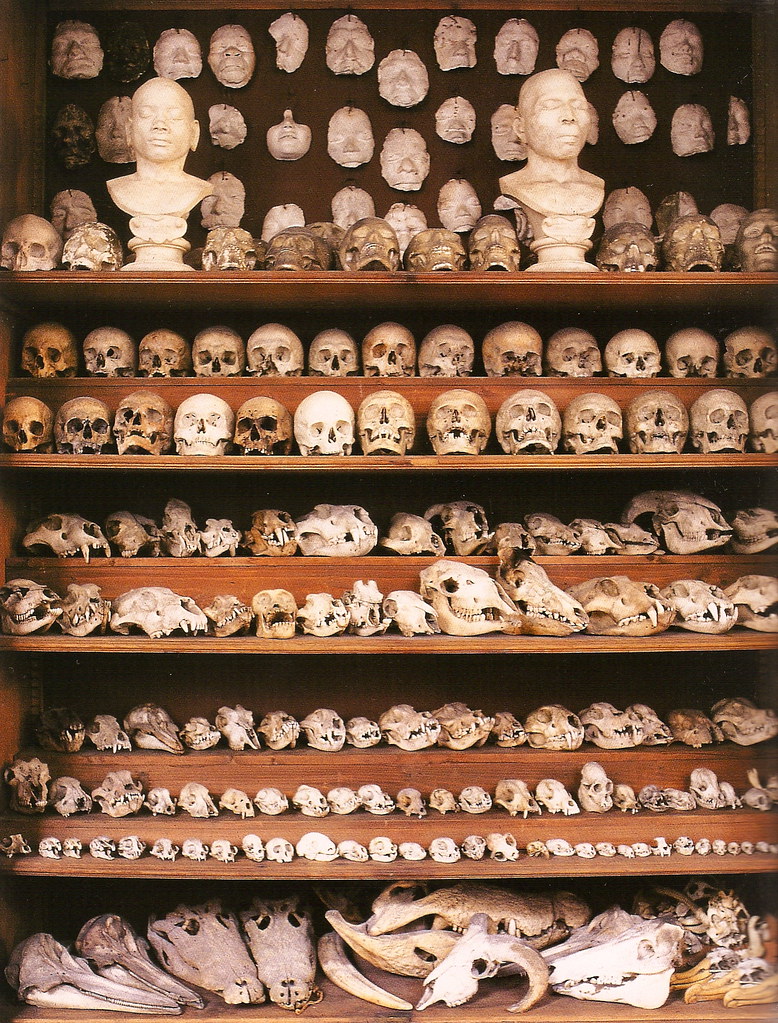
Skulls of humans and various animals from the Galerie Huguier. École des Beaux-Arts, Paris, 2008.
Resembling part medical research facility and part life-science museum, the Ecole des Beaux-Arts gathered human and animal anatomical examples–ideal, real and atypical–for use in training.
For artists at the Ecole des Beaux-Arts, academic training meant mastering the human figure. As described in a previous post, this training took place over a series of graduated steps, beginning with isolating parts of the human figure, to studying idealized forms in Greco-Roman statues, and, finally, working with live models.
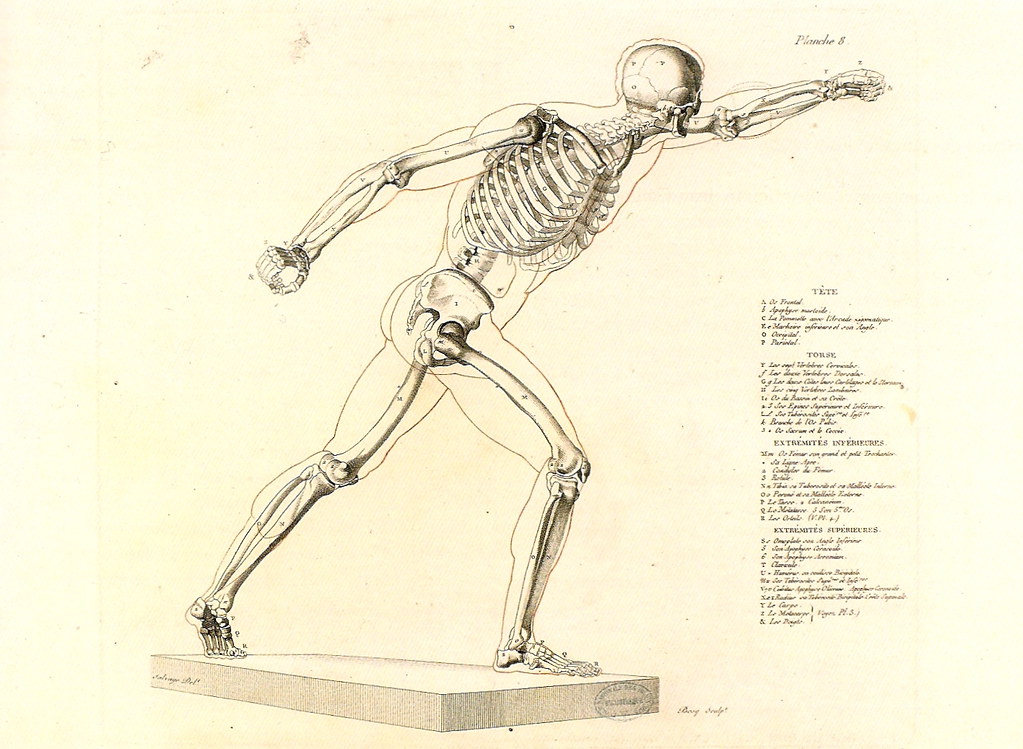
Jean Bosq (1812-1830?) Squelette du Gladiateur combattant from Anatomie du Gladiateur combattant, applicable aux beaux-arts, ou Traité des os, des muscles, du mécanisme des mouvements, des proportions et des caractères du corps humain, Paris, chez lAuteur, 1812. École des Beaux-Arts, Paris.
The catalogue includes several examples of classical forms that have been worked over to reveal underlying skeletal and muscular structure. It is evidence of a startling lack of superficiality in their approach to their craft and art. There are numerous accounts of dissections of both humans and animals, and visits from surgeons to discuss recent medical discoveries.
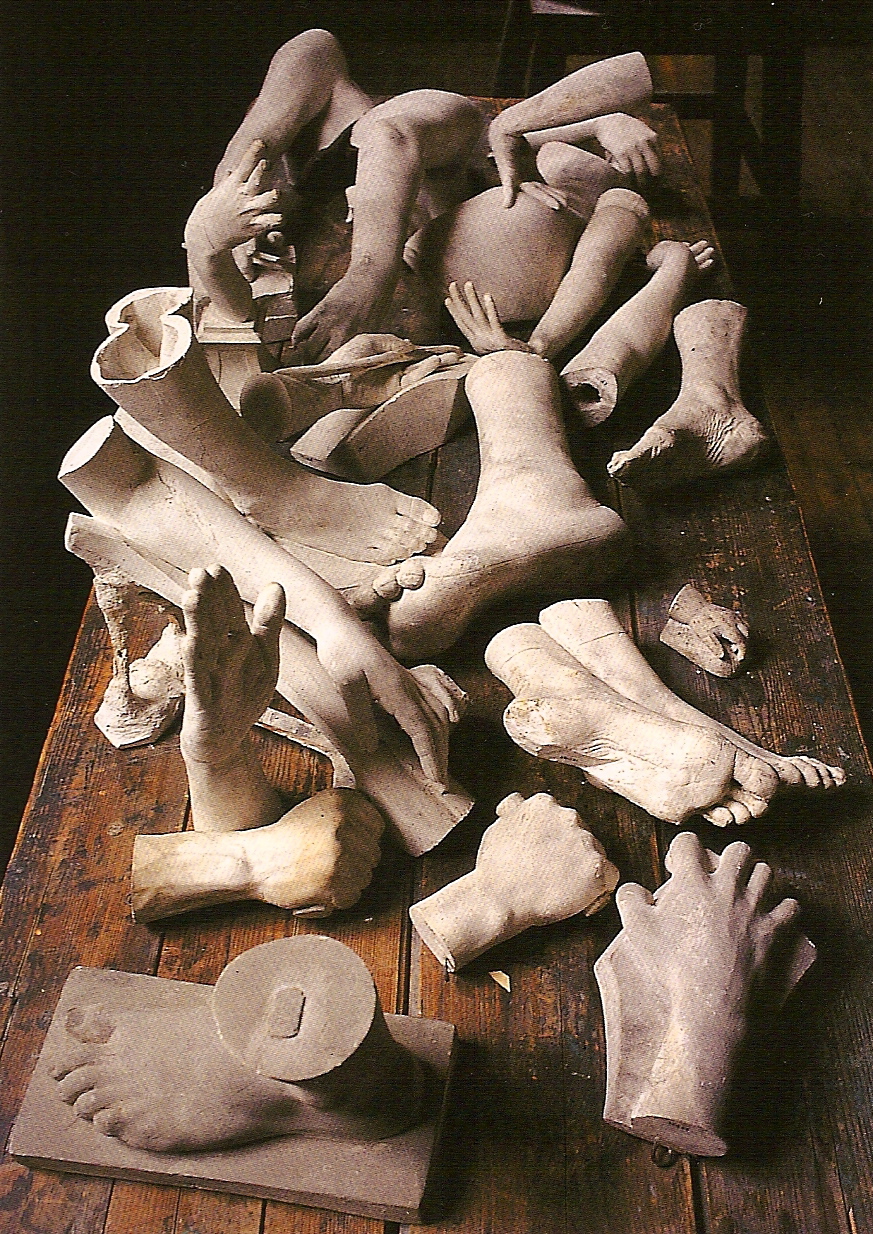
Fourteen hands, and seven human feet (Nineteenth Century) Éecole des Beaux-Arts, Paris
Looking at examples of plaster casts from the book, I was surprised at how many of them were obviously taken from human subjects and not from statues. The catalogue is unclear as to when many of these casts were made and used. Regardless, it is fascinating to see that they went to great lengths to articulate hands and feet in a wide range of challenging positions that were not always quoted from classical forms.
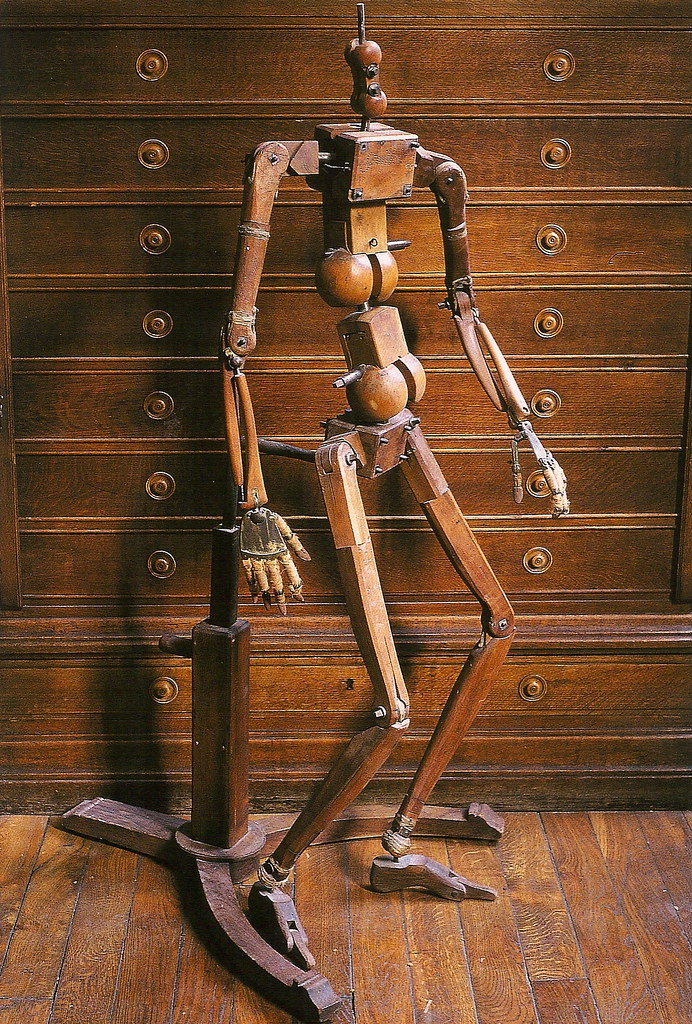
Mannequin d'atelier articulé, fin du XCIII siècle. Signed, "Guillois." École des Beaux-Arts, Paris.
One of the greatest costs in training was the hiring of live models. As a result, contraptions of all kinds–mannequins, photographs, stereoscope images–were made to substitute, or perhaps more accurately, supplement, models.
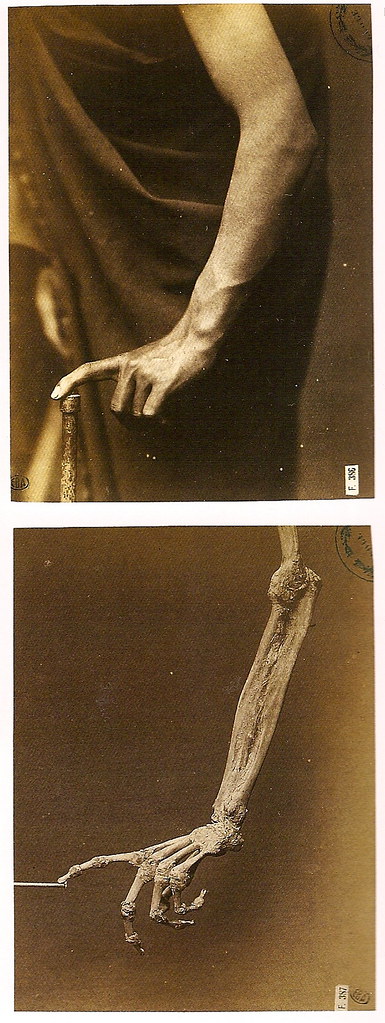
Hermann Heid (Darmstadt, 1834-Vienna, 1891) Étude comparée de la forme d'un avant-bras en pronation et de son squelette (1880) 14 by 10.3; 13.8 by 10.3. École des Beaux-Arts, Paris.
One man at the Ecole des Beaux-Arts, Paul Richer (Chartes, 1849-Paris, 1933) was particularly skilled both as a creator of artist aides and as a sculptor himself.
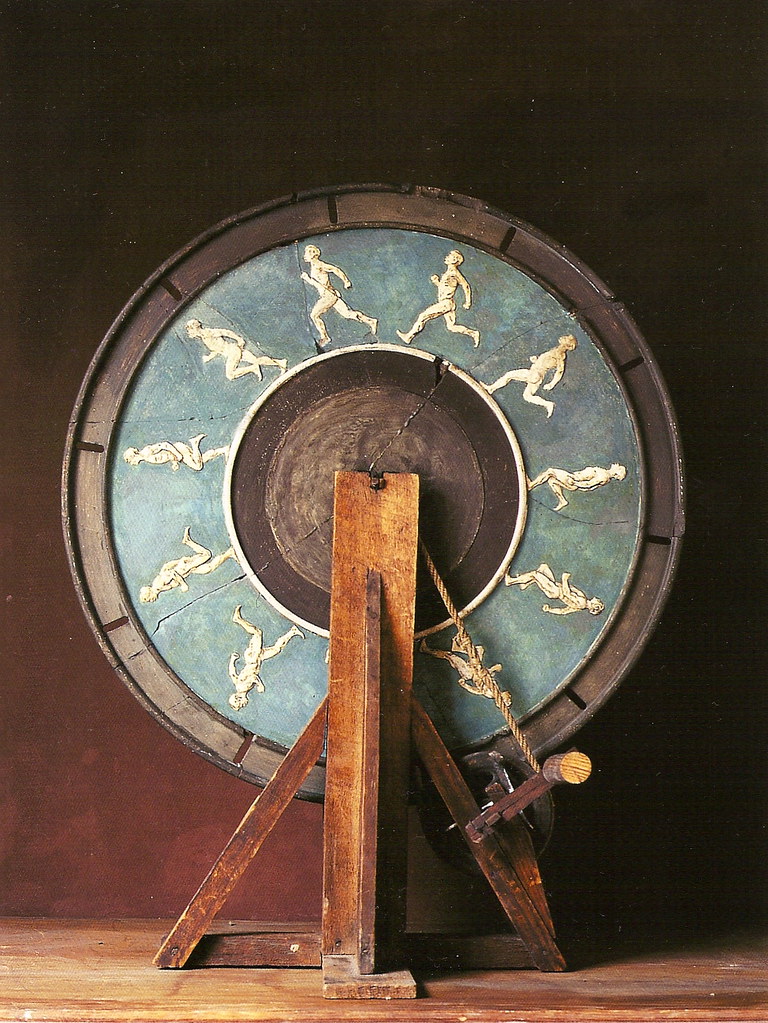
Paul Richer (Chartes, 1849-Paris, 1933) The Runner, phénakistiscope (1895) 70 by 45 by 15 cm. École des Beaux-Arts, Paris.
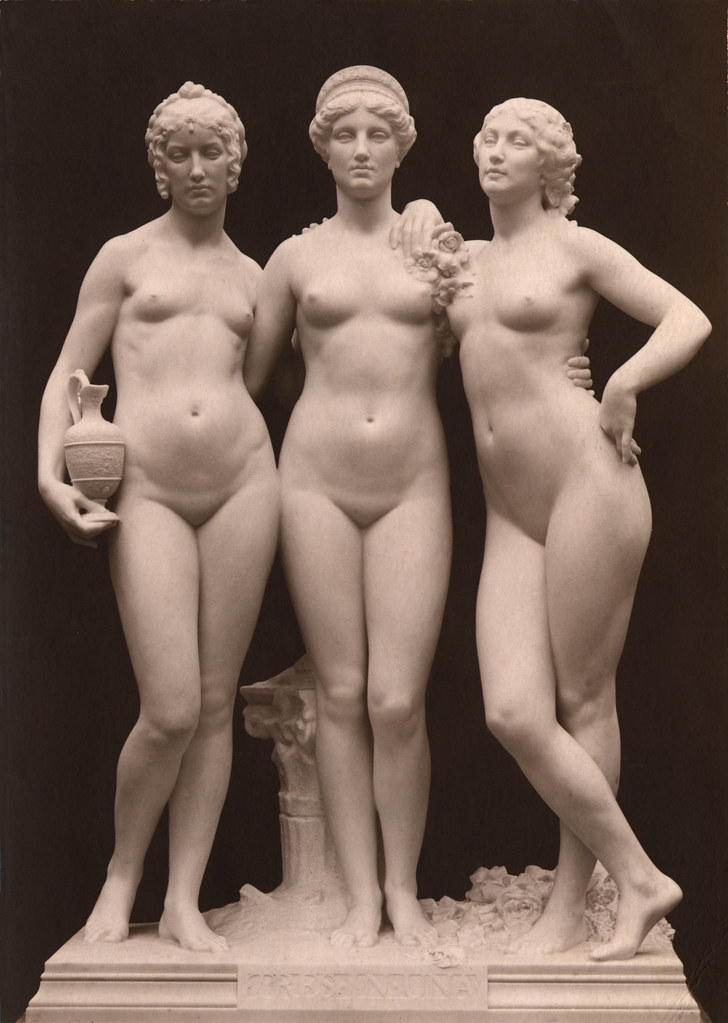
Paul Richer (Chartes, 1849-Paris, 1933) Tres in una (1910) 185 by 124 by 60 cm. École des Beaux-Arts, Paris
His work Tres in Una, above, is a terrific example of the late-nineteenth, early-twentieth century combinations realist and classical approaches to art. There is disappointingly little written about Richer in the catalogue, yet he is clearly one of a rare breed, simultaneaously gifted at educational innovation and a talented artist in his own right. For one, I would love to learn more about him, and hope to.
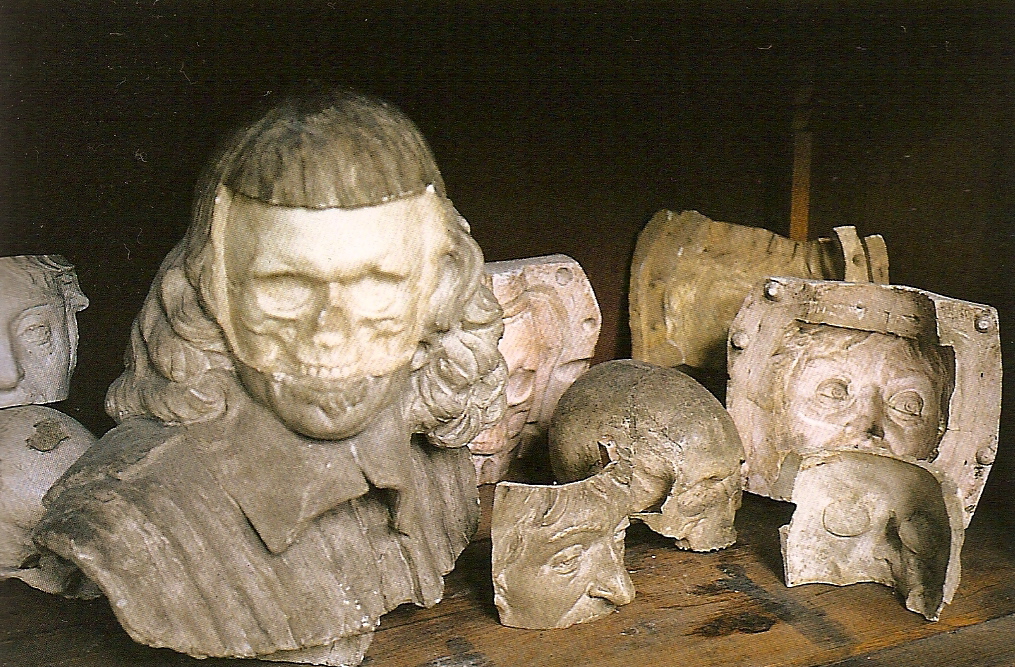
Bust of Decartes, with incorporated skull (1913) Plaster, in three parts. 44 by 27 by 28 cm. École des Beaux-Arts, Paris.
A great deal of the catalogue is dedicated to the anatomical models of animals, especially horses Just as in England, where George Stubbs (British , 1724-1806) led a generation of artists at the Royal Academy to explore and correctly understand the anatomy of horses, the French Academy invested a great deal in equine models.
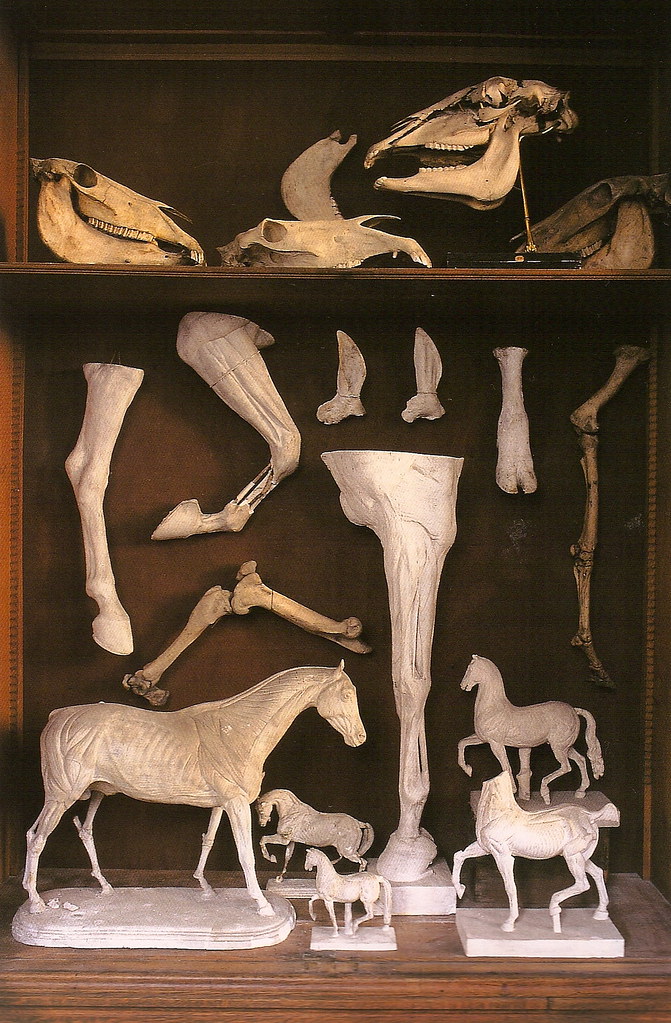
Collection of various horse anotomical constructions and skulls. Galerie Huguier, École des Beaux-Arts, Paris.
One stunning example of an artist using the models is a study of horse legs, below, by Théodore Géricault (Rouen, 1971-Paris, 1824).
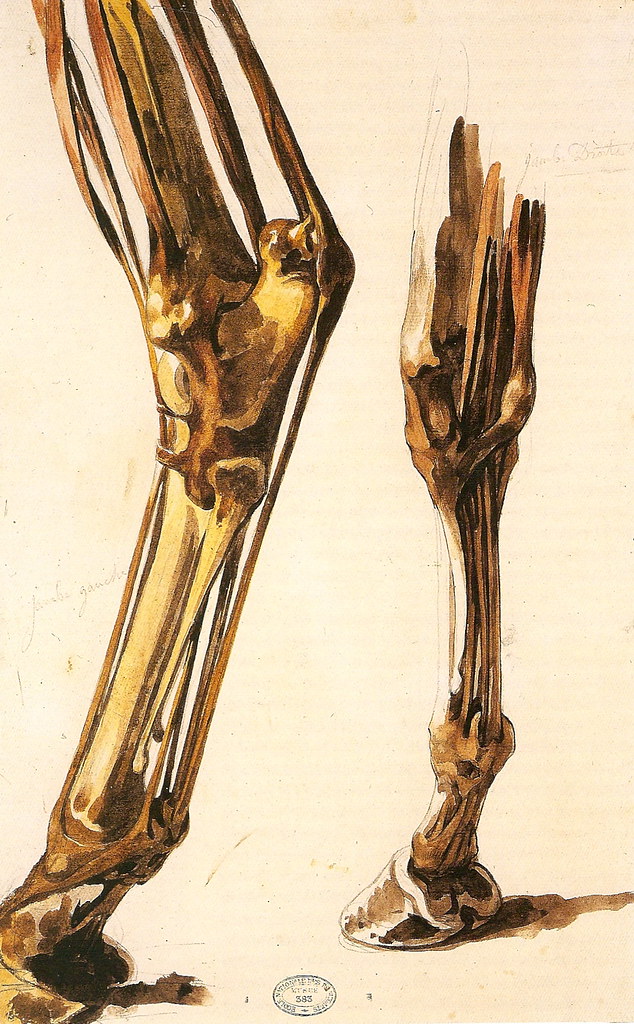
Théodore Géricault (Rouen, 1971-Paris, 1824) Étude de membres postérieur et antérieur de cheval, écorchés. (1815) Pen, brown crayon and watercolor. 43.5 by 26.8 cm.
This catalogue makes it possible to comprehend the lengths to which artists would go to learn their craft. For me, it is both an inspiration and a reminder of how much we can learn from them.
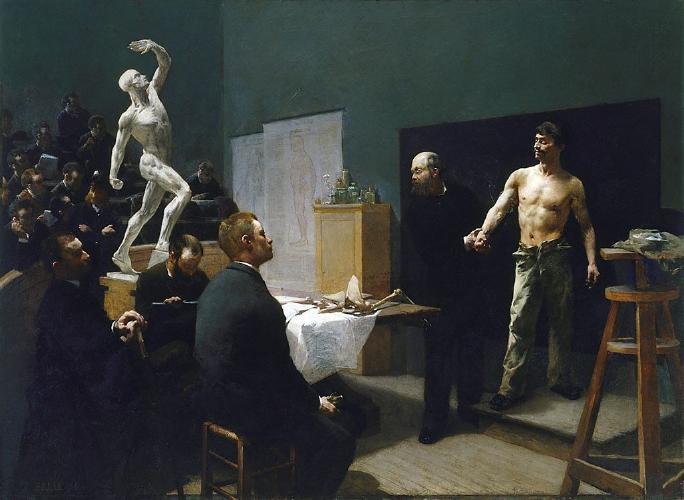
François Sallé (France, 1839-1899) The anatomy class at the Ecole des Beaux Arts (1888) Oil on canvas. 218 by 299 cm. Art Gallery of New South Wales, Sidney.
Three Paintings by Anthony Van Dyck (Flemish, 1599-1641) for Christmas
When Anthony Van Dyck (Flemish, 1599-1641) made these three paintings, he was between 19 and 20 years old. All three were owned by Peter Paul Rubens (Flemish, 1577-1640), and were bought from his collection by the Spanish royal family after Rubens’ death. That Rubens had them in his private collection says a great deal about his admiration for Van Dyck. Rubens was 12 years older than Van Dyck and had hired him to work as his chief assistant in his studio. “Assistant” doesn’t do enough justice to Van Dyck, who was young but extremely competent. Even today, scholars have a difficult time distinguishing between the two artists’ work during the period they worked together.

Anthony Van Dyck (Flemish, 1599-1641) The Capture of Christ or Judas' Kiss (c. 1618-1620) Oil on canvas. 344 cm x 249 cm. Prado Museum, Madrid.
In this first work, Christ is betrayed by Judas, who leads a crowd of Suducees and Pharisees (i.e. member of the ruling Jewish priesthood) to take Christ into custody. Christ had just offered his interceding prayer in the Garden of Gethsemane, while three faithful apostles (Peter, James and John) had fallen asleep keeping watch.
Van Dyck brilliantly creates a torrent of action swooping in towards Christ, the only figure with two feet on the ground, effectively stopping the large crowd by himself. The contrasting patches of dark and light, red and black create an emotional upheaval. It’s an unsettling painting, and, with figures at almost real-life proportions, imposing.
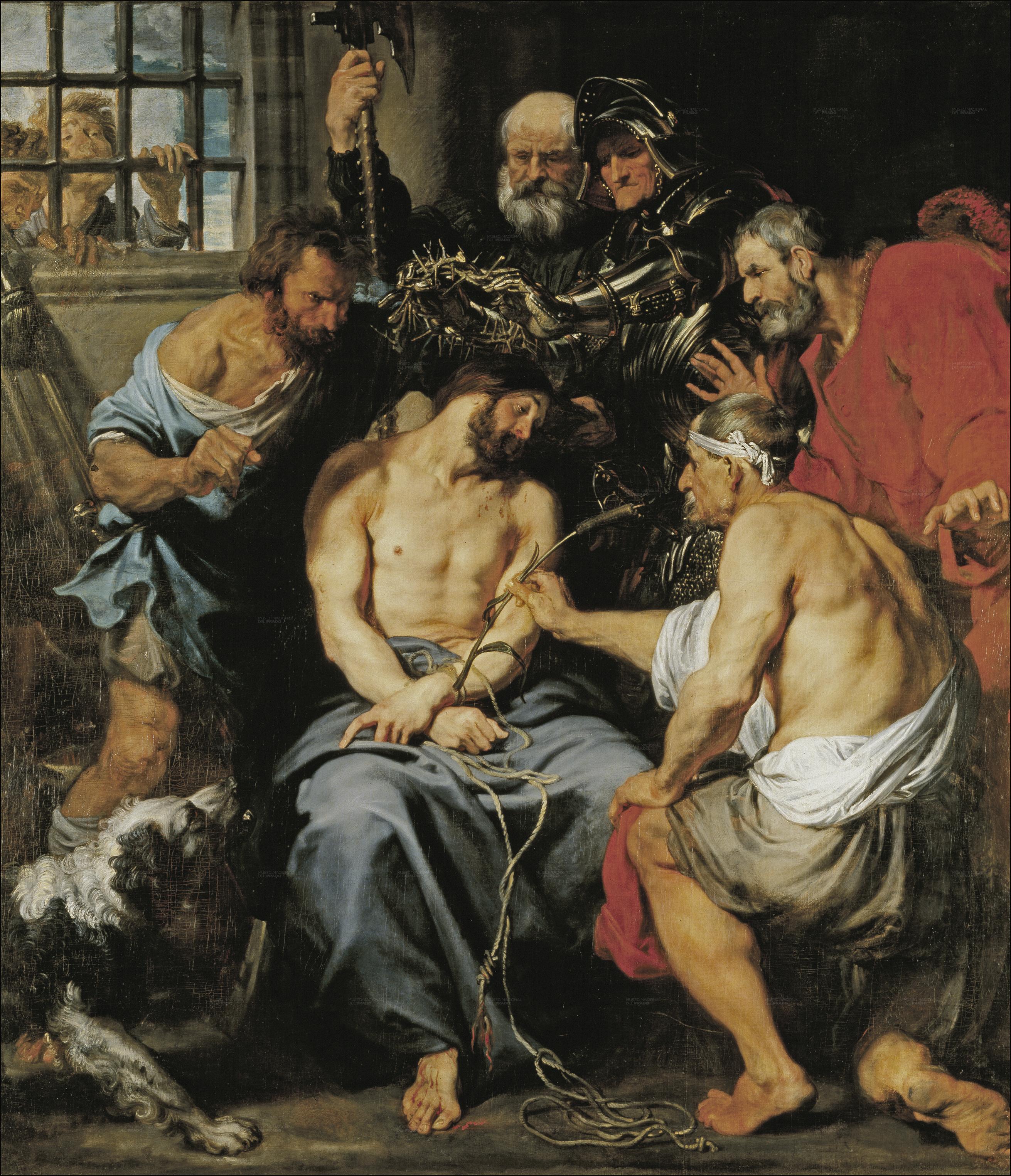
Anthony Van Dyck (Flemish, 1599-1641) Crowning Christ with Thorns (c. 1618-1620) Oil on canvas. 224 cm x 197 cm. Prado Museum, Madrid.
Looking at this painting, its hard to know whether you are in the prison, and therefore an accomplice, or, like the figures in the top left of the painting, looking through a window. In either case, you have a front-and-center view of the scene. Christ is being crowned with thorns by Roman soldiers.
Van Dyck uses an astounding arsenal–especially given his young age–for his cast of characters. Armor, dog fur, the weakened, pale skin of Christ, the young, healthy skin of the Roman soldiers, wood, sky, rope . . . up close (click on the image for a much larger version) and in person, the brushwork is incredibely varied and the pallet rich.
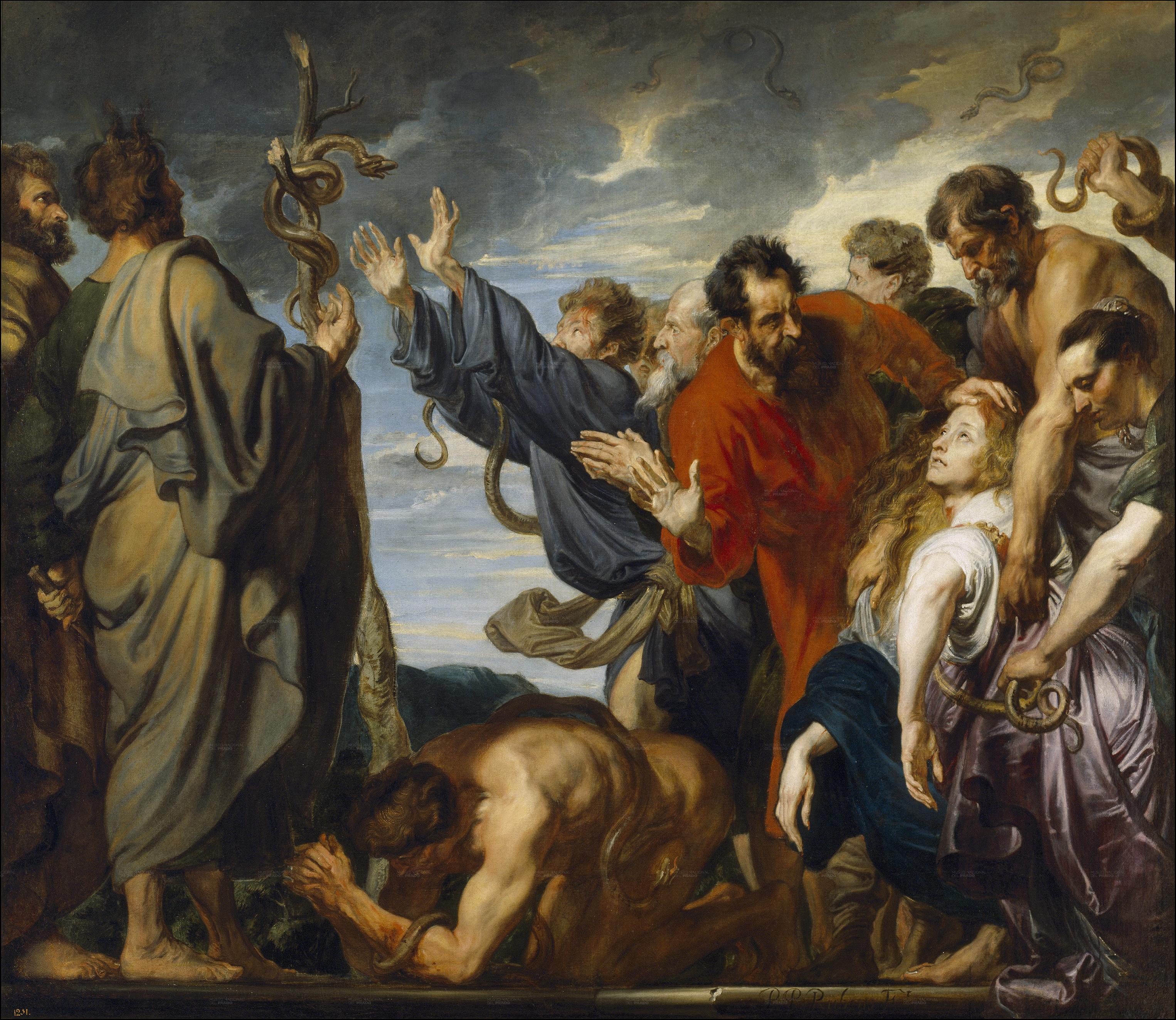
Anthony Van Dyck (Flemish, 1599-1641) The Brass Serpents (c. 1618-120) Oil on canvas. 205 cm x 235 cm . Prado Museum, Madrid.
Though not overtly Christian to us today, this painting would have been an obvious reference to Christ’s saving role. It depicts a story from Number chapter 21 in the Bible. Jehovah sent poisonous sepents among the Israelites, and many were bitten. He then commanded Moses to create a brass serpent and put it on a pole. Any person who would look at the brass serpent would be instantly healed. Many did not look, and died. According to the book of John chapter 3 verse 14: “And as Moses lifted up the serpent in the wilderness, even so must the Son of Man be lifted up.”
Van Dyck painted this for a very Bible-literate audience that would have understood the reference to Christ. All three of these paintings hang in the same room, but separately, at the Prado Museum, but I don’t know if there were meant to hang together. Sometimes I wish The Brass Serpents were hung to the right of the The Capture of Christ. The symmetry and dates of the three makes me wonder if they were meant to be together, perhaps with the Crowning of Christ with Thorns in between.
In any case, have a wonderful Christmas.
Eve After the Fall by Eugène Delaplanche (French, 1831-1892)
Lately, I have been looking at my collection of images by theme, grouping Biblical and mythological subjects in categories. (It becomes helpful to have these groupings, which would normally not be seen in museums, when giving lectures or teaching children.) It was while piecing together my images of Eve that I found several photos I had taken of Eugène Delaplanche’s (French, 1831-1892) work Eve After the Fall (1869).
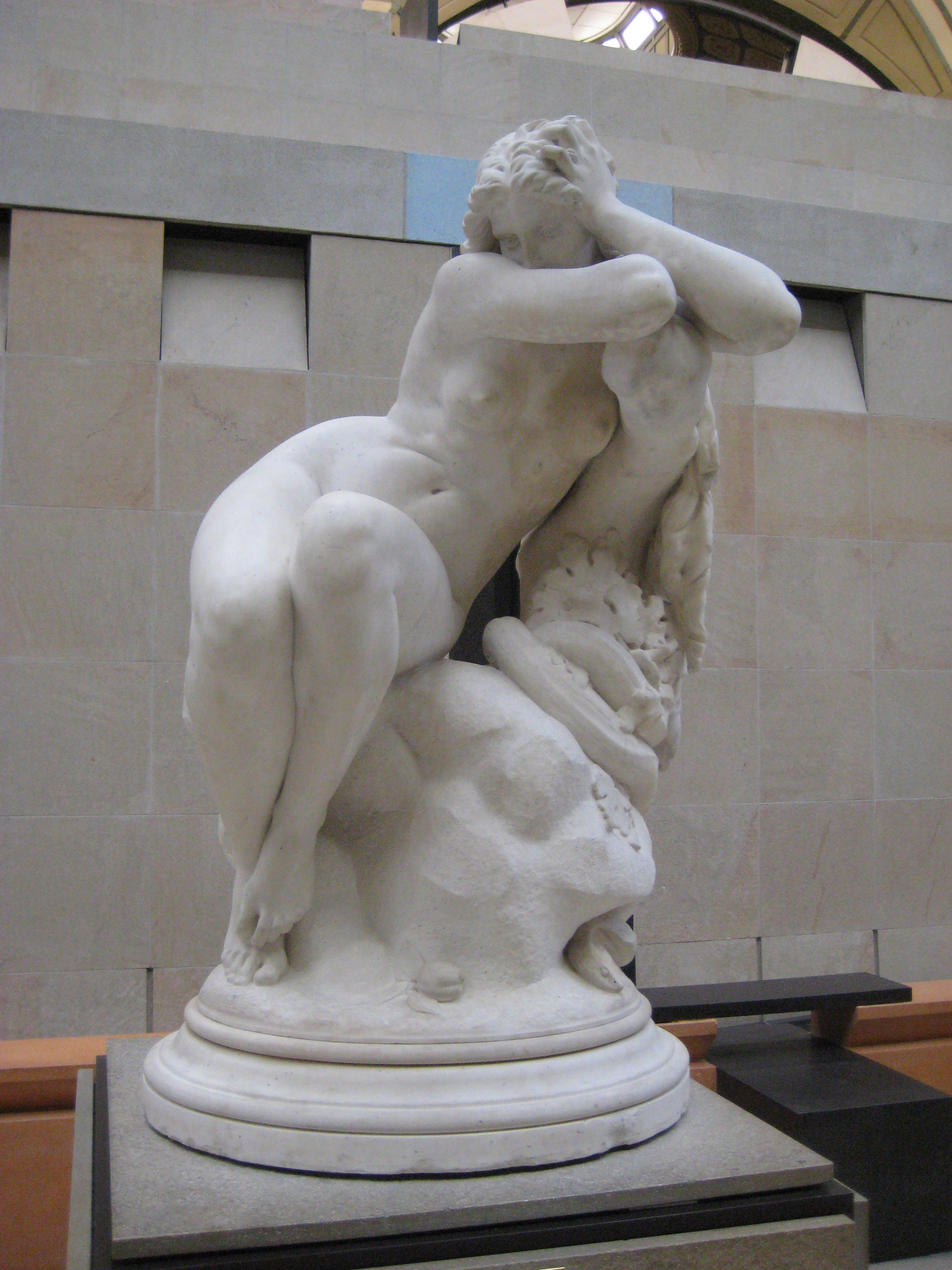
Eugène Delaplanche (French, 1831-1892) Eve After the Fall (1869) Marble. Musée d'Orsay, Paris.
I will never forget the first time I saw it, years ago, at the Musée d’Orsay. Although I was familiar with Eve’s eating of the forbidden fruit and her subsequent expulsion from Eden, I had never considered her feelings and, especially, the moment of realization she must have had after eating the Forbidden Fruit. The sculpture filled me with sympathy for Eve and remorse for my own bad decisions in life. Only great art can do that.
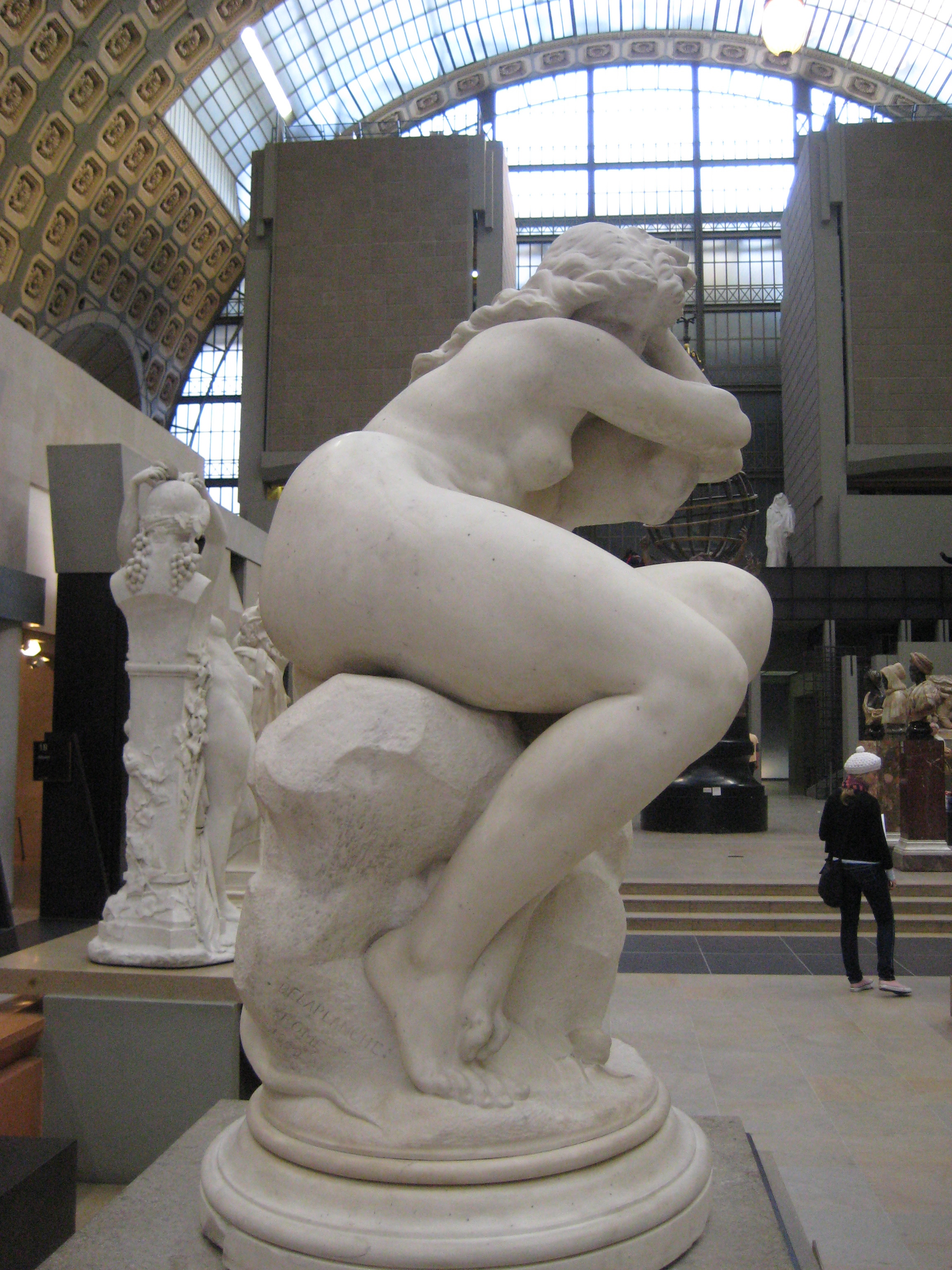
Eugène Delaplanche (French, 1831-1892) Eve After the Fall (1869) Marble. Musée d'Orsay, Paris (Side View)
Delaplanche studied under the neoclassical sculptor Francisque Joseph Duret (French, 1804-1865) . In 1864, Delaplanche was awarded the Prix de Rome and, subsequently, went to Italy where he studied Greco-Roman works and the sculptures of Michaelangelo and Bernini. He returned to Paris with an approach his work that combined classical idealism with natural forms. The result in Eve After the Fall (1869), done shortly after returning from Rome, is almost Hellenistic, but much larger in scale than most Greek statues.

Eugène Delaplanche (French, 1831-1892) Eve After the Fall (1869) Marble. Musée d'Orsay, Paris. (From Behind)
Eve is beautiful, yet forceful. Her features are idealized, yet her figure, almost drawn into a fetal position from horror, is sinuous, organic.
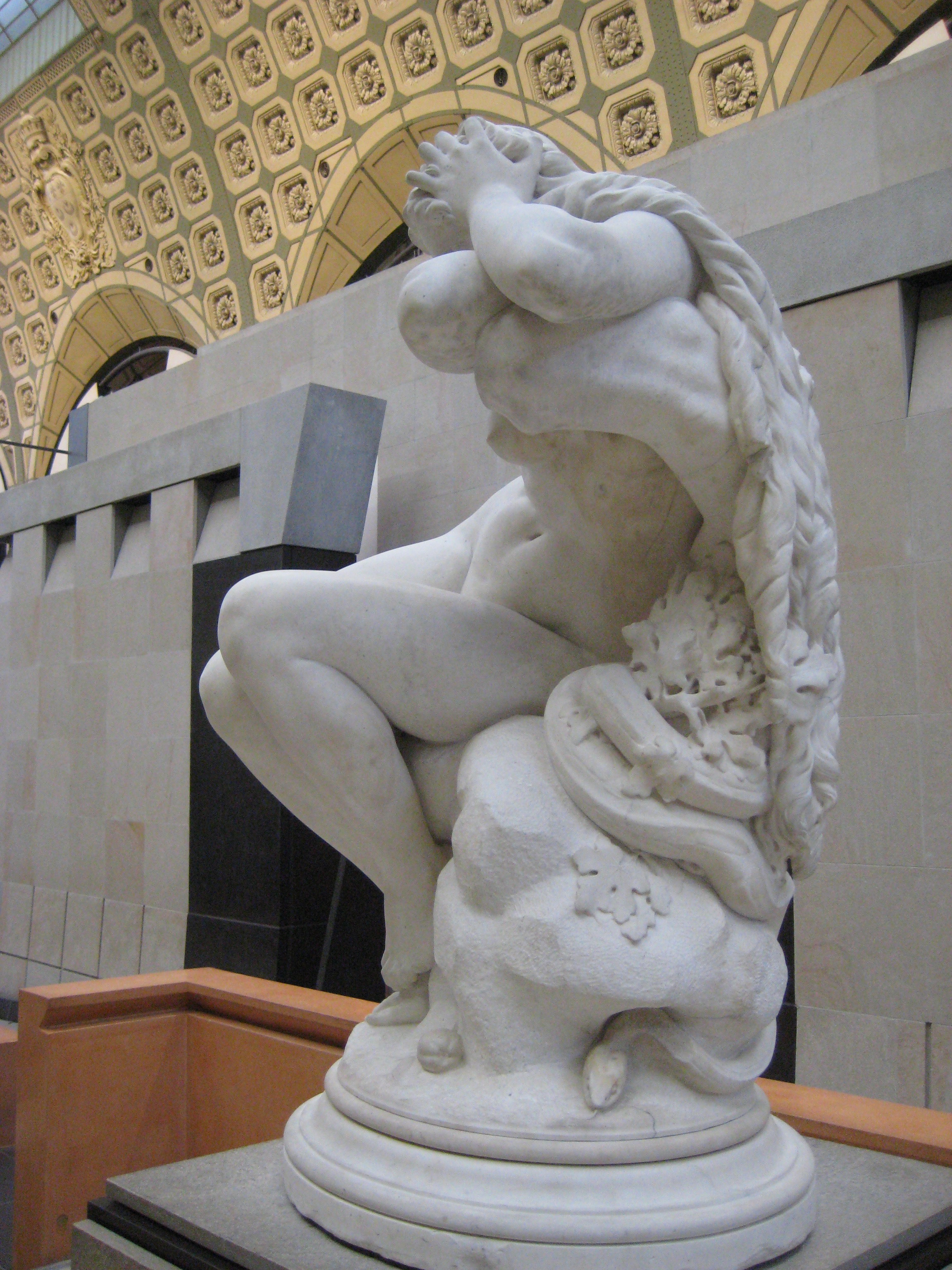
Eugène Delaplanche (French, 1831-1892) Eve After the Fall (1869) Marble. Musée d'Orsay, Paris (Side View)
All of the elements of the story are here: the discarded, bitten fruit from the Tree o Life, the serpent coiled around the tree, and Eve, full of horror and realization of her transgression.
Eugène Delaplanche (French, 1831-1892) Eve After the Fall (1869) Marble. Musée d'Orsay, Paris (Detail of Eyes)
Delaplanche went on to do a number of works and recieved a number of prizes. Unfortunately, like many of his contemporary sculptors and unlike many contemporary painters, little has been written about his work and life.
Drawing Is Not the Only Way to Paint (e.g. Velázquez)
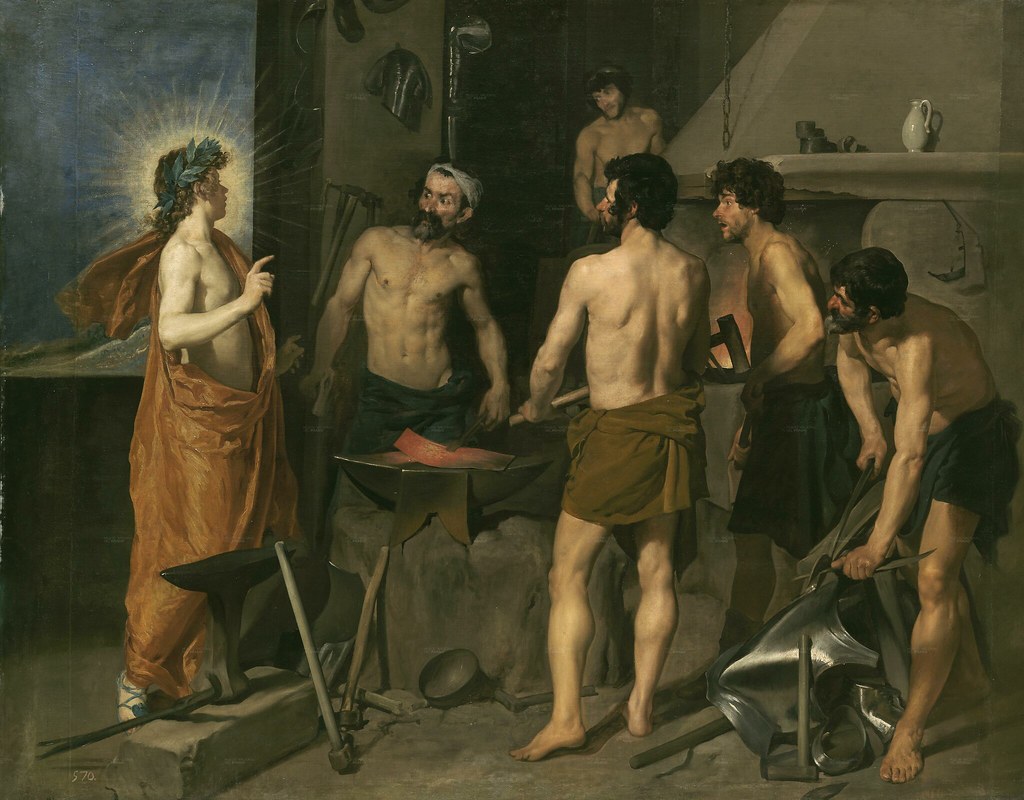
Diego Rodríguez de Silva y Velázquez (Spanish, 1599-1660) The Forge of Vulcan (1630) Oil on canvas. 230 BY 290CM. Prado Museum, Madrid. (Click image for larger version)
In several of my posts, I have pressed the importance of drawing. But it is important to know that not all the greats drew. One artist, in particular, who did not was Diego Rodríguez de Silva y Velázquez (Spanish, 1599-1660). Simply known as “Velázquez,” he was the greatest painter in the history of Spain and admired everywhere by academic and non-academic painters alike.
As mentioned in a previous post, Leon Bonnat, who became Director of the Ecole des Beaux Arts, regularly sent his students to Mardrid to study Velázquez’s works. Thomas Eakins said he was the “greatest painter who ever lived.” Painters as diverse as Millet, Manet, Sargent, Degas, Courbet, and Whistler admired and studied Velázquez’s paintings. They alll may have been surprised to learn what modern technology has taught us about Velázquez’s working method.
We know of only about 100 paintings by Veláquez, 45 of which are kept in the Prado Museum in Madrid. There, they have undergone chemical analysis of his pigments and a barrage of tests to show what lies under the paint. In the book Velázquez: The Technique of a Genius, Jonathan Brown and Carmen Garrido publish some of these findings.
Velázquez does not seem to have started with a fixed idea for a composition, but rather preferred to see what happened as he worked, making adjustments as he painted . . . The contours of figures overlap as their position in the composition changes or as elements are added or subtracted. Even within the forms of individual figures changes can be observed. The positions of hands and sleeves are adjusted, collars and lace are shifted, as are other parts of costume.
Landscape and neutral interior backgrounds were added, generally speaking, after the contours of the figures had been established.
(Jonathan Broan and Carmen Garrido, Velazquez: Technique of a Genius. (New Haven and London: Yale University Press, 1998), p. 18.)
One of my favorite paintings by Velázquez, The Forge of Vulcan, is a good example of this improvisational approach. Originally, the head of Vulcan, the older man in the left-hand side of the painting, was turned away from Apollo.
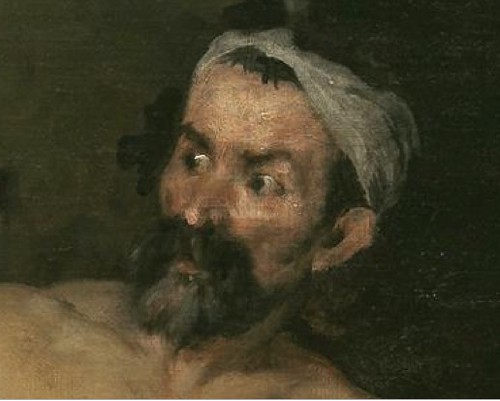
Diego Rodríguez de Silva y Velázquez (Spanish, 1599-1660) The Forge of Vulcan, detail. (1630) Oil on canvas. 230 BY 290CM. Prado Museum, Madrid.
To the left of Vulcan’s head, we can see a dark patch of brown paint where the back of his head used to be. In addition to this change, Velázquez enlarged the canvas. Over time, the pieces that were glued on became separated from the original piece and lines on the left and right of the canvas have become visible (See the first image.)
Not having drawn out the composition before hand, Velázquez created more work for himself. At the same time, it allowed him to go where his creativity led.
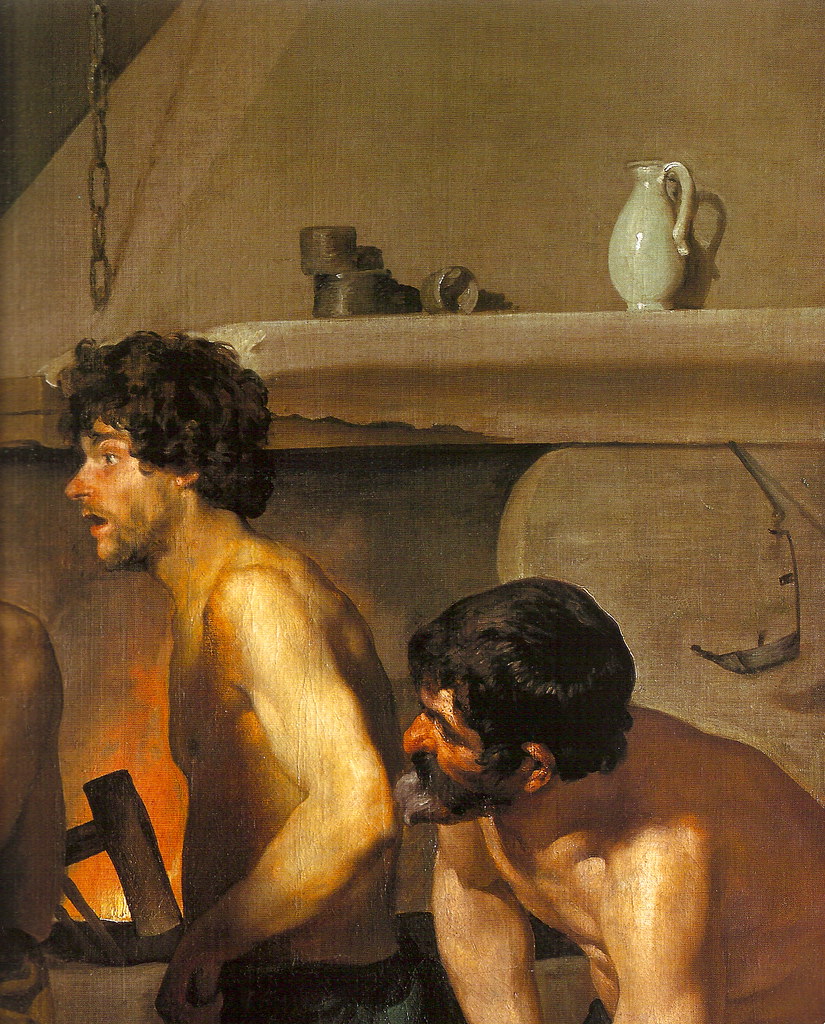
Diego Rodríguez de Silva y Velázquez (Spanish, 1599-1660) The Forge of Vulcan, detail. (1630) Oil on canvas. 230 BY 290CM. Prado Museum, Madrid. (Click image for larger version)
The results are stunning.
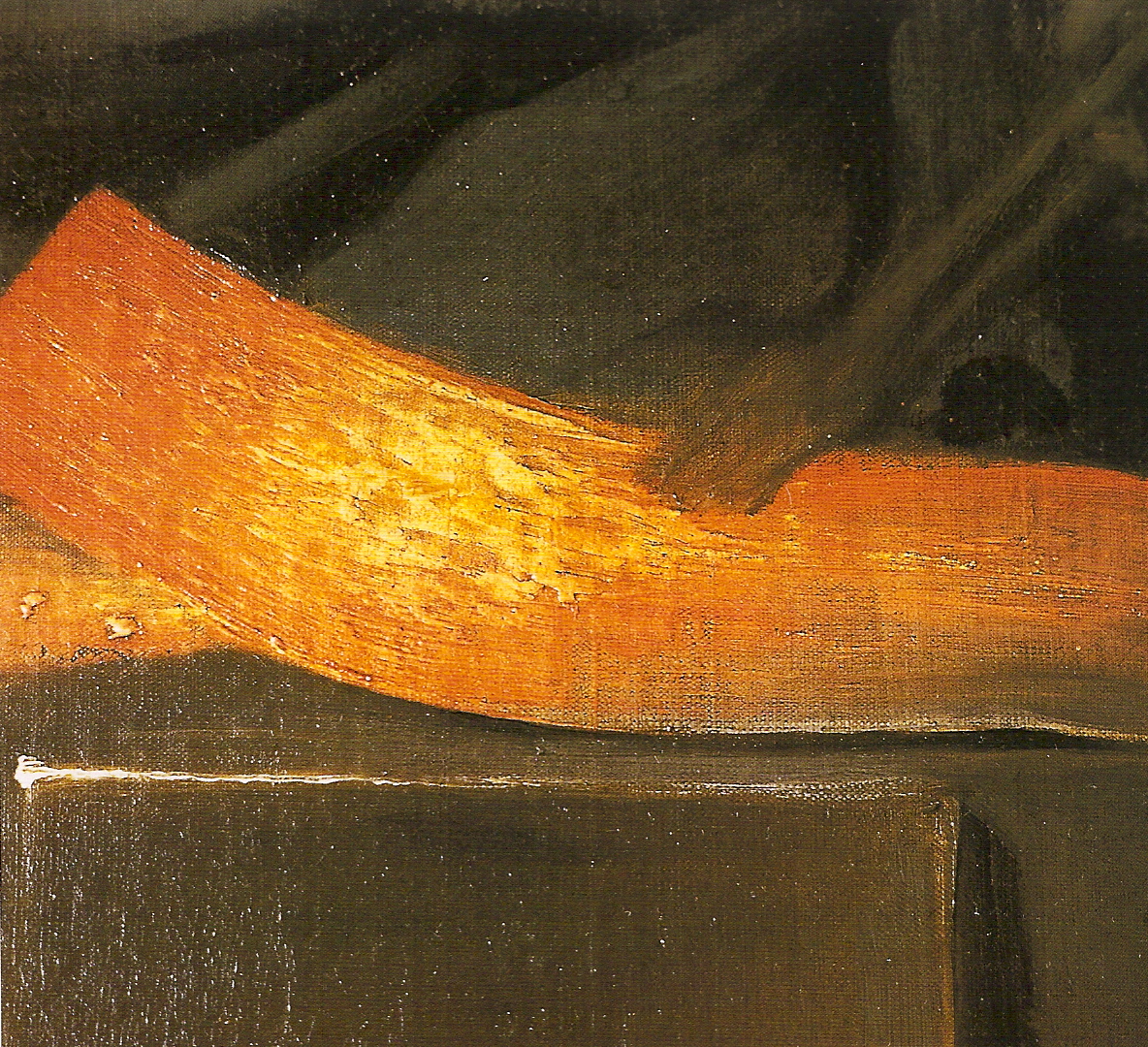
Diego Rodríguez de Silva y Velázquez (Spanish, 1599-1660) The Forge of Vulcan, detail. (1630) Oil on canvas. 230 BY 290CM. Prado Museum, Madrid. (Click image for larger version)
Obviously, drawing isn’t everything.
A Rediscovered Archive of Spanish Drawings: The Academia de San Fernando de Bellas Artes in Madrid
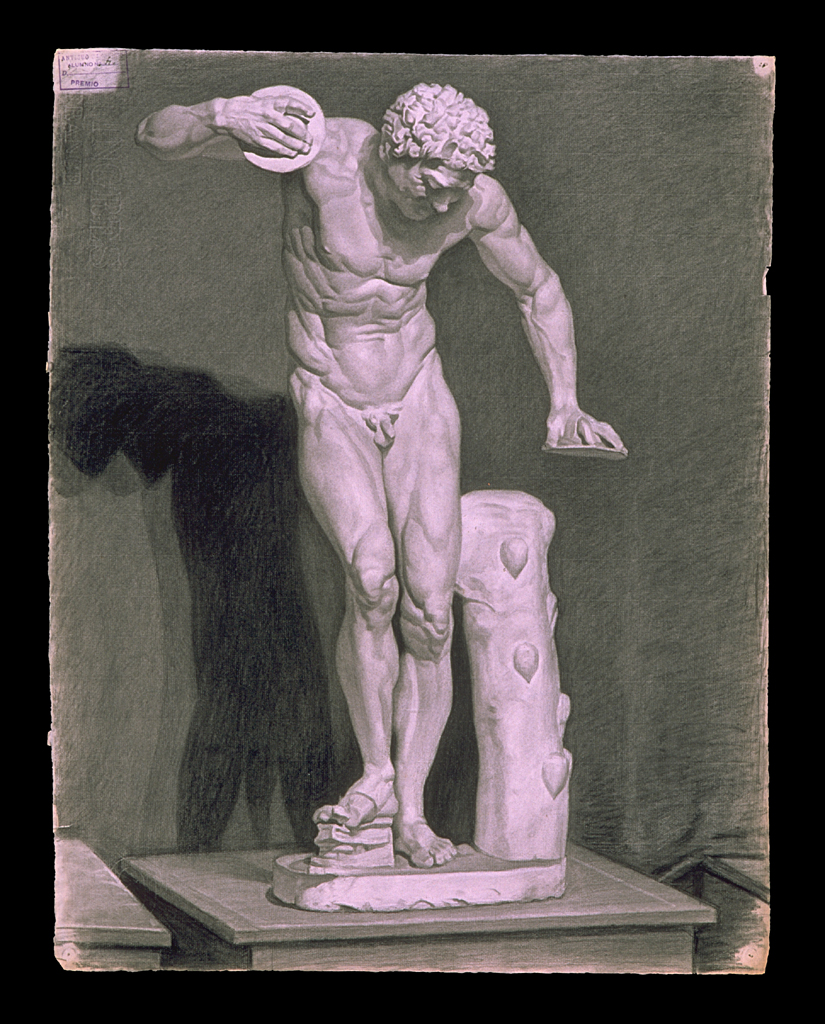
Anonymous (Spanish, c. 1870) Satyr with his cymbals or Sátiro tocando los platillos. Graphite on paper. 61.6 BY 48.3CM. Colección de Bellas Artes, Universidad Complutense, Madrid.
(All of the drawings in this post are by eighteenth and nineteenth-century students of the Academia de San Fernando. I am extemely grateful for the help of the brilliant Angeles Vian Herrero, Director of the Library of the Facultad de Bellas Artes of the Universidad Cumplutense in Madrid. These and many more drawings are available at a new website she has created for them. For larger versions of each image in this post, please click each work.)
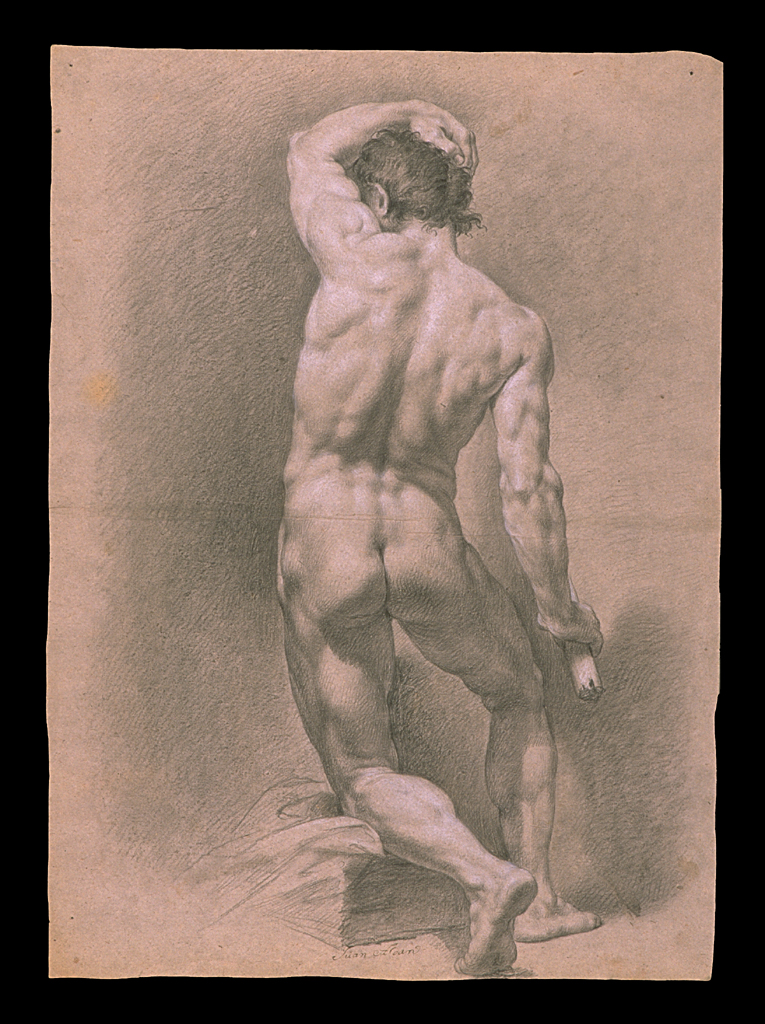
Juan Adán Morlán (Spanish) Desnudo masculino de espaldas con una pierna apoyada en un escalón. (a. 1741-1816) Pencil and pastel on paper, 54.4 BY 39.3CM. Colección de Bellas Artes, Universidad Complutense, Madrid.
Anonymous (Spanish). Colección de Bellas Artes, Universidad Complutense, Madrid.
Nineteenth-century art academies all over Europe used drawing as the foundation for art education. As I have noted before on this blog, Jean-Dominique Auguste Ingres (French, 1780-1867), once said “Over three quarters of what constitutes painting is comprised of drawing. If I had to put a sign above my door I would write: ‘School of drawing,’ and I’m sure that I would produce painters.” (It was not until the mid-1860s that oil painting was taught at the Ecole des Beaux-Arts, where Ingres had been the director from 1825-1841. His approach to artist training was adopted in Spain’s most important school for artists, the Academia de San Fernando de Bellas Artes in Madrid.
Anonymous (Spanish). Colección de Bellas Artes, Universidad Complutense, Madrid.
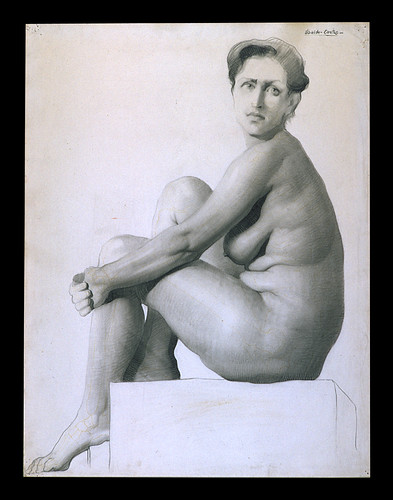
Anonymous (Spanish, c. 1850) Study of nude female. Graphite on paper. Colección de Bellas Artes, Universidad Complutense, Madrid.
The Academia de San Fernando de Bellas Artes was founded in 1752. Based in Madrid, it was one of several art academies in Spain (other cities with academies included Barcelona, Valencia, Zaragosa, and Seville). By the mid-nineteenth century, the Academia de San Fernando had become the dominant art academy in Spain and the model for art education throughout the country.
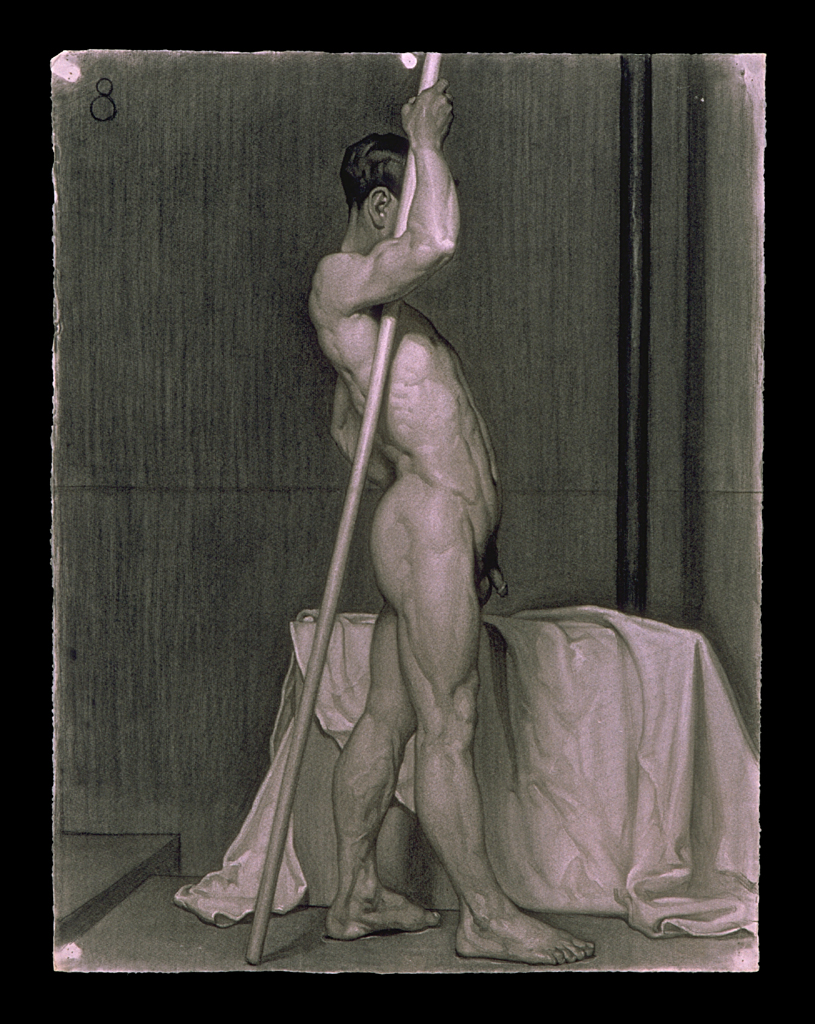
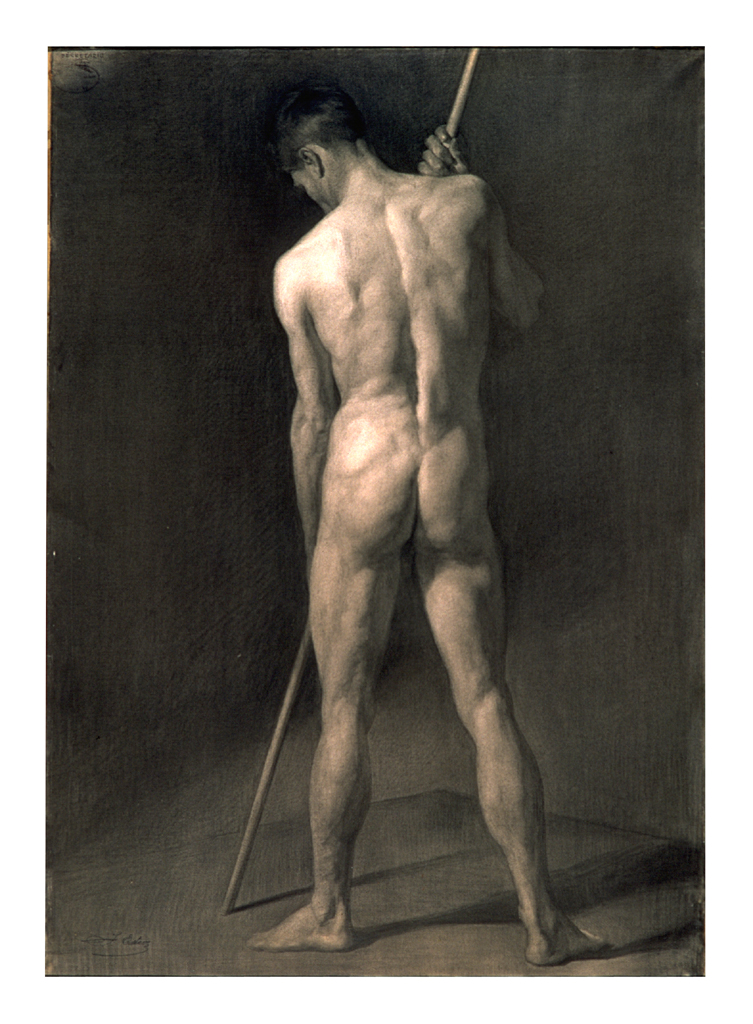
Anonymous (Spanish, c. 1890) Desnudo masculino en pie y de perfil apoyado en una vara. Graphite and pastel on paper. 61.9 BY 47.9CM. Colección de Bellas Artes, Universidad Complutense, Madrid.
The Academia de San Fernando, founded in 1751, was heavily influenced by French-trained artists. One family in particular, the Madrazos, dominated the Academia de San Fernando for most of the nineteenth century. José de Madrazo (Spanish, 1781-1859), court painter for Ferdinand VII, was sent to Paris to study with Jacques-Louis David (French, 1748-1825). José’s son, Francisco de Madrazo y Kuntz (Sapnish, 1815-1894) was trained by Jean-August Dominique Ingres (French, 1780-1867) in Rome, and would serve as the Academia de San Fernando’s director from 1866 to 1894. José’s other son, Pedro (Spanish, 1816-1898), was the director of the Prado Museum, as well as a prominent art critic. All three were influential in setting standards and tastes for the Academia.
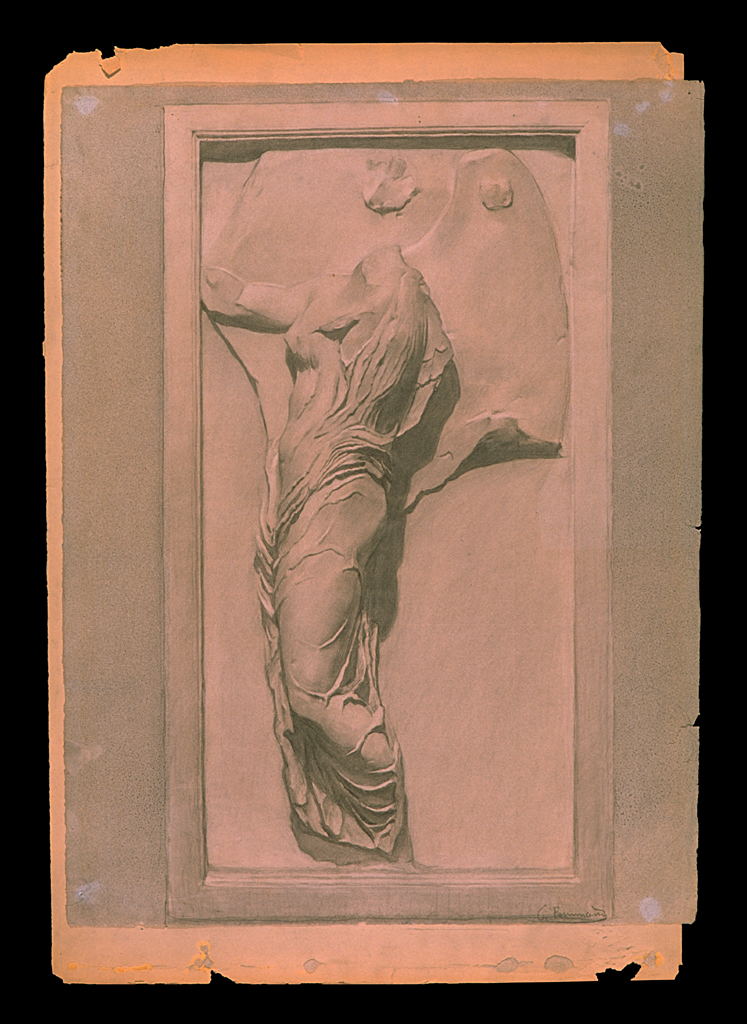
G. Ponman (Spanish) Female figure from a Greek Relief Sculpture or Figura femenina (copia de un relieve griego). Pencil and pastel on paper. 62.9 BY 47.7CM. Colección de Bellas Artes, Universidad Complutense, Madrid.
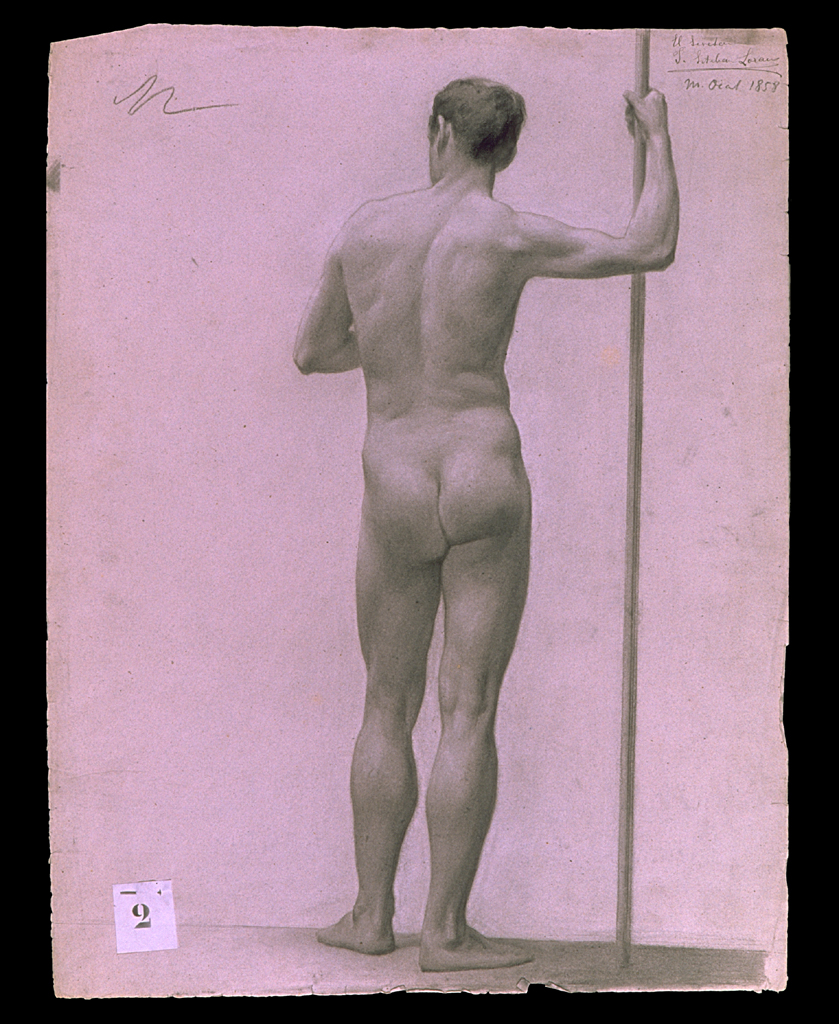
Miguel Ocal (Spanish) Desnudo masculino de espladas y en pie apoyado en una vara (1858) Graphite on paper. 61.4 BY 47.4CM. Colección de Bellas Artes, Universidad Complutense, Madrid.
As in Paris, students in Madrid’s arts academy studied, on average, for four years. Some went on to receive scholarships and study at the Spanish School in Rome. (Established in 1873, the Spanish sent winners of an annual competition on the equivalent of the French Prix de Rome.) Students at the Academia began by drawing from castes of isolated portions of statues. Then, they were allowed to study from full statues of classical origins, either from castes made of the Spanish Royal collection or from collections in Rome or Paris. Advanced students, were allowed to study from live models, who were often placed in the poses of classical statuary or from scenes in Old Master paintings. As the century progressed, classical poses increasingly gave way to more natural poses and depictions of the human figure.

Anonymous (Spanish). Colección de Bellas Artes, Universidad Complutense, Madrid.

Miguel González de La Peña (Spanish) Desnudo masculino sentado sobre volúmenes en forma piramidal con la cara hundida entre las manos. Graphite on paper. 62.2 BY 48CM. Colección de Bellas Artes, Universidad Complutense, Madrid.
The majority of the works featured here are of nude men. This is because, in nineteenth-century Spain, there were strong cultural taboos against female nudity, even classical nudes. As a result, Spanish artists privately hired female models for their studio work as opposed to using them in official schools.

Anonymous (Spanish). Colección de Bellas Artes, Universidad Complutense, Madrid.
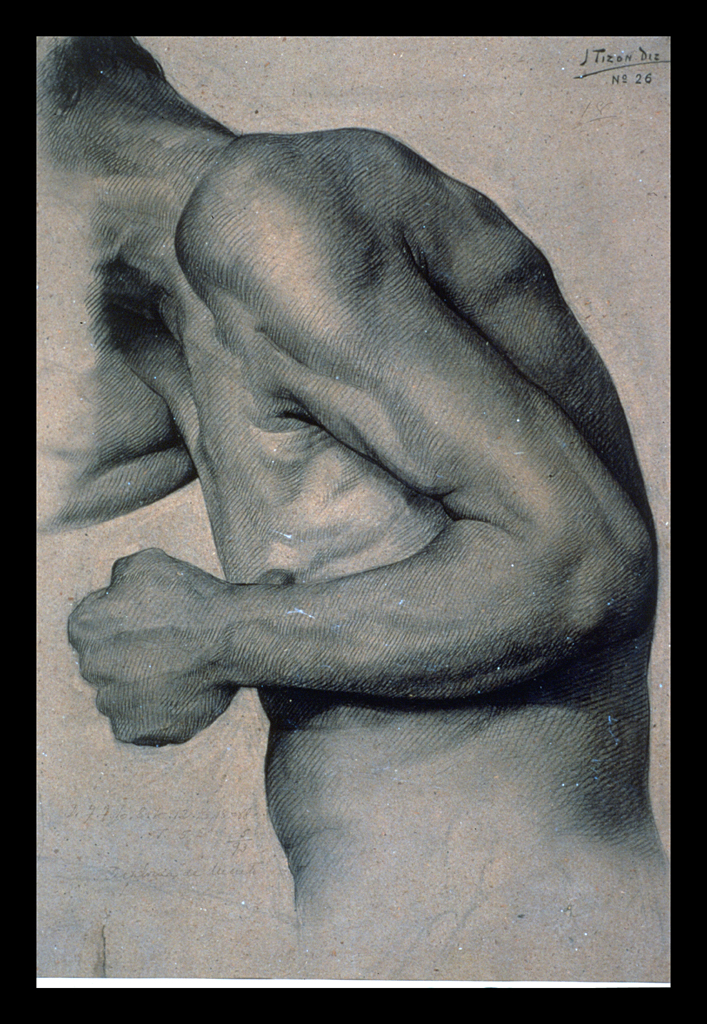
Some of the works perserved in archives are anatomy studies. Many of theses seem to be copied from books while other appear to be made from looking at live models and perceiving underlying muscle and bone structure. This is interesting because models were expensive. Using them for anatomical studies shows how important the Academia considered these studies.
Consider a Contrast: Young Contemporary British Artist versus Nineteenth-Century Academic Student
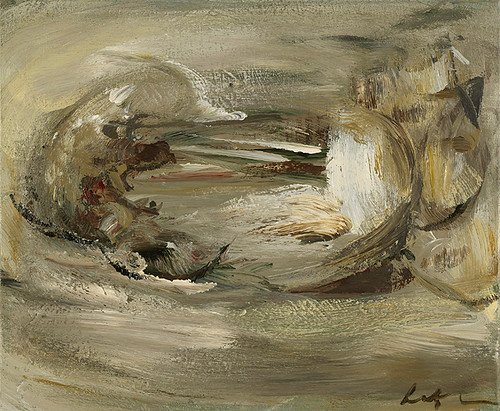
Katy Moran (British, 1975) Volestere (2007) Oil on canvas. Currently on view at the Andrea Rosen Gallery, London.
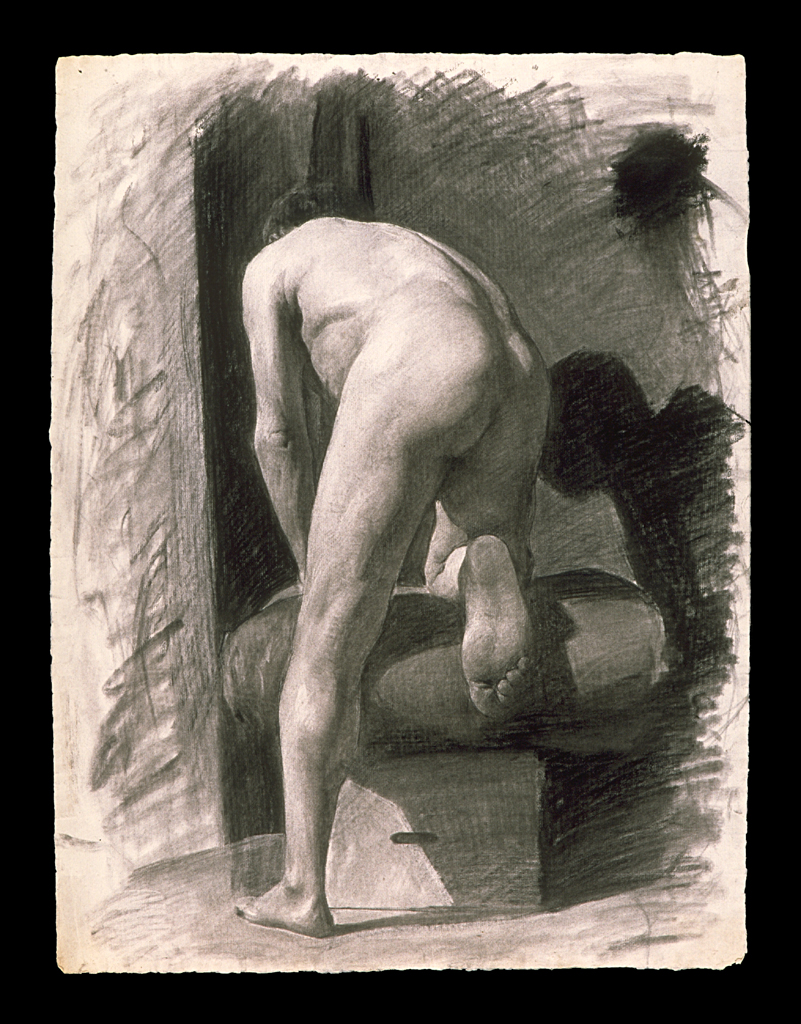
Anonymous (Spanish, c. 1890) Study of an Adult Male. Chalk on paper. La Facultad de Bellas Artes, Universidad Complutense, Madrid. Created as part of student exercises at the Spanish School in Rome.
Today, I was looking through a collection of nineteenth-century Spanish Academic drawings–which I will explore at greater length in my next post–when I decided to take a break and read today’s Financial Times. In its “Collecting” section, the newspaper features the work of two “prodigious young British artists who capture the fractured experience of comtemporary life.” The contrast between the two sets of artists, nineteenth-century Spanish students and young contemporary British artists, could not be greater.
In her article “The P-Word,” critic Jackie Wullschlager writes about the painting Strange Solutions by Katy Moran (British, 1975), saying: “Vestiges of landscape or portrait forms persist alluringly. I detected a thick, snowy avenue . . . which briefly reminded me of Monet, and a human figure is suggested in deft gestural outline at the heart of the rococo brushwork . . .”
If art is a medium of communication and the artist is the communicator, then we are either playing a very poor game of telephone with Moran or the artist hopes that, like Navajo codebreakers, critics will interpret what they mean. For her part, Wullschlager will not commit to any ideas or feelings inspired by the work; not even being sure as to whether or not the works are portraits or landscapes. Instead she says it “reminds” or “suggests” something. I could go on, but my point, unlike the artists’ intent, is clear: this does not communicate, it confuses.
By comparison, the skills being taught to the Spanish student who created the “Study of an Adult Male,” are steeped in a tradition of clear communication. The artist is learning the vocabulary of the human figure, its structure and its range of motion. As a result, this artist will be able to place the figure in a wide array of narratives.
Much has been written about nineteenth-century academic training. For the most part, Modern to Contemporary artists and art historians dismissed the Academy and its strict teaching as oppressive to creative abilities and limited in its ability to communicate. As a result, they regularly discuss the Academy as if it were Goliath and the Impressionsists were David. All who followed David’s example of opposing the Academy were numbered among the Chosen People and all others were, by comparison, Philistines. But, I ask, is this evident in the fruits of either philosophy? Which generation of young artist seems more limited in its ability to communicate?
As my father often says, “Art is personal.” Personally, I am more stimulated and provoked to deeper thought and feeling by clear communication than by vague suggestions.
Feriarte 2008: Visiting Spain’s Largest Annual Art Fair
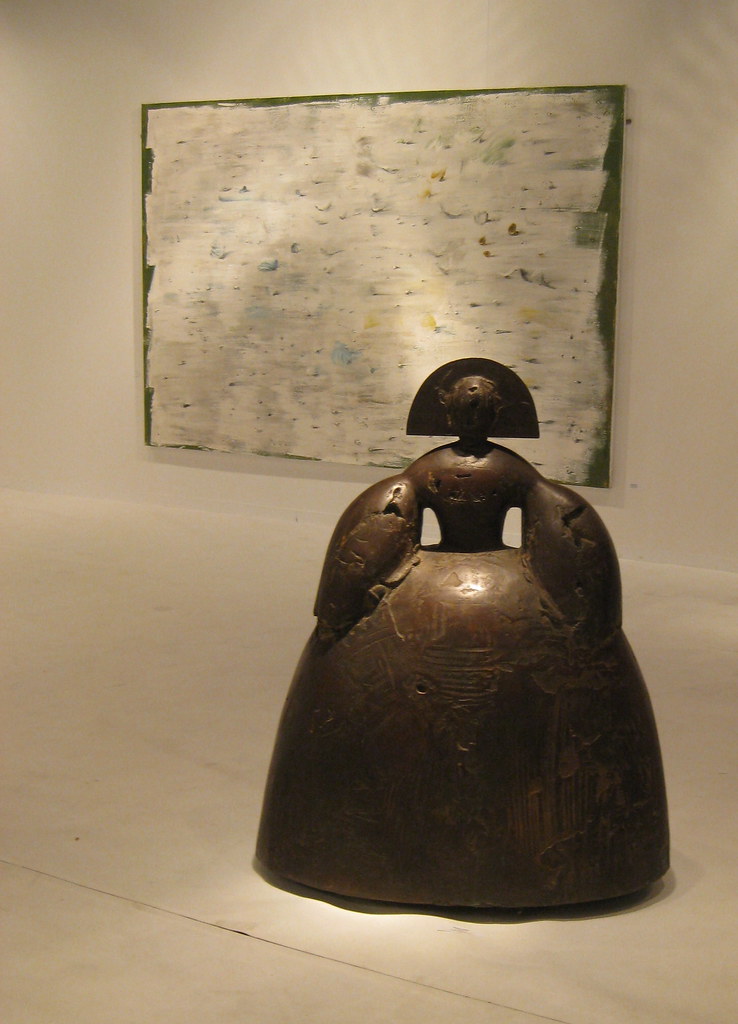
Manolo Valdés (Spanish, 1942) Infanta Margarita (2002) Bronze. 123 BY 100 BY 70 CM. Dealer: Francesc Llopis, Barcelona. In this work, Valdés quotes from a portrait of Infanta Margarit by the seventeenth-century Spanish painter Diego Velázquez.
According to Victor Bardia, Feriarte is Europe’s largest annual Fine & Decorative Art fair. Bardia is one of the event’s principal organizers. I met him and his son, David Bardia, at their gallery, Victor I Fills, during my last trip to Madrid. At that time, Bardia extended an invitation for me to return for the Fair. I’m grateful he did.
I’ve been to a number of fairs over the years and was skeptical Spain’s fair could be larger than others. If it was, I assumed, it must be of lesser quality. Having walked at a casual pace for three hours, I thought I had seen all there was only to pass through a door that revealed another space, filled with more exhibitors and larger than the last. In total, I spent nearly eight hours on my feet, talking with dealers and collectors. For the most part, I was impressed by the quality of pieces, which were at least comparable, and often superior, to those of other fairs like Olympia or BADA in London.
Each dealer I met, with the exception of one–a German gallery that specialized in Russian and German turn-of-the-century art–was based in Spain. The majority of exhibitors had galleries in Madrid, Barcelona or both. Works at the fair, which ran from November 15 to 23, were overwhelmingly Spanish, or from former Spanish territories (e.g. The Netherlands, Naples) with small but impressive selection of works by Italian artists. There was a surprising dearth of Latin American and other foreign works of art, perhaps reflecting a lack of foreign buyers at this year’s fair.
More than one dealer told me that compared to previous years, visitors were down by one half or two thirds. These are difficult times for art fairs and dealers. In other words, it was a buyers market. I was often surprised by low prices for objects and paintings that, less than a year ago, I had seen at much higher prices in the same galleries. For the occasion, dealers were bringing out their best pieces. The quantity of works was astounding–an art historian’s dream.

Pere Borrell del Caso (Italian, 1835-1910) Two Laughing Girls (1880) Oil on canvas. 69 BY 69CM. Dealer: Gothsland, Barcelona.
Two Laughing Girls by Borrell is a wonderful example of the kind of academic painting taught and practiced in late-nineteenth century Rome. Though Paris was undeniably the center of the art world a number of painters work and studied in the Eternal City.
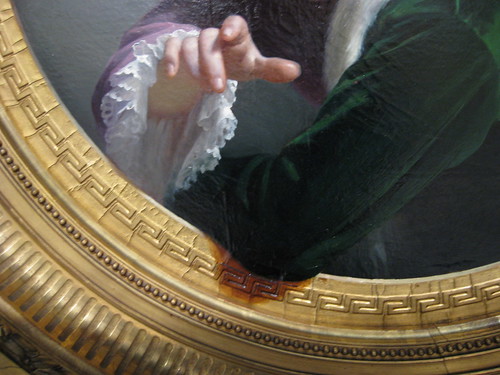
Pere Borrell del Caso (Italian, 1835-1910) Two Laughing Girls (1880) Oil on canvas. 69 BY 69CM. Dealer: Gothsland, Barcelona. DETAIL.
Borrell brilliantly draws the girls into our space by incorporating ornamentation from the neoclassical frame into the painting. The last two centimeters of the canvas are a combination of gesso and gold leaf over which he has painted one the two girls leaning her elbow on a Greek key patterned frieze. Seeing the piece, I wondered if Borrell had seen works by Dutch painters like Gerrit Dou, a contemporary of Rembrandt, who played similar visual tricks with his canvases.
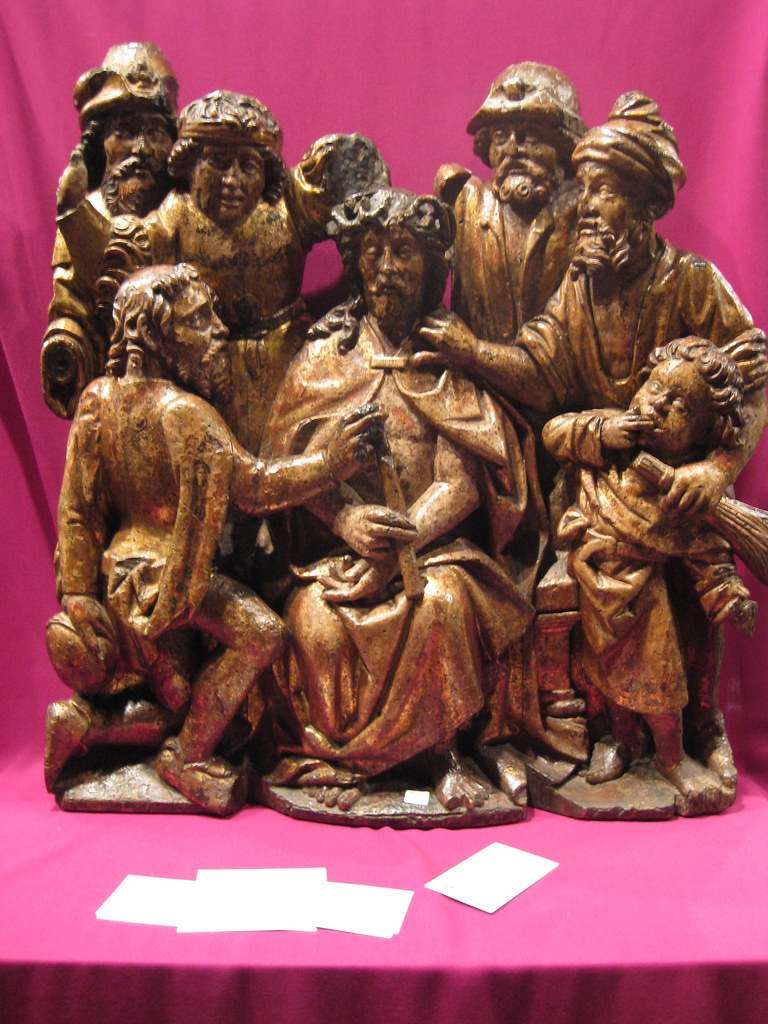
Christ crowned with thorns (Spanish, Sixteenth Century) Pine with gesso and gold. Dealer: Alcora Antiguedades, Madrid.
With so many religious works, at times the fair seemed like a destination for pilgrims. God, the Virgin, and Saints were everywhere, covered in gesso, gold and pastel-colored oil paints. A number of the exhibitor’s stall were set up as small houses of worship, with some even burning incense.
Spanish pieces like Christ crowned with thorns reflect skills brought the country by workmen from the Netherlands. Through the fifteenth and sixteenth centuries, The Netherlands were Spanish territory. A number of Netherlandish artists moved to Spain, infusing a northern realism–as opposed to classical idealism–into Spanish sculpture and painting.
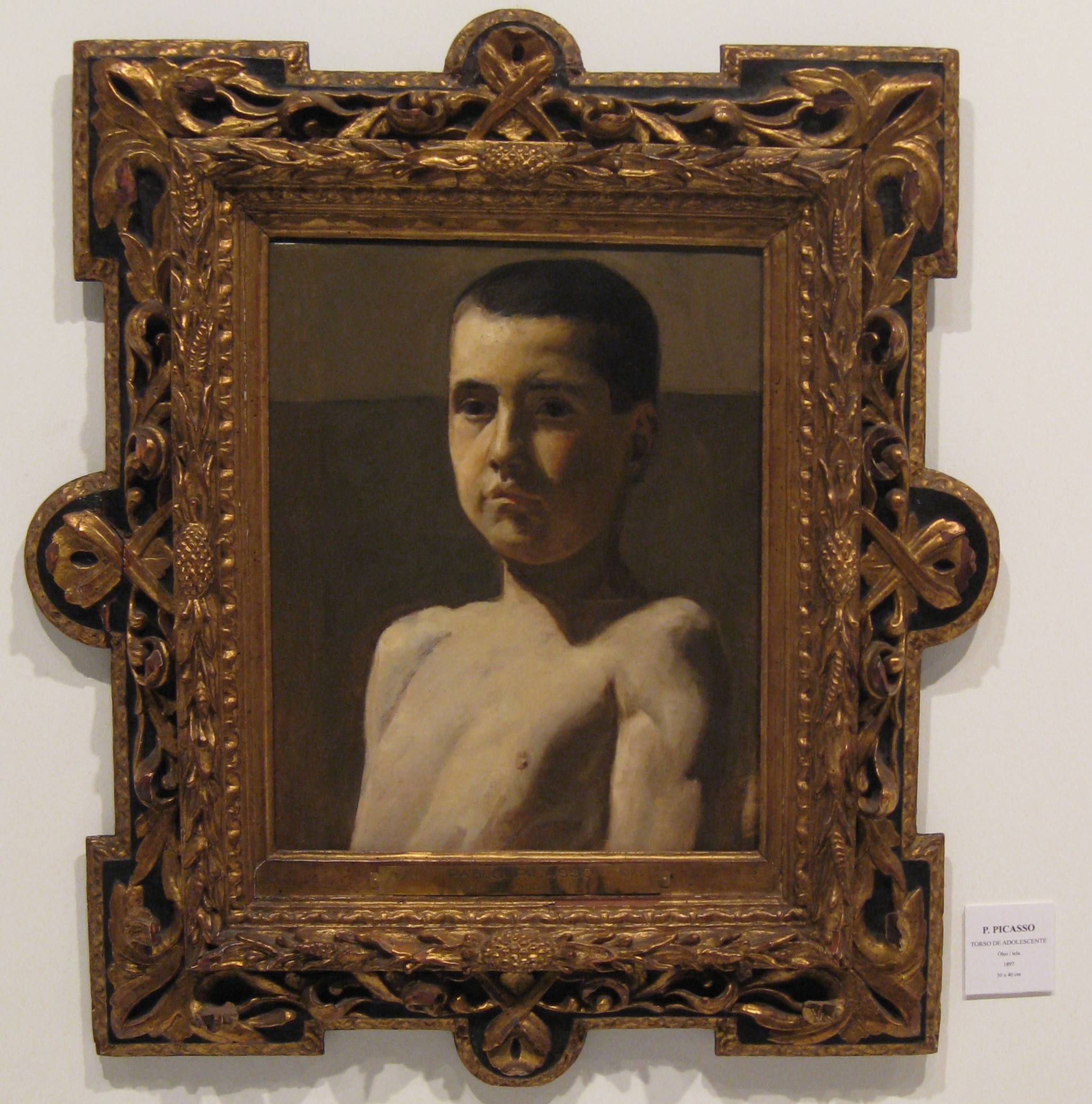
Pablo Picasso (Spanish, 1881-1973 ) Torso of a Young Man (1897) Oil on canvas. 50 BY 40CM. Dealer: Gomez Turu Gallery, Barcelona.
Having made his name in abstract painting and Cubism, some people are surprised to learn that Picasso was trained as an Academic painter. He studeid at the academy in Barcelona, where he produced a number of figure studies in charcoal and a few oil paintings. Some can be seen as the Picasso Museum, installed in his former home in Barcelona. His ability to accurately render the human figure, especially in chalk, is impressive.
I was surprised to see one of his academic oils available at the fair. The work is evidence of his early propensity towards breaking down objects into basic forms. The shadows in Torso of a Young Man are sharp, clearly delineating muscles and separating the figure from its background. To me, the head and the body appear to belong to different figures, which is, perhaps, a choice or, more likely, a reflection of his inexperience. (He was only sixteen when it was painted.)

A Roman Youth (Rome, First Century AD) White Marble.
Once overseen by Julius Caesar and the birthplace of the Emperor Hadrian, Spain was one of of Rome’s most important provinces. Besides the obvious inheritance of a Latin language, Spain retained a number of Roman works of art and architecture. A few Feriarte stalls were dedicated exclusively to ancient sculpture and architectural pieces (e.g. fountains, doorways).
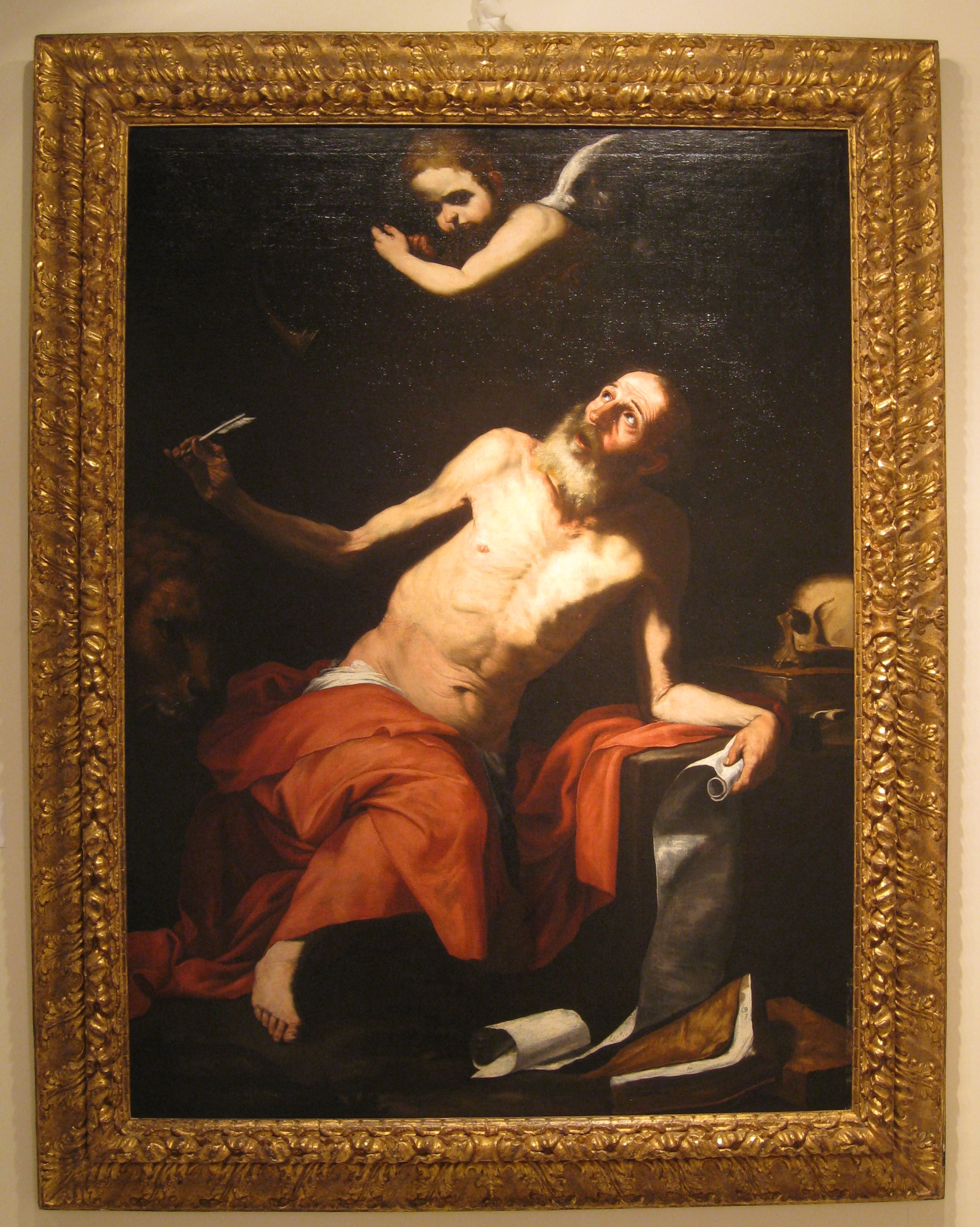
José de Ribera (Spanish, 1591-1656) Saint Jerome hearing the trumpet of the Final Judgement (c. 1630) Oil on canvas. 176.5 BY 129.5CM. Dealder: Artemisia, Madrid.
It’s not every day that a Ribera could be yours. Considered one of Spain’s greatest painters, Ribera’s oeuvre is represented in nearly every major European museum. Ribera was born in Valencia but moved to Naples, which was a Spanish territory at the time. Naples was home to a number of influence painters, such as Giordano and Caravaggio, who established a taste for religious paintings with earthy, realistic people.
Many of Ribera’s works are contemplative with figures deep in thought or asleep. In this, he has captured a fleeting moment, when the Saint receives his assurance of a place in heaven. Saint Jerome, a fifth-century compiler of the Bible, was a favorite subject of Ribera. (Maybe it would be more accurate to say Ribera’s patrons loved the way he painted Jerome, making it a regular request.) I’ve seen perhaps eight versions of Saint Jerome by the painter. I was particularly taken by the brilliant light in this one. The arrival of the angel above Jerome’s head brings light on the elderly man’s torso. Up close, his chest and belly are a soup of oily paint that, despite their fluidity, are convincincly skin like.
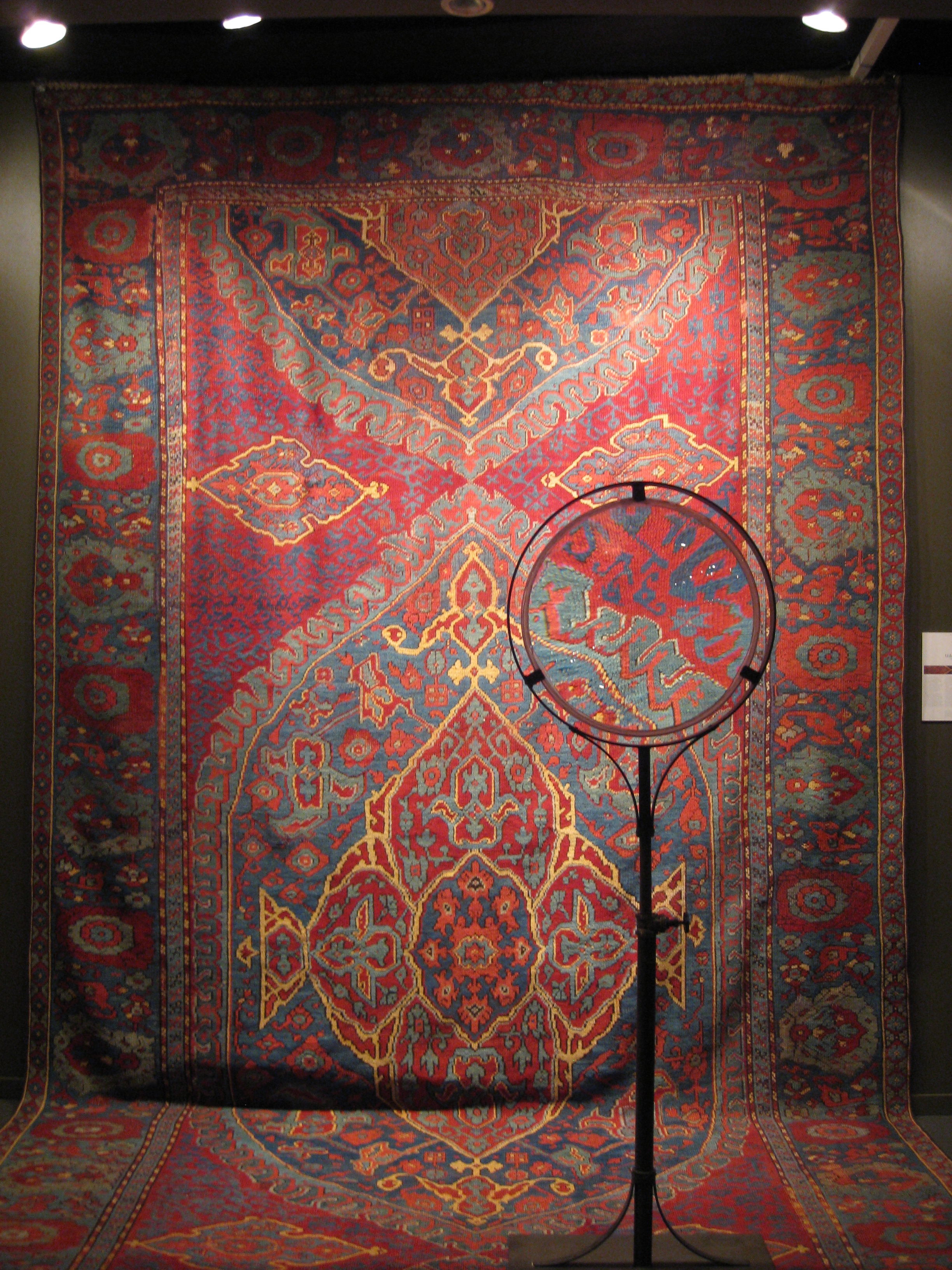
Rug (Turkish, Sixteenth Century) Dealer: Rica Basagoiti, Madrid.
Both this and the image from the previous post of a tree trunk in front of a rug were on display in the stall of Rica Basagoiti from Madrid. Once rugs were considered the most luxurious items in a collection. In the sixteenth and seventeenth centuries, the Spanish and Dutch put rugs like these on their tables, rather than on the ground. Walking on them would have been considered the height of conspicuous consumption.
The display of these rugs by Rica Basagoiti seemed to return these rugs to a level of prestige that was appropriate to their era. In the above image, a large magnifying glass is placed several feet from the rug, making the richly-preserved colors jump out at anyone passing by.
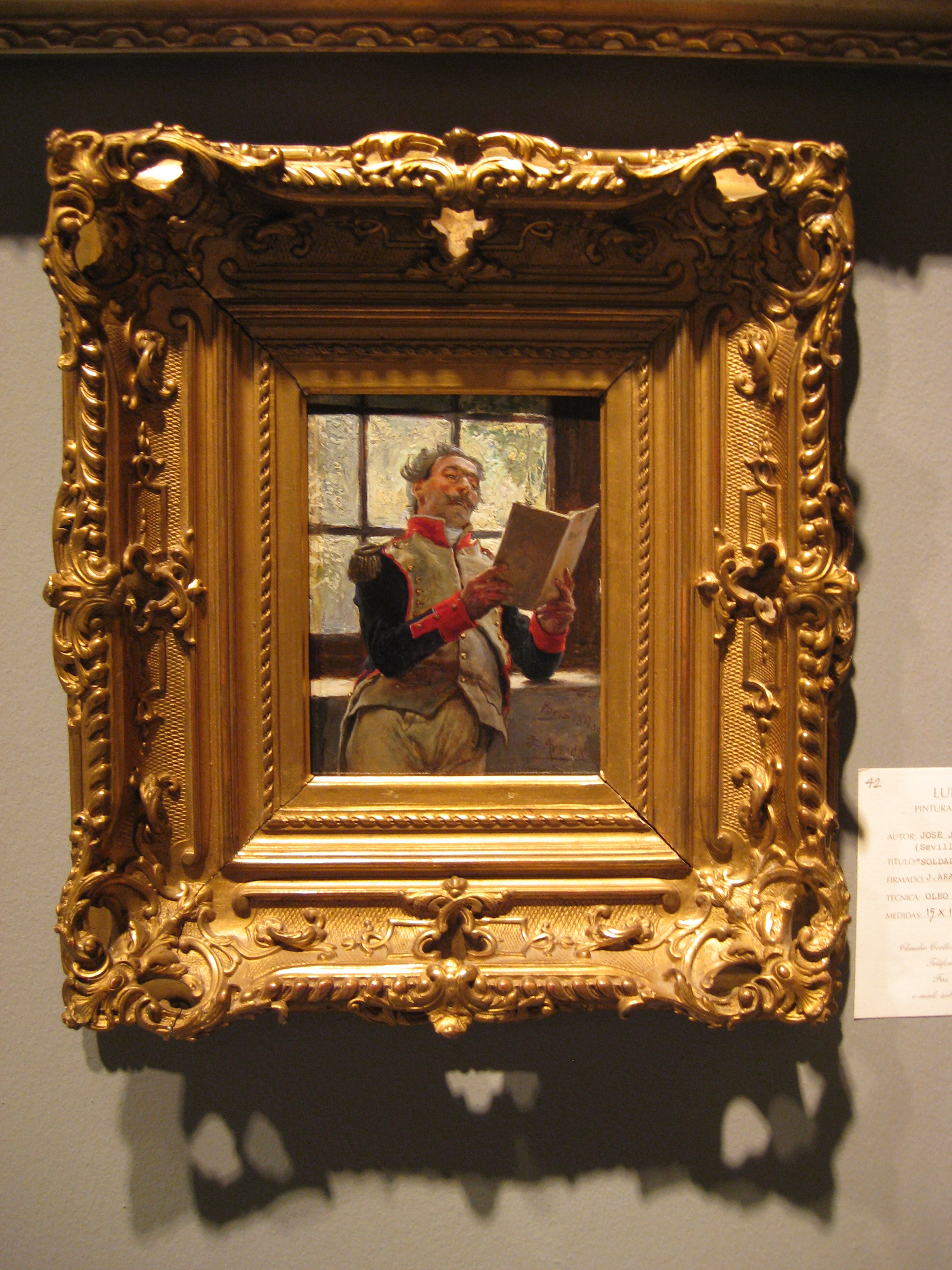
José Jiménez y Aranda (Spanish, 1845-1928) Legendary Soldier (Paris, 1890) Oil on canvas. 15 BY 12CM. Dealer: Luis Carvajal, Madrid.
Jiménez was a Spanish painter who had moved to Paris, where he regularly participated in the annual Salons–one of the few Spanish painters to do so. His work careful attention to detail and tendency to paint figures in period costume are reminiscent of the French painter Meissonier, who was popular in Paris at the time.
Though this is a small work, it shows off Jiménez’s arsenal of skils and powers of observation. The figure seems to be well relaxed and effortlessly painted, but close inpection reveals countless tiny strokes. The light coming through the window casts a series of complicated shadows. I found myself wondering how much easier it would have been to have the light coming from a different direction or having the window at his front rather than his back.

Ivory tankard (German, a. 1675) Ivory with silver fixtures. Dealer: FERMA, Madrid
By far, my favorite piece from the Fair was this German tankard, which stands nearly 25 centimeters in height. Made of several ivory sections seemlessly pieced together, it is a wonder of craftsmanship and artistry. Rather than discuss it at length, I believe a lengthy look at it provides a kind of refinement and appreciation beyond words. (Each image can be clicked for a much higher resolution image.)
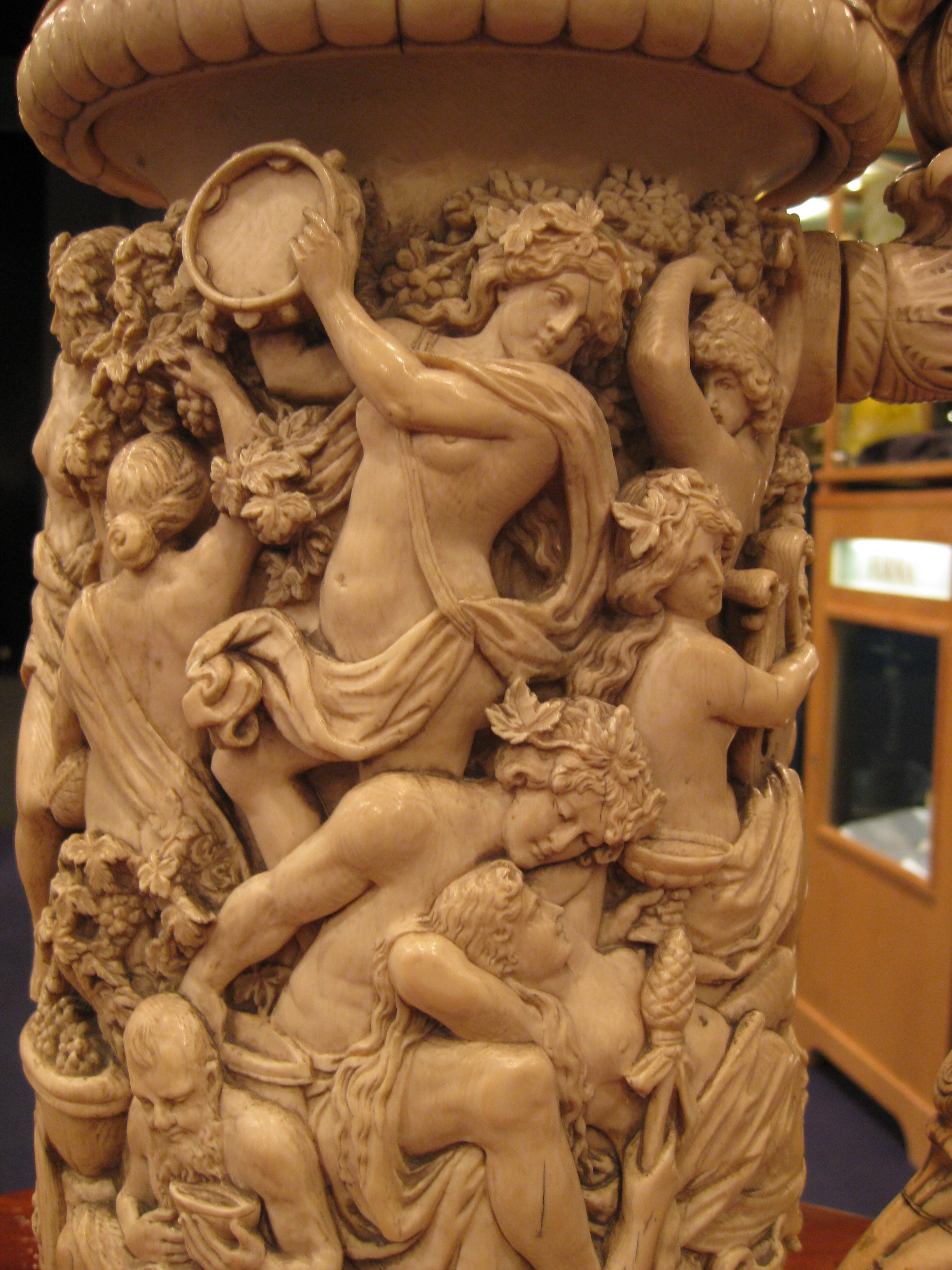
Ivory tankard (German, a. 1675) Ivory with silver fixtures. Dealer: FERMA, Madrid. DETAIL.

Ivory tankard (German, a. 1675) Ivory with silver fixtures. Dealer: FERMA, Madrid. DETAIL.
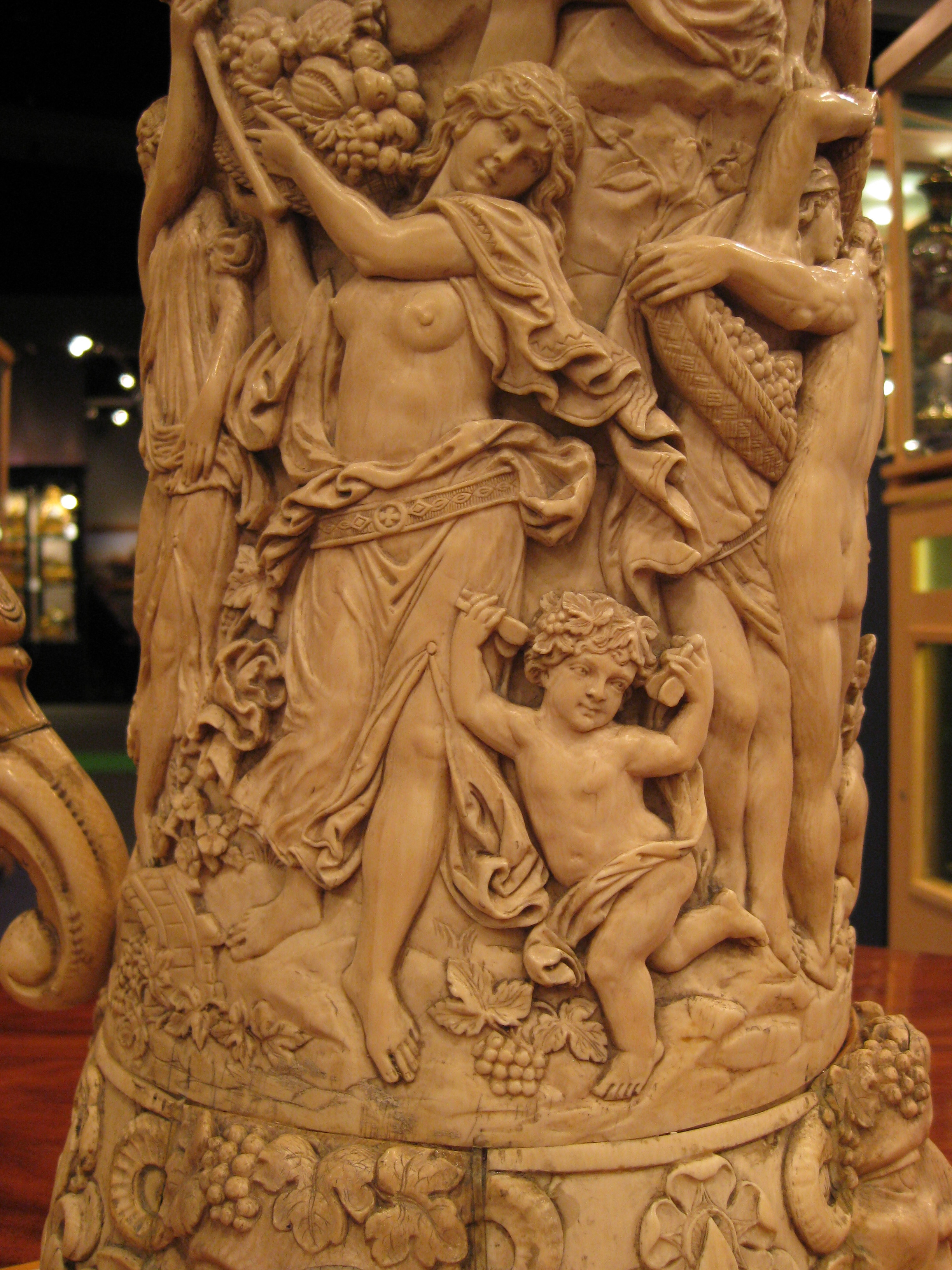
Ivory tankard (German, a. 1675) Ivory with silver fixtures. Dealer: FERMA, Madrid. DETAIL.
For more pictures of the tankard, and a number of other pieces that I saw at Feriarte, visit my Flickr page.