Posts in Category: Art
Beauty Holding Back Time by Donato Barcaglia
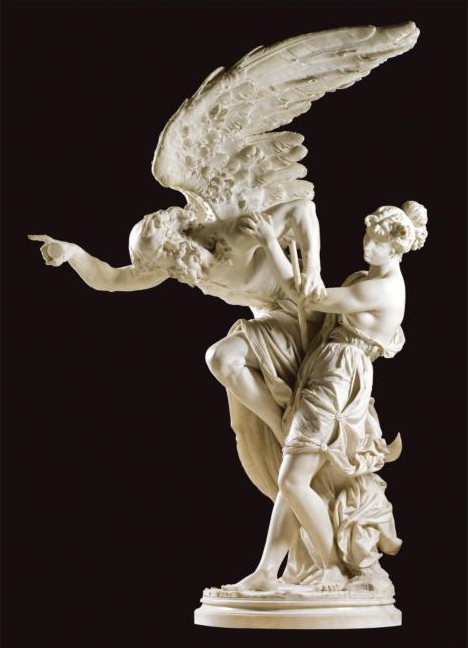
Donato Barcaglia (Italian, 1849-1930) La Giovanezza che Tenta di Arrestare il Tempo, or Beauty Holding Back Time. White marble. 89 BY 59IN.
Yesterday, I visited Sotheby’s in London to preview its nineteenth-century painting auction. Before I could get to the paintings, I was stopped and dumbstruck by La Giovanezza che Tenta di Arrestare il Tempo, or Beauty Holding Back Time, by Donato Barcaglia (Italian 1849-1930).
Barcaglia created the work when he was only 27. It was his “coming out” or graduate work, made at the end of his studies and, therefore, meant to showcase the accumulated skills of his years in the Roman Academy. An instant popular and critical success, Beauty Holding Back Time travelled to Florence, Philadelphia, and Milan before being collected by Michael Alexander Wilsone Swinfen Broun (1858-1948), a Colonel in the British Army, and taken to England.
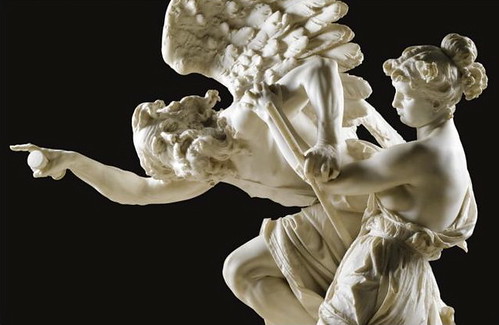
The breadth and depth of Barcaglia’s artistic arsenal, especially at such a young age, is impressive. He exhibits command the material by conveying a large variety of textures (e.g. young skin, old skin, clothing, feathers, hair, wood, metal) and making it appear to defy gravity. As was common for Academic painters and sculptors from the period, Barcaglia mixes his understanding of the ideal, or antique, human form in his depiction of Youth, with Naturalism, as seen in the wings of Father Time.
According to a sculpture dealer in London I know, Beauty Holding Back Time is the most important nineteenth-century statue to reach the market in nearly 25 years. It is estimated at only £150,000 to £200,000. I write “only” because, if it were a painting of similar importance by Gerome or Bouguereau from the same period, it would be estimated at well over £1 million.
Forgotten Master: Vasily Polenov (Russian, 1844-1927)
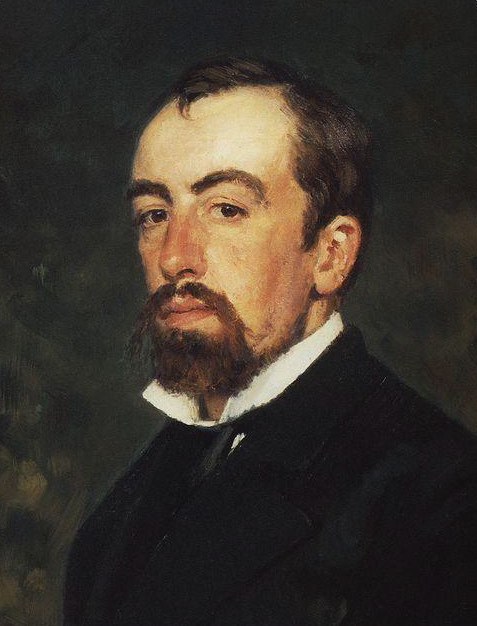
Vasily Polenov (Russian, 1844-1927) was 17 years old when Alexander II freed the serfs of Russia. The Tsar’s Emancipation Manifesto of 1861 was an acknowledgement of democratic changes in Western governments. The decree changed the political and economic landscape of Russia, forcing landowning aristocrats to pay for labor and contributing to a rising middle class.

Vasily Polenov (Russian, 1844-1927) Early Snow (c. 1880) Oil on canvas.The social and economic changes in Russia spilled into the arts.
Art academies in St. Petersburg and Moscow catered to the classical tastes of old Russia, represented by the aristrocracy. Shortly after the emancipation of the serfs, a group of artists, named Peredvizhniki, or The Wanderers, believed it was time “take art to the people.” With their first exhibition in 1870, The Wanderers rejected the classical ideals taught in official school in favor of Realism. They painted earthy, everyday peasants and took their exhibitions to rural areas of the country where a wider public could appreciate it.
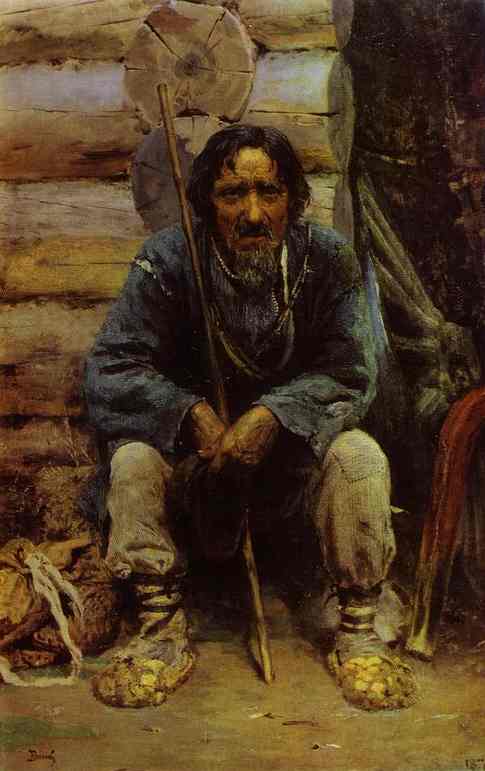
Vasily Polenov (Russian, 1844-1927) The Crippled Serf (c. 1878) Oil on canvas.
Polenov was an adopted as a member of The Wanderers, yet maintained his ties with the Russian Academy. He studied in the Imperial Academy of Arts in St. Petersburg from 1863-1871. Polenov was perhaps the most traveled Russian artist of his generation. During his studies, he was pensioned in Italy and France, where he experienced first hand the contemporary movements of Realism and Impressionism. He returned with a love of plein air, and was one of the first to introduce the approach to other Russian painters. Using the technique he created numerous landscapes of his native countryside.
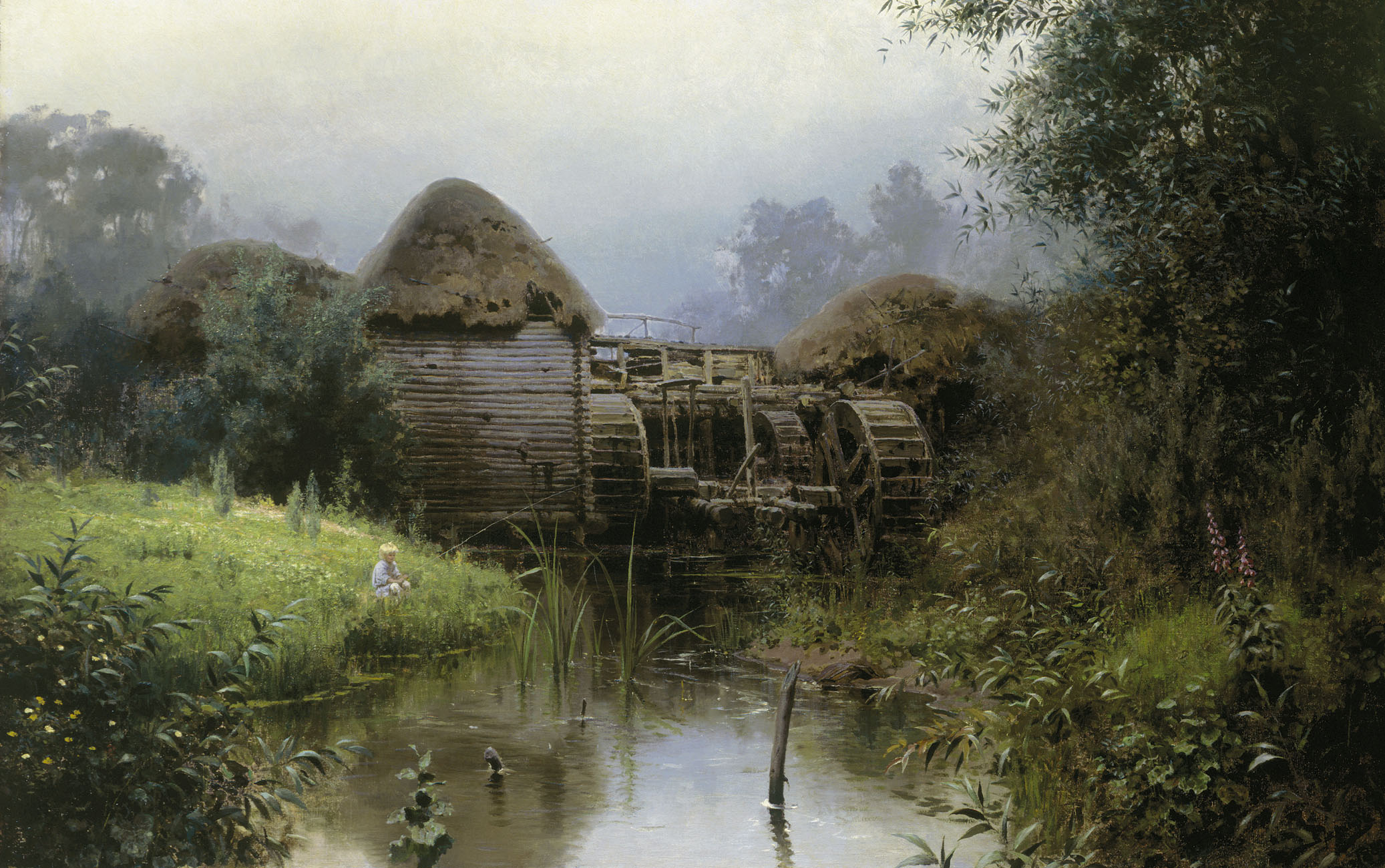
Vasily Polenov (Russian, 1844-1927) Old mill (1880) Oil on canvas.
From 1877-1878, Polenov served as a military artist in the Russo-Turkish war. Shortly thereafter, he dedicated his work to religious scenes, especially from the New Testament.
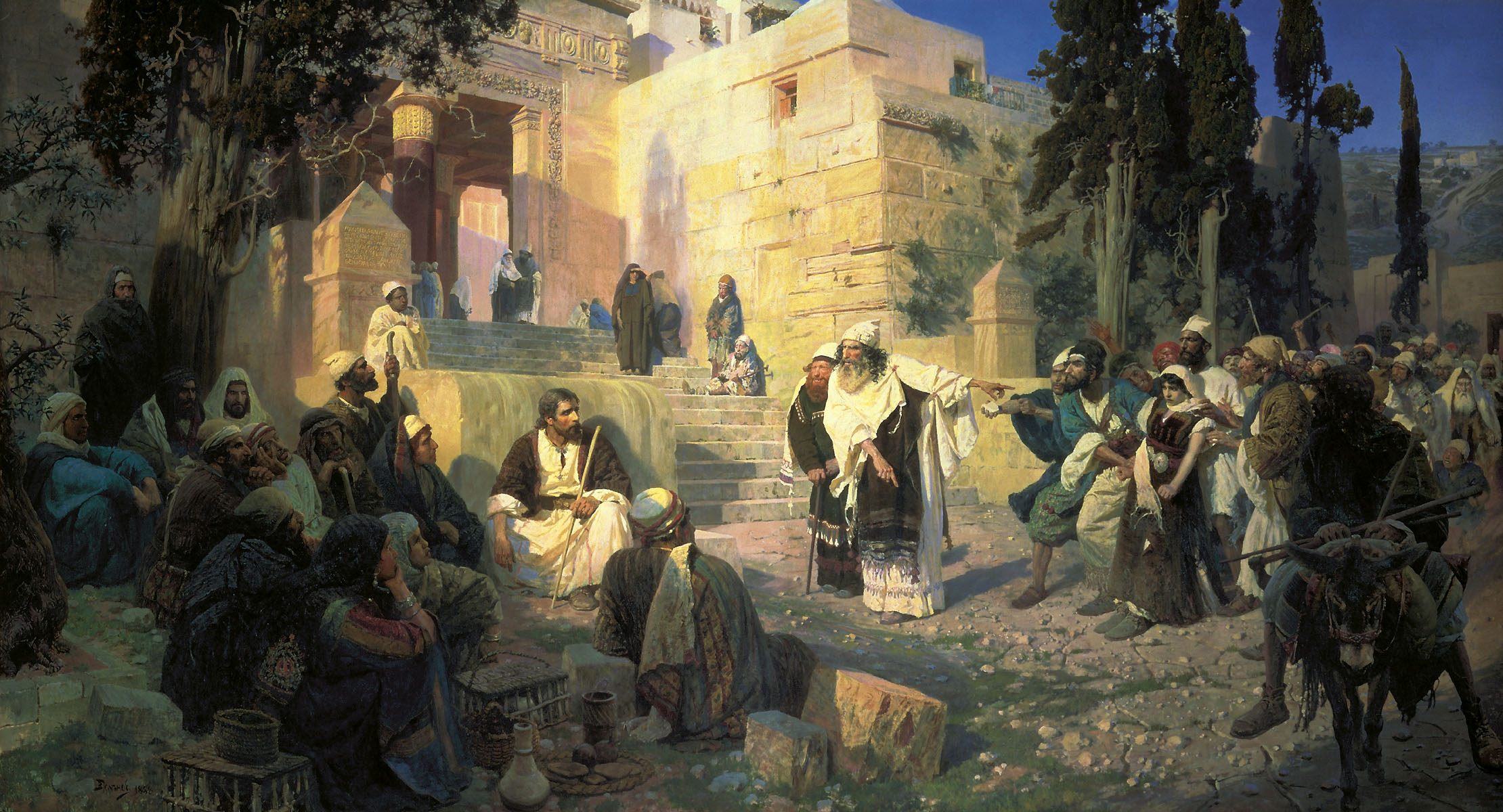
Vasily Polenov (Russian, 1844-1927) Christ and Woman Taken in Adultery (1886-1887) Oil on canvas. The State Tretyakov Gallery, Moscow.
His painting, Christ and the Woman Taken in Adultery (a. 1886) is considered by many to be his masterpiece. It is drawn from the Gospel of John, Chapter 8, verses 1-11, where a woman caught in the act of adultery is taken to Christ. Hoping trick Christ, a group of his enemies brought the woman to him:
4 They say unto him, Master, this woman was taken in adultery, in the very act.
5 Now Moses in the law commanded us, that such should be stoned: but what sayest thou?
6 This they said, tempting him, that they might have to accuse him. But Jesus stooped down, and with his finger wrote on the ground, as though he heard them not.
7 So when they continued asking him, he lifted up himself, and said unto them, He that is without sin among you, let him first cast a stone at her.
8 And again he stooped down, and wrote on the ground.
9 And they which heard it, being convicted by their own conscience, went out one by one, beginning at the eldest, even unto the last: and Jesus was left alone, and the woman standing in the midst.
10 When Jesus had lifted up himself, and saw none but the woman, he said unto her, Woman, where are those thine accusers? hath no man condemned thee?
11 She said, No man, Lord. And Jesus said unto her, Neither do I condemn thee: go, and sin no more.
In preparation for the painting, Polenov had made sketches of people, architecture, and landscape in the Middle East and Greece, where he travelled from 1881-1882.

Vasily Polenov (Russian 1844-1927) The Parthenon, Temple of Athena Pallas (c. 1881) Oil on canvas. The Tretyakov Gallery, Moscow, Russia.
During his lifetime, Polenov was widely acclaimed for his work by both the Russian Academy and those that had broken from it. In 1893, he was made a fellow of the Imperial Academy of Arts in St. Petersburg, and taught at the Moscow School of Painting, Sculpture and Architecture until his death in 1893.

Vasily Polenov (Russian, 1844-1927) Christ overlooking Jerusalem (c. 1885) Oil on canvas. The State Tretyakov Gallery, Moscow.
Today, Polenov’s home in Borok, near Moscow, has been made a museum and placed in the national trust.
The Discovery of Velázquez by Thomas Eakins
Since I am now here in Madrid I do not regret at all my coming. I have seen big painting here. When I had looked at all the paintings by all the masters I had known I could not help saying to myself all the time, its very pretty but its not all yet. It ought to be better, but now I have seen what I always thought ought to have been done & what did not seem to me impossible. O what a satisfaction it gave me to see the good Spanish work so good so strong so reasonable so free from every affectation. It stands out like nature itself. [sic.]
-Thomas Eakins, in a letter to his father, Benjamin, dated December 2, 1869.
Saying that everything he had seen before “was pretty” but “not enough” is surprising. Eakins had just left the studio of one of the greatest painters of his day, Jean-Leon Gerome (French, 1824-1904), and lived in Paris, then capitol of the art world.
Eakins’ trip to Spain was a watershed for his personal development, and an indication of the draw Spain had for many painters working in Paris.

Thomas Eakins (American, 1844-1916) Self-portrait (1902) Oil on canvas 30 BY 25 IN. National Academy of Design, New York.
At the time Eakins visited Spain–during of the Winter of Spring of 1869 and 1870–it was considered a backwater, years behind civilized Europe in the arts and economics.
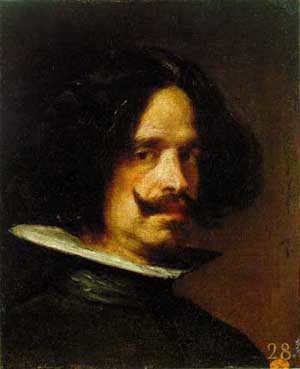
Deigo Rodríguez de Silva y Velázquez (Spanish, 1599-1600) Self-portrait (a. 1630) Museo de Bellas Artes de San Carlos, Valencia.
Yet, Eakins and a number of other important artists (e.g.. Eduoard Manet, Mary Cassat, John Singer Sargent) traveled to Spain works by Spanish masters in the Prado Museum. In 2003, the Metropolitan Museum of Art in New York, featured an exhibition on French artists in Spain. Titled Manet and Velázquez and with 200 works, the exhibition discussed a newfound love of Spain that grew out of the French invasion by Napoleon’s armies in 1808 and the Mariage of Napoleon III to, Eugénie de Montijo, a Countess of Spanish Royal blood.
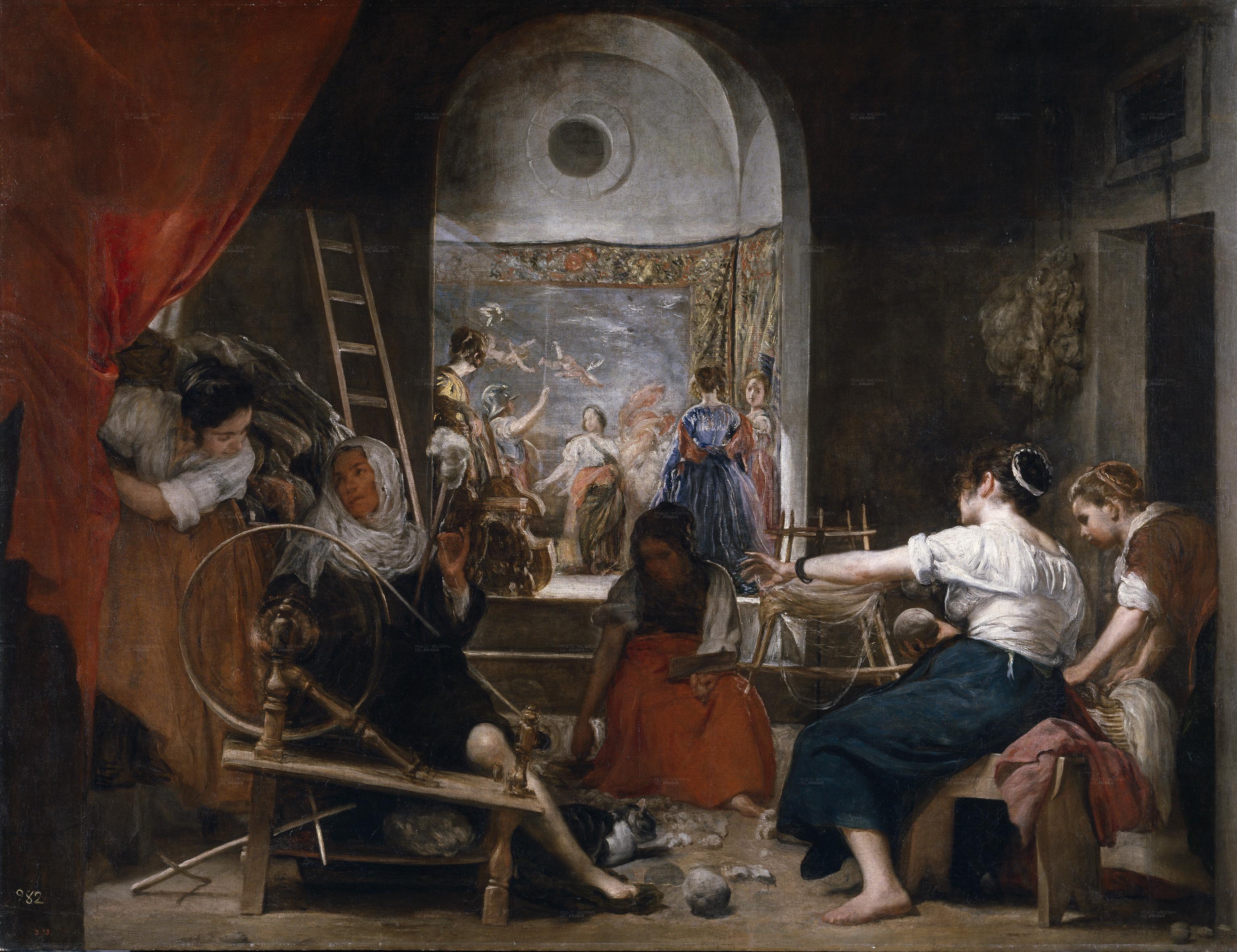
Deigo Rodríguez de Silva y Velázquez (Spanish, 1599-1600) The Weavers (1657) Prado Museum, Mardid.
Eakins travelled to Spain shortly after the country’s government was overthrown. Despite the chaos, he was able to visit the Prado Museum and a number of galleries throughout the country.
He was especially impressed by the work of Diego Rodríguez de Silva y Velázquez (Spanish, 1599-1660). Eakins claimed Velázquez’s painting, The Weavers, was “the most beautiful piece of painting I have seen in all my life.”
“Here is how I think the woman tapestry-weaver was painted . . . [Velázquez] drew her withouth giving attention to the details. He put her head and arme well in place. Then he painted her very solidly without seeking or even marking the fold of the draperies, and perhaps he sought his color harmonies by repeated painting over, for the color is excessively thick on the neck and all the delicate parts . . .”
This kind of careful attention to technique was absorbed into Eakins’ own work.
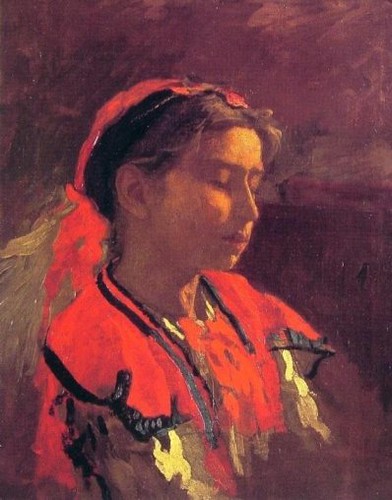
Thomas Eakins (American, 1844-1916) Carmelita Requeña (1869) Oil on canvas 26 1/6 BY 17 1/8 IN. Metropolitan Museum of Art, New York.
According to M. Elizabeth Boone, author of Visitas de España: American Views of Art and Life in Spain, 1860-1914, it was shortly after seeing these that Eakins made his first original painting: Carmelita Requeña . In it, Eakins mimics Velázquez’s subtle use color and shadow, using very closely-related tones and small gradations of light to dark.

Deigo Rodríguez de Silva y Velázquez (Spanish, 1599-1600) The Crucifixion (1632) Oil on Canvas. Prado Museum, Mardid.
Besides, The Weavers, Eakins was inspired by Velázquez’s Crucifixion, painting a version of his own.
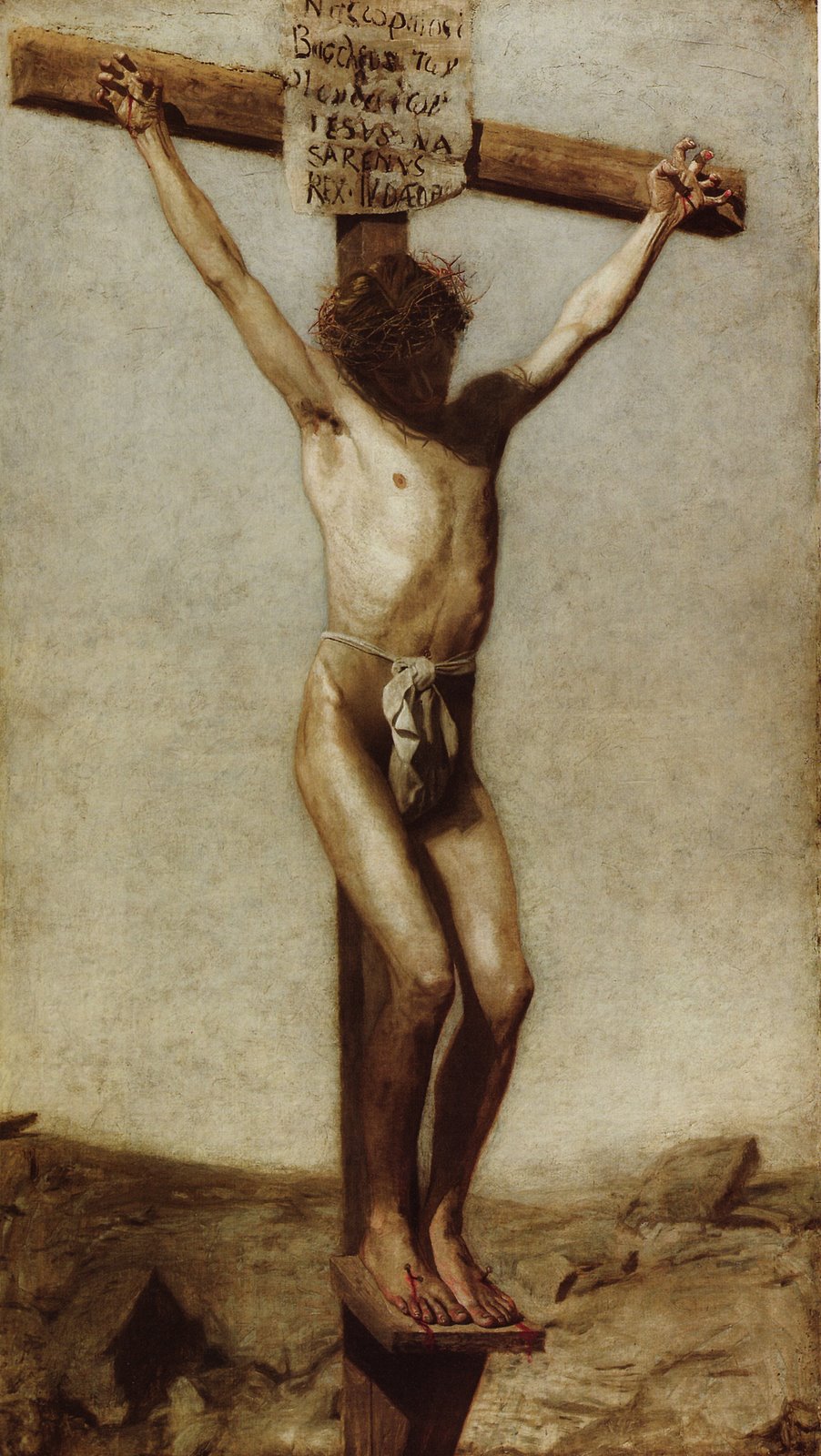
Thomas Eakins (American, 1844-1916) The Crucifixion (1880). Oil on canvas.
In the past decade, a great deal has been done to re-assert the influence of Thomas Eakins and France on American painting. With that in mind, it would seem necessary to explore the role of Spanish painting on these painters.
Pursuing Lost Painting Methods: An Excellent Article from the NY Times
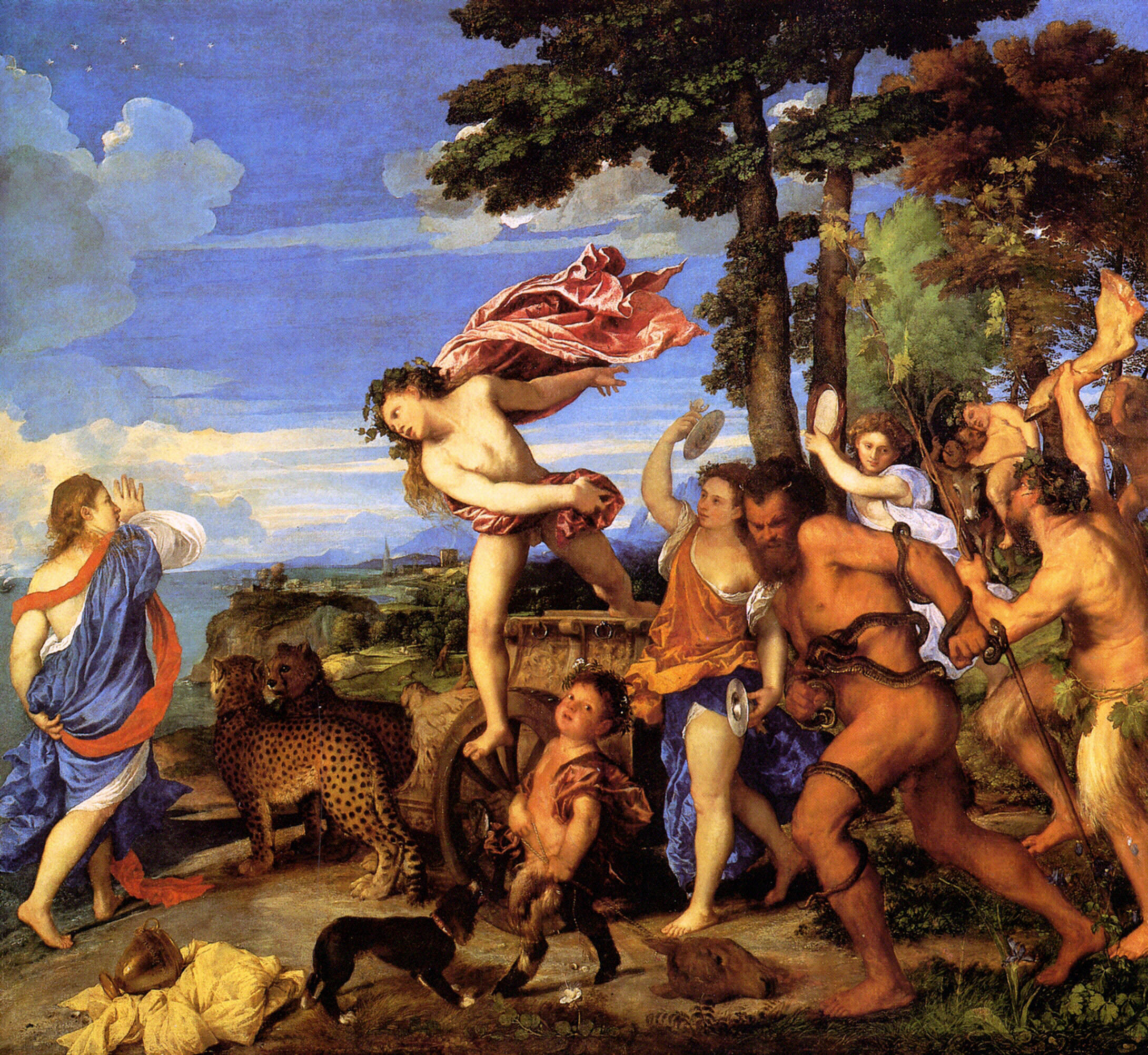
Titian (Venetian, a. 1506-1576) Bacchus and Ariadne (1520-23) Oil on canvas. 176.5 BY 191CM. National Gallery, London.
In the upcoming exhibition, “Benjamin West and the Venetian Secret,” (beginning September 18) Yale’s Center for British Art explores an obsession with recreating the methods of Titian. The Sunday New York Times dedicates an excellent article to the topic.
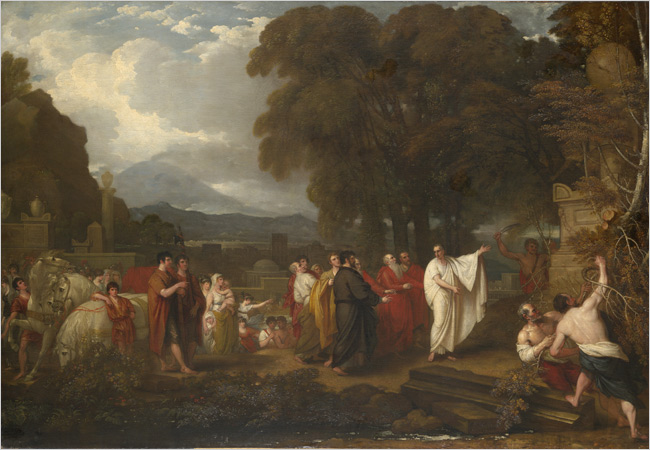
Benjamin West (Anglo-American, 1738-1820) Cicero Discovering the Tomb of Archimedes (1797) Oil on canvas. 124.5 BY 180.5CM. Yale University Art Gallery.
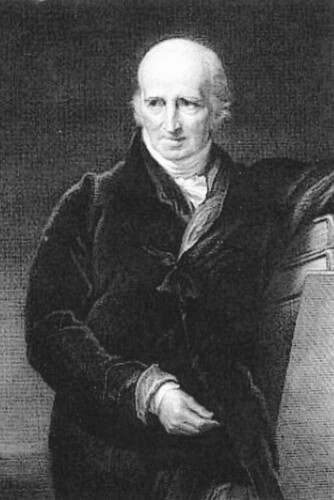
Benjamin West (Anglo-American, 1738-1820) Portrait of artist posing as President of the Royal Academy.
West had served as President of the Royal Academy (1792-1805; 1806-1820) and was particularly interested in the works of the Venetian painter Titian (Venetian, a. 1506-1576), and his ability to achieve high intensity color in his paintings.
So when an artist named Ann Jemima Provis and her father, Thomas Provis, approached West and told him they had found a copy of an old manuscript that explained how the Venetians achieved their distinctive style of painting, he jumped at the chance to learn more. Eager to incorporate the methods in the manuscript into his own work, West began experimenting with them.
There was only one problem.
“The story was an absurd invention, and the manuscript was a fake,†said Angus Trumble, senior curator of paintings and sculpture at the Yale Center.
In addition, to the manuscript Ann and Thomas Provis offered demonstrations of the Venetian technique. These included a new approach to painting grounds and using Prussian blue.
(Prussian blue was invented by Heinrich Diesbach and Johann Konrad Dippel in 1704 or 1705, more than 100 years after Titian’s death. In his own paintings, Titian used lapis lazuli (a.k.a ultramarine); therefore, the “rediscovered” method was clearly not Titian’s.)
(From “Be An Old Master, for 10 Guineas” by J. D. BIERSDORFER, August 29, 2008. New York Times.)
Painters working under the instructions of the Provises did not have the same results as the Old Masters, which led to suspicions regarding the Provises’s claims. The Provises were discovered for their hoax, and a number of artists who had paid for their advice were discredited in the press and at the Royal Academy. West, especially, was criticized for not having seen the hucksters for what they were.
Forgotten Master: Adolf von Menzel (Polish/German, 1815-1905)
“Not a day without drawing,” was a motto often repeated by Menzel and recalled by his students at the Royal Academy of Art in Berlin.
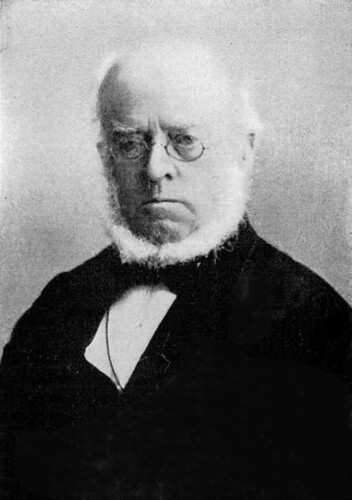
Portrait of Adolf von Menzel (a. 1880) Image published in Newcomb, A; Blackford, K.M.H.: Analyzing Character, 1922. Photographer Paul Thompson.
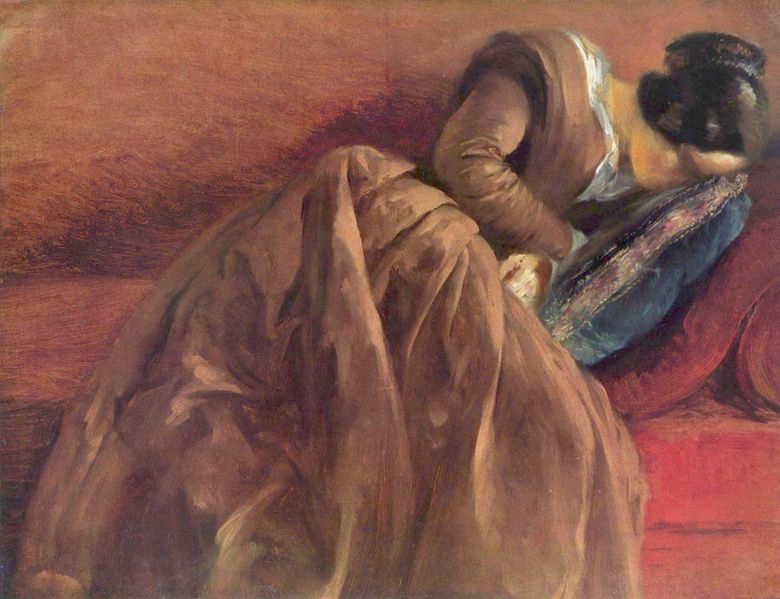
Adolf von Menzel (Polish/German, 1815-1905) The Artist’s Sister, Emille, Sleeping (c. 1848). Oil on paper. 46 BY 60CM. Kunsthalle, Hamburg.
Menzel was born in Breslau, Poland. In 1830, his father moved the family to Berlin and founded a lithgraphy business, in which Menzel worked from the age of fourteen.
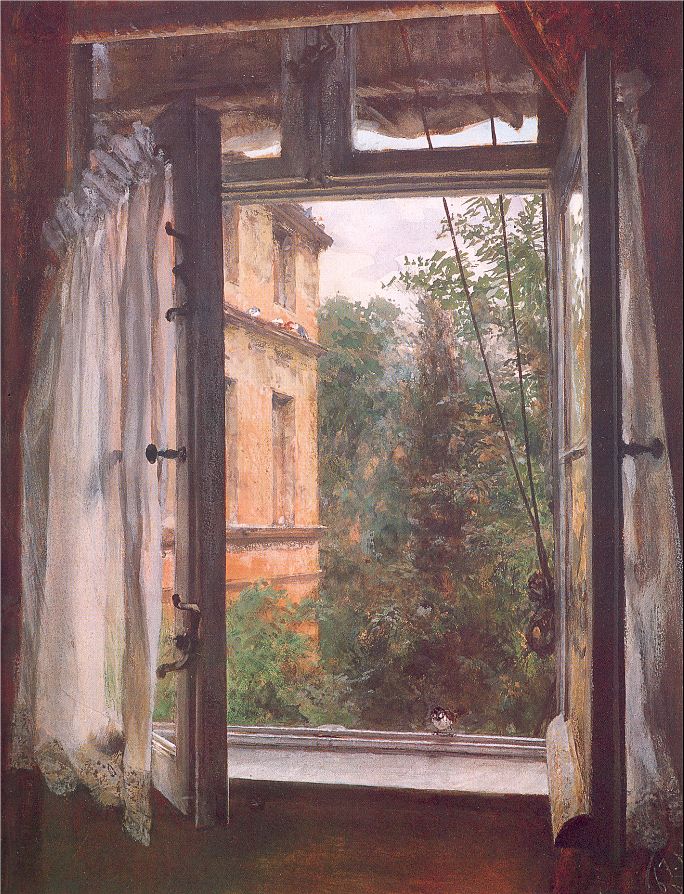
Adolf von Menzel (Polish/German, 1815-1905) View from a window in the Marienstrasse (1867) Gouache over chalk. Oskar Reinhart Foundation, Winterthur.
Shortly after moving to Berlin, Menzel’s father died unexpectedly leaving a young Menzel as the sole provider for the family. Eventually, Menzel was able to involve other members of the family in the business and pursue an education and career in art.
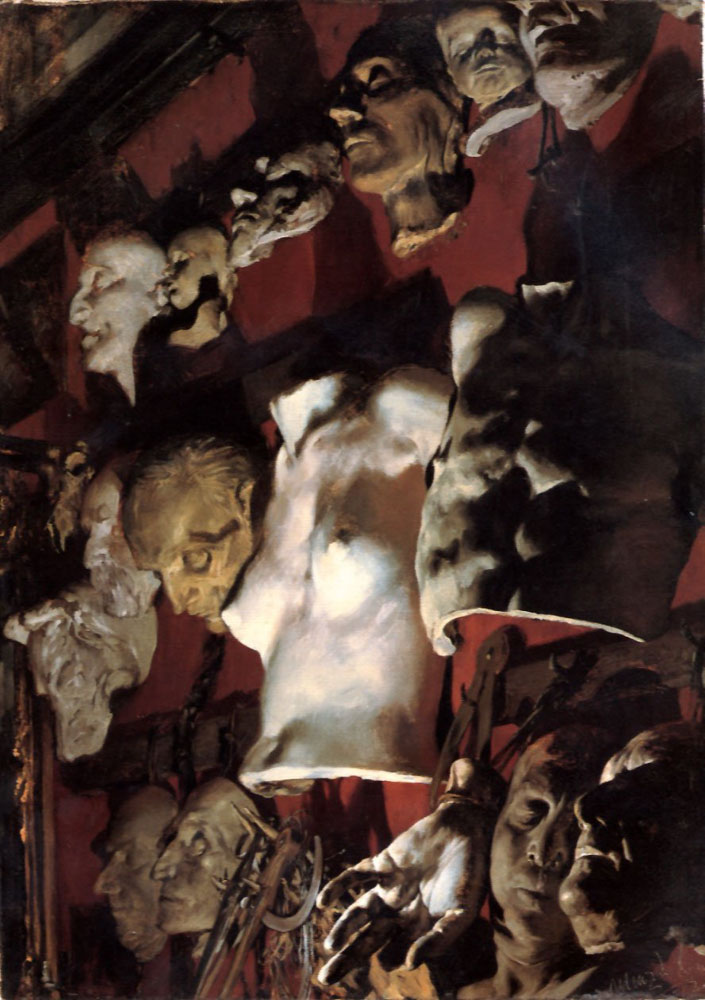
Adolf von Menzel (Polish/German, 1815-1905) A Study of Castes. Oil on canvas. Private collection.
He accepted at the prestigious Royal Academy of Art, where he was discovered by a wallpaper magnate, Carl Heinrich Arnold, who would be become Menzel’s patron, promoter, and friend.
His graduation from the Academy was followed by a series of lithographic commissions, including works by Goethe and a history of the Frederick the Great.
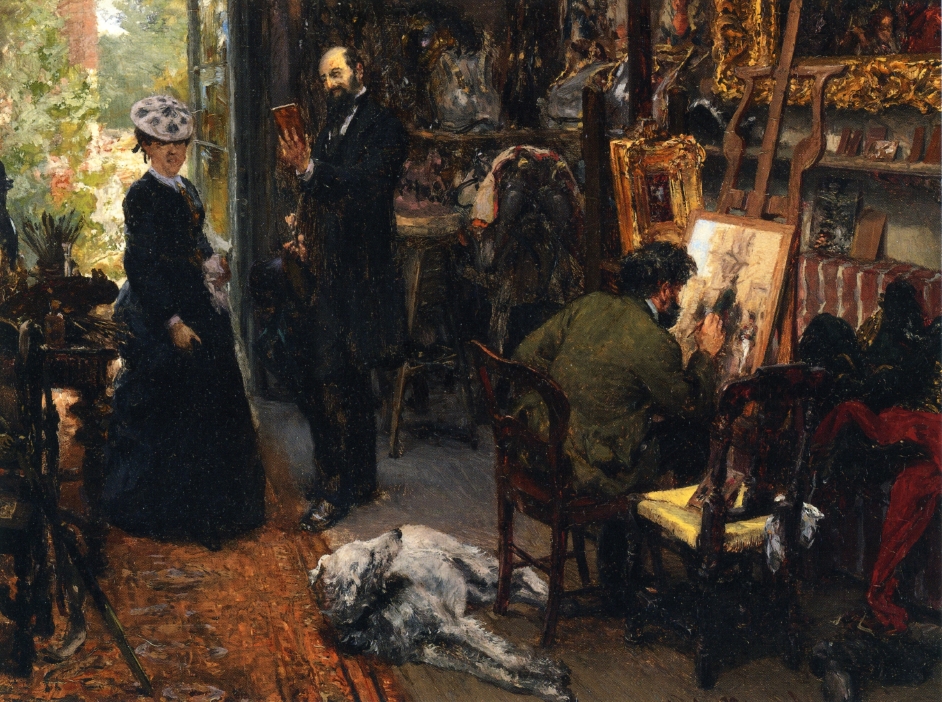
Adolf von Menzel (Polish/German, 1815-1905) Meissonier in his studio at Poissy (1869) Oil on panel. 8 1/4 BY 11 3/8IN. Private collection.
In 1855, Menzel traveled to Paris for the first time. The occasion was most likely the influential Paris Exposition Universelle, with thousands of artists’ works on display in series of pavilions organized by nationality. There Menzel saw Gustave Courbet’s “Pavillon du Réalism,” which led to a more naturalistic approach to his paintings. From that time forward, he would make regular trips to Paris and came to know some of the city’s most important artists.
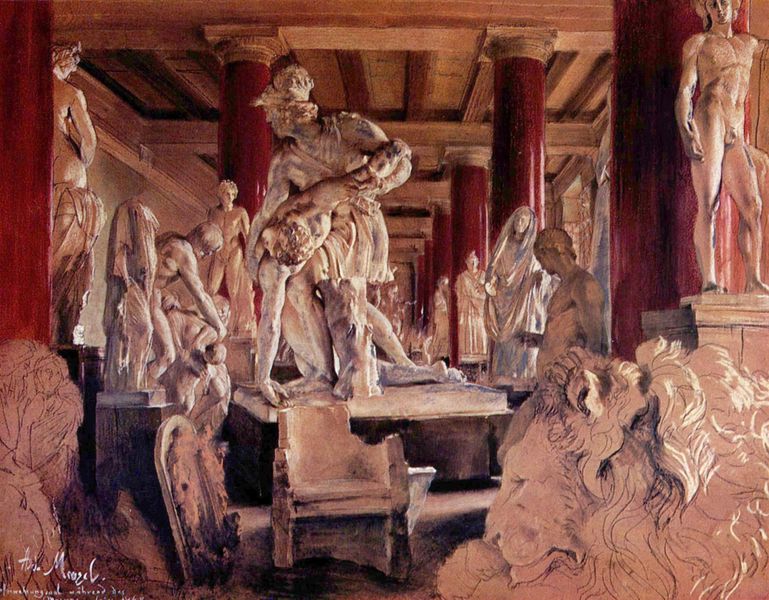
Adolf von Menzel (Polish/German, 1815-1905) Aufbewahrungssaal während des Museumsumbaus (1848) Pastel on paper. 46 BY 57CM. Alte Nationalgalerie, Berlin.
By the end of his life, Menzel was considered one of Berlin’s greatest artists. He joined the Royal Academy of Art in 1853, and was a teacher at the school from 1875 until his death in 1905. He had been decorated as a Knight of the Black Order, given the rank of Privy Councilor with the title “Your Excellency,” and awarded an honorary doctorate at the University of Berlin.
This gave him a crowd of admirers and friends within government and other circles; in fact, one of his closest friends was the composer Johannes Brahms.

Adolf von Menzel (Polish/German, 1815-1905) Portrait of an Old Man (1884) Pencil on paper. 8 1/2 BY 5IN. Private collection.
Internationally, he had been honored with a show dedicated to his work in Paris in 1884, and was granted membership at the Royal Academies of London, St. Petersburg, and Paris. His works regularly appeared in the Paris Salon until his death.
The Undervalued Genre Painting

Theodore Gerard (Belgian, 1829-1895) The Farmer’s Child (1861) Oil on panel 33 BY 22IN. Private collection.
The French word “genre,” directly translated as “kind” or “type,” is used to describe a variety of paintings. As a result the use of the term “genre painting” can be confusing.
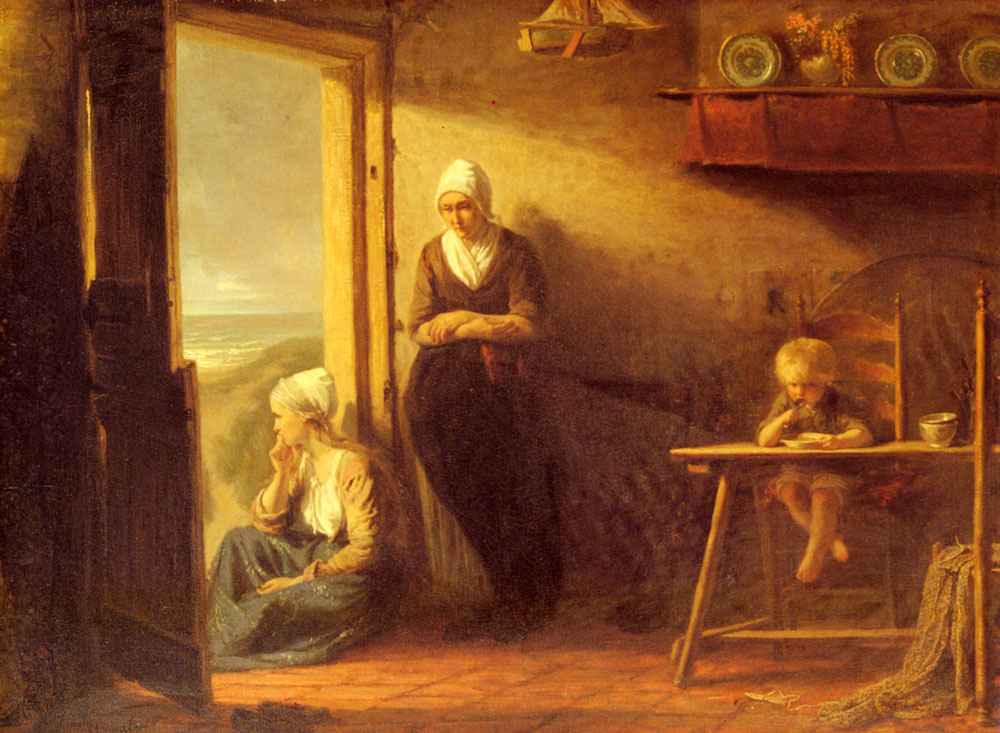
Jozef Israëls (Dutch, 1824-1911) Awaiting the Fisherman’s Return. Oil on canvas. 32 1/2 BY 44 3/4IN. Private collection. A painting that depicts a scene of everyday life is generally considered a genre painting, and can include contemporary figures, urban life or peasant scenes. In her book, Keywords of Nineteenth-Century Art, Dr. Christine Lindey describes what sets a genre painting apart:
It did not aspire to the elevated scale, generalised effects or high moral truths of the grand manner; rather it sought to be entertaining (and often humorous), anecdotal and sentimental. Moreover, it depicted in telling detail non-heroic, anonymous, “ordinary” people going about their daily lives, whether they be contemporary and “real,” historical or literary.
(Christine Lindey. Keywords of Nineteenth-Century Art. p. 105)
Genre paintings originate from Dutch and Flemish painting traditions going as back as the fifteenth century. In the seventeenth-century, Dutch painters like Jan Steen (1626-1679) and de Hooch (1629-1684) took common genre scenes to a new level of refinement through their nuanced use of symbols (e.g. an discarded slipper as sexual innuendo) and highly skilled treatments of light and materials.

Peiter de Hooch (Dutch, 1629-1684) The Courtyard of a House in Delft (1658) Oil on canvas.
The greatest criticism of genre paintings came from painters following Italian and French traditions of art that emphasized large scale works of historical or mythological scenes. In his assessment of Gustave Courbet, the father of Realist painting, Pierre-Joseph Proud’hon, an academic painter, wrote:
It would be no truer to call him a genre painter, like the Dutch and Flemish, whose paintings, though pleasant or comic, are insubstantial; they rarely go to the heart of things, reflect no philosophical concerns, and reveal more imagination than observation . . .
(Harrison and Wood. Du principe de l’art et sa distination social. Christine Lindey, trans. p. 408)
Despite the lack of credibility they often received, there were many nineteenth-century genre painters. During the first half of the century, their works appeared more often on the private market than in public exhibitions. By the end of the century genre painting had gained greater credibility and regularly appeared in the annual Paris Salon.
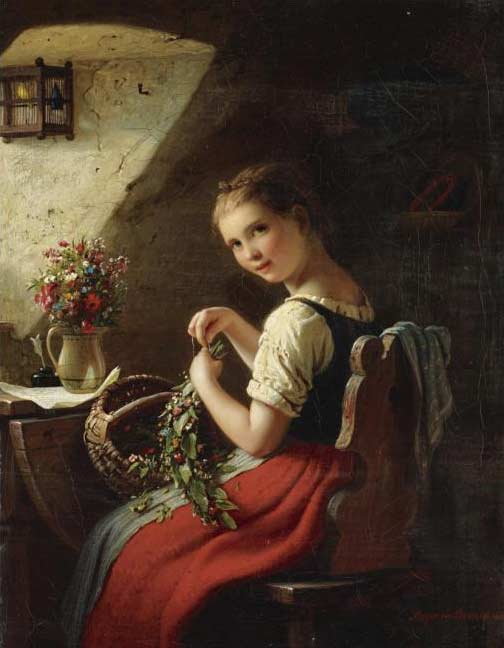
Johann Georg Meyer von Bremen (German, 1813-1886) Making a Bouquet. Oil on canvas. Private collection.
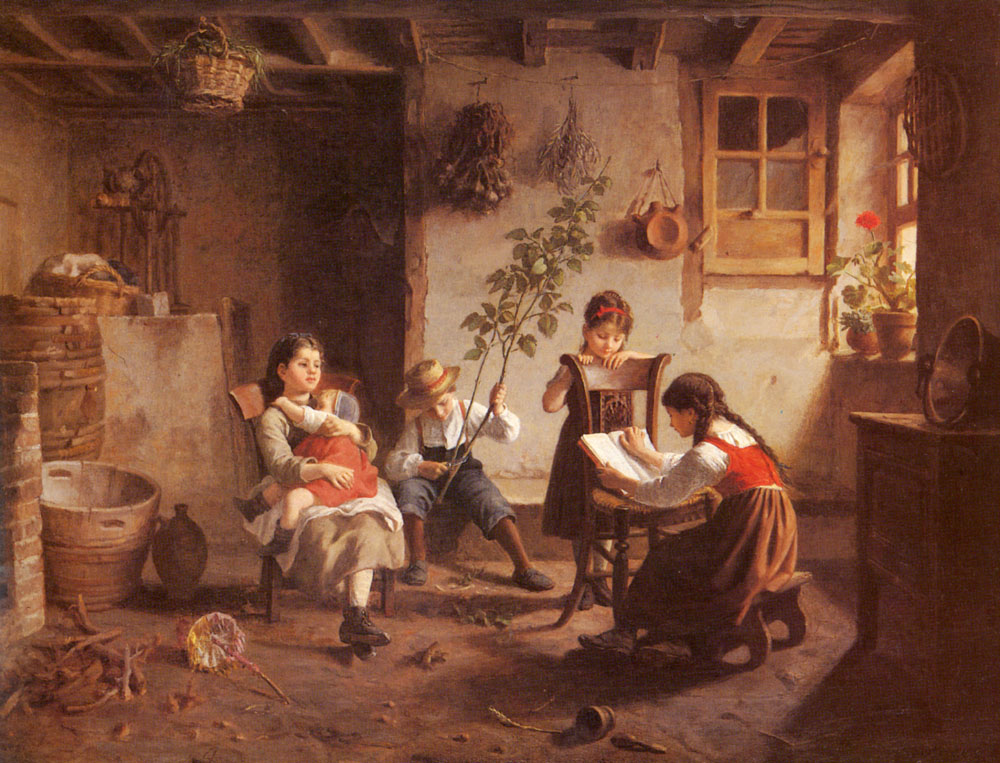
Paul Seignac (French, 1826-1904) The Reading Lesson. Oil on panel. 19 BY 26 1/4IN. Private collection.
The Ideal versus the Observed in Nineteenth-Century Painting
[This post was inspired by a conversation I had with the talented and thoughtful painter Joseph Brickey. For more on his work, visit his website here.]
Over three quarters of what constitutes painting is comprised of drawing. If I had to put a sign above my door I would write: “School of drawing,” and I’m sure that I would produce painters.
-Jean-Dominique Auguste Ingres (French, 1780-1867) (Henri Delborde. Ingres. sa vie, ses travaux, sa doctrine. Paris: Henri Plon, p. 123)
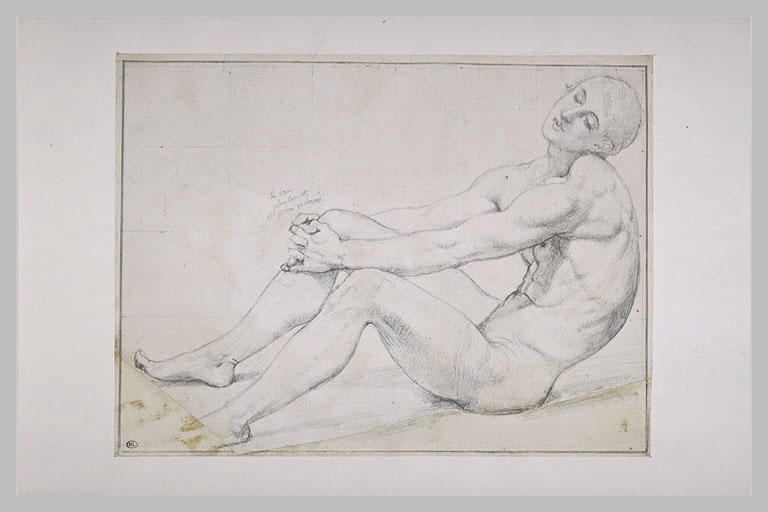
Jean-Dominique Auguste Ingres (French, 1780-1867) A Young, Seated Nude Male. (c. 1850) Graphite on paper. Musée du France, Paris.
Previously on this blog, I have received comments questioning the sincerity, artistic integrity or creativity in nineteenth-century, academic painters and contemporary artists attempting to model them.The criticism is based on a belief that drawing accurately is not artistic (right-brain), but, in essence, an act of left-brained practice. In other words, a camera could do the same as the artist. I absolutely agree that an artist should not be a camera.
However, nineteenth-century, academic painting was not based on mimicking nature, but on observation combined with the ideal, sometimes described as the “antique.”
In France and much of Western Europe, the first half of the nineteenth century was dominated by an artistic philosophy that emphasized the dominance of line, or contour, over color. Drawing was considered the underlying structure of a painting and, therefore, was the principle skill taught in the major academies. In fact, it was not until the mid-nineteenth century that the Ecole des Beaux-Arts included oil painting as part of its curriculum. (Previous to that time, artists would learn oil painting in the ateliers of a master to whom they would be assigned in tandem with their studies or after graduation from the Ecole.)

Eugene Delacroix (French, 1798-1863). Study of a Man, Soldiers and a Dog. Graphite on paper. Musée de France, Paris, France.
In his journal, Eugene Delacroix (French, 1798-1863) planned a study program and dictionary for artists writing:
The first and most important thing in painting is the contour. Even if all the rest were to be neglected, provided the contours were there, the painting would be strong and finished. I have more need than most to be on my guard about this matter; think constantly about it, and always begin that way. (Delacoix’s Journal, April 17, 1824)
To modern eyes and to many artists who are attempting to resurrect the academic methods of the nineteenth century, the emphasis on drawing could be interpreted as an ability to correctly copy or mimic what the eye sees. This is an incorrect belief. Nineteenth-century academic drawing was only partially observational. In practice, it was a combination between observation of nature and classical construction based on an understanding of ideal form.

Charles Gleyre (Swiss, 1808-1874). Seated Woman. Graphite on paper. Louvre, Paris.
This combination of the ideal and the observation of nature was often objected to by the Impressionists. Claude Monet (French, 1840-1926) studied with the academic painter Charles Gleyre (Swiss, 1808-1874) and recalled an experience where the two perspectives on drawing clashed. Monet was working from a live, nude model and, on seeing his work, Gleyre reacted:
‘It is not bad,” he said, “but the breast is heavy, the shoulder too powerful and the foot too big.”
“I can only draw what I see,” I replied timidly.
“Praxiteles borrowed the best parts from a hundred imperfect models, to create a masterpiece,” Gleyre replied dryly. “When you make something, you must think of the antique!”
That same evening, I took Sisley, Renoir and Bazille to one side: “Let’s get out of here,” I said, “This place is unhealthy, it is lacking in sincerity.”
(Gustave Geoffroy. Claude Monet, sa vie, son temps, son oeuvres. Paris: Les éditions G. Cres et Cie, 1927, p. 26-27)
Again, academic painters were not interested in being cameras or making accurate copies of what they saw. Academic painting was deeply ideological and conceptual. It was based on the need to construct the human figure after the ideal. In this way, many artists today, including art historians, would be surprised to know that ideologically, academic painters had more in common with the avant garde Suprematism and Constructivism in the purity of geometry and line than the Impressionist did with those same movements.
An appreciation of nineteenth-century, academic painting–and, for that matter, many Old Masters–begins with an understanding of the ideology of the ideal and as the basis for painting.
“The Greatest Painter in the World” Jean-Louis Ernest Meissonier (French, 1815-1891)
“One of the un-constestable masters of our epoch.”
“All of us will be forgotten, but Meissonier will be remembered.”
-Eugène Delacroix, Painter and Friend of Meissonier
—
“His presence will be assured in the museums of the future.”
-Théophile Gautier, Nineteenth Century Critic
—
“One of the greatest glories of the entire world.”
-Kaiser Wilhelm II of Germany

Jean-Louis Ernest Meissonier (French, 1815-1891) Self-portrait (1889) Oil on canvas
In his book, The Judgment of Paris–which I have referred to on more than one occasion on this blog–Ross King explores how one of the world’s formost painters could become nearly anonymous nearly 100 years after his death.

Jean-Louis Ernest Meissonier (French, 1815-1891). The Siege of Paris (1876) Oil on canvas. Private collection.
Jean-Louis Ernest Meissonier was the highest paid painter of his day. His paintings, which often took years to paint, were unveiled to huge crowds and discussed in international newspapers. The list of people buying his painting reads like a who’s who of late-nineteenth-century, European money and power.
Now, he is primarily remembered as a “costume painter.”
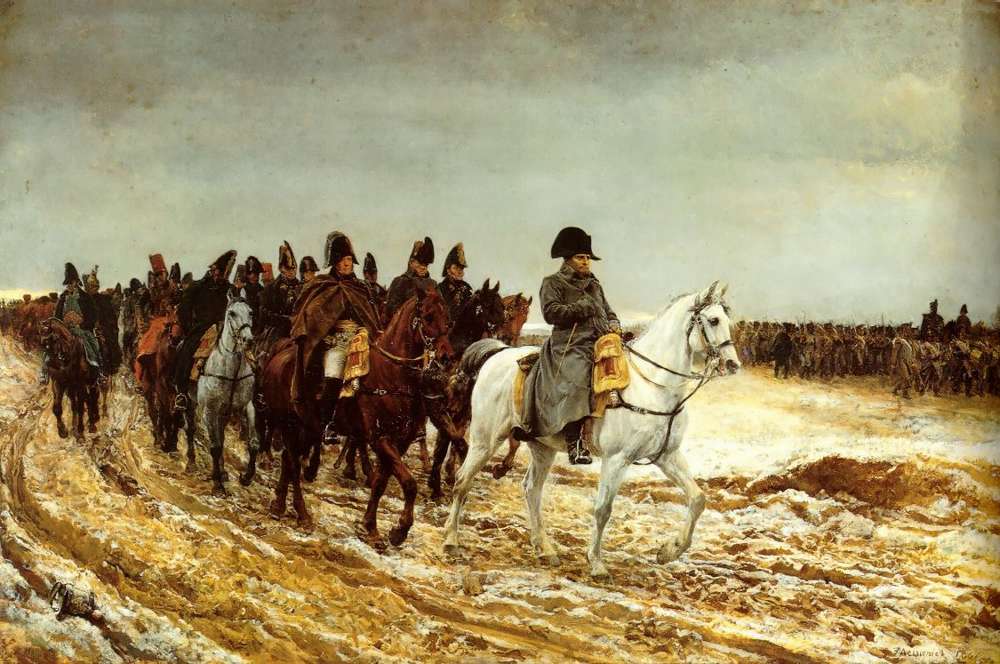
Jean-Louis Ernest Meissonier (French, 1815-1891). The French Campaign (1861) Oil on canvas. Musée d’Orsay, Paris.
In short video interview, Ross King talks about Meissonier and his fall into obscurity (Click here to see the video.)
Forgotten Master: Frederick Arthur Bridgman (American, 1847-1928)
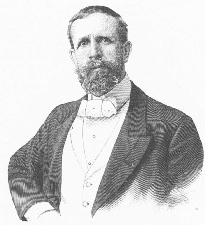
Frederick Arthur Bridgman, c. 1900
Bridgman was a born in Tuskegee, Alabama and died in Rouen, France in 1928. Joining other talented American painters, such as Thomas Eakins, he studied at the Ecole des Beaux-Arts in Paris in the studio of Jean-Léon Gérôme (1824-1904) from 1866 to 1870. Bridgman regularly participated in the Paris Salon and, in 1907, he was awarded the Légion d’Honneur. During his long and prolific career, Bridgman traveled to Morocco, Algeria, Egypt, Turkey and Syria to paint and document local customs.
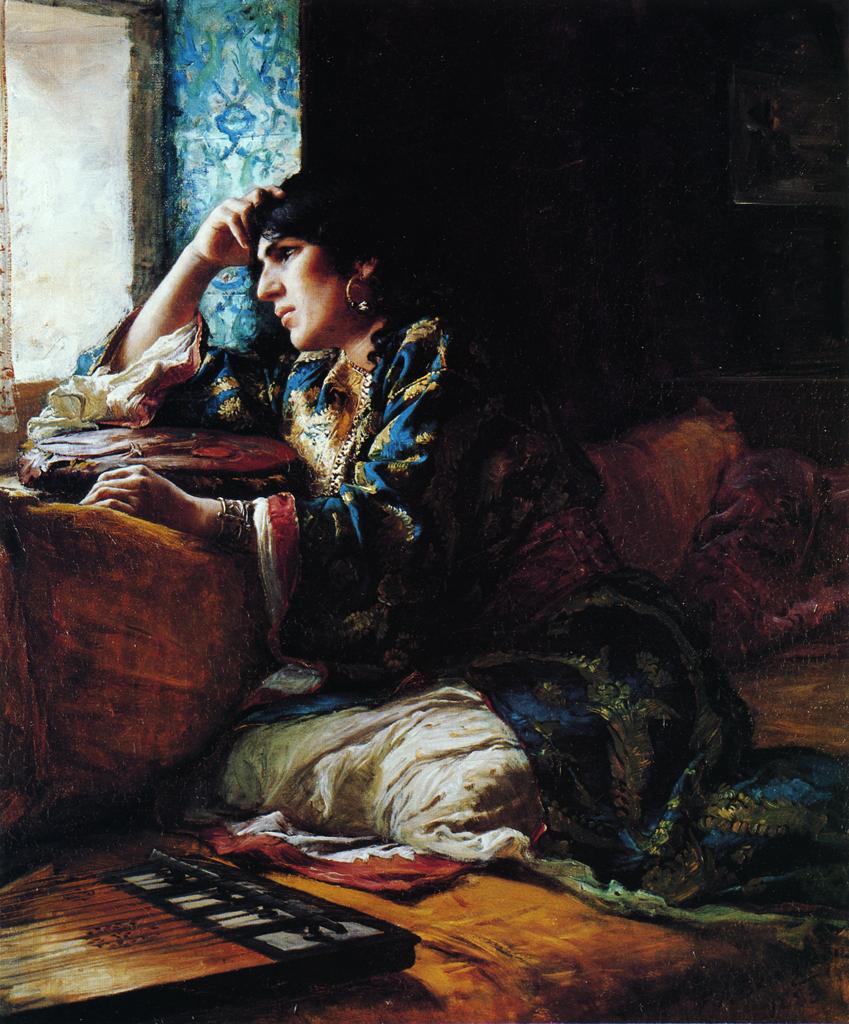
Frederick Arthur Bridgman. Aicha, a Woman of Morocco (1883) Oil on canvas. 21 1/2 BY 10 1/2IN. Newark Museum, New Jersey.
Some may object to labelling Bridgman as a “forgotten” master. His paintings regularly turn up at auctions and he is familiar to many nineteenth-century painting dealers and collectors. I submit that he is forgotten for two reasons: first, his work is rarely recognized on its own merit and second, his tendency to be self-promotional has deterred others from telling his story.
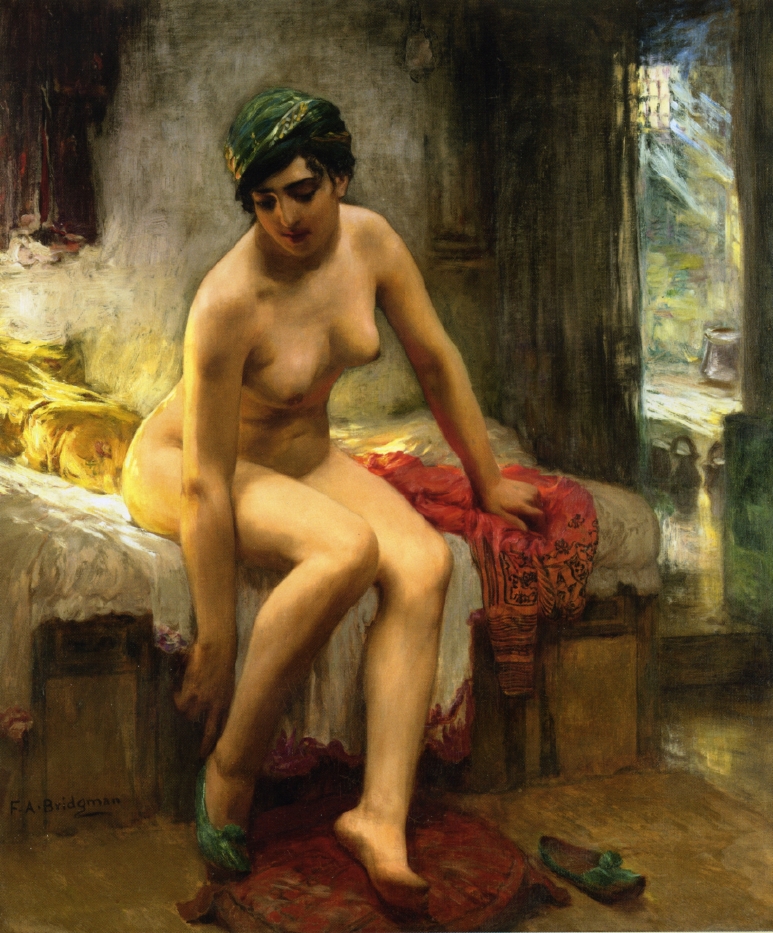
Frederick Arthur Bridgman. After the Bath. Oil on canvas. 31 BY 25 3/4IN. Private collection.
After nearly a century of obscurity, Orientalist painters have found their way into the limelight. Paintings by Bridgman, Max Ernst (Austrian, 1891-1976), and John Frederick Lewis (British, 1805-1876) have sold for higher prices at auction and, recently, been the subject of a major exhibition at Tate Britain. According to conversations I have had with auctioneers at Sotheby’s and Christie’s in London, increased interest has been driven by Middle-eastern collectors who often see orientalist paintings as the sole visual record of their nineteenth-century cultures.
As a result, interest in Bridgman’s paintings is rarely driven by an appreciation for his skill or creativity. Rather, Bridgman is grouped into a genre. To my knowledge, since his death, there has not been a biography or single exhibition in a major museum dedicated exclusively to Bridgman.

Frederick Arthur Bridgman. Abu Simbel (1874) Oil on canvas. 20 BY 30IN. Private Collection.
In the 1870s, Bridgman traveled to Algeria on a painting expedition. In addition to canvases, Bridgman took copious notes that, eventually, became a feature article in Atlantic Monthly Magazine. The article, along with reproductions of paintings from his trip have recently been reprinted in book format.
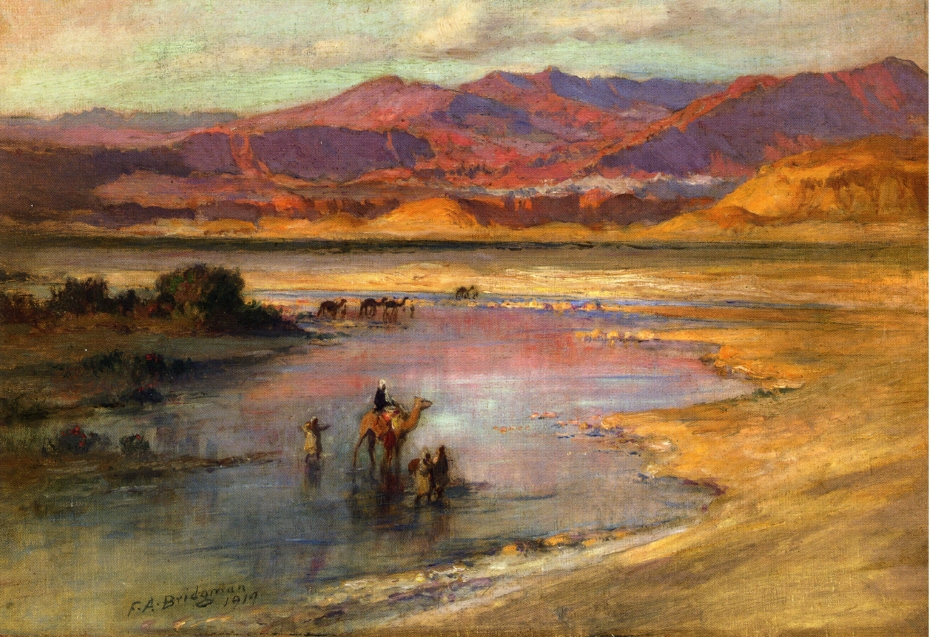
Frederick Arthur Bridgeman. Crossing an Oasis, with the Atlas Mountains in the Distance, Morocco (1919) Oil on Canvas. 13 BY 19 1/4IN. Private collection.
After World War I, Bridgman settled in Normandy, France. Although he continued to paint, his paintings were no longer shown publicly. He died in 1928 in near obscurity.
Links
- A blog dedicated to Bridgman with several images.
- Frederick Arthur Bridgman at the Anthenaeum includes over 35 images of Bridgman’s paintings available for free use.
- A longer biography on the artists taken from the book Les Orientalists de L’École Américaine by Gerald M. Ackerman.
Books
- Winters in Algeria by Frederick Arthur Bridgman
- Orientalists by Kristian Davies
- The Orientalists by Lynne Thornton
The Paris Salon or “Exhibition of Living Artists”

Francois Joseph Heim (French, 1787-1865) Charles X Distributing Awards to Artists Exhibiting at the Salon of 1824 at the Louvre (1827) MuseÌe du Louvre, Paris
In his book, The Judgment of Paris, Ross King compares Salon attendance to today’s most visited museum exhibitions:
[The Salon was] one of the greatest spectacles in Europe, it was an even more popular attraction, in terms of the crowds it drew, than public executions. Opening to the public in the first week of May and running for some six weeks, it featured thousands of works of art specially—and sometimes controversially—chosen by a Selection Committee. Admission on most afternoons was only a franc, which placed it within easy reach of virtually every Parisian, considering the wage of the lowest-paid workers, such as milliners and washerwomen, averaged three to four francs a day. Those unwilling or unable to pay could visit on Sundays, when admission was free and the Palais des Chaps-Élysées thronged with as many as 50,000 visitors—five times the number that had gathered in 1857 to watch the blade of guillotine descend on the neck of a priest names Verger who had murdered the Archbishop of Paris. In some years, as Many as a million people visited the Salon during its six-week run, meaning crowds averaged more than 23,000 people a day*
*To put these figures into context, the most well-attended art exhibition in the year 2003 was Leonardo da Vinci: Master Draftsman, at the Metropolitan Museum of Art in New York. Over the course of a nine-week run, the show drew and average of 6,863 visitors each day, with an overall total of 401,004. El Greco, likewise at the Metropolitan Museum of Art, averaged 6,807 per day during its three-month run in 2003-4, ultimately attracting 574,381 visitors. The top-ranked schibition of 2002, Van Gogh and Gaugin, at the Van Gogh Museum in Amsterdam, drew 6,719 perday for four months, with a final attendance of 739,117.
(Ross King. The Judgment of Paris. New York: Walker and Company, 2006. p. 17)
Comparing the Paris Salon to modern-day museum exhibitions is probably unfair. In the nineteenth century–before the advent of photography, radio, and movie theaters–painting was truly the most public art form. A more appropriate comparison would mostly likely be comparing Salon attendance to movie ticket sales. (How about comparing Ernest Meissonier’s painting Friedeland, the painting sold for the highest price in the nineteenth century and a Salon blockbuster, with Batman Begins?)

Ernest Meissonier (French, 1815-1891) 1807, Friedland (c. 1861-1875), Metropolitan Museum of Art, New York
If that is true, it would also be appropriate to consider the Paris Salons as some of the most culturally significant and telling events of the nineteenth century. Recently, while undertaking a research question, I was surprised to learn that there is little published about the Salon as an intitution previous to or after the Salon de Refusées in 1863.