Posts in Category: Art
Prix de Rome: One of the world’s most prestigious awards remembered
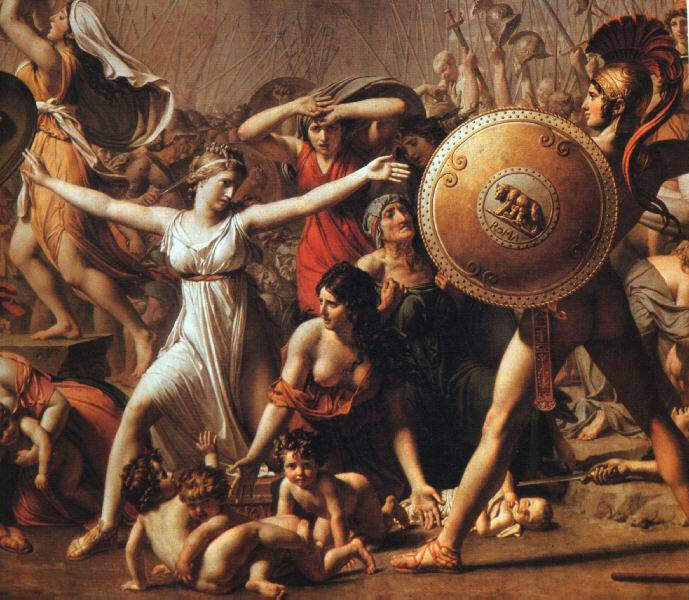
(The Sabine Women Enforcing Peace by Running Between the Combatants
detail by Jacques Louis David-Winner of the 1774 Prix de Rome)
In 1663, the French government, under the direction of the King, instituted the Prix de Rome. Its purpose was to send the nation’s most promising artists, architects, and composers to Rome to learn to work classical styles of the masters. A list of the winners, originally compiled on wikipedia, is found below.
Winners of the Prix de Rome became key figures in shaping art and culture when they returned home. They were instructors in the Ecole des Beaux-Arts in Paris and judges of the Paris Salon and composers for European opera houses.
They were seen as guardians of classical ideals and virtue in the arts by one generation. By another generation, beginning with the French Impressionists, they were sometime seen as too restrictive in their classical views.
After 320 years, the Prix de Rome was ended during the 1968 student revolts in France. There have been attempts to reignite the Prix de Rome. The most recent is in the Netherlands.
(You can read more about the Prix de Rome and its history at the official website half-heartedly maintained by the French government.)
Prix de Rome Winners:
The Architecture Category
- 1786 – Charles Percier
- 1823 – Félix Duban
- 1824 – Henri Labrouste
- 1833 – Victor Baltard
- 1840 – Théodore Ballu
- 1848 – Charles Garnier
- 1864 – Julien Guadet
- 1870 – Albert-Félix-Théophile Thomas
- 1878 – Victor Laloux
- 1880 – Louis Girault
- 1881 – Henri Deglane
- 1886 – Albert Louvet – “First Grand Prize” and “Second Prize”
- 1892 – Guillaume Tronchet
- 1899 – Tony Garnier
- 1923 – Jean-Baptiste Mathon
- 1955 – Ngo Viet Thu
The Painting Category
- 1682 – Hyacinthe Rigaud
- 1720 – François Boucher
- 1734 – Jean-Baptiste Pierre
- 1738 – Charles-Amédée-Philippe van Loo
- 1752 – Jean-Honoré Fragonard
- 1768 – François-André Vincent
- 1771 – Joseph-Benoît Suvée
- 1772 – Pierre-Charles Jombert, Anicet Charles Gabriel Lemonnier – “Second Grand Prize”
- 1773 – Pierre Peyron
- 1774 – Jacques-Louis David
- 1775 – Jean-Baptiste Regnault
- 1784 – Jean-Germain Drouais
- 1787 – François-Xavier Fabre
- 1789 – Girodet-Trioson
- 1790 – Jacques Réattu
- 1801 – Jean Auguste Dominique Ingres
- 1807 – François Joseph Heim
- 1808 – Alexandre-Charles Guillemot
- 1811 – Alexandre-Denis-Joseph Abel
- 1812 – L.V.L. Pallière
- 1813 – François-Edouard Picot[1]
- 1832 – Antoine Wiertz
- 1837 – Thomas Couture
- 1844 – Félix-Joseph Barrias
- 1849 – Gustave Boulanger
- 1850 – William-Adolphe Bouguereau, Paul Baudry
- 1858 – Jean-Jacques Henner
- 1861 – Léon Perrault
- 1865 – André Hennebicq
- 1868 – Édouard-Théophile Blanchard[2]
- 1880 – Henri Lucien Doucet
- 1884 – Edouard Cabane – “Second Prize”
- 1891 – Hubert-Denis Etcheverry – “Second Prize”
- 1906 – Albert Henry Krehbiel
- 1910 – Jean Dupas
- 1924 – René-Marie Castaing
- 1925 – Odette Pauvert – First “First Grand Prize” obtained by a woman
- 1930 – Salvatore DeMaio
- 1948 – John Heliker
- 1950 – Paul Collomb – “First Grand Prize” and “Second Prize”
- 1960 – Pierre Carron
The Sculpture Category
- 1748 – Augustin Pajou
- 1812 – François Rude
- 1813 – James Pradier
- 1832 – François Jouffroy
- 1855 – Henri-Michel-Antoine Chapu
- 1864 – Louis-Ernest Barrias
- 1901 – Henri Bouchard
- 1919 – César Schroevens – “Third Prize”
The Engraving Category
- The engravery prize was created in 1804 and suppressed in 1968 by André Malraux, the minister of the Culture.
- 1906 – Henry Cheffer
- 1910 – Jules Piel
- 1911 – Albert Decaris
- 1921 – Pierre Gandon
- 1952 – Claude Durrens
The Musical Composition Category
- 1803 – Albert Androt
- 1804 – no Grand Prize awarded
- 1805 – Ferdinand Gasse (“first” First Grand Prize) and Victor Dourlen (“second” First Grand Prize)
- 1806 – Victor Bouteiller
- 1807 – no Grand Prize awarded
- 1808 – Pierre-Auguste-Louis Blondeau
- 1809 – Louis Joseph Daussoigne-Méhul
- 1810 – Désiré Beaulieu
- 1811 – Hippolyte André Jean Baptiste Chélard
- 1812 – Louis Joseph Ferdinand Herold (“first” First Grand Prize) and Félix Cazot (“second” First Grand Prize)
- 1813 – Auguste Panseron
- 1814 – P.-G. Roll
- 1815 – François Benoist
- 1816 – no Grand Prize awarded
- 1817 – Désiré-Alexandre Batton
- 1818 – no Grand Prize awarded
- 1819 – Fromental Halévy (“first” First Grand Prize) and P.-J.-P.-C. Massin-Turina (“second” First Grand Prize)
- 1820 – Aimé Ambroise Simon Leborne
- 1821 – L.-V.-E. Rifaut
- 1822 – J.-A. Lebourgeois
- 1823 – E. Boilly and L.-C. Ermel
- 1824 – A.-M.-B. Barbereau
- 1825 – A. Guillion
- 1826 – C.-J. Paris
- 1827 – J.-B.-L. Guiraud
- 1828 – G. Ross-Despréaux
- 1829 – no Grand Prize awarded
- 1830 – Hector Berlioz (“first” First Grand Prize) and Alexandre Montfort (“second” First Grand Prize)
- 1831 – Eugène-Prosper Prévost
- 1832 – Ambroise Thomas
- 1833 – A. Thys
- 1834 – A. Elwart
- 1835 – Ernest Boulanger
- 1836 – X. Boisselot
- 1837 – L.-D. Besozzi
- 1838 – A.-G.-J. Bousquet
- 1839 – Charles Gounod
- 1840 – F.E.V. Bazin
- 1841 – L. Maillard
- 1842 – A.-A. Roger
- 1843 – no Grand Prize awarded
- 1844 – V. Massé
- 1845 – no Grand Prize awarded
- 1846 – L.-G.-C. Gastinel
- 1847 – P.-L. Deffès
- 1848 – J.-L.-A. Duprato
- 1849 – no Grand Prize awarded
- 1850 – J.-A. Charlot
- 1851 – J.-C.-A. Delehelle
- 1852 – L. Cohen
- 1853 – P.-C.-C. Galibert
- 1854 – G.-N. Barthe
- 1855 – J. Conte
- 1856 – no Grand Prize awarded
- 1857 – Georges Bizet
- 1858 – S. David
- 1859 – Ernest Guiraud
- 1860 – Emile Paladilhe
- 1861 – Théodore Dubois
- 1862 – L. Bourgault-Ducoudray
- 1863 – Jules Massenet
- 1864 – Victor Sieg
- 1865 – Charles Ferdinand Lenepveu
- 1866 – Émile Louis Fortuné Pessard – “1st Harmony Prize”
- 1867 – no prize awarded
- 1868 – V.-A. Pelletier-Rabuteau and E. Wintzweiller
- 1869 – Antoine Taudou
- 1870 – Charles Edouard Lefebvre and Henri Maréchal
- 1871 – Gaston Serpette
- 1872 – Gaston Salvayre
- 1873 – Paul Puget
- 1874 – Léon Erhart
- 1875 – André Wormser
- 1876 – Paul Joseph Guillaume Hillemacher
- 1877 – no Grand Prize awarded
- 1878 – Clément Broutin
- 1879 – Georges Hüe
- 1880 – Lucien Joseph Edouard Hillemacher
- 1881 – no Grand Prize awarded
- 1882 – Georges Marty
- 1883 – Paul Vidal
- 1884 – Claude Debussy
- 1885 – Xavier Leroux
- 1886 – André Gedalge – “Second Prize”
- 1887 – Gustave Charpentier
- 1894 – Henri Rabaud
- 1908 – Nadia Boulanger – “Second Prize”
- 1913 – Lili Boulanger
- 1914 – Marcel Dupré
- 1919 – Jacques Ibert – “First Grand Prize”
- 1923 – Jeanne Leleu – “First Grand Prize”
- 1923 – Robert Bréard – “Second Prize”
- 1934 – Eugène Bozza
- 1935 – Samuel Barber
- 1938 – Henri Dutilleux
- 1953 – Jacques Castérède
- 1955 – Pierre Max Dubois
“Neo-classicist” Graydon Parrish
NPR recently did a story on the artist Graydon Parrish. (Click here to listen to the story.) The story centers around his painting memorializing the fall of the Trade Center Towers.
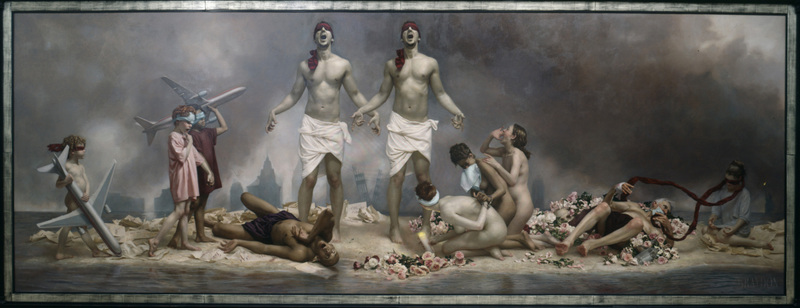
The painting relies heavily on symbolism and comes with a four-page pamphlet describing the contents of the painting (e.g. a burning US Constitution, a faded Statue of Liberty). It begs the question: In a world where symbolism is not readily understood, can we return to the style of painting of the Old Masters?
“Combat Art” in Iraq: US Marine Michael Fay

from his blog, http://mdfay.blogspot.com/
In today’s Wall Street Journal, Daniel Grant talk about US Marine “combat artists” currently working in Iraq. From the article:
“The military uses artists in a variety of roles. Most create recruiting posters, maps and diagrams, and animation for interactive military-training software, but some also produce combat art. Those soldiers will go into the field with a platoon, drawing and painting scenes of military life.”
From “This Military Basic Training Is in Art” by Daniel Grant (Wall Stret Journal | October 18, 2006)
A quick search on the Google took me to the blog of Michael Fay, who describes himself as “one of three combat artists for the United States Marine Corps.” His blog (http://mdfay.blogspot.com/) features work, in various stages, that he has done in the field.
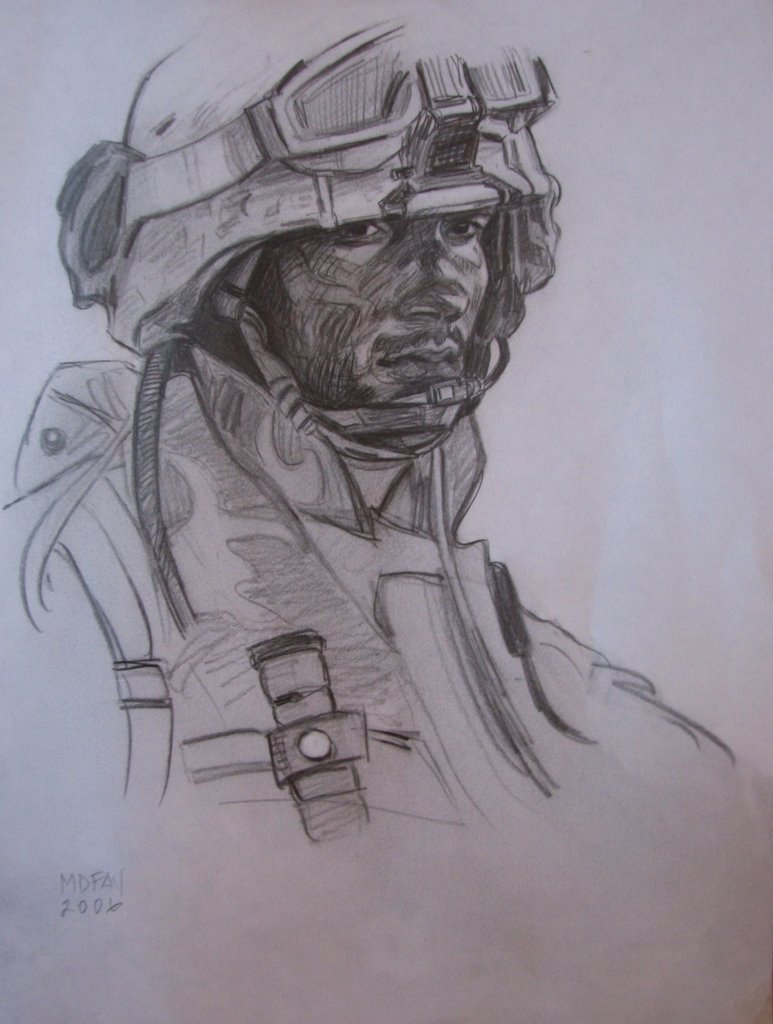
from his blog, http://mdfay.blogspot.com/
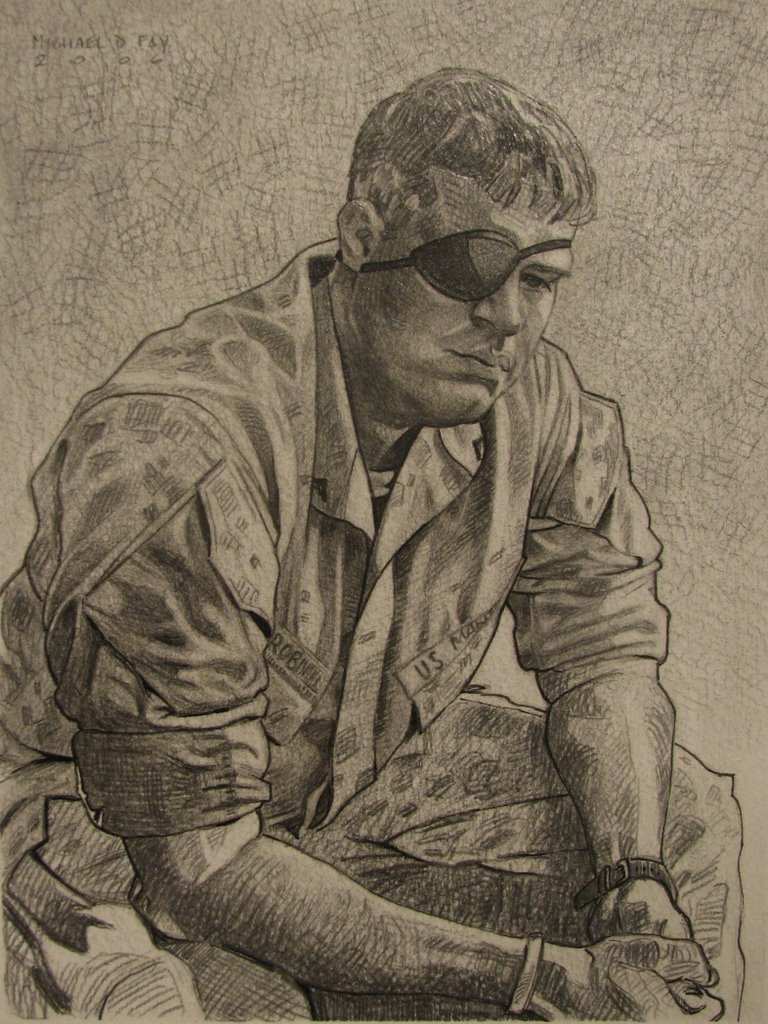
from his blog, http://mdfay.blogspot.com/
His paintings evoke for me the kind of 19-century painting done by the French artists accompanying Napoleon on the Nile. (There is currently an exhibition on this French art at the Dahesh Museum in New York.) It’s a wonderful surprise to know that the Military is supporting this kind of reflection on their work.