Posts in Category: Ramblings/Ideas
The Prodigal Son in Modern Life Series by James Tissot
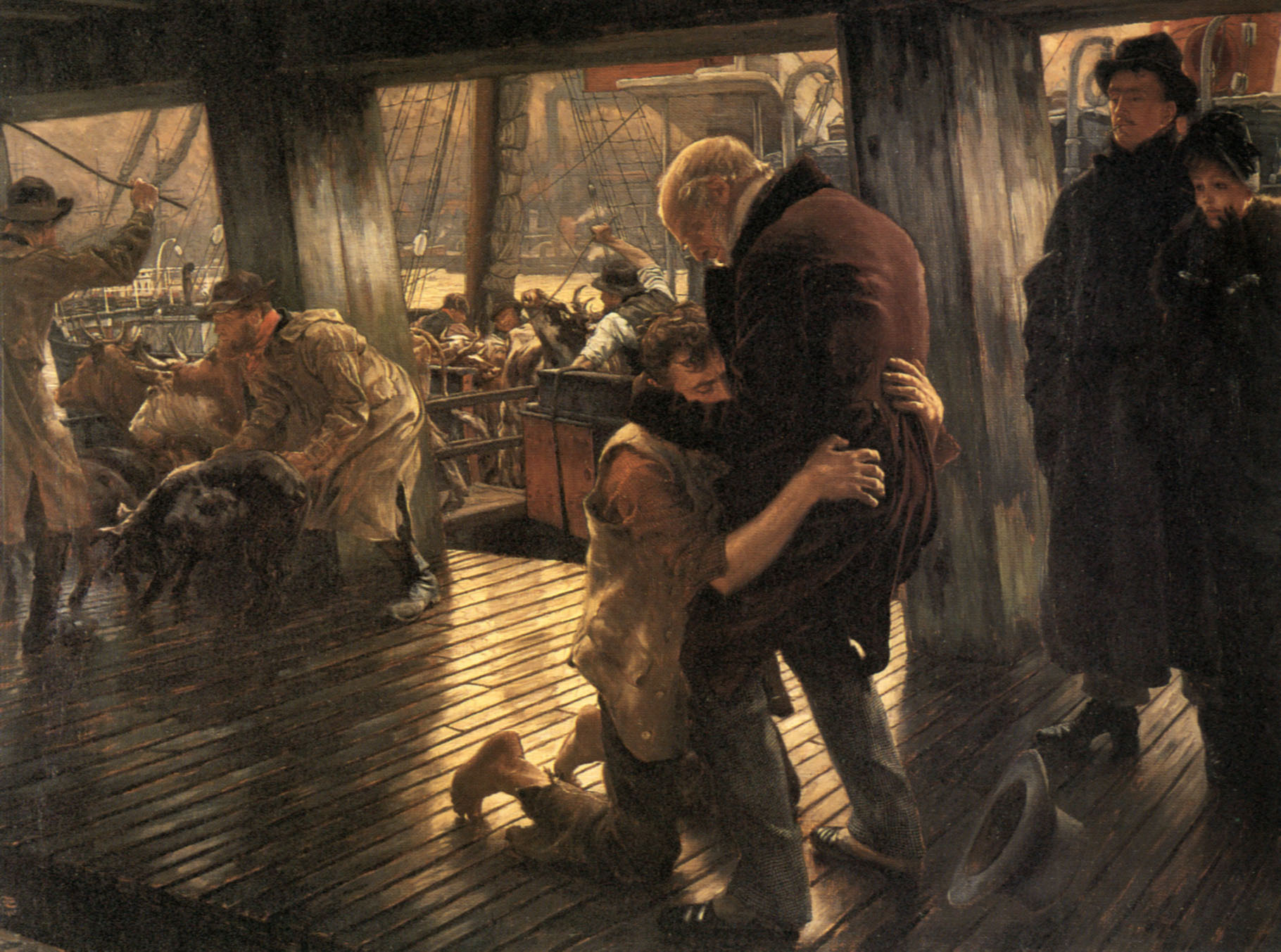
James Jacques Joseph Tissot (1836-1902) The Prodigal Son in Modern Life: The Return. Oil on Canvas (c. 1882) Muse?e de Nantes, France. (Click for high-resolution image.)
After such a long absence, I thought it fitting to make this post’s topic reflect both my sincere repentance at not having actively updated the blog and my hopes that I’ll be forgiven by those who have been patiently waiting for any sign I was still alive.
I have been in deep-research mode, and have a number of exciting things to share. Next week, I’ll begin off-loading a number of the projects I am doing on the blog and, hopefully, reignite a dialogue with many of you.
Tissot’s Prodigal Son in Modern Life
James Tissot (French, 1836-1902) is largely remembered for his scenes and portraits of the upper-middle class, but, during the 1880s he had a religious awakening and produced a number of works inspired by the New Testament. In 1885, he had what he referred to as an “epiphany” and “revelation” that lead him on a pilgrimmage to cathedrals in France and to create a series of 35 scenes from the life of Christ.
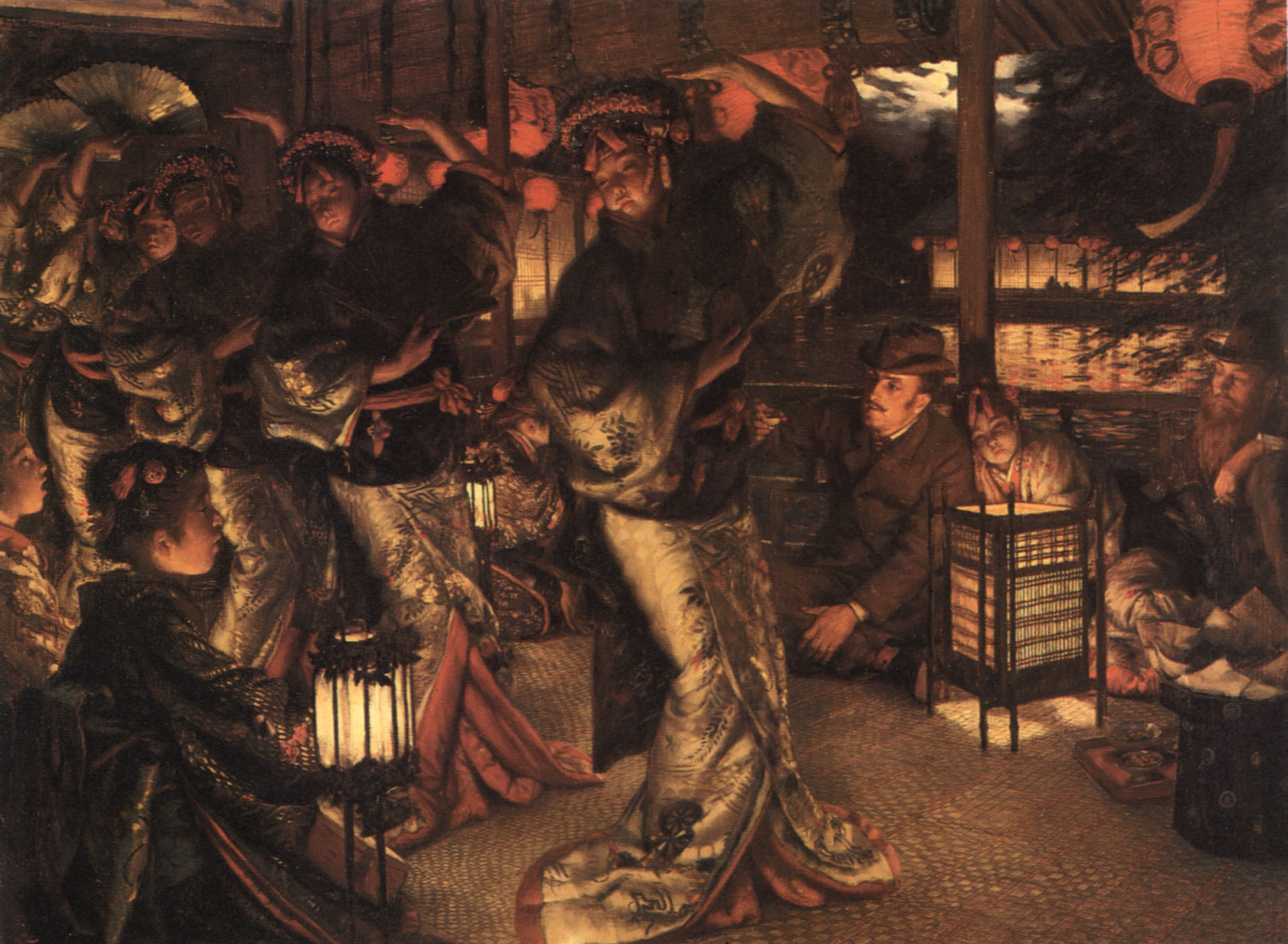
James Jacques Joseph Tissot (1836-1902) The Prodigal Son in Modern Life: In Foreign Climes. Oil on Canvas (c. 1882) Muse?e de Nantes, France. (Click for high-resolution image.)
During this religious decade Tissot did multiple version of the Prodigal Son. This particular series is titled “The Prodigal Son in Modern Times” and consists of three paintings all set in contemporary English life. They were exhibited at a one-man show at the Dudley Gallery (London) in May of 1882 and accompanied by watercolor sketches of the same paintings and etchings that were later reproduced widely in England.

James Jacques Joseph Tissot (1836-1902) The Prodigal Son in Modern Life: The Departure. Oil on Canvas (c. 1882) Muse?e de Nantes, France. (Click for high-resolution image.)
Shortly after the show, Tissot returned to France and took the three original oils with him. They remained in his studio until his death in 1902 and were, then, offered to the Louvre, which would not take them. Instead, the three paintings were taken by Musée de Nantes, located in Tissot’s hometown, where they remain today.
Restoring a Masterpiece: CSI for the Art World, Only Happier
Artwork is not often built to last or to move, yet we insist on both. Some time ago, I worked with a collector of eighteenth-century French paintings who regularly shipped works to his home in Utah. Moving paintings from a relatively humid Western Europe to the American desert compounded other problems associated with older works of art. Paint decays over time, causing colors to lose their original hues. Glazes age, darken colors and yellowing the overall work. But, perhaps more dangerous that all of these is the lack of–or dramatic increase in–humidity. Works on panel (i.e. wood), in particular, tend to crack, buckle or completely detiorate. Solving these problems can cause collectors to recruit a CSI-like team of experts to stabalize restore and conserve a work.
(Dim your computer screen to emulate CSI filming.)
In trying to explain this to another collector, I was very happy to find this video, published by the Indianapolis Museum of Art on the restoration and conservation of a major work in its collection: Madonna and Child with St. Nicolas of Babi and St. Justina by Sebastiano Mainardi (San Gimignano, 1460-1513). Painted with oil on wood, the altarpiece was moved to the US in the early twentieth century. At the time, in order to stablized the large panel of wood it was painted on, a complex lattice of wood–called a “cradle”–was fastened to the back. Cradles were a typical solution to stabalizing wood panels throughout the nineteenth century. Though well intentioned, they prevent wood from breathing and cause it to buckle and crack, which then leads to problems with the paint on its surface. The solution, as demonstrated by the video, can stretch the capabilities of modern technology.
The Most Wanted Painting (The Flemish Were Not Far Off)
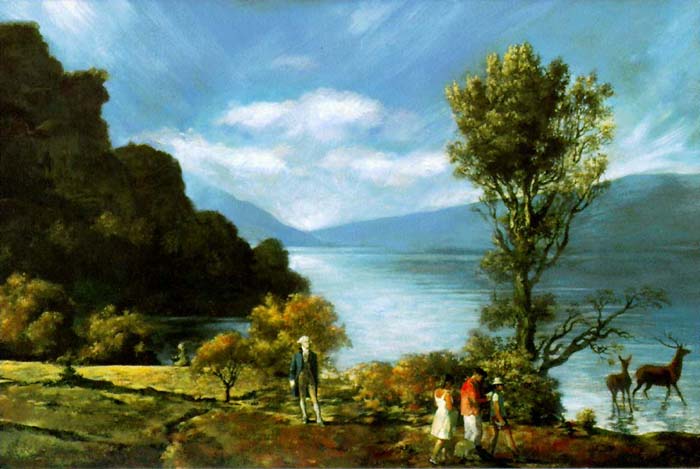
Vitaly Komar and Alex Melamid. Most Wanted Painting, America. (1995) Digital composite image.Vitaly Komar and Alex Melamid. Most Wanted Painting, America. (1995) Digital composite image. (Note George Washington in the center of the work.)
What if we made art according to surveys? What if artists, like many politicians, relied on polls? This week, the public radio show This American Life features an interview with two digital artists, Vitaly Komar and Alex Melamid, who received a grant from Chase Manhattan Bank to determine the attributes of the most and least wanted painting. To do this, Komar and Melamid conducted a number of online surveys allowing participants to choose their favorite elements from famous works. The result has been called the “most wanted” painting.
Having read through study, it is difficult to determine the level of professionalism in its methods. The results were only published online and were never peer reviewed. Regardless of its integrity, it is an interesting exercise.
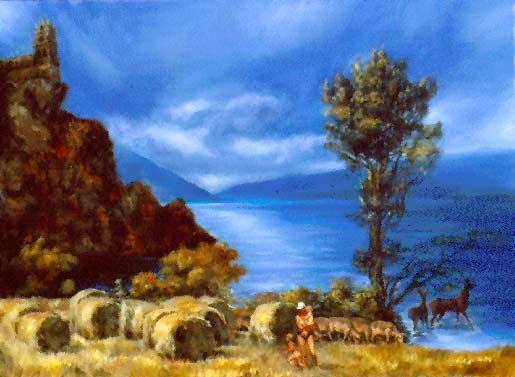
Vitaly Komar and Alex Melamid. Most Wanted Painting, France. (1995) Digital composite image.
Of the dozen countries represented in the study, all of them, with the exception of Holland, preferred realistic landscapes. The Dutch, for reasons unexplained in the study, value abstract art, which, for most other countries, is the “least preferred” type of painting. The contents of the “most wanted” are surprisingly uniform:
- landscape
- mountain on the left
- tree on the right
- wild animals
- gathering of people
- famous political figure
- strong blues
The elements read like a description of any number of sixteenth-century Flemish paintings.
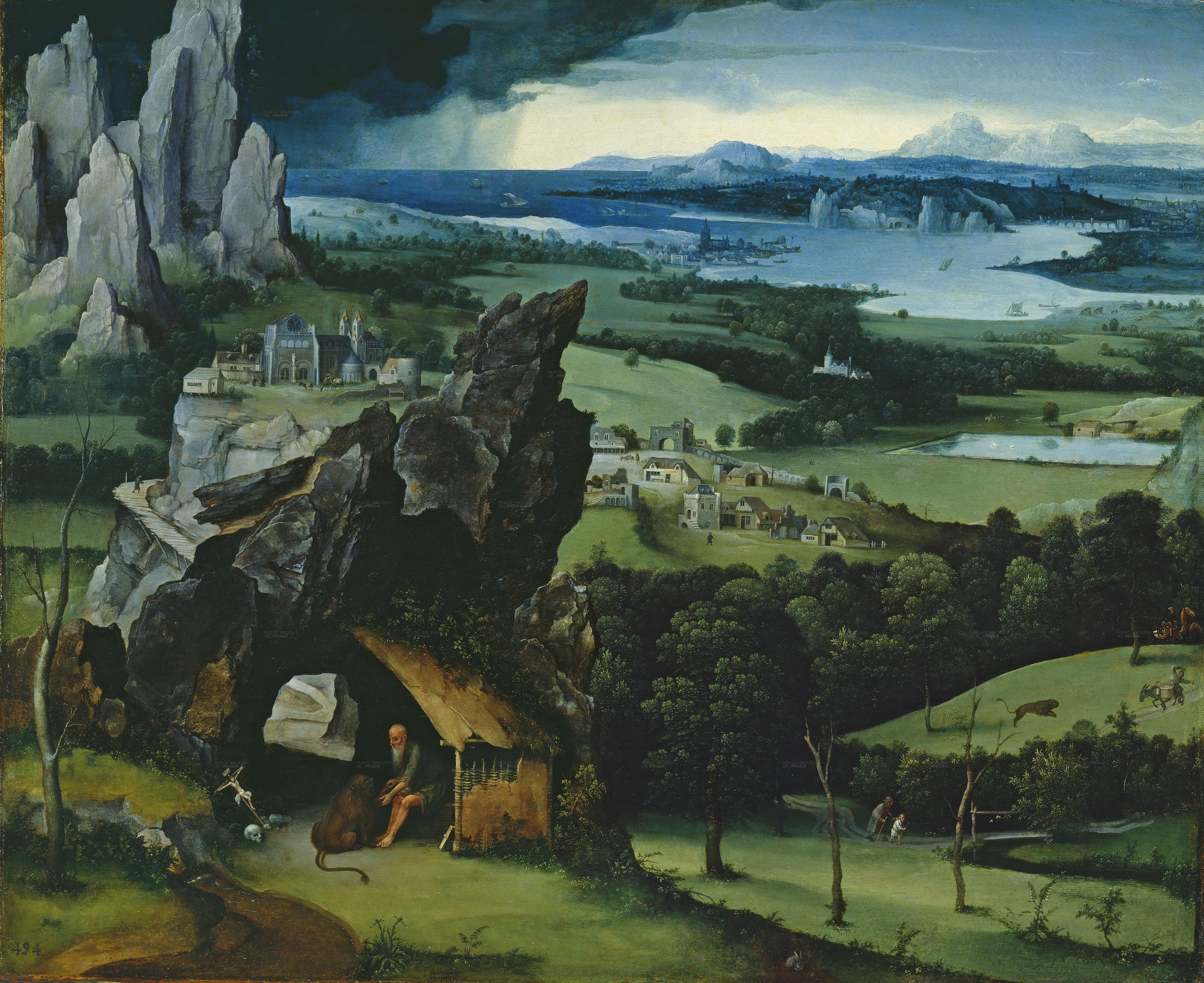
JOACHIM PATINIR (Flemish, 1480-1524) Landscape with Saint Jerome (c. 1516-1517) Oil on board. 74 BY 91 cm. Prado Museum, Madrid.
Several years ago, I had a conversation with one of London’s foremost dealers of Old Masters paintings. He told me that, of all paintings, landscapes were the most popular in his gallery. When asked “Why?” he responded: “I suppose it is because they are the least controversial. They can be enjoyed without taxing the viewer. And, they do not make any overt political or value statements that need to be defended.”
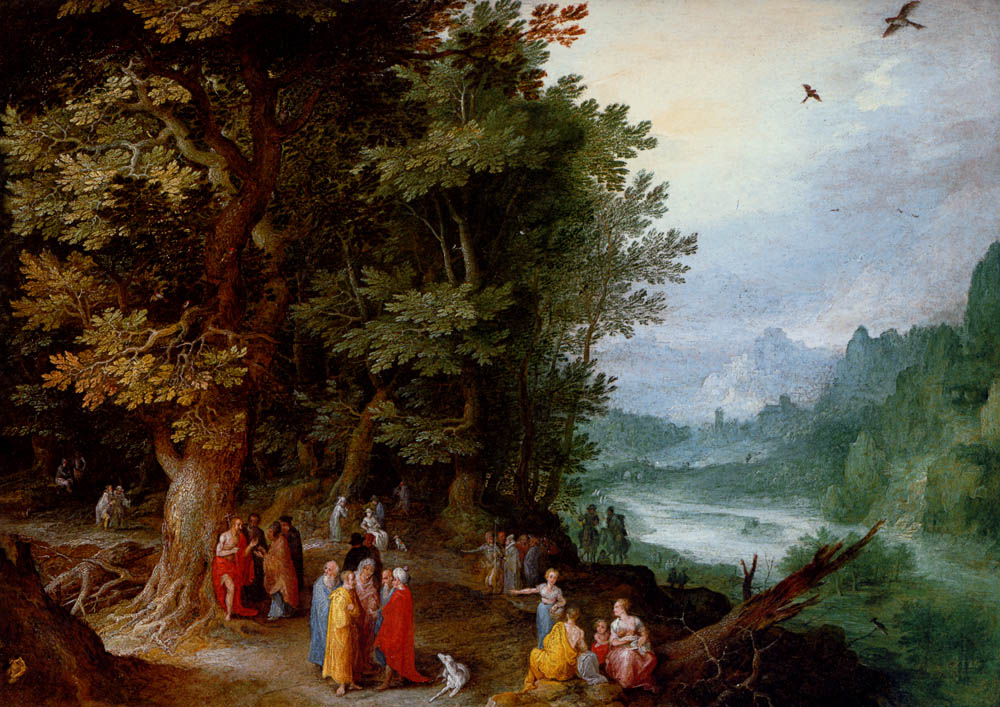
JAN BREUGHEL, THE ELDER (1568-1625) Saint John preaching in the wilderness (c. 1615) Oil on copper 25.5 BY 35 cm.
No doubt there are many reasons to love these paintings that have little to do with political correctness. Personally, I love works by Patinir and Jan Breughel. They were often small and, rather than hung on a wall, meant to be looked at while holding them on a lap with with a magnifying glass. The paintings are full of rich detail, distant views, and multiple paths. These are works that can be looked at again and again, each time with a new discovery.
The idea that painting could be put together by committee flies in the face of our belief in the lone genius painter. However, in their public radio interview the authors of “The Most Wanted Painting” study are quick to point out that the notion that our ideas about a creative genius are just as clichéed and inaccurate as our judgment that painting by polls are somehow unable to create good art. Though I am not suggesting art should be created by polling, I would suggest an adjustment to anyone attempting to repeat and improve upon the “most wanted” painting.
Several years ago, Malcolm Gladwell, author of many books and a writer for the New Yorker, gave a lecture on “What we can learn from spaghetti sauce.” In it, he profiles a food scientist that found that instead of trying to satisfy the American palette with one perfect spaghetti sauce–the unreachable Holy Grail for food production industry-we should be looking for the perfect sauces. According to taste testings, Americans fell into one of three categories of spaghetti sauce. The same proved true for coffee and a number of other foods. As a result, most companies produce a limited variety of each category of food to meet the needs of each general group’s taste.
If I were a gambling man, I would bet that the same would be true for the “most wanted” painting. Perhaps someone reading this would be able to convince Chase Manhattan Bank for a second grant.
Drawing Is Not the Only Way to Paint (e.g. Velázquez)
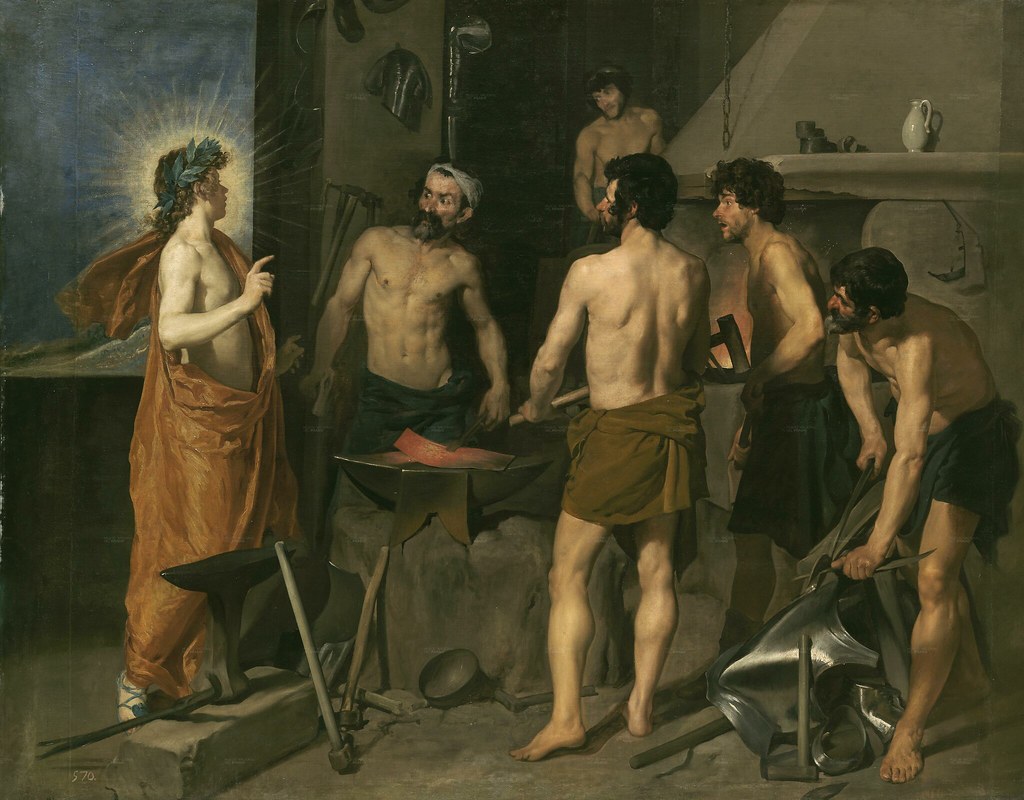
Diego Rodríguez de Silva y Velázquez (Spanish, 1599-1660) The Forge of Vulcan (1630) Oil on canvas. 230 BY 290CM. Prado Museum, Madrid. (Click image for larger version)
In several of my posts, I have pressed the importance of drawing. But it is important to know that not all the greats drew. One artist, in particular, who did not was Diego Rodríguez de Silva y Velázquez (Spanish, 1599-1660). Simply known as “Velázquez,” he was the greatest painter in the history of Spain and admired everywhere by academic and non-academic painters alike.
As mentioned in a previous post, Leon Bonnat, who became Director of the Ecole des Beaux Arts, regularly sent his students to Mardrid to study Velázquez’s works. Thomas Eakins said he was the “greatest painter who ever lived.” Painters as diverse as Millet, Manet, Sargent, Degas, Courbet, and Whistler admired and studied Velázquez’s paintings. They alll may have been surprised to learn what modern technology has taught us about Velázquez’s working method.
We know of only about 100 paintings by Veláquez, 45 of which are kept in the Prado Museum in Madrid. There, they have undergone chemical analysis of his pigments and a barrage of tests to show what lies under the paint. In the book Velázquez: The Technique of a Genius, Jonathan Brown and Carmen Garrido publish some of these findings.
Velázquez does not seem to have started with a fixed idea for a composition, but rather preferred to see what happened as he worked, making adjustments as he painted . . . The contours of figures overlap as their position in the composition changes or as elements are added or subtracted. Even within the forms of individual figures changes can be observed. The positions of hands and sleeves are adjusted, collars and lace are shifted, as are other parts of costume.
Landscape and neutral interior backgrounds were added, generally speaking, after the contours of the figures had been established.
(Jonathan Broan and Carmen Garrido, Velazquez: Technique of a Genius. (New Haven and London: Yale University Press, 1998), p. 18.)
One of my favorite paintings by Velázquez, The Forge of Vulcan, is a good example of this improvisational approach. Originally, the head of Vulcan, the older man in the left-hand side of the painting, was turned away from Apollo.
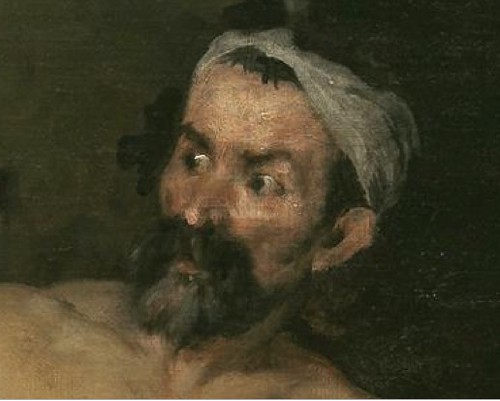
Diego Rodríguez de Silva y Velázquez (Spanish, 1599-1660) The Forge of Vulcan, detail. (1630) Oil on canvas. 230 BY 290CM. Prado Museum, Madrid.
To the left of Vulcan’s head, we can see a dark patch of brown paint where the back of his head used to be. In addition to this change, Velázquez enlarged the canvas. Over time, the pieces that were glued on became separated from the original piece and lines on the left and right of the canvas have become visible (See the first image.)
Not having drawn out the composition before hand, Velázquez created more work for himself. At the same time, it allowed him to go where his creativity led.
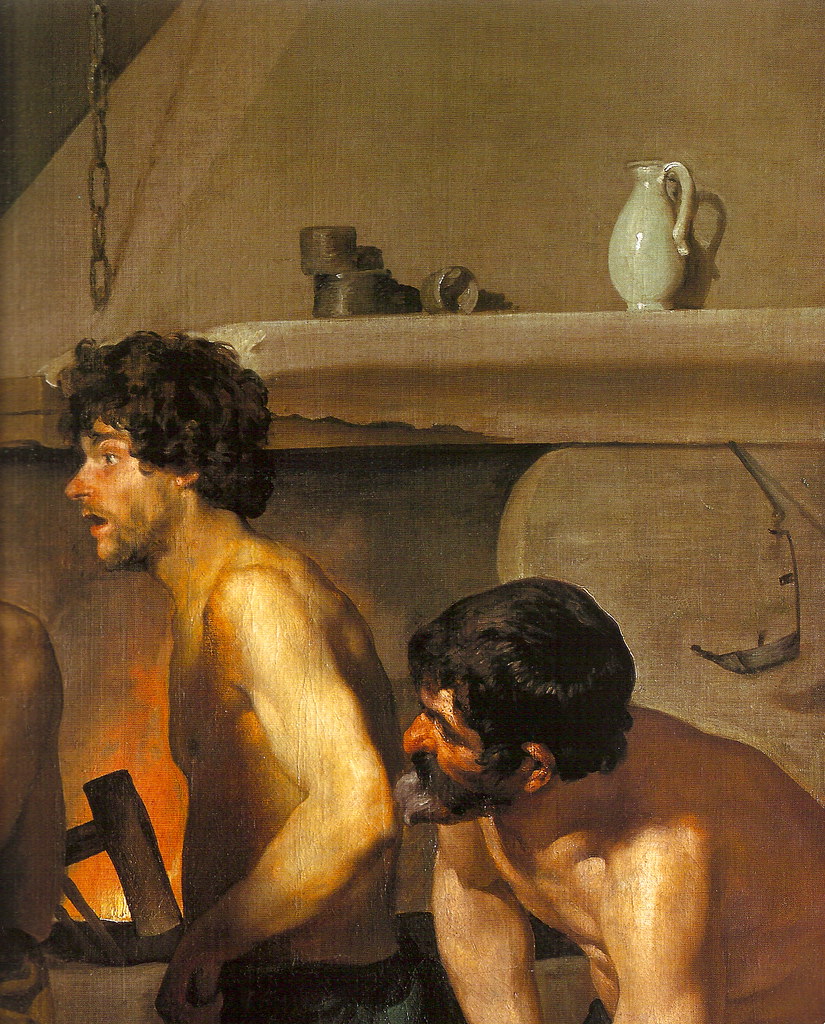
Diego Rodríguez de Silva y Velázquez (Spanish, 1599-1660) The Forge of Vulcan, detail. (1630) Oil on canvas. 230 BY 290CM. Prado Museum, Madrid. (Click image for larger version)
The results are stunning.
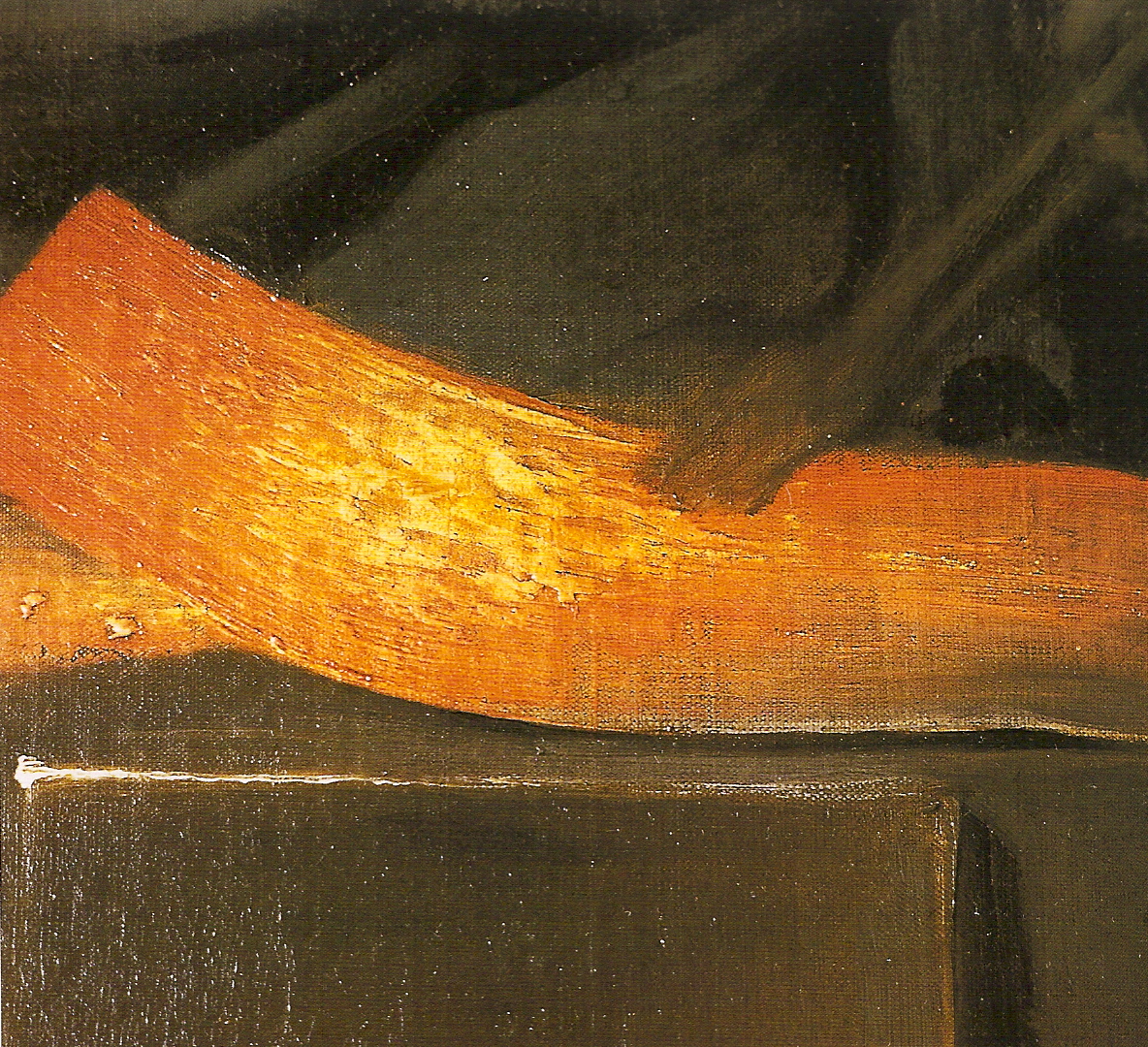
Diego Rodríguez de Silva y Velázquez (Spanish, 1599-1660) The Forge of Vulcan, detail. (1630) Oil on canvas. 230 BY 290CM. Prado Museum, Madrid. (Click image for larger version)
Obviously, drawing isn’t everything.
A Rediscovered Archive of Spanish Drawings: The Academia de San Fernando de Bellas Artes in Madrid
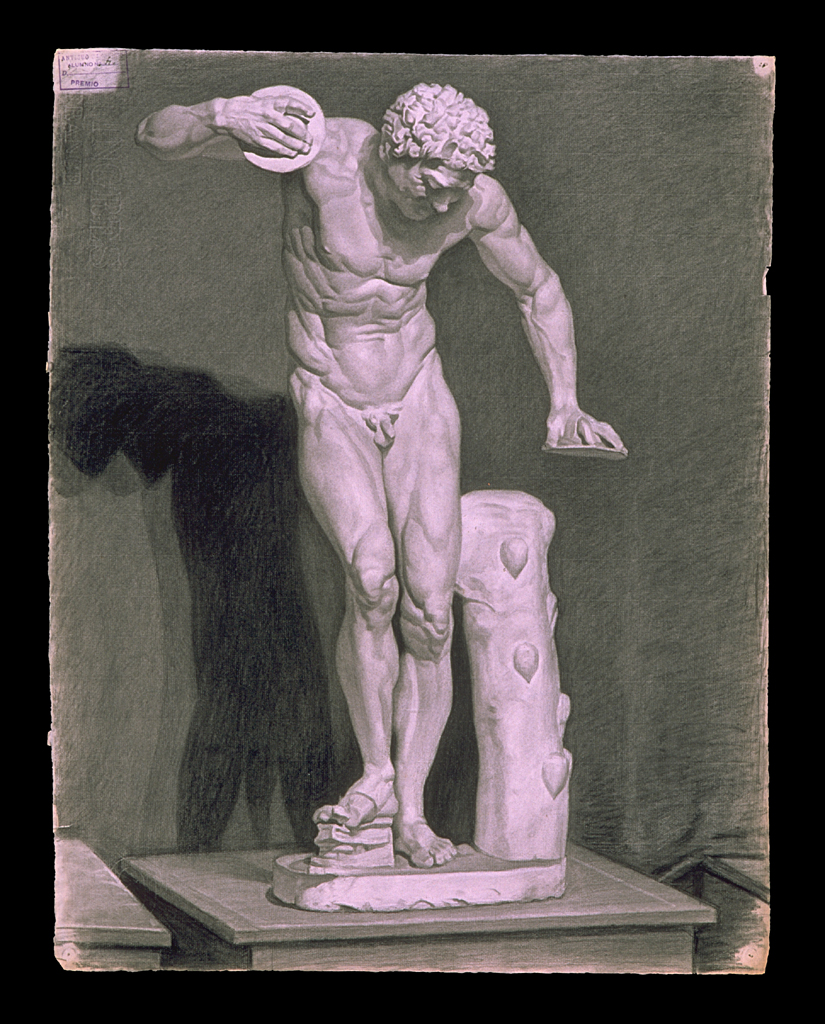
Anonymous (Spanish, c. 1870) Satyr with his cymbals or Sátiro tocando los platillos. Graphite on paper. 61.6 BY 48.3CM. Colección de Bellas Artes, Universidad Complutense, Madrid.
(All of the drawings in this post are by eighteenth and nineteenth-century students of the Academia de San Fernando. I am extemely grateful for the help of the brilliant Angeles Vian Herrero, Director of the Library of the Facultad de Bellas Artes of the Universidad Cumplutense in Madrid. These and many more drawings are available at a new website she has created for them. For larger versions of each image in this post, please click each work.)
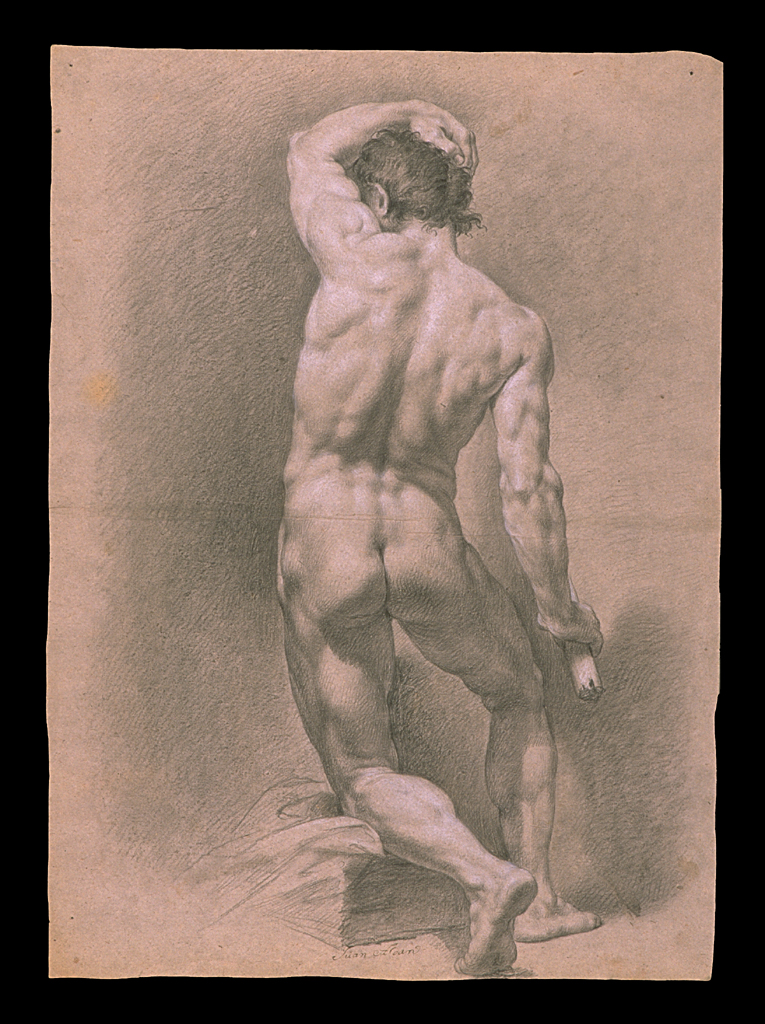
Juan Adán Morlán (Spanish) Desnudo masculino de espaldas con una pierna apoyada en un escalón. (a. 1741-1816) Pencil and pastel on paper, 54.4 BY 39.3CM. Colección de Bellas Artes, Universidad Complutense, Madrid.
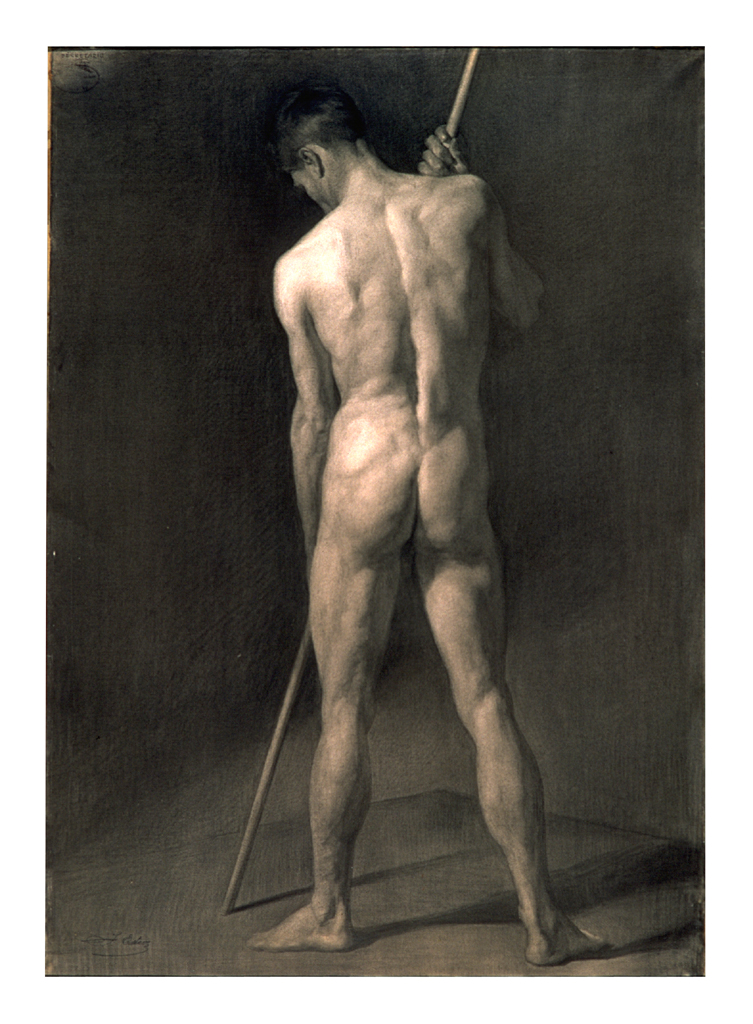
Anonymous (Spanish). Colección de Bellas Artes, Universidad Complutense, Madrid.
Nineteenth-century art academies all over Europe used drawing as the foundation for art education. As I have noted before on this blog, Jean-Dominique Auguste Ingres (French, 1780-1867), once said “Over three quarters of what constitutes painting is comprised of drawing. If I had to put a sign above my door I would write: ‘School of drawing,’ and I’m sure that I would produce painters.” (It was not until the mid-1860s that oil painting was taught at the Ecole des Beaux-Arts, where Ingres had been the director from 1825-1841. His approach to artist training was adopted in Spain’s most important school for artists, the Academia de San Fernando de Bellas Artes in Madrid.
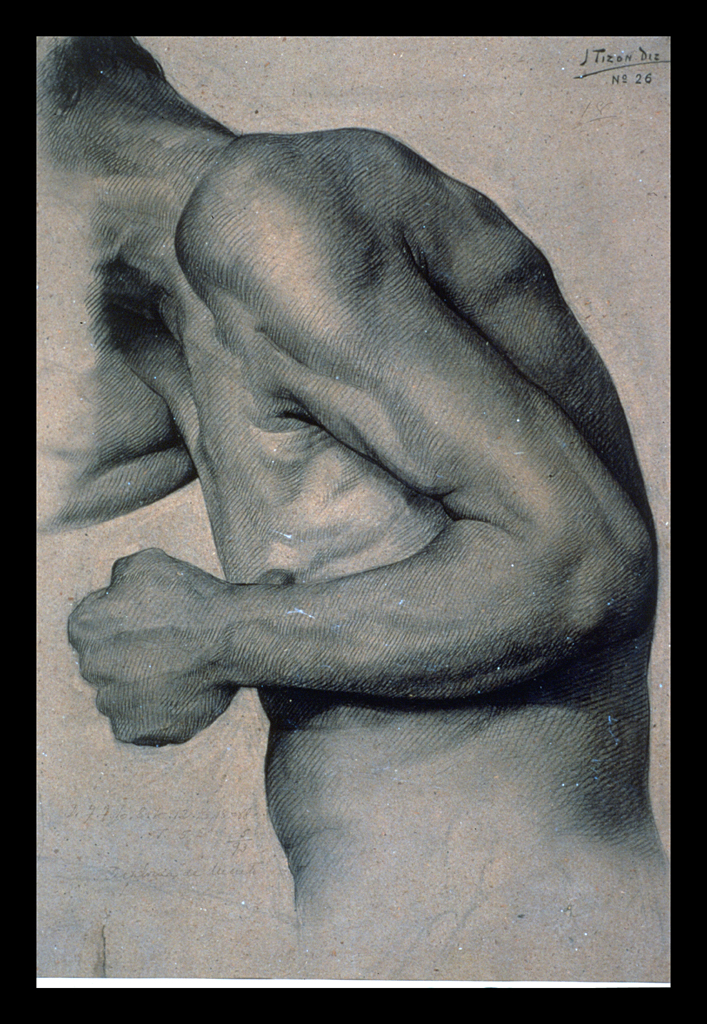
Anonymous (Spanish). Colección de Bellas Artes, Universidad Complutense, Madrid.
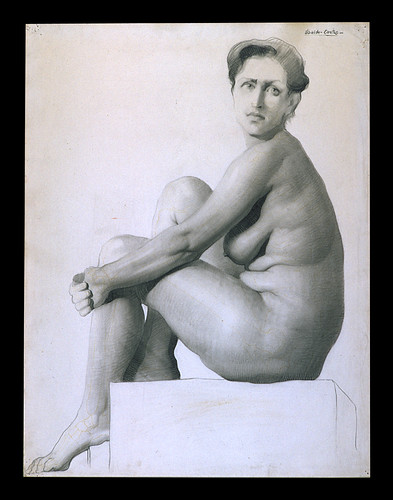
Anonymous (Spanish, c. 1850) Study of nude female. Graphite on paper. Colección de Bellas Artes, Universidad Complutense, Madrid.
The Academia de San Fernando de Bellas Artes was founded in 1752. Based in Madrid, it was one of several art academies in Spain (other cities with academies included Barcelona, Valencia, Zaragosa, and Seville). By the mid-nineteenth century, the Academia de San Fernando had become the dominant art academy in Spain and the model for art education throughout the country.
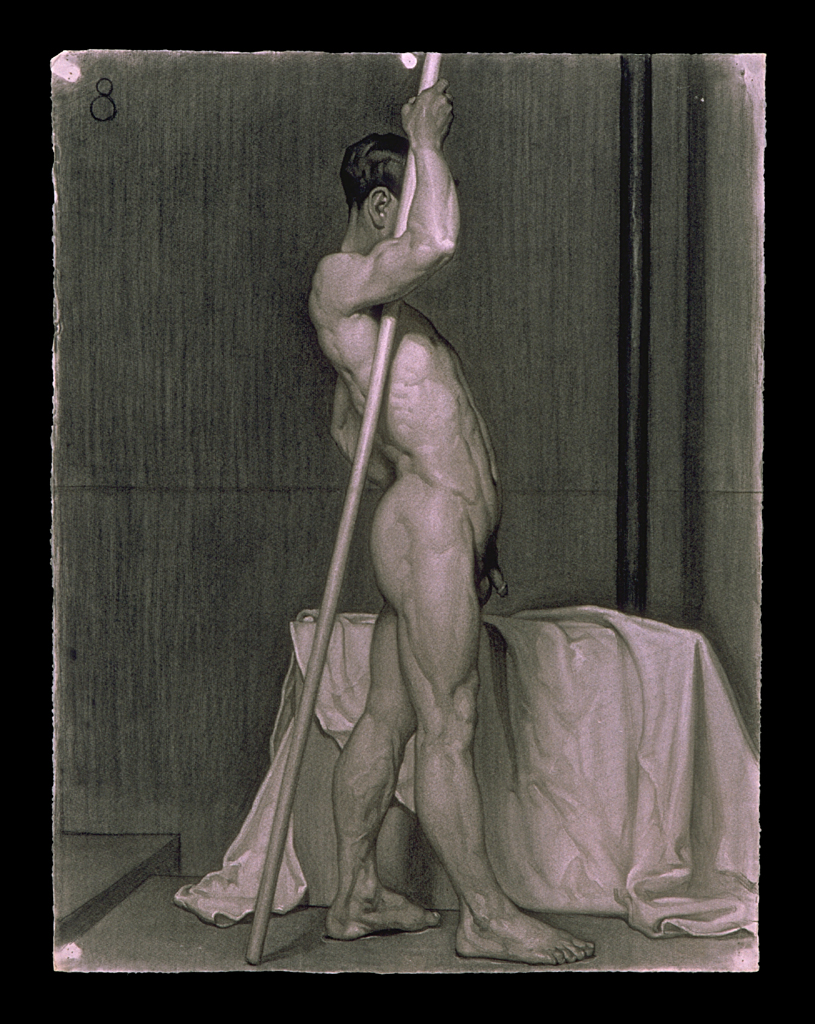
Anonymous (Spanish, c. 1890) Desnudo masculino en pie y de perfil apoyado en una vara. Graphite and pastel on paper. 61.9 BY 47.9CM. Colección de Bellas Artes, Universidad Complutense, Madrid.
The Academia de San Fernando, founded in 1751, was heavily influenced by French-trained artists. One family in particular, the Madrazos, dominated the Academia de San Fernando for most of the nineteenth century. José de Madrazo (Spanish, 1781-1859), court painter for Ferdinand VII, was sent to Paris to study with Jacques-Louis David (French, 1748-1825). José’s son, Francisco de Madrazo y Kuntz (Sapnish, 1815-1894) was trained by Jean-August Dominique Ingres (French, 1780-1867) in Rome, and would serve as the Academia de San Fernando’s director from 1866 to 1894. José’s other son, Pedro (Spanish, 1816-1898), was the director of the Prado Museum, as well as a prominent art critic. All three were influential in setting standards and tastes for the Academia.
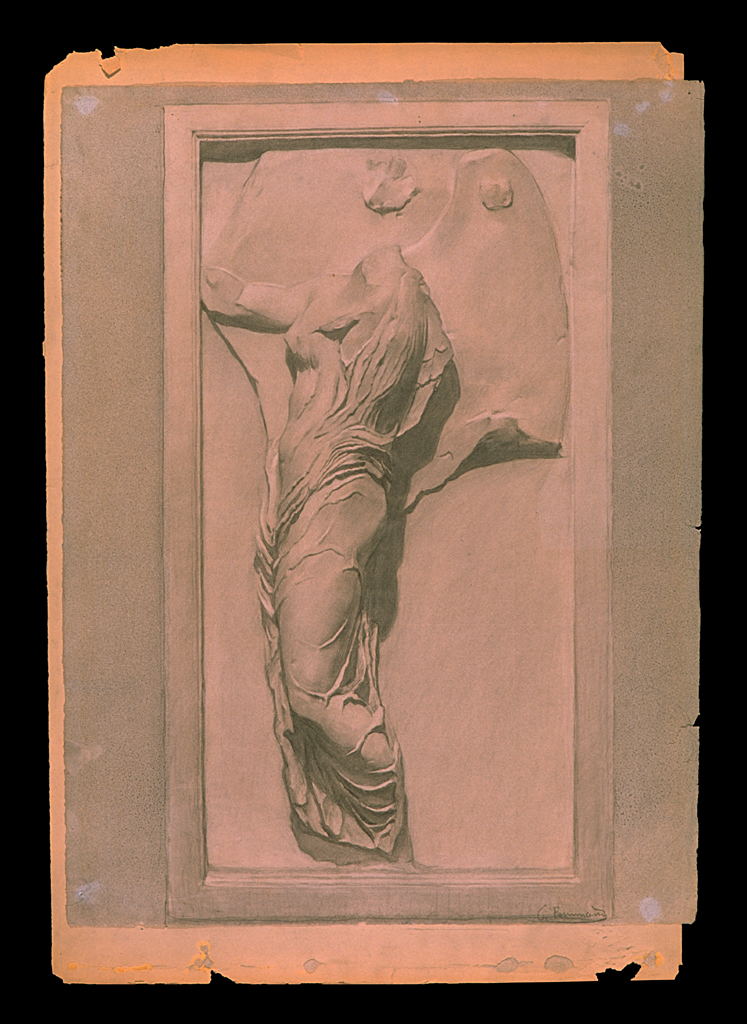
G. Ponman (Spanish) Female figure from a Greek Relief Sculpture or Figura femenina (copia de un relieve griego). Pencil and pastel on paper. 62.9 BY 47.7CM. Colección de Bellas Artes, Universidad Complutense, Madrid.
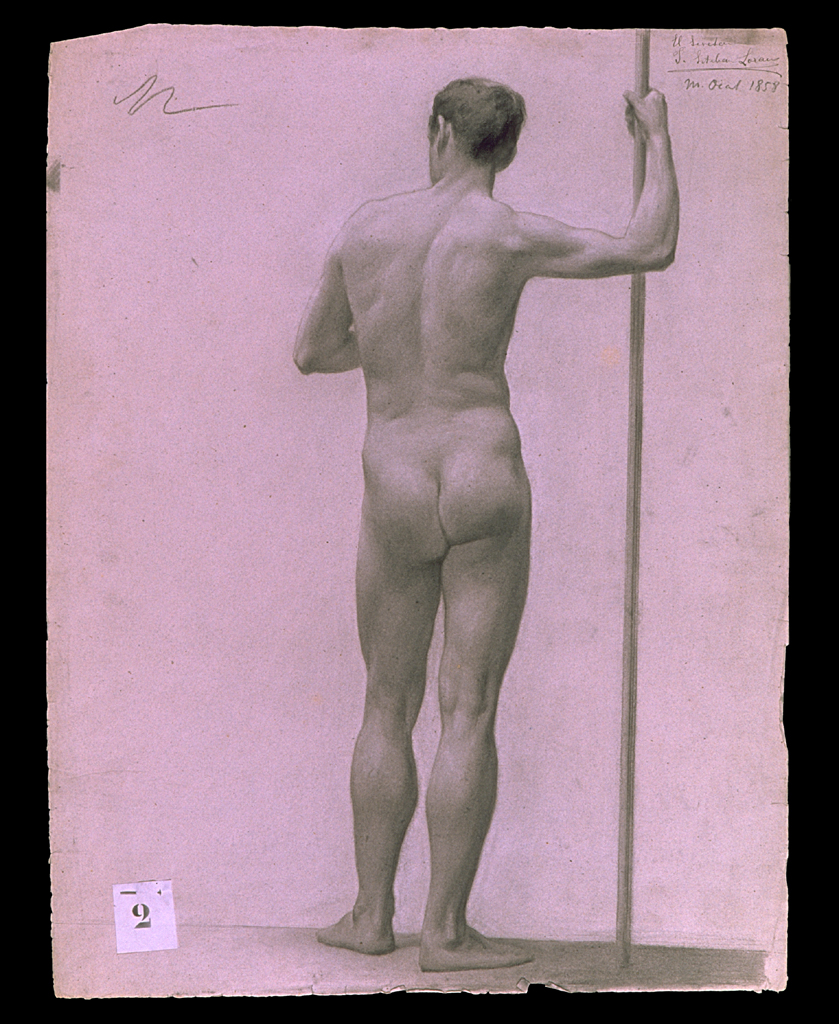
Miguel Ocal (Spanish) Desnudo masculino de espladas y en pie apoyado en una vara (1858) Graphite on paper. 61.4 BY 47.4CM. Colección de Bellas Artes, Universidad Complutense, Madrid.
As in Paris, students in Madrid’s arts academy studied, on average, for four years. Some went on to receive scholarships and study at the Spanish School in Rome. (Established in 1873, the Spanish sent winners of an annual competition on the equivalent of the French Prix de Rome.) Students at the Academia began by drawing from castes of isolated portions of statues. Then, they were allowed to study from full statues of classical origins, either from castes made of the Spanish Royal collection or from collections in Rome or Paris. Advanced students, were allowed to study from live models, who were often placed in the poses of classical statuary or from scenes in Old Master paintings. As the century progressed, classical poses increasingly gave way to more natural poses and depictions of the human figure.

Anonymous (Spanish). Colección de Bellas Artes, Universidad Complutense, Madrid.

Miguel González de La Peña (Spanish) Desnudo masculino sentado sobre volúmenes en forma piramidal con la cara hundida entre las manos. Graphite on paper. 62.2 BY 48CM. Colección de Bellas Artes, Universidad Complutense, Madrid.
The majority of the works featured here are of nude men. This is because, in nineteenth-century Spain, there were strong cultural taboos against female nudity, even classical nudes. As a result, Spanish artists privately hired female models for their studio work as opposed to using them in official schools.

Anonymous (Spanish). Colección de Bellas Artes, Universidad Complutense, Madrid.
Some of the works perserved in archives are anatomy studies. Many of theses seem to be copied from books while other appear to be made from looking at live models and perceiving underlying muscle and bone structure. This is interesting because models were expensive. Using them for anatomical studies shows how important the Academia considered these studies.
Consider a Contrast: Young Contemporary British Artist versus Nineteenth-Century Academic Student
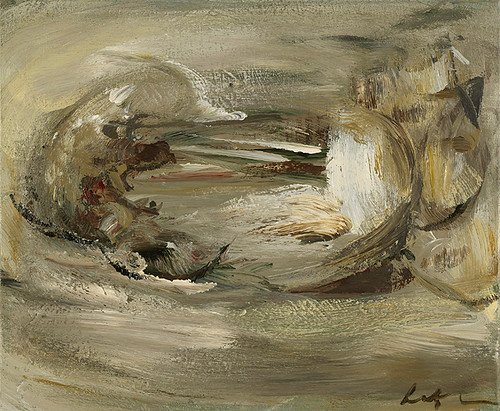
Katy Moran (British, 1975) Volestere (2007) Oil on canvas. Currently on view at the Andrea Rosen Gallery, London.
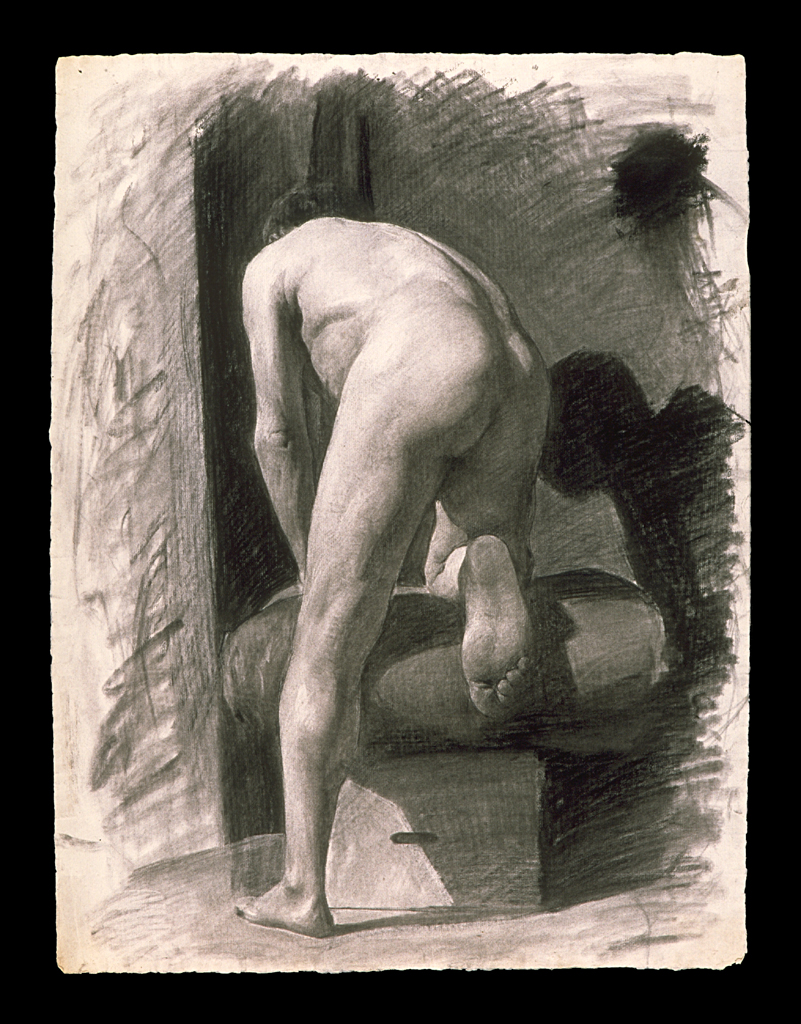
Anonymous (Spanish, c. 1890) Study of an Adult Male. Chalk on paper. La Facultad de Bellas Artes, Universidad Complutense, Madrid. Created as part of student exercises at the Spanish School in Rome.
Today, I was looking through a collection of nineteenth-century Spanish Academic drawings–which I will explore at greater length in my next post–when I decided to take a break and read today’s Financial Times. In its “Collecting” section, the newspaper features the work of two “prodigious young British artists who capture the fractured experience of comtemporary life.” The contrast between the two sets of artists, nineteenth-century Spanish students and young contemporary British artists, could not be greater.
In her article “The P-Word,” critic Jackie Wullschlager writes about the painting Strange Solutions by Katy Moran (British, 1975), saying: “Vestiges of landscape or portrait forms persist alluringly. I detected a thick, snowy avenue . . . which briefly reminded me of Monet, and a human figure is suggested in deft gestural outline at the heart of the rococo brushwork . . .”
If art is a medium of communication and the artist is the communicator, then we are either playing a very poor game of telephone with Moran or the artist hopes that, like Navajo codebreakers, critics will interpret what they mean. For her part, Wullschlager will not commit to any ideas or feelings inspired by the work; not even being sure as to whether or not the works are portraits or landscapes. Instead she says it “reminds” or “suggests” something. I could go on, but my point, unlike the artists’ intent, is clear: this does not communicate, it confuses.
By comparison, the skills being taught to the Spanish student who created the “Study of an Adult Male,” are steeped in a tradition of clear communication. The artist is learning the vocabulary of the human figure, its structure and its range of motion. As a result, this artist will be able to place the figure in a wide array of narratives.
Much has been written about nineteenth-century academic training. For the most part, Modern to Contemporary artists and art historians dismissed the Academy and its strict teaching as oppressive to creative abilities and limited in its ability to communicate. As a result, they regularly discuss the Academy as if it were Goliath and the Impressionsists were David. All who followed David’s example of opposing the Academy were numbered among the Chosen People and all others were, by comparison, Philistines. But, I ask, is this evident in the fruits of either philosophy? Which generation of young artist seems more limited in its ability to communicate?
As my father often says, “Art is personal.” Personally, I am more stimulated and provoked to deeper thought and feeling by clear communication than by vague suggestions.
Feriarte 2008: Visiting Spain’s Largest Annual Art Fair
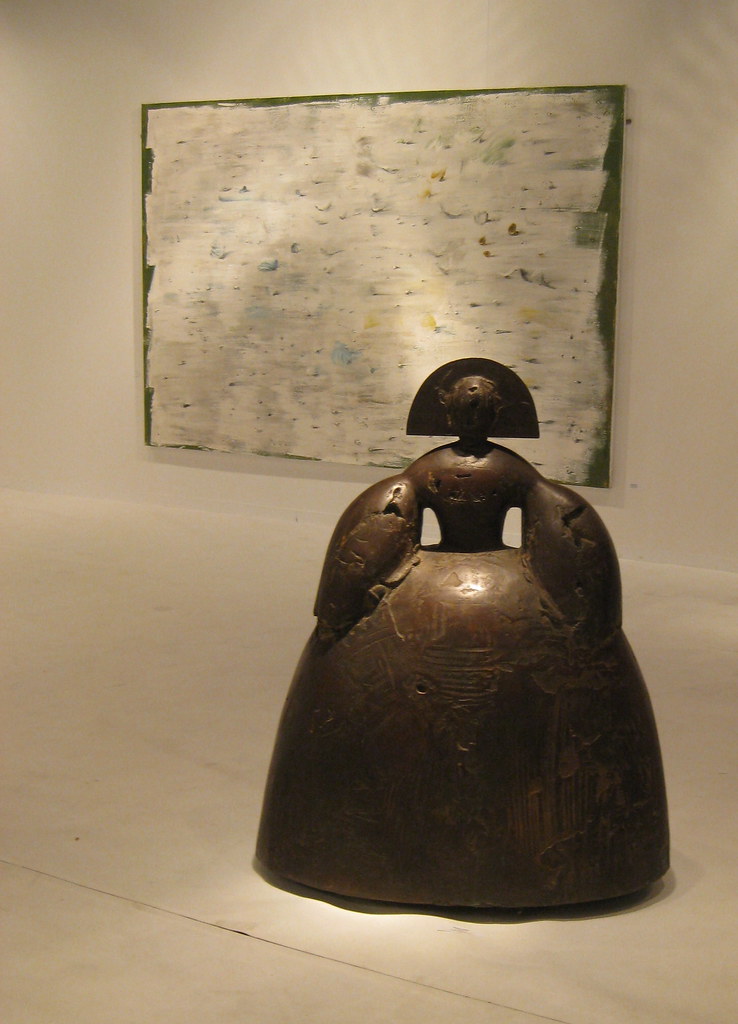
Manolo Valdés (Spanish, 1942) Infanta Margarita (2002) Bronze. 123 BY 100 BY 70 CM. Dealer: Francesc Llopis, Barcelona. In this work, Valdés quotes from a portrait of Infanta Margarit by the seventeenth-century Spanish painter Diego Velázquez.
According to Victor Bardia, Feriarte is Europe’s largest annual Fine & Decorative Art fair. Bardia is one of the event’s principal organizers. I met him and his son, David Bardia, at their gallery, Victor I Fills, during my last trip to Madrid. At that time, Bardia extended an invitation for me to return for the Fair. I’m grateful he did.
I’ve been to a number of fairs over the years and was skeptical Spain’s fair could be larger than others. If it was, I assumed, it must be of lesser quality. Having walked at a casual pace for three hours, I thought I had seen all there was only to pass through a door that revealed another space, filled with more exhibitors and larger than the last. In total, I spent nearly eight hours on my feet, talking with dealers and collectors. For the most part, I was impressed by the quality of pieces, which were at least comparable, and often superior, to those of other fairs like Olympia or BADA in London.
Each dealer I met, with the exception of one–a German gallery that specialized in Russian and German turn-of-the-century art–was based in Spain. The majority of exhibitors had galleries in Madrid, Barcelona or both. Works at the fair, which ran from November 15 to 23, were overwhelmingly Spanish, or from former Spanish territories (e.g. The Netherlands, Naples) with small but impressive selection of works by Italian artists. There was a surprising dearth of Latin American and other foreign works of art, perhaps reflecting a lack of foreign buyers at this year’s fair.
More than one dealer told me that compared to previous years, visitors were down by one half or two thirds. These are difficult times for art fairs and dealers. In other words, it was a buyers market. I was often surprised by low prices for objects and paintings that, less than a year ago, I had seen at much higher prices in the same galleries. For the occasion, dealers were bringing out their best pieces. The quantity of works was astounding–an art historian’s dream.

Pere Borrell del Caso (Italian, 1835-1910) Two Laughing Girls (1880) Oil on canvas. 69 BY 69CM. Dealer: Gothsland, Barcelona.
Two Laughing Girls by Borrell is a wonderful example of the kind of academic painting taught and practiced in late-nineteenth century Rome. Though Paris was undeniably the center of the art world a number of painters work and studied in the Eternal City.
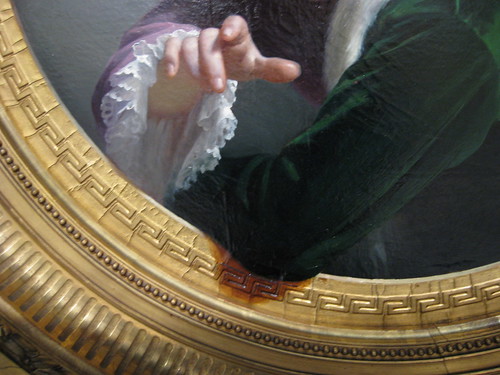
Pere Borrell del Caso (Italian, 1835-1910) Two Laughing Girls (1880) Oil on canvas. 69 BY 69CM. Dealer: Gothsland, Barcelona. DETAIL.
Borrell brilliantly draws the girls into our space by incorporating ornamentation from the neoclassical frame into the painting. The last two centimeters of the canvas are a combination of gesso and gold leaf over which he has painted one the two girls leaning her elbow on a Greek key patterned frieze. Seeing the piece, I wondered if Borrell had seen works by Dutch painters like Gerrit Dou, a contemporary of Rembrandt, who played similar visual tricks with his canvases.
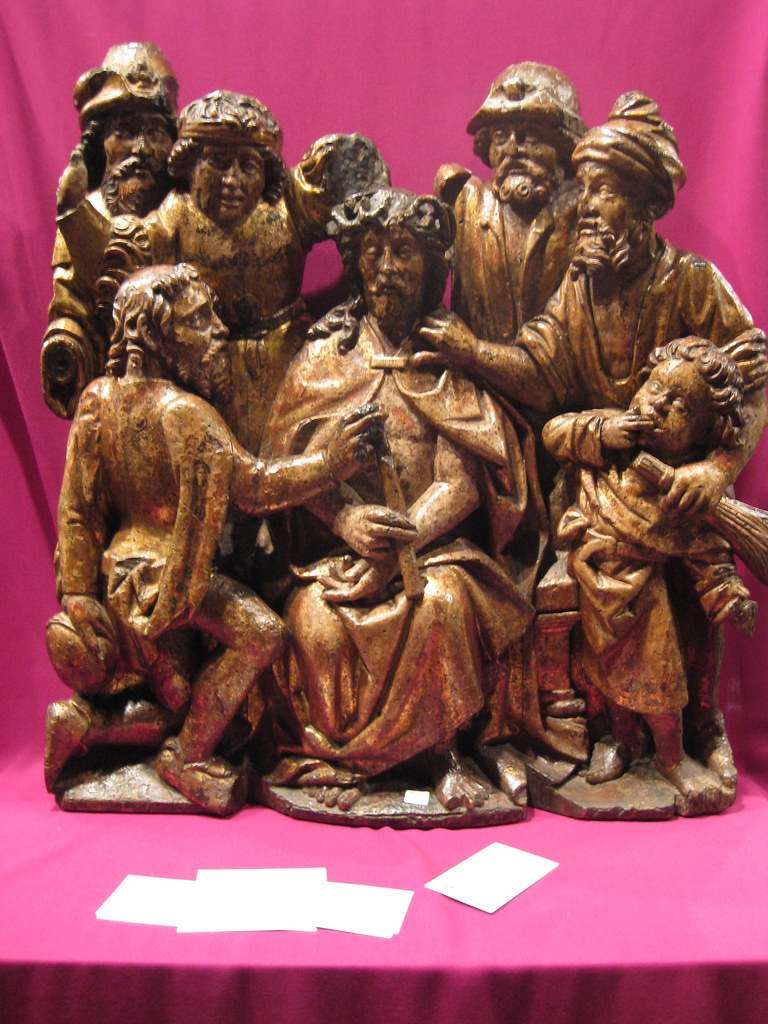
Christ crowned with thorns (Spanish, Sixteenth Century) Pine with gesso and gold. Dealer: Alcora Antiguedades, Madrid.
With so many religious works, at times the fair seemed like a destination for pilgrims. God, the Virgin, and Saints were everywhere, covered in gesso, gold and pastel-colored oil paints. A number of the exhibitor’s stall were set up as small houses of worship, with some even burning incense.
Spanish pieces like Christ crowned with thorns reflect skills brought the country by workmen from the Netherlands. Through the fifteenth and sixteenth centuries, The Netherlands were Spanish territory. A number of Netherlandish artists moved to Spain, infusing a northern realism–as opposed to classical idealism–into Spanish sculpture and painting.
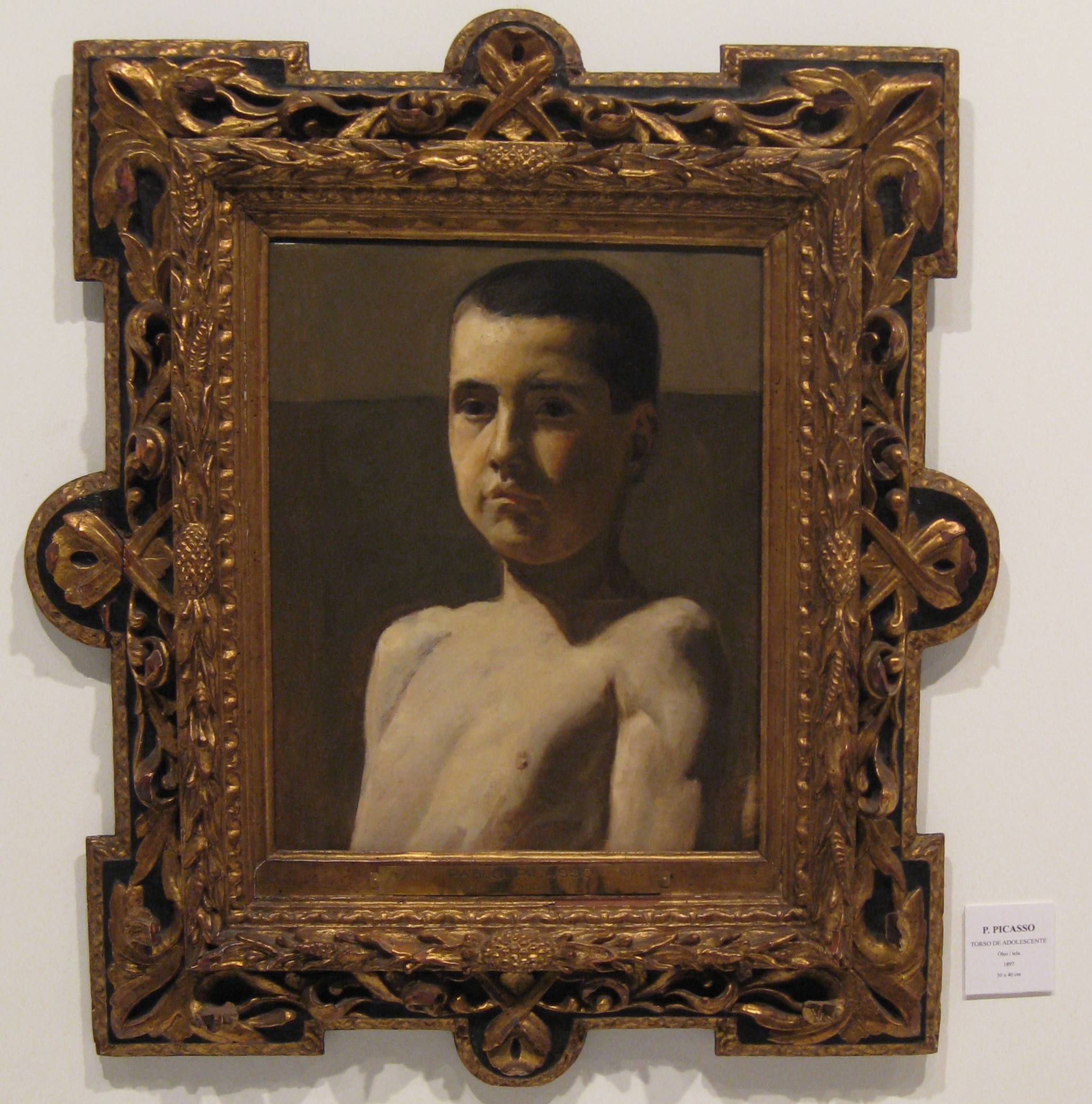
Pablo Picasso (Spanish, 1881-1973 ) Torso of a Young Man (1897) Oil on canvas. 50 BY 40CM. Dealer: Gomez Turu Gallery, Barcelona.
Having made his name in abstract painting and Cubism, some people are surprised to learn that Picasso was trained as an Academic painter. He studeid at the academy in Barcelona, where he produced a number of figure studies in charcoal and a few oil paintings. Some can be seen as the Picasso Museum, installed in his former home in Barcelona. His ability to accurately render the human figure, especially in chalk, is impressive.
I was surprised to see one of his academic oils available at the fair. The work is evidence of his early propensity towards breaking down objects into basic forms. The shadows in Torso of a Young Man are sharp, clearly delineating muscles and separating the figure from its background. To me, the head and the body appear to belong to different figures, which is, perhaps, a choice or, more likely, a reflection of his inexperience. (He was only sixteen when it was painted.)

A Roman Youth (Rome, First Century AD) White Marble.
Once overseen by Julius Caesar and the birthplace of the Emperor Hadrian, Spain was one of of Rome’s most important provinces. Besides the obvious inheritance of a Latin language, Spain retained a number of Roman works of art and architecture. A few Feriarte stalls were dedicated exclusively to ancient sculpture and architectural pieces (e.g. fountains, doorways).
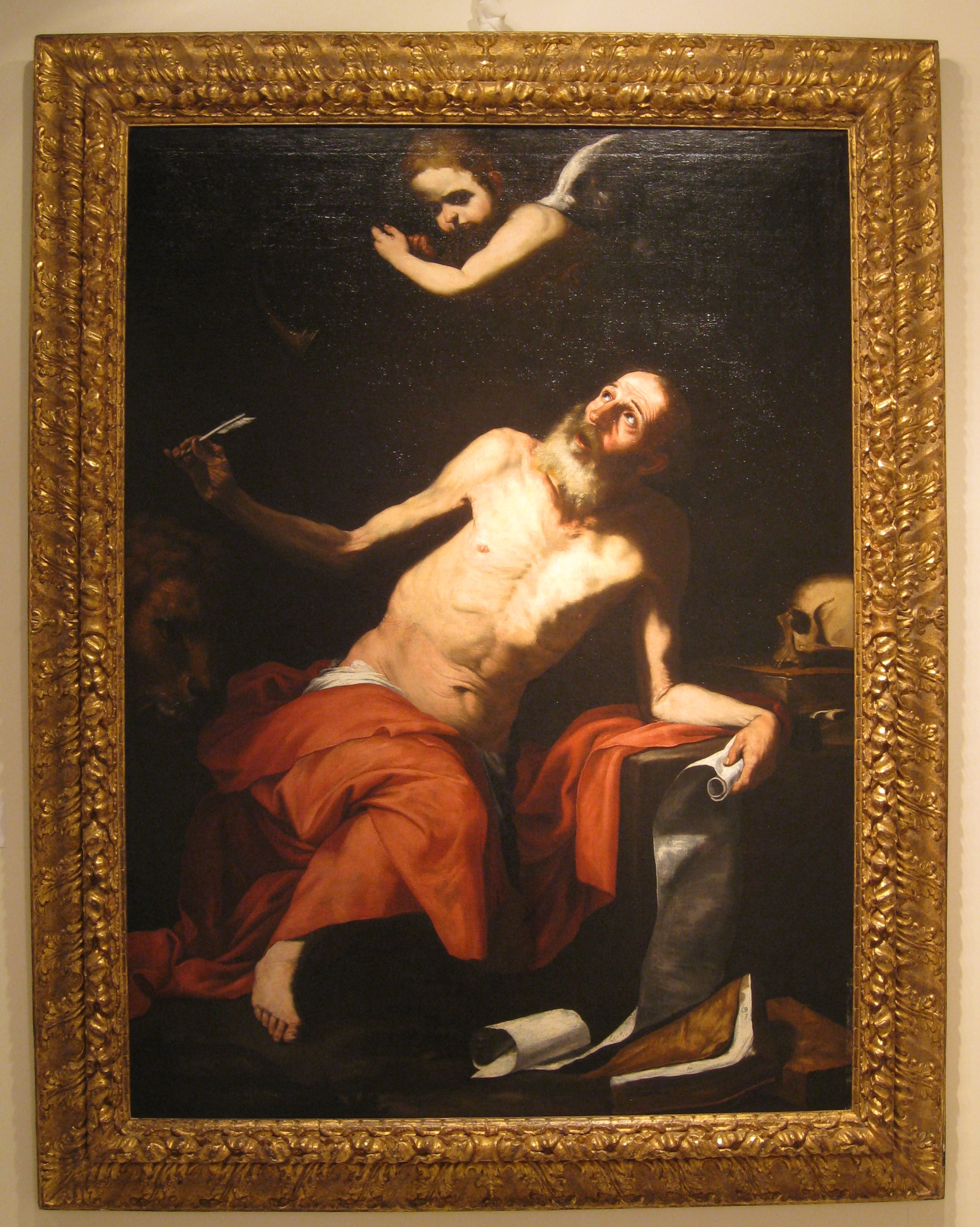
José de Ribera (Spanish, 1591-1656) Saint Jerome hearing the trumpet of the Final Judgement (c. 1630) Oil on canvas. 176.5 BY 129.5CM. Dealder: Artemisia, Madrid.
It’s not every day that a Ribera could be yours. Considered one of Spain’s greatest painters, Ribera’s oeuvre is represented in nearly every major European museum. Ribera was born in Valencia but moved to Naples, which was a Spanish territory at the time. Naples was home to a number of influence painters, such as Giordano and Caravaggio, who established a taste for religious paintings with earthy, realistic people.
Many of Ribera’s works are contemplative with figures deep in thought or asleep. In this, he has captured a fleeting moment, when the Saint receives his assurance of a place in heaven. Saint Jerome, a fifth-century compiler of the Bible, was a favorite subject of Ribera. (Maybe it would be more accurate to say Ribera’s patrons loved the way he painted Jerome, making it a regular request.) I’ve seen perhaps eight versions of Saint Jerome by the painter. I was particularly taken by the brilliant light in this one. The arrival of the angel above Jerome’s head brings light on the elderly man’s torso. Up close, his chest and belly are a soup of oily paint that, despite their fluidity, are convincincly skin like.
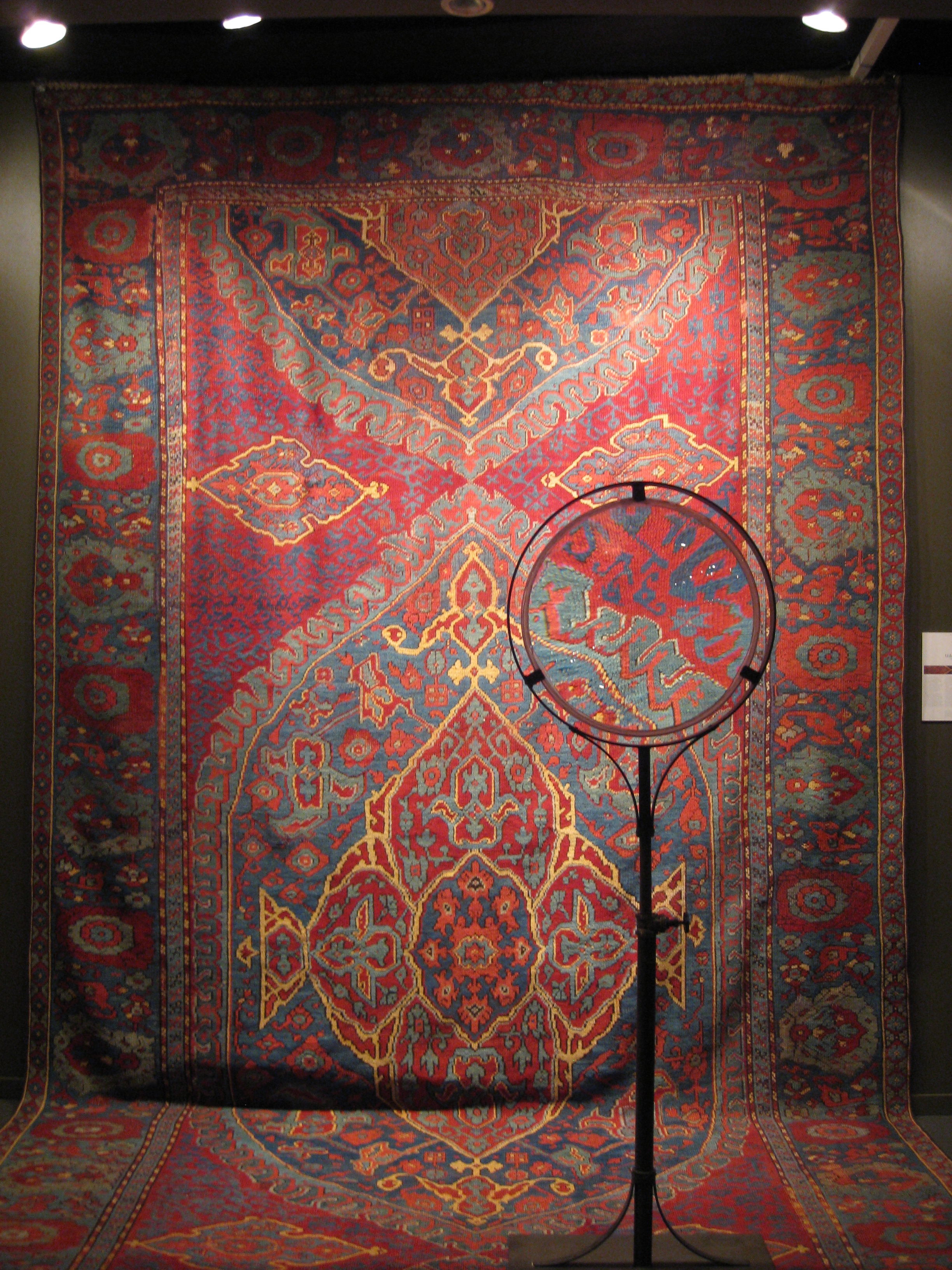
Rug (Turkish, Sixteenth Century) Dealer: Rica Basagoiti, Madrid.
Both this and the image from the previous post of a tree trunk in front of a rug were on display in the stall of Rica Basagoiti from Madrid. Once rugs were considered the most luxurious items in a collection. In the sixteenth and seventeenth centuries, the Spanish and Dutch put rugs like these on their tables, rather than on the ground. Walking on them would have been considered the height of conspicuous consumption.
The display of these rugs by Rica Basagoiti seemed to return these rugs to a level of prestige that was appropriate to their era. In the above image, a large magnifying glass is placed several feet from the rug, making the richly-preserved colors jump out at anyone passing by.
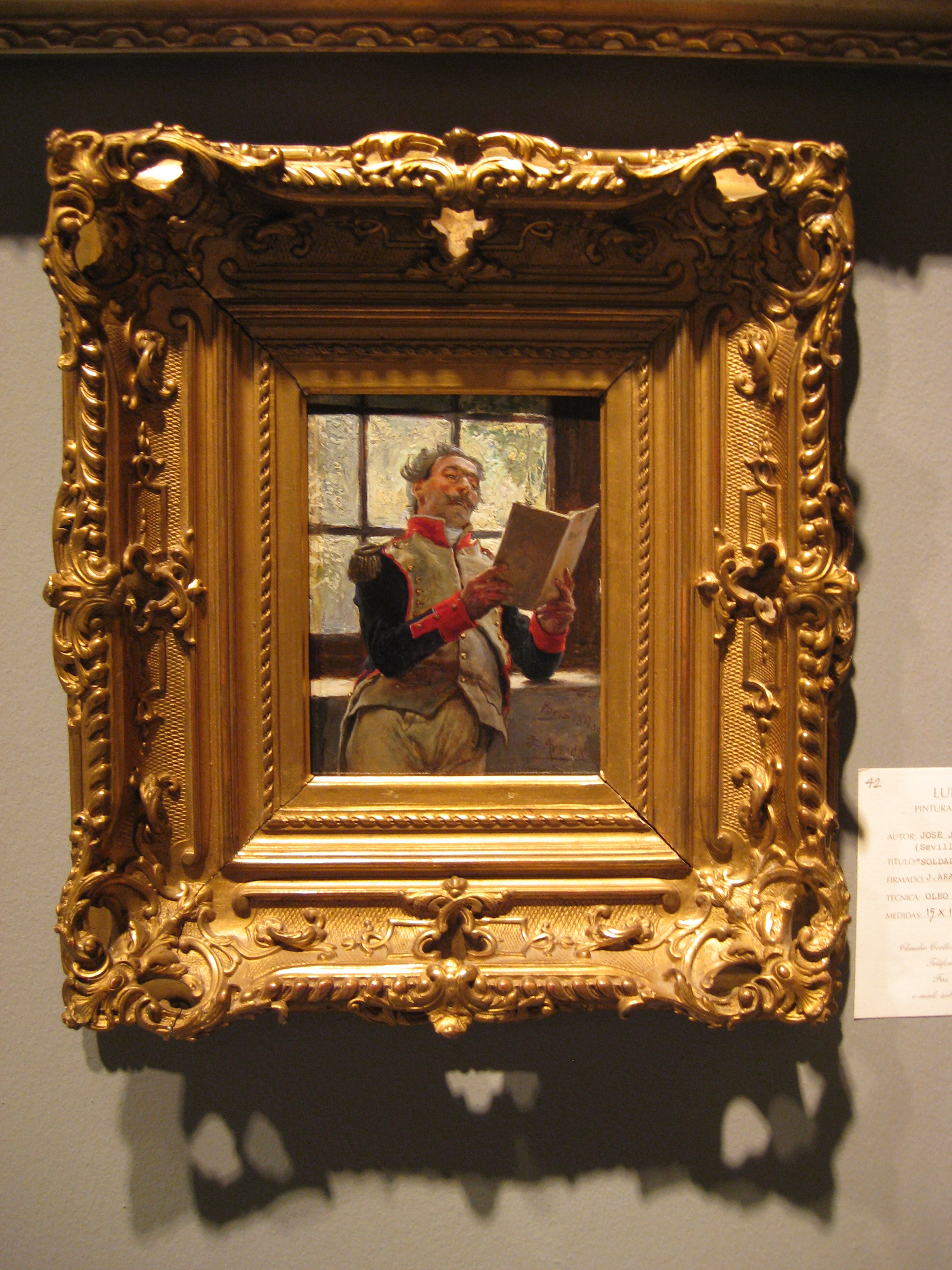
José Jiménez y Aranda (Spanish, 1845-1928) Legendary Soldier (Paris, 1890) Oil on canvas. 15 BY 12CM. Dealer: Luis Carvajal, Madrid.
Jiménez was a Spanish painter who had moved to Paris, where he regularly participated in the annual Salons–one of the few Spanish painters to do so. His work careful attention to detail and tendency to paint figures in period costume are reminiscent of the French painter Meissonier, who was popular in Paris at the time.
Though this is a small work, it shows off Jiménez’s arsenal of skils and powers of observation. The figure seems to be well relaxed and effortlessly painted, but close inpection reveals countless tiny strokes. The light coming through the window casts a series of complicated shadows. I found myself wondering how much easier it would have been to have the light coming from a different direction or having the window at his front rather than his back.

Ivory tankard (German, a. 1675) Ivory with silver fixtures. Dealer: FERMA, Madrid
By far, my favorite piece from the Fair was this German tankard, which stands nearly 25 centimeters in height. Made of several ivory sections seemlessly pieced together, it is a wonder of craftsmanship and artistry. Rather than discuss it at length, I believe a lengthy look at it provides a kind of refinement and appreciation beyond words. (Each image can be clicked for a much higher resolution image.)
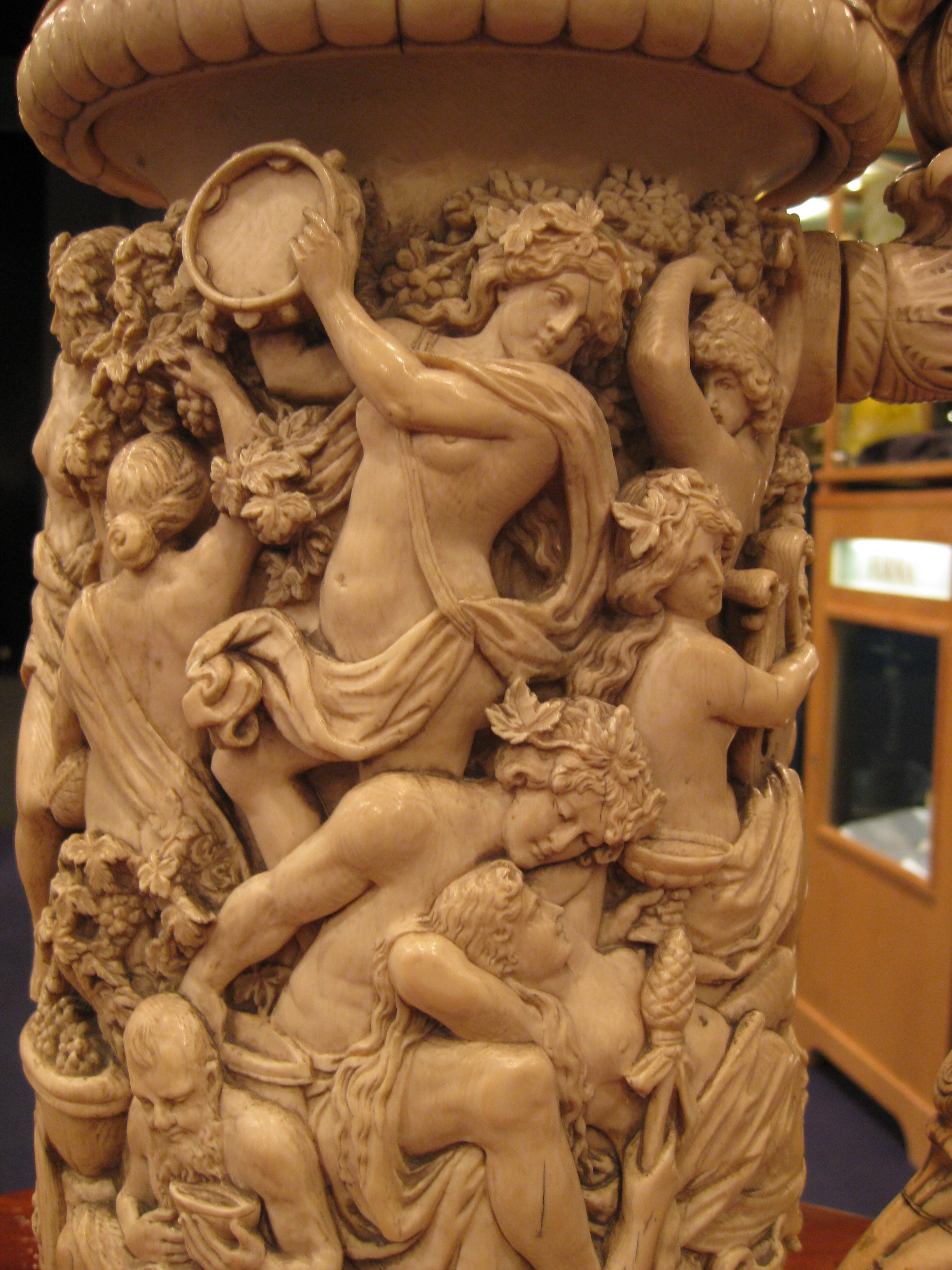
Ivory tankard (German, a. 1675) Ivory with silver fixtures. Dealer: FERMA, Madrid. DETAIL.

Ivory tankard (German, a. 1675) Ivory with silver fixtures. Dealer: FERMA, Madrid. DETAIL.
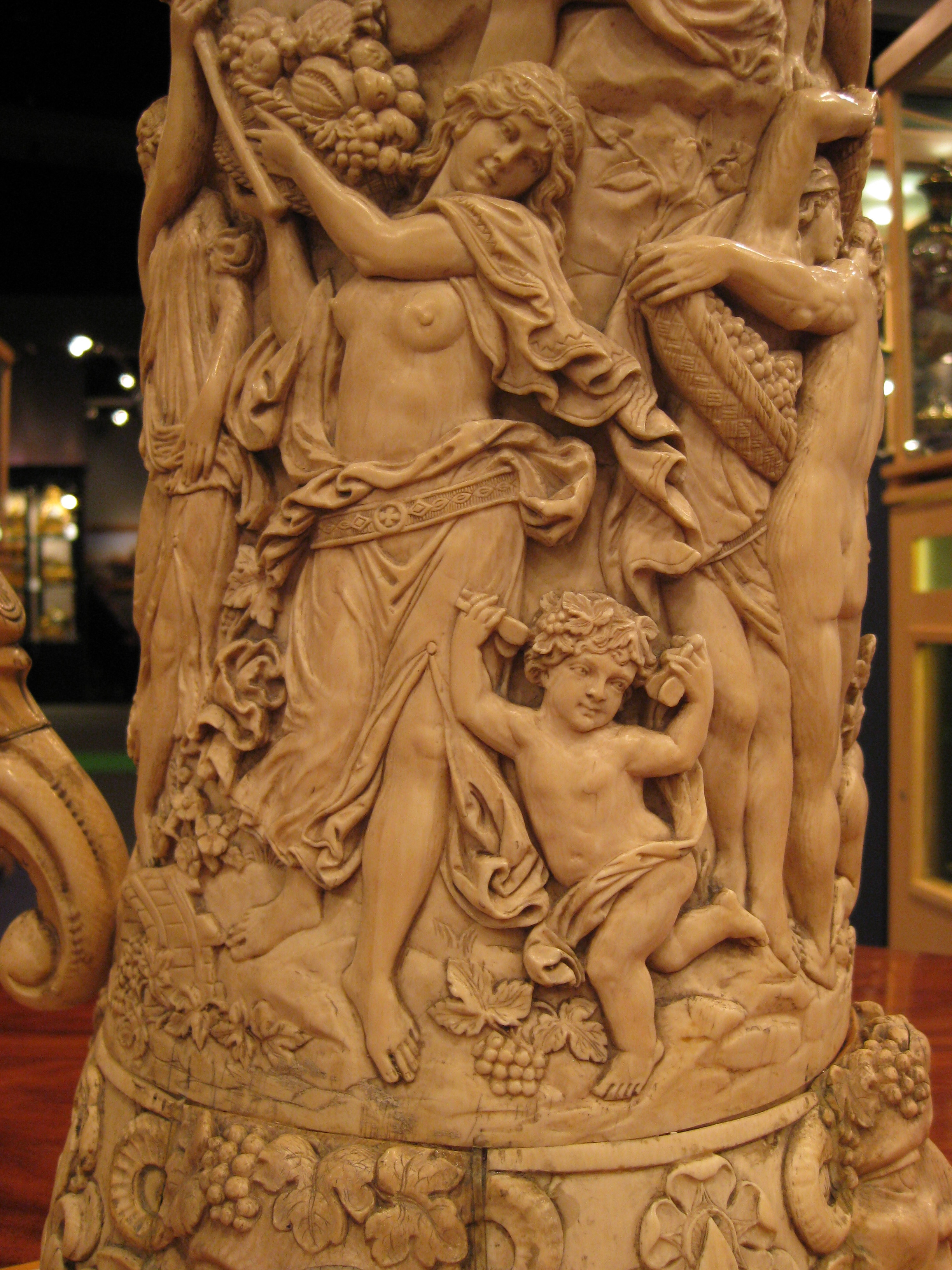
Ivory tankard (German, a. 1675) Ivory with silver fixtures. Dealer: FERMA, Madrid. DETAIL.
For more pictures of the tankard, and a number of other pieces that I saw at Feriarte, visit my Flickr page.
Bearded Roman in Madrid
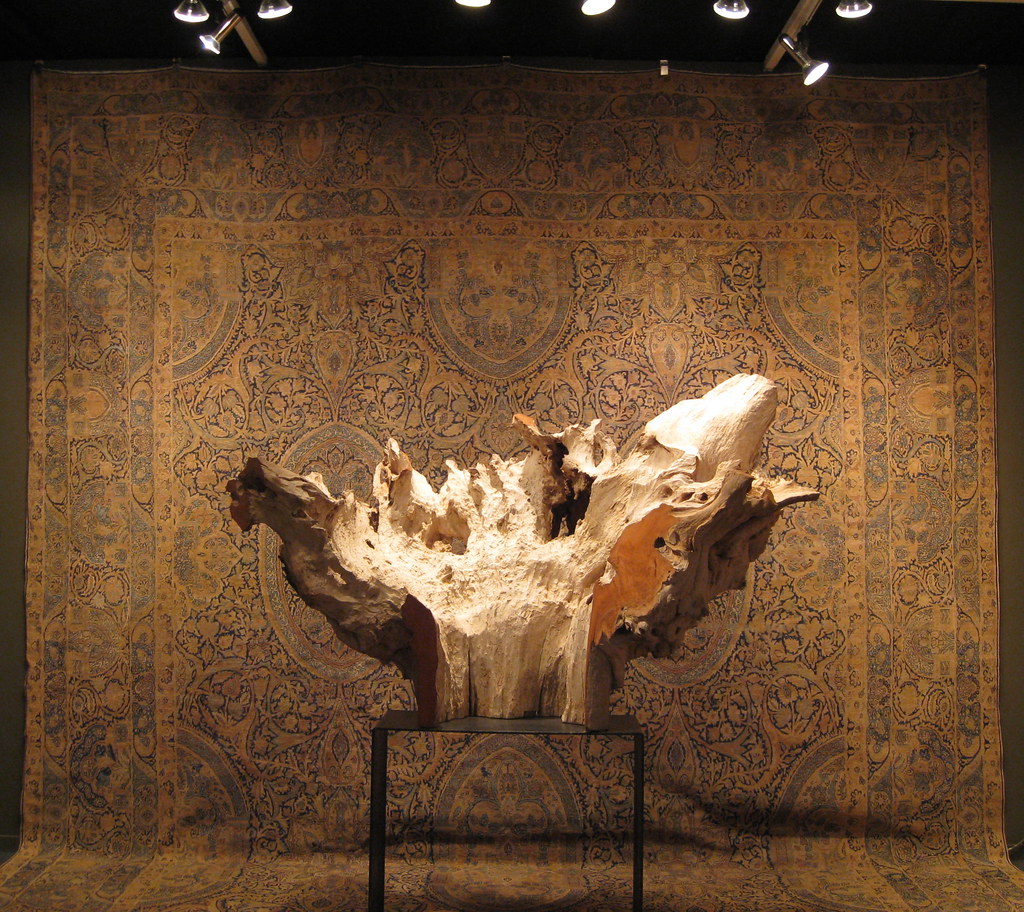
Photo of upturned tree trunk placed with 18th-century Persian rug. Seen at Feriarte Madrid
This week and next, I’m in Madrid, where a number of impressive exhibitions and fairs are taking place, including:
- The 32nd Annual Feriarte: One of Europe’s largest Fine & Decorative Art Fairs.
- Rembrandt, History Painter: An exhibition of painter’s narrative works the Prado Museum.
- Between Gods & Men: A rare look at two major ancient sculpture collections, from Dresden and Madrid, on show at the Prado Museum.
- Sorolla Museum in Madrid: My report on a visit to the home and private studio of the Valencian painter who befriended Zorn and Sargent.
- El Escorial: The country palace of Spain’s Hapsburg Royalty, which contains major works from their collection
All this coming over the next week in a series of posts.
Forgotten Master: Vasily Polenov (Russian, 1844-1927)
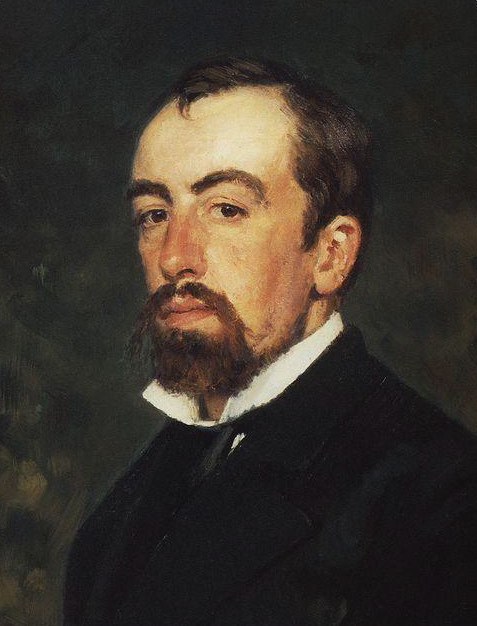
Vasily Polenov (Russian, 1844-1927) was 17 years old when Alexander II freed the serfs of Russia. The Tsar’s Emancipation Manifesto of 1861 was an acknowledgement of democratic changes in Western governments. The decree changed the political and economic landscape of Russia, forcing landowning aristocrats to pay for labor and contributing to a rising middle class.

Vasily Polenov (Russian, 1844-1927) Early Snow (c. 1880) Oil on canvas.The social and economic changes in Russia spilled into the arts.
Art academies in St. Petersburg and Moscow catered to the classical tastes of old Russia, represented by the aristrocracy. Shortly after the emancipation of the serfs, a group of artists, named Peredvizhniki, or The Wanderers, believed it was time “take art to the people.” With their first exhibition in 1870, The Wanderers rejected the classical ideals taught in official school in favor of Realism. They painted earthy, everyday peasants and took their exhibitions to rural areas of the country where a wider public could appreciate it.
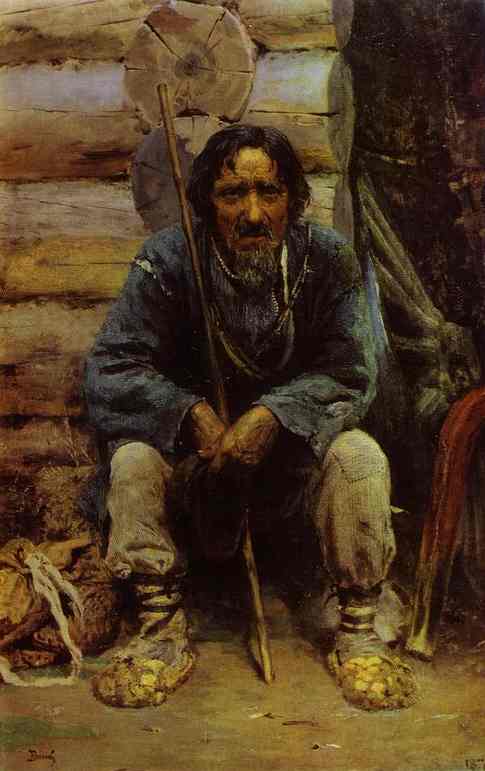
Vasily Polenov (Russian, 1844-1927) The Crippled Serf (c. 1878) Oil on canvas.
Polenov was an adopted as a member of The Wanderers, yet maintained his ties with the Russian Academy. He studied in the Imperial Academy of Arts in St. Petersburg from 1863-1871. Polenov was perhaps the most traveled Russian artist of his generation. During his studies, he was pensioned in Italy and France, where he experienced first hand the contemporary movements of Realism and Impressionism. He returned with a love of plein air, and was one of the first to introduce the approach to other Russian painters. Using the technique he created numerous landscapes of his native countryside.
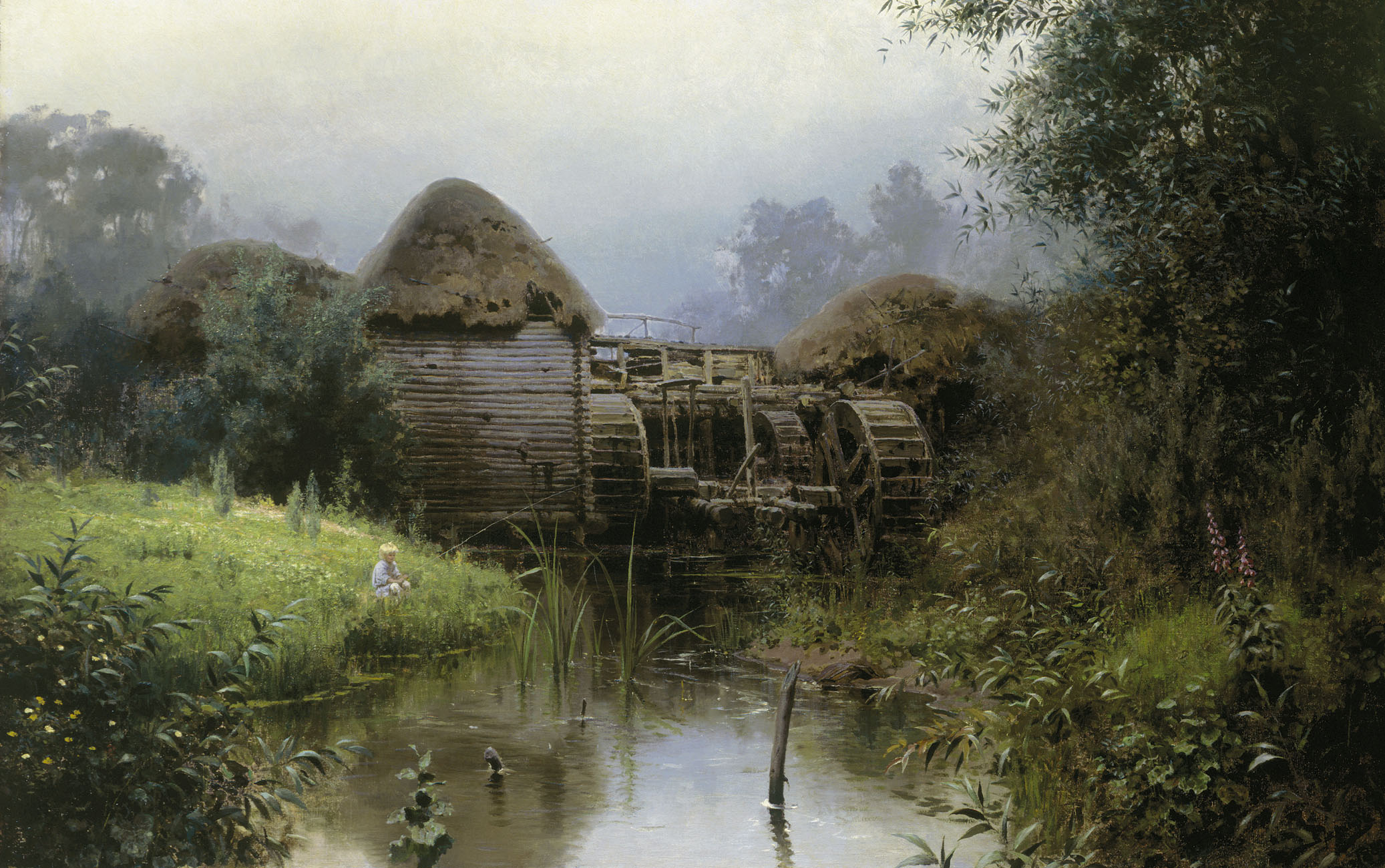
Vasily Polenov (Russian, 1844-1927) Old mill (1880) Oil on canvas.
From 1877-1878, Polenov served as a military artist in the Russo-Turkish war. Shortly thereafter, he dedicated his work to religious scenes, especially from the New Testament.
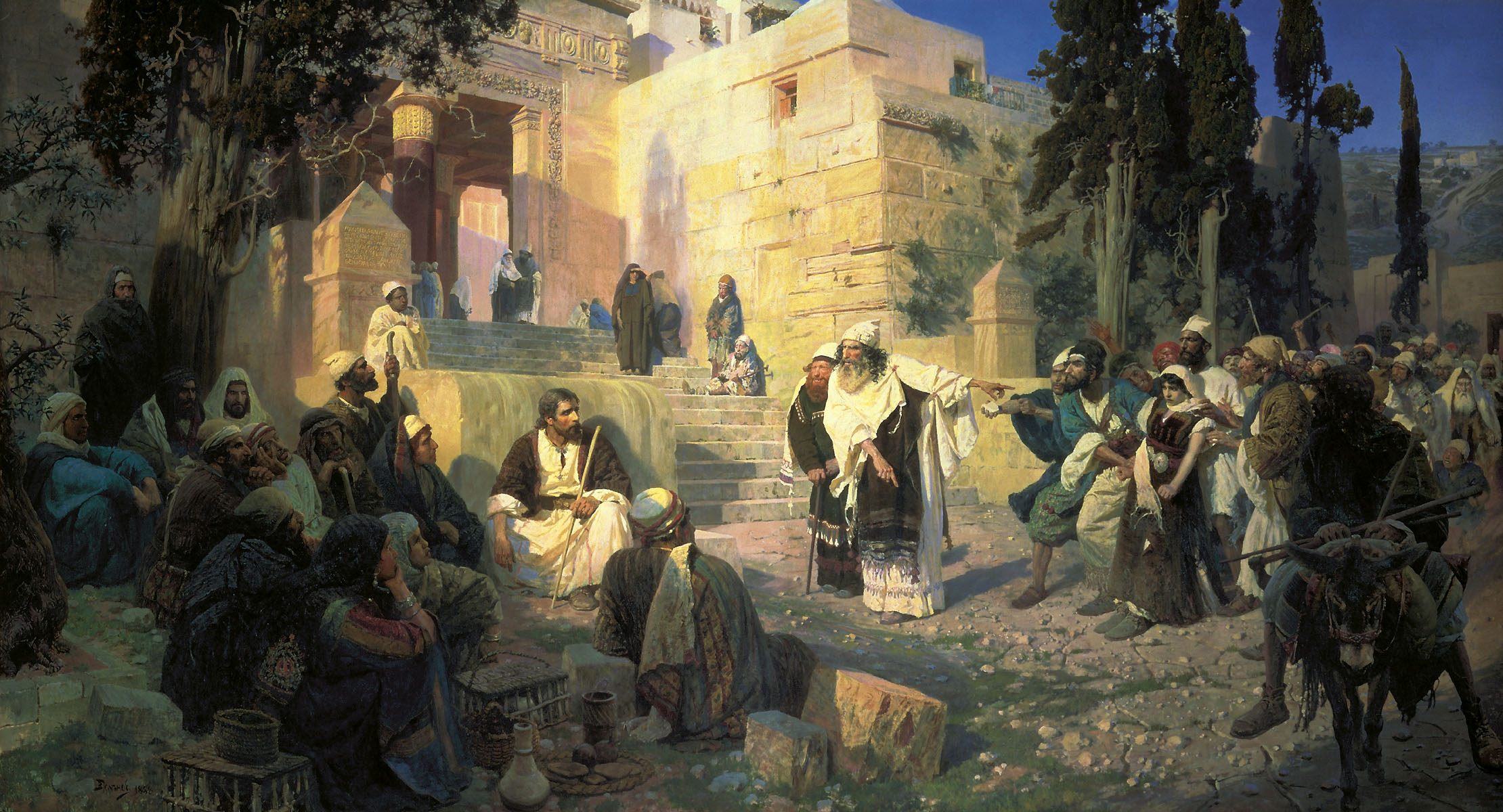
Vasily Polenov (Russian, 1844-1927) Christ and Woman Taken in Adultery (1886-1887) Oil on canvas. The State Tretyakov Gallery, Moscow.
His painting, Christ and the Woman Taken in Adultery (a. 1886) is considered by many to be his masterpiece. It is drawn from the Gospel of John, Chapter 8, verses 1-11, where a woman caught in the act of adultery is taken to Christ. Hoping trick Christ, a group of his enemies brought the woman to him:
4 They say unto him, Master, this woman was taken in adultery, in the very act.
5 Now Moses in the law commanded us, that such should be stoned: but what sayest thou?
6 This they said, tempting him, that they might have to accuse him. But Jesus stooped down, and with his finger wrote on the ground, as though he heard them not.
7 So when they continued asking him, he lifted up himself, and said unto them, He that is without sin among you, let him first cast a stone at her.
8 And again he stooped down, and wrote on the ground.
9 And they which heard it, being convicted by their own conscience, went out one by one, beginning at the eldest, even unto the last: and Jesus was left alone, and the woman standing in the midst.
10 When Jesus had lifted up himself, and saw none but the woman, he said unto her, Woman, where are those thine accusers? hath no man condemned thee?
11 She said, No man, Lord. And Jesus said unto her, Neither do I condemn thee: go, and sin no more.
In preparation for the painting, Polenov had made sketches of people, architecture, and landscape in the Middle East and Greece, where he travelled from 1881-1882.

Vasily Polenov (Russian 1844-1927) The Parthenon, Temple of Athena Pallas (c. 1881) Oil on canvas. The Tretyakov Gallery, Moscow, Russia.
During his lifetime, Polenov was widely acclaimed for his work by both the Russian Academy and those that had broken from it. In 1893, he was made a fellow of the Imperial Academy of Arts in St. Petersburg, and taught at the Moscow School of Painting, Sculpture and Architecture until his death in 1893.

Vasily Polenov (Russian, 1844-1927) Christ overlooking Jerusalem (c. 1885) Oil on canvas. The State Tretyakov Gallery, Moscow.
Today, Polenov’s home in Borok, near Moscow, has been made a museum and placed in the national trust.
The Gettysburg Cyclorama Open Again

Photograph of painter Paul Philippoteaux (French, 1826-1923) working on the Gettysburg Cyclorama (c. 1884)
Today’s Washington Post features a story on a major work by the ninteteenth-century painter, Paul Philippoteaux (French, 1826-1923).
In 1884, the painter was commisioned to create a massive dedication to the Battle of Gettysburg for the site’s visitors center. Under rennovation for several years, the Cyclorama, as the piece is known, is open to the public:
On Friday, after a five-year and $15 million restoration effort, the panoramic Battle of Gettysburg cyclorama will reopen to the public. Decades of neglect, cropping and overpainting have been fixed. The painting has been restored to its original 377-foot-by-42-foot size and installed in a new rotunda.
The Cyclorama was considered a major innovation in visitor experience by placing a visitor in the center of the battle.
Philippoteaux came to America after an impressive education at the Ecole des Beaux-Arts in Paris and in the studios of Leon Cogniet (French, 1794-1880) and Alexandre Cabanal (French, 1883-1829).