Posts in Category: Exhibitions
Pursuing Lost Painting Methods: An Excellent Article from the NY Times
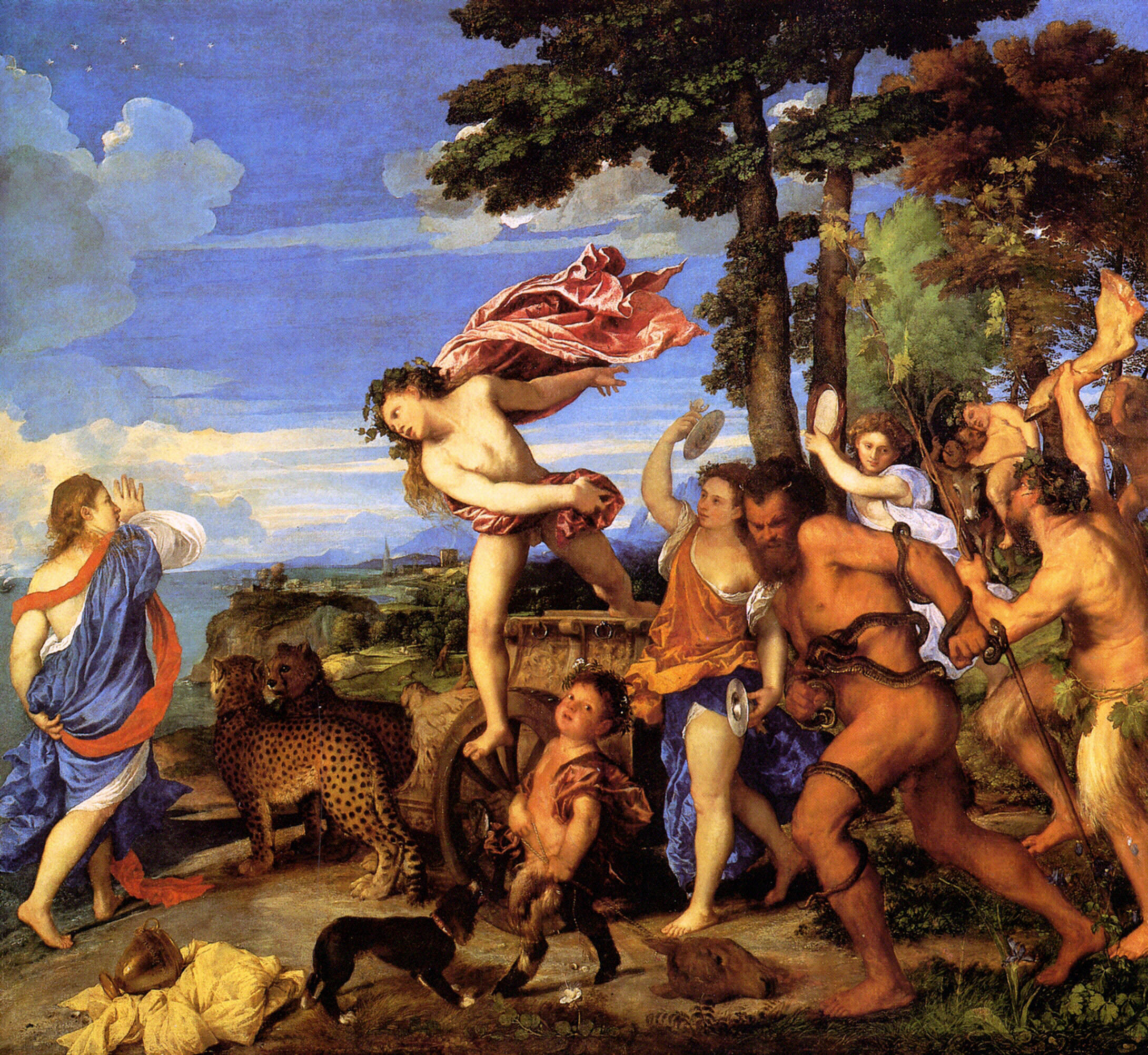
Titian (Venetian, a. 1506-1576) Bacchus and Ariadne (1520-23) Oil on canvas. 176.5 BY 191CM. National Gallery, London.
In the upcoming exhibition, “Benjamin West and the Venetian Secret,” (beginning September 18) Yale’s Center for British Art explores an obsession with recreating the methods of Titian. The Sunday New York Times dedicates an excellent article to the topic.
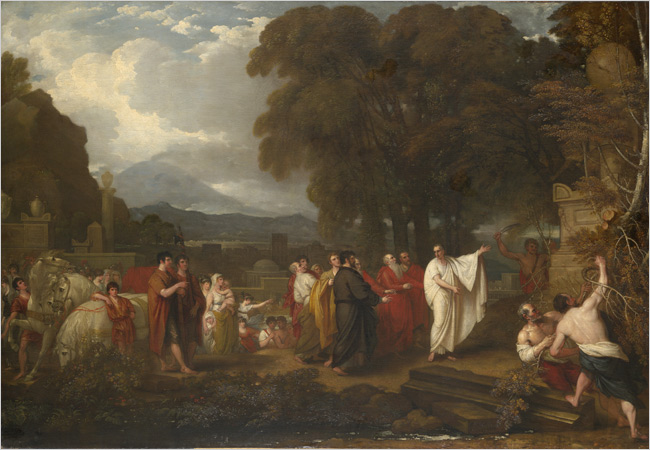
Benjamin West (Anglo-American, 1738-1820) Cicero Discovering the Tomb of Archimedes (1797) Oil on canvas. 124.5 BY 180.5CM. Yale University Art Gallery.
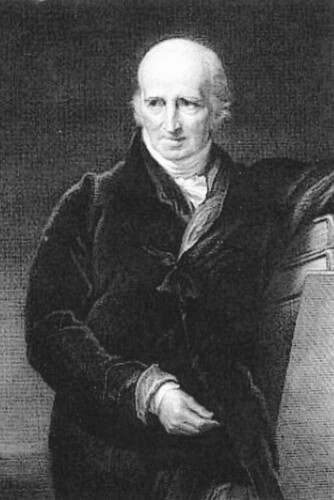
Benjamin West (Anglo-American, 1738-1820) Portrait of artist posing as President of the Royal Academy.
West had served as President of the Royal Academy (1792-1805; 1806-1820) and was particularly interested in the works of the Venetian painter Titian (Venetian, a. 1506-1576), and his ability to achieve high intensity color in his paintings.
So when an artist named Ann Jemima Provis and her father, Thomas Provis, approached West and told him they had found a copy of an old manuscript that explained how the Venetians achieved their distinctive style of painting, he jumped at the chance to learn more. Eager to incorporate the methods in the manuscript into his own work, West began experimenting with them.
There was only one problem.
“The story was an absurd invention, and the manuscript was a fake,†said Angus Trumble, senior curator of paintings and sculpture at the Yale Center.
In addition, to the manuscript Ann and Thomas Provis offered demonstrations of the Venetian technique. These included a new approach to painting grounds and using Prussian blue.
(Prussian blue was invented by Heinrich Diesbach and Johann Konrad Dippel in 1704 or 1705, more than 100 years after Titian’s death. In his own paintings, Titian used lapis lazuli (a.k.a ultramarine); therefore, the “rediscovered” method was clearly not Titian’s.)
(From “Be An Old Master, for 10 Guineas” by J. D. BIERSDORFER, August 29, 2008. New York Times.)
Painters working under the instructions of the Provises did not have the same results as the Old Masters, which led to suspicions regarding the Provises’s claims. The Provises were discovered for their hoax, and a number of artists who had paid for their advice were discredited in the press and at the Royal Academy. West, especially, was criticized for not having seen the hucksters for what they were.
The Paris Salon or “Exhibition of Living Artists”

Francois Joseph Heim (French, 1787-1865) Charles X Distributing Awards to Artists Exhibiting at the Salon of 1824 at the Louvre (1827) MuseÌe du Louvre, Paris
In his book, The Judgment of Paris, Ross King compares Salon attendance to today’s most visited museum exhibitions:
[The Salon was] one of the greatest spectacles in Europe, it was an even more popular attraction, in terms of the crowds it drew, than public executions. Opening to the public in the first week of May and running for some six weeks, it featured thousands of works of art specially—and sometimes controversially—chosen by a Selection Committee. Admission on most afternoons was only a franc, which placed it within easy reach of virtually every Parisian, considering the wage of the lowest-paid workers, such as milliners and washerwomen, averaged three to four francs a day. Those unwilling or unable to pay could visit on Sundays, when admission was free and the Palais des Chaps-Élysées thronged with as many as 50,000 visitors—five times the number that had gathered in 1857 to watch the blade of guillotine descend on the neck of a priest names Verger who had murdered the Archbishop of Paris. In some years, as Many as a million people visited the Salon during its six-week run, meaning crowds averaged more than 23,000 people a day*
*To put these figures into context, the most well-attended art exhibition in the year 2003 was Leonardo da Vinci: Master Draftsman, at the Metropolitan Museum of Art in New York. Over the course of a nine-week run, the show drew and average of 6,863 visitors each day, with an overall total of 401,004. El Greco, likewise at the Metropolitan Museum of Art, averaged 6,807 per day during its three-month run in 2003-4, ultimately attracting 574,381 visitors. The top-ranked schibition of 2002, Van Gogh and Gaugin, at the Van Gogh Museum in Amsterdam, drew 6,719 perday for four months, with a final attendance of 739,117.
(Ross King. The Judgment of Paris. New York: Walker and Company, 2006. p. 17)
Comparing the Paris Salon to modern-day museum exhibitions is probably unfair. In the nineteenth century–before the advent of photography, radio, and movie theaters–painting was truly the most public art form. A more appropriate comparison would mostly likely be comparing Salon attendance to movie ticket sales. (How about comparing Ernest Meissonier’s painting Friedeland, the painting sold for the highest price in the nineteenth century and a Salon blockbuster, with Batman Begins?)

Ernest Meissonier (French, 1815-1891) 1807, Friedland (c. 1861-1875), Metropolitan Museum of Art, New York
If that is true, it would also be appropriate to consider the Paris Salons as some of the most culturally significant and telling events of the nineteenth century. Recently, while undertaking a research question, I was surprised to learn that there is little published about the Salon as an intitution previous to or after the Salon de Refusées in 1863.
The Poetry of Silence: Vihelm Hammershøi at the Royal Academy in London

Vilhelm Hammershøi (1864-1916) was born in Copenhagen, Denmark. The exhibition, Vilhelm Hammershøi: The Poetry of Silence, at the Royal Academy in London displays more than 60 of Hammershøi’s works and runs until September 7. (It will then travel to Tokyo.)
Hammershøi received training at the Royal Danish Academy of Fine Arts, and produced a number of landscapes early in his career. After graduating he submitted a number of portraits to the Royal Academy’s annual exhibition, but was regularly rejected.
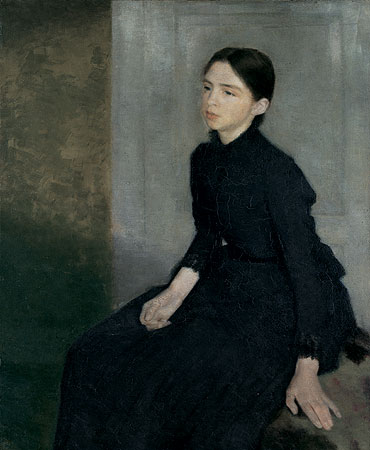
Portrait of the Artist’s Sister (1887) Oil on Canvas.
Instead of challenging the system, beginning in the 1890s Hammershøi began painting interior scenes of his home that usually featured his wife, Ida. These paintings were generally sold directly to patrons and only occasionally on public view.
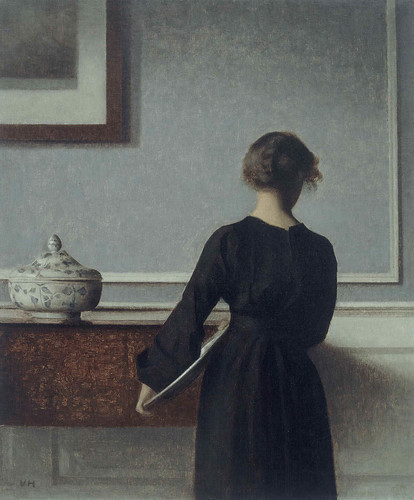
Vilhelm Hammershøi. Interior with Young Woman seen from the Back (c.1903–04) Oil on canvas. Randers Kunstmuseum.
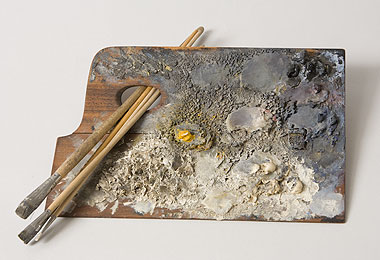
Vilhelm Hammershoi’s Palette.
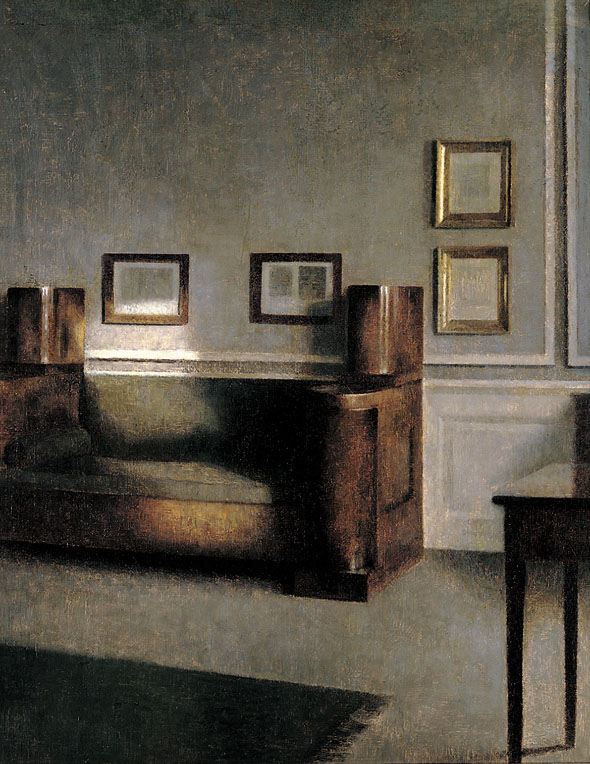
Vilhelm Hammershøi. Sonnige Stube (1905) Oil on canvas, 49.7 x 40 CM. Nationalgalerie Berlin.
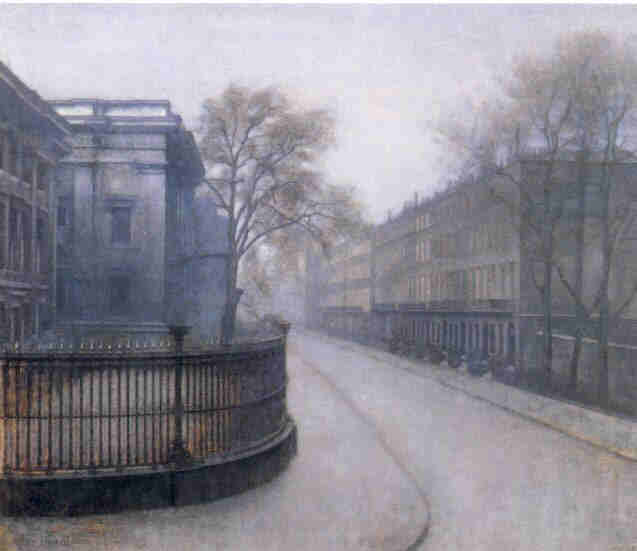
Vilhelm Hammershøi. The British Museum (c. 1905-1906). Oil on Canvas.
Thinking of the title of the exhibition, The Poetry of Silence, I was reminded of a poem titled Silence by Billy Collins:
There is the sudden silence of the crowd
above a motionless player on the field,
and the silence of the orchid.
The silence of the falling vase
before it strikes the floor
the silence of the belt when it is not striking the child.
. . .
The silence before I wrote a word
and the poorer silence now.
(Excerpt from Silence by Billy Collins. The Trouble with Poetry and Other Poems.)
For an antidote to the ever-busy lifestyle we all lead, I highly recommend finding a Hammershøi painting and sitting in silence for a time.