Posts in Category: Historical
Happy Fourth: The Declaration of Independence by John Trumbull
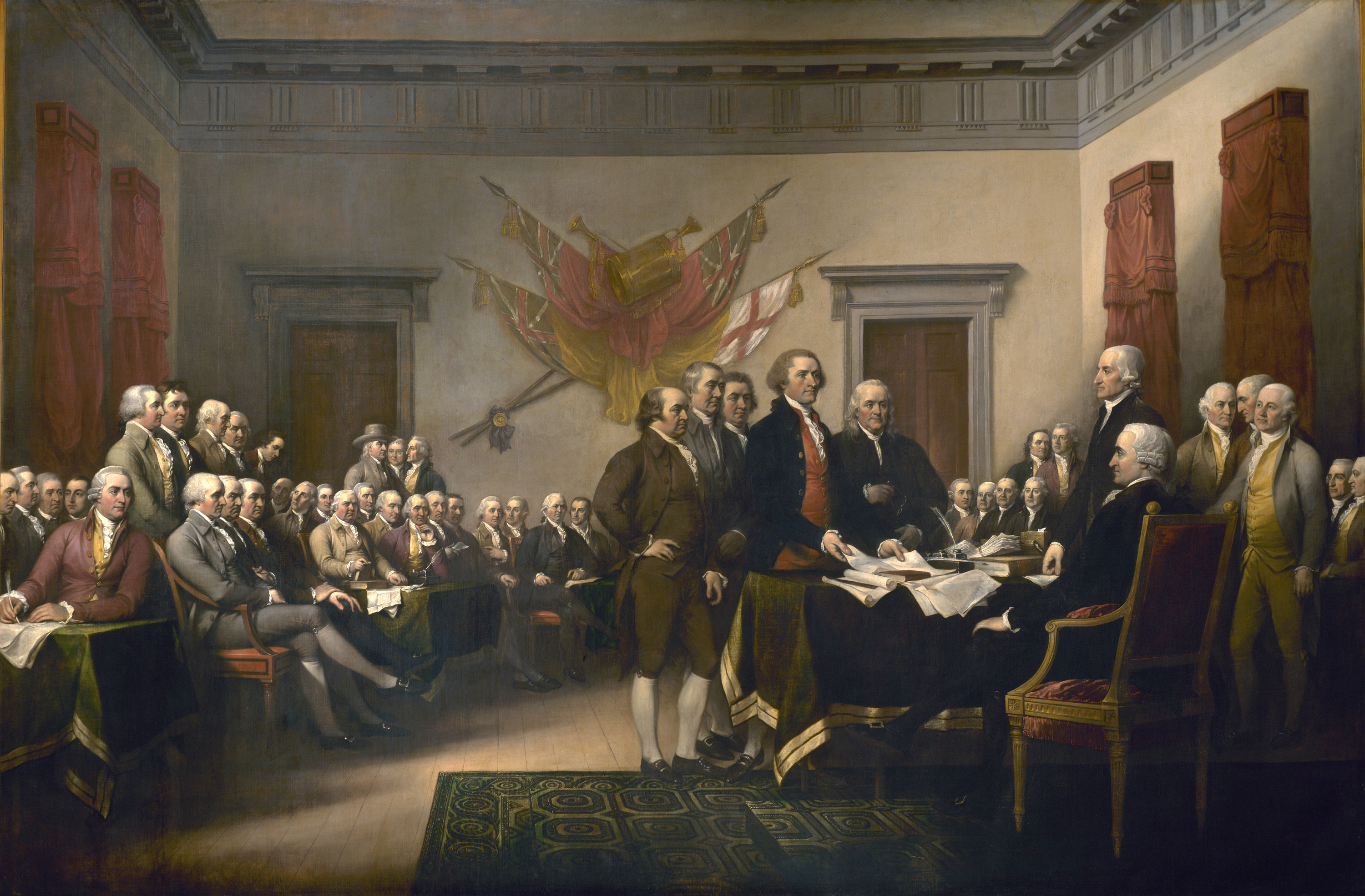
John Trumbull. The Declaration of Independence. (c. 1817-1819) 144 BY 216 IN. United States Capitol Building Rotunda. (Click on the image for a high resolution version.)
John Trumbull (1756-1843) was born in the Colony of Connecticut, where his father was the Crown-appointed Governor and the only Royal Governor to support Independence for the Colonies.
Using his family’s close ties to England, Trumbull studied and worked in the London studio of the British portraitist Benjamin West. While in Europe he painted the portraits of John Adams, serving as the Ambassador to England at the time, and Benjamin Franklin and Thomas Jefferson, who were both Ambassadors to the French Court. These portraits would later be incorporated into The Declaration of Independence.
The scale and multi-figural nature of the painting are ambitious. There are 47 portraits, all done from life. The painting itself was made over a period of three years. However, Trumbull, in his career as a portraitist in the Colonies, had gathered many of the portraits over f decades and brought together his sketches for this piece.

A key to the painting with the name of each figure.
The painting was later used as the back of the two-dollar bill.
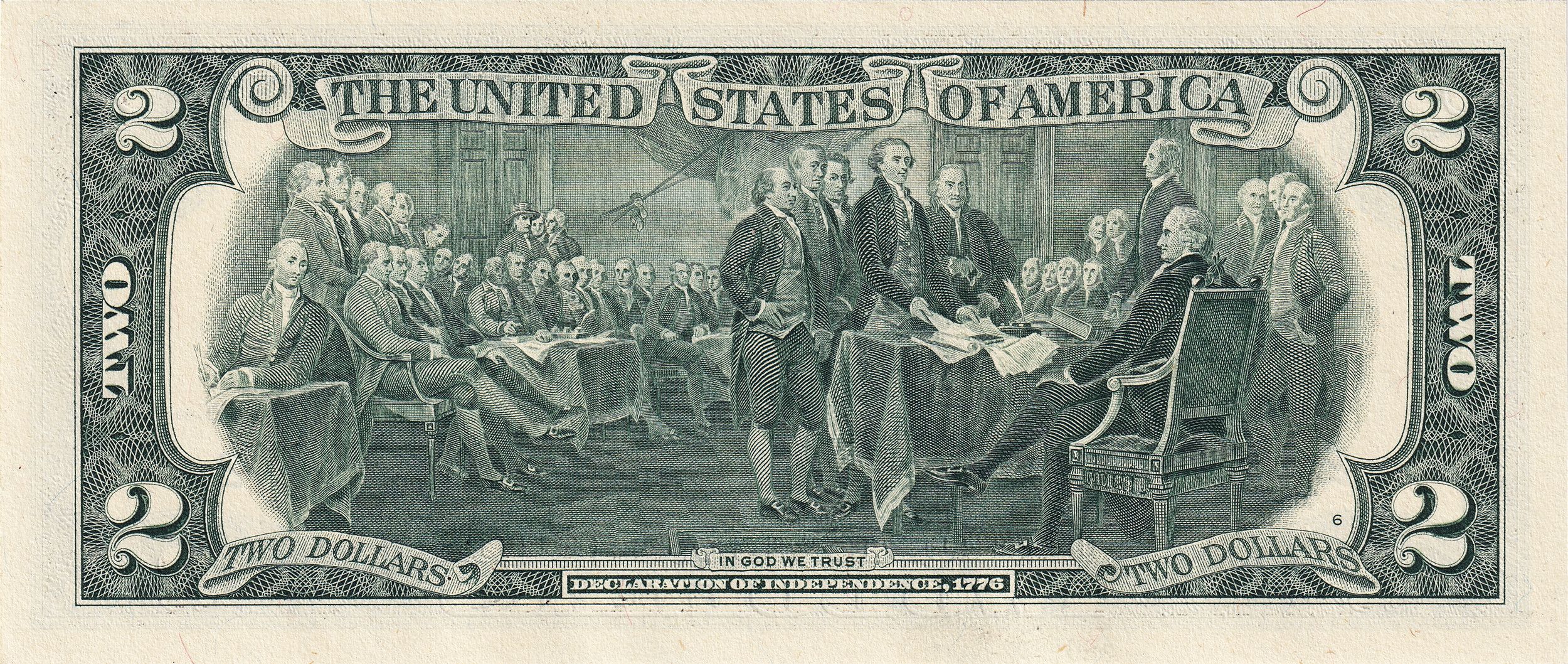
The Declaration of Independence was commissioned by the United States Congress to be hung in the Capitol Building. It is one of eight paintings of the same scale that Turnbull painted for the Rotunda:
- Surrender of General Burgoyne
- Surrender of Lord Cornwallis
- General George Washington Resigning his Commission
- Death of General Warren
- Death of General Montgomery
- George Washington before the Battle of Trenton
- Battle of Princeton
But, because Congress had only commissioned four paintings, the last four were sent or sold to other institutions.
Surprised by Alphonse Mucha in Madrid
I went to Madrid to continue research on Spanish painters, and left with an obsession for the Czech painter Alphonse Mucha (1860-1939).

Photograph of the CaixaForum building’s vertical garden.
While walking to a cafe next to my hotel, I stumbled onto an exhibition on Mucha. Titled Alphonse Mucha: Seduction, Modernity, and Utopia, the exhibition is a joint effort between CaixaForum and the Mucha Foundation. It will be on show at CaixaForums new building, located across the street from the Prado, until August 31.
The CaixaForum is the cultural wing of the Caixa Bank. Banks in Spain are required by law to use a percentage of their profits for cultural purposes. As a result, many important exhibitions, like this one, have come to Spain in the past few years. As a rule they are free to the public, and are almost always accompanied by beautiful catalogs. Unfortunately, these catalogs, like the one accompanying the Mucha exhibition, are almost never available in stores or online.

Alphonse Mucha was born in Moravia (the modern-day Czech Republic). At the age of 25, he began studies at Academy of Fine Arts in Munich. Two years later, he would move to Paris and study at the prestigious Academie Julien in France.
Eventually, he would become friends with Gauguin and participate in Symbolist art shows with Bonnard, Grasset, Toulouse-Lautrec, Mallarmé and Verlaine. His participation in Symbolism, which has underlying metaphysical and religious beliefs, went hand in hand with his participation in Freemasonry.
Mucha was initiated in the Masonic Lodge of Paris in 1898 and continued to practice Freemasonry until he died, including references to it in many of his works.
One of my favorite moments in the exhibition came from a group of school children visiting at the same time I was. Their teacher asked them: “Does anyone know what a Masonic Lodge is?” The students seemed puzzled and no one was able to answer the question. Lesson: Don’t expect a group of students in a country where 94% of the public is Catholic to know much about Masonry.
Besides being an important Symbolist, Mucha was one of the most influential players in the development of Art Nouveau, for which he is most remembered.
His Work
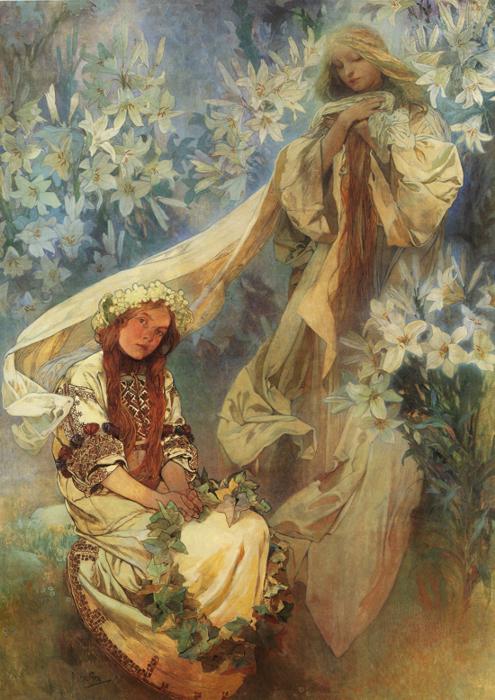
Alphonse Mucha. Madonna of the Lilies. (1905) Oil on canvas. Mucha Museum, Prague
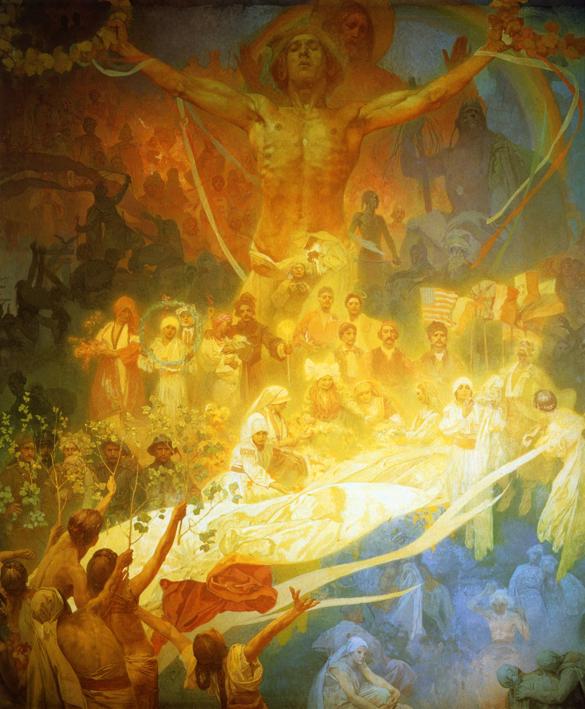
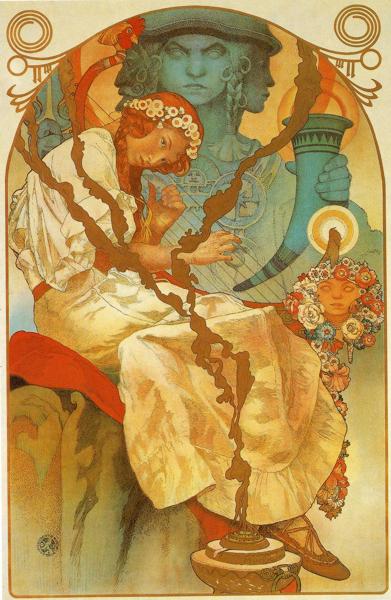
In contrast to the posters, the oils are full of light and use a generous palette. His ability to gradate from one color to another is extraordinary. While looking at The Apotheosis of the Slavs (1926), I thought of late-fifteenth-century paintings by Bellini, where he was just beginning to use oil rather than tempera, egg-based paints. Almost overnight, Bellini was able to make smooth shadows and gradual changes in color that were previously impossible. Mucha seems to crown nearly five hundred years of oil painting with a symphony of color that seamlessly glides from one bright color to another.
The Slav Epic
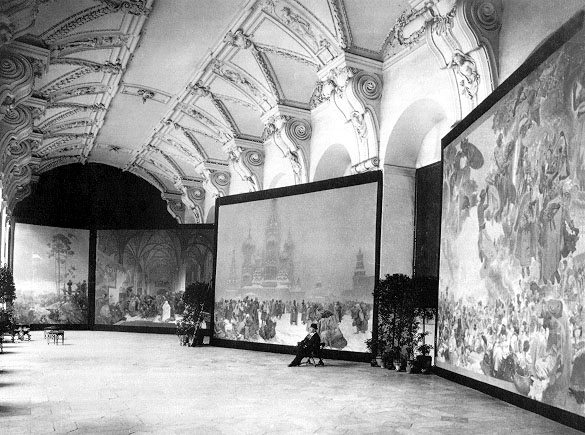
Photograph of Alphonse Mucha at the opening of the Exhibition of The Slav Epic. (1919) Klementinum, Prague.
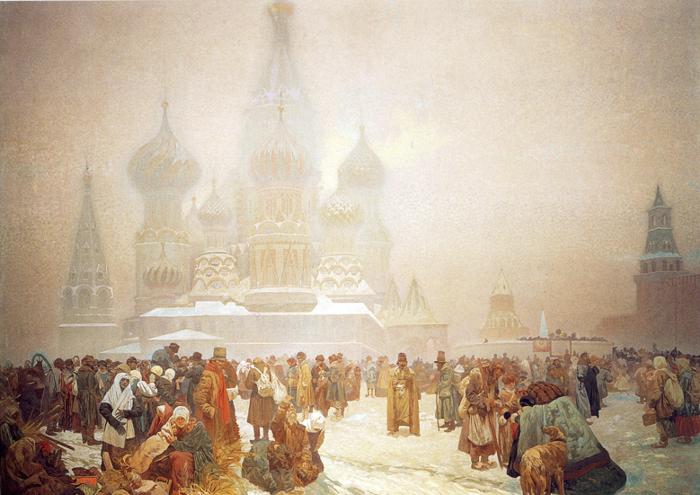
Alphonse Mucha. The Abolition of Serfdom in Russia. (1914) Tempera on canvas. Mucha Museum, Prague
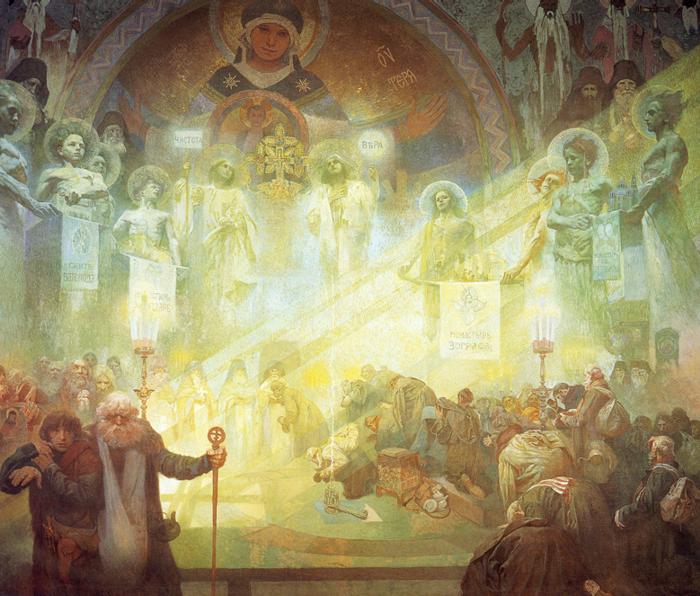
Alphonse Mucha. Holy Mount Athos. (1926) Tempera on canvas. Mucha Museum, Prague
Masters & Pupils: The Artistic Succession from Perugino to Manet (1480-1880)

Cover of the book by Gert-Rudolf Flick
Many would be surprised to learn that Manet, considered by many to be the first artist of the modern period, was the last in a long line of teachers going back to Perugino. In his book Masters& Pupils: The Artistic Succession from Perugino to Manet 1480 to 1880, Gert-Rudolf Flick traces the artistic genealogy of Manet connecting him to Carracci, Raphael and many of the greatest artists in Western history.
From the inside flap:
The line of descent that connects Perugino with Manet is made up of just eighteen artists. Some are household names such as Raphael and David. Others, for example, Horace Le Blanc and Louis Boullogne, have fallen into obscurity. All are connected by a common bond: the belief that art could be taught and learned, and that skill and knowledge would be passed on from an older artist to a younger. With Manet, the succession came to a halt, marking the end of a great tradition but also the beginning of the modern art wold, in which the desirability of teaching art has been thrown into question.
Flick traces the genealogy with an in-depth exploration of each artist in the line–eighteen in all–together with examples of each artist’s work.
These days, we do not talk much about the dynastic traditions carried down from one artist to another. For example, we talk of philosophical connections between Warhol and Banksy, but not where they studied. The idea of training an artist seems counter to the freedom inherent in our conception of “artistic expression.” How can an artist be trained by someone and, then, be expected to create something worthwhile?
The idea that tradition and training stifles an artist’s god-given talent may have begun with Manet. Together with other artists of his day, he had an antagonistic relationship with the art establishment in Paris.
In the last half of the nineteenth century, the annual Paris Salons were the premiere showcase for painters. Over 20,000 people would visit the Salon daily. Artists whose work appeared in the show were much more likely to be commercially successful. For every painting shown in the Salon ten were rejected.
A group of elite people, a mix of government appointees and past winners judged the Salon and accepted or rejected paintings. These judges were often teachers in the Ecole des Beaux-Arts and would reward their own students. It was a system that had tremendous stakes for artists who felt artistic merit was often subject to nepotism and rigid decisions. (For a very entertaining and accurate description of this struggle in the last quarter of the nineteenth century, I suggest reading Ross King’s The Judgment of Paris: The Revolutionary Decade that Gave the World Impressionism.)
It was, I believe, this institutional favoritism–teacher favoring student–in the academic system that led to the ultimate downfall of the master and pupil system. It bred a resentment in Manet’s generation, ultimately resulting a series of artistic movements (e.g. Impressionism, Divisionism, Futurism, etc.) that opposed academic training. By rejecting the system and encouraging others to do the same, Manet laid the foundation for its destruction.
Flick remains even-handed in his approach to the topic; not casting doubt on the idea that artists are born not trained. Reading the book, it is difficult to not come to the conclusion that the system should have been reformed rather than lost.
While it is true that there are many talented artists today, few of them can participate in a system that allows them to instill that talent in another generation. As a result, each generation discovers painting for themselves. This leads to a lot of fresh ideas, but severs them and us from the experience that leads to deeper understanding.
If Newton “stood on the shoulders of Giants,” where do the artists from Manet to today place their feet? That is the question that haunts this book and one that we need to have a serious debate about.
TEFAF Maastricht 2008
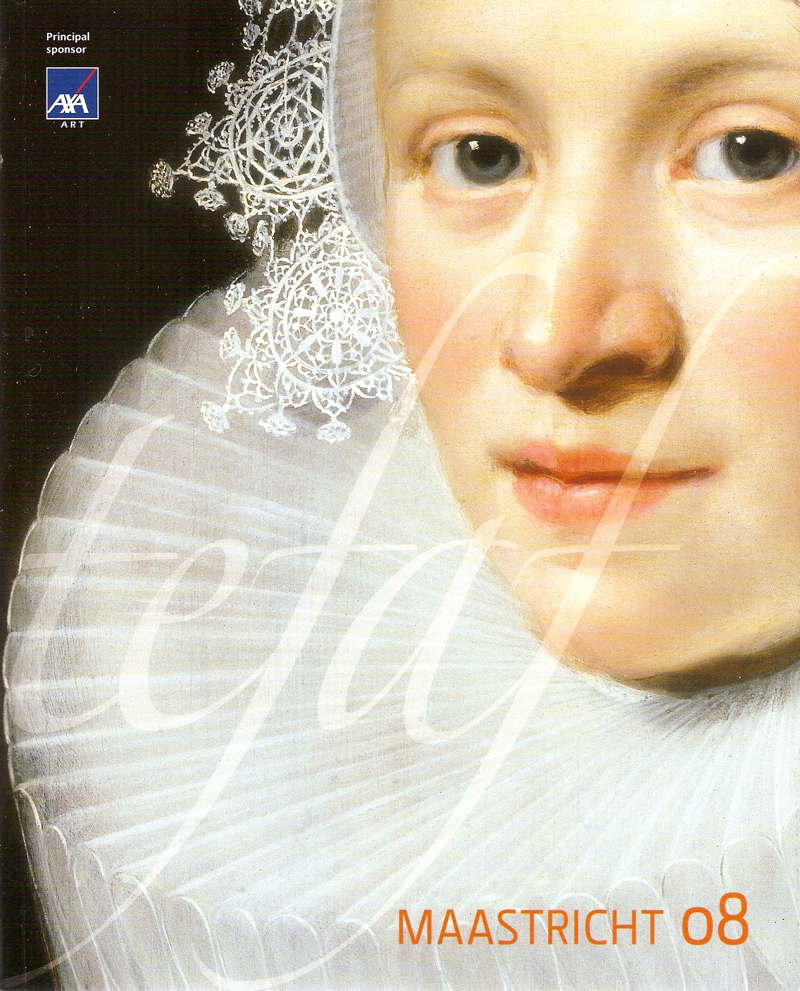
Cover from the guide to TEFAF
Friday, I took the train from London’s St. Pancras International to Maastricht. It was the opening weekend of The European Fine Art Foundation (TEFAF) held in Maastricht in the Netherlands from March 7 to 16, 2008.
Unlike museums with limited budgets, dealers at TEFAF have the cash and motivation to restore paintings. Nearly every painting had a new coat of shiny, barely-dried varnish. On one hand, paintings looked nearly new. On the other hand, some paintings had been through so many iterations of cleaning and varnishing that paint had become dangerously thin, obscuring brushwork and coloring. I often felt I was looking at them through an unfocused lens.

One of the many booths dedicated to Old Masters paintings
It was overwhelming to see so many Old Masters works under one roof. I was especially impressed by Richard L. Feigen & Co. (New York) and Whitfield Fine Art Ltd. (London). I could name a dozen others dealers in the Old Masters paintings wing. I wish I could say the same for nineteenth-century art.
There were myriad Monets and a plethora of Pissaros, but where were the academic painters?! I saw a Gerome, a L’Hermitte, and a Breton, but their colleagues from the Ecole des Beaux-Arts were poorly represented. Those that I saw were overpriced by 50 percent or more compared to my previous experience buying at auctions and from dealers in France and Belgium.
As a buyer who deals principally in nineteenth-century paintings, this was not the best venue. It might have been different if I were looking for Old Masters and Modern works.
Many of the dealers I know and have visited in London were there (e.g. Richard Green with his sons Mathew and Jonathan, The Fine Art Society, Whitford Fine Art.) They had saved their best work for the event. By the time I arrived on Saturday, the Exhibition had already been open for two days and several of the best paintings were already sold. (The early bird gets the worm . . . or Bruegel, Monet, Rembrant, van Huysum, etc.)
Also, TEFAF seems to be more for people who want to see and be seen than for those hunting for a deal. Those of us who have sold art before know that there are some people who buy something if they like it, regardless of price. This has both negative and positive consequences. Inflated prices make current stock more valuable, but they also lead to unrealistic expectations by buyers and sellers
I was surprised to learn from conversations with a few–to remain nameless–dealers that some 30 to 40 percent of their annual revenue comes from sales at Maastricht. So, either I’m missing something or there is a huge advantage to celebrity-level art events.
—
As a city, Maastricht is beautiful. It was too early in the year for tulips, but the town square, restaurants and entertainment overpowered any disappointment from the cold weather. A bit of advice: Book dinner reservations in advance, otherwise you will be eating at the bar.
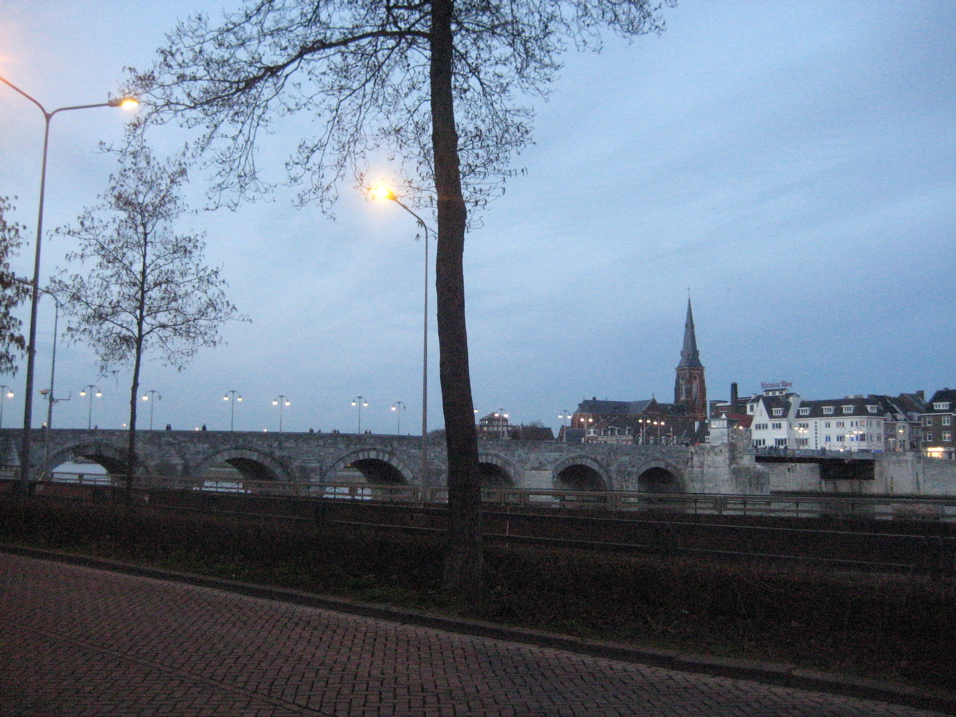
Picture of the “old bridge” downtown Maastricht.
Ecole des Beaux-Arts: Faded Glory
I just came back from Paris, where I was doing research on nineteenth nentury painters who studied at the highly admired Ecole des Beaux-Arts in Paris.
The Ecole was the most important and influential school for painting in the nineteenth century. Arguably, it is the most influential institution in the history of painting, having lead trends during the majority of the nineteenth century, when there were more than 300,000. Founded in 1648, it trained artists for more than 350 years. Some of the artists include David, Ingres, Gerome, Delacroix, and Bouguereau to name very, very few. (For a longer history of the Ecole online visit the Wikipedia entry or for more, in-depth reading see Albert Biome’s book The Academy and French Painting in the Nineteenth Century.)
While in Paris, I decided to stop by the Ecole. I wanted to see the great institution that produced great works that hang in great museums around the world. I was surprised at what I found.

(Main bathroom through the front hall of the Ecole)

(View of the Mulberry Tree Courtyard at the Ecole, with students eating lunch)

(Another shot of the courtyard with a statue and graffiti)

(A hall along the courtyard. Pay attention to the pealing paint on the ceiling.)

(Another statue with graffiti in the main courtyard)
The building is in decay at best and a victim of blatant neglect at worst. While Ingres paintings have rooms dedicate to their viewing in the Louvre, the institution Ingres dedicated his life to is rotting.
It is now a school that specializes in modern architecture. I asked several of the students and two people who worked in the main office if they could tell me where I could find the former studios of Gerome, Bouguereau, and Ingres. No one recognized the first two names, and they had no idea where I could find Ingres well-respected workshop.
It was a sad experience.
Can anything be done about it?
Should anything be done?