Posts in Category: Classical
“Warsaw Street Types” by Józef Rapacki (1871-1929)
Via BibliOdyssey is a series of drawings by the Polish painter and illustrator Józef Rapacki.
Józef Rapacki (Polish, 1871-1929). From the book:Z dawnej i niedawnej Warszawy. Lithograph
Rapacki was born in Warsaw, Poland and trained in Munich, Germany. In the late-nineteenth century, many Eastern European painters, including Muckansy and Mucha, used academic schooling in Germany as a gateway to the rest of Europe.
Józef Rapacki (Polish, 1871-1929). From the book:Z dawnej i niedawnej Warszawy. Lithograph
In addition to Germany, Rapacki traveled through Italy. Very little is printed in English or Polish about his life and work, though his paintings and drawings occasionally surface at international auction houses.
Though little is known, it is obvious that Rapacki has a solid grasp on anatomy and proportion. He has moved beyond the basic studies of academic training and is combining classical understanding of form with direct observation from nature.
Józef Rapacki (Polish, 1871-1929). From the book:Z dawnej i niedawnej Warszawy. Lithograph
This series of lithographs depicts street figures observed by Rapacki in Warsaw. These and more works by him are published online at the Polish National Library’s website.
Forgotten Masters: Resurrecting an Appreciation for Artists Worth Remembering
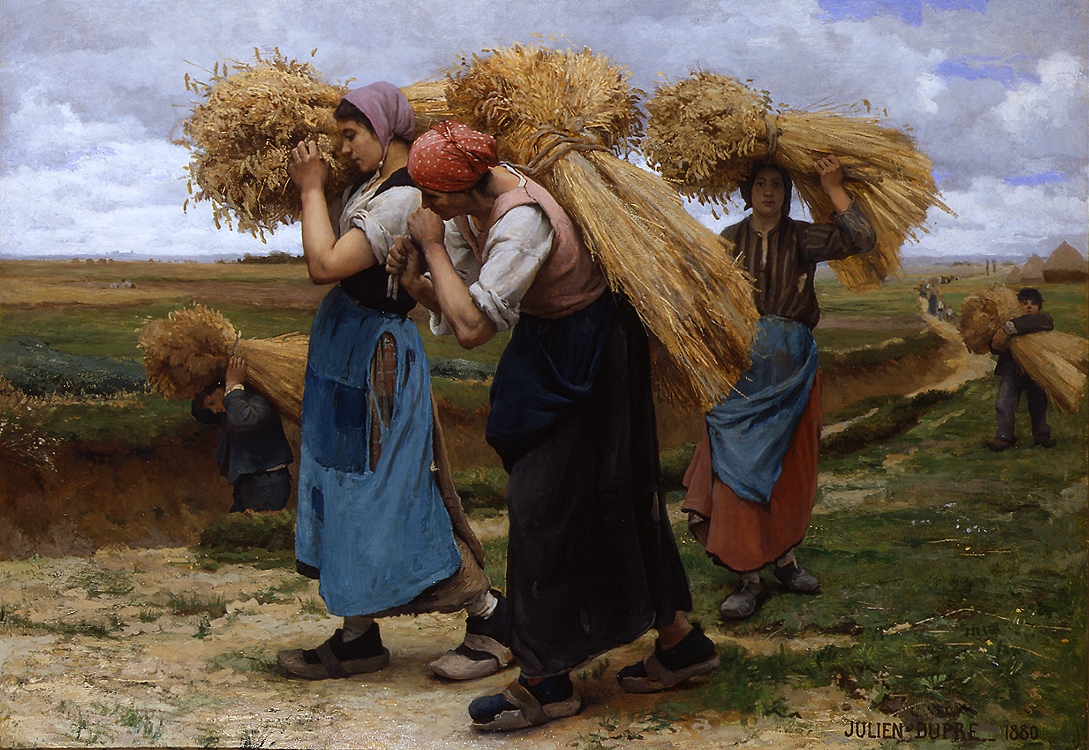
Julien Dupre, French, 1851-1910. The Gleaners (1880). Private Collection. Dupre is one of many artists that should be better remembered.
With the intent of helping to resurrect appreciation for some of the great and less-remembered artists of the past, I plan on regularly writing about what I will call “Forgotten Masters.”
Many nineteenth-century artists still sit in obscurity, not for lack of brilliance, but due to the shifting winds of culture at the end of the nineteenth and beginning of the twentieth centuries. The meteoric rise of Impressionism and other artistic movements left many academic artists, still at the peak of their talents, in the dust.
As we have distanced ourselves from changing fashions of those times, painters like Ingres, Gerome, Bouguereau, Eakins, Leighton, and Alma-Tadema have become more well known and received the recognition their works deserve through major exhibitions, scholarly books, and, finally, coffee-table books (the ultimate evidence that an artist has “made it”).
Yet we have only scratched the surface of nineteenth-century painting. According to a friend of mine, Dr. Vern Swanson, there were over 300,000 painters working in France in the nineteenth century.
300,000!
(For that number to sink in, here is an exercise: name as many French-Impressionist painters as you can. I come up with about 12 off the top of my head.)
Two websites, in particular, have been key in offering information and images of these artists:
- The Art Renewal Center: www.artrenwal.org
- Nineteenth Century Art Worldwide: www.19thc-artworldwide.org
If you have any nineteenth-century artists that you feel have been neglected and would like to see me post on them, please feel free to write me: mjc “at” beardedroman.com. Because my research is currently focused on Spain, many of the artists I will begin with in the series will be Spanish.
Starting tomorrow, look for posts tagged and titled “Forgotten Master.”
Neuroesthetics: The Science of Art and the Brain

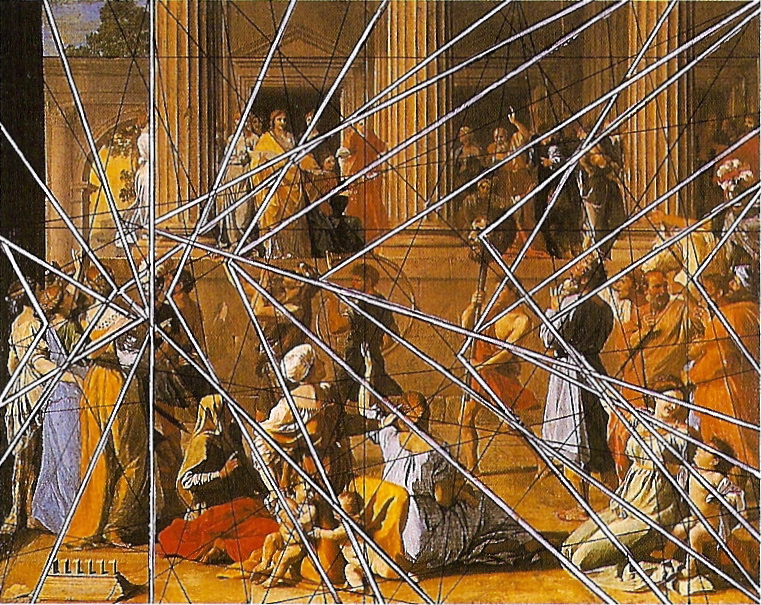
Nicolas Poussin (1594-1665) The Triumph of David. Oil on canvas. 118.4 BY 148.3CM. Dulwich Gallery, Dulwich, UK. Poussin is remembered for his highly structured paintings that influenced generations of artists looking for a more scientific approach to their painting. Three geometric analysis of this work are included in this article.
Over the past decade a new field of neurology has emerged, Neuroesthetics, with the intent of mapping the brain’s reaction to the fine arts.
The term “neuroesthetics” and the field was pioneered by Dr. Semir Zeki, who is the first Professor of Neuroesthetics at University College London, founder of the Wellcome Department of Cognitive Neuroscience at University College London and the Minerva Foundation at UC Berkley, where he is an adjunct professor. The website of the Institute defines its work as seeking “to establish the biological and neurobiological foundations of aesthetic experience.”
The notion of scientifically quantifying art might seem opposed a central purpose of art, which is subject to individual experience with an original work of art. In his long essay, What is Art?, Leo Tolstoy said it another way:
The activity of art is based on the fact that a man, receiving through his sense of hearing or sight another man’s expression of feeling, is capable of experiencing the emotion which moved the man who expressed it. To take the simplest example: one man laughs, and another, who hears, becomes merry; or a man weeps, and another, who hears, feels sorrow . . . And it is on this capacity of man to receive another man’s expression of feeling, and experience those feelings himself that the activity of art is based.
(Leo Tolstoy. Aylmer Maude, trans. What Is Art? Bridgewater: Baker & Taylor, 2000. p. 48)
Tolstoy’s way of describing art seems like a set up for a scientific experiment.
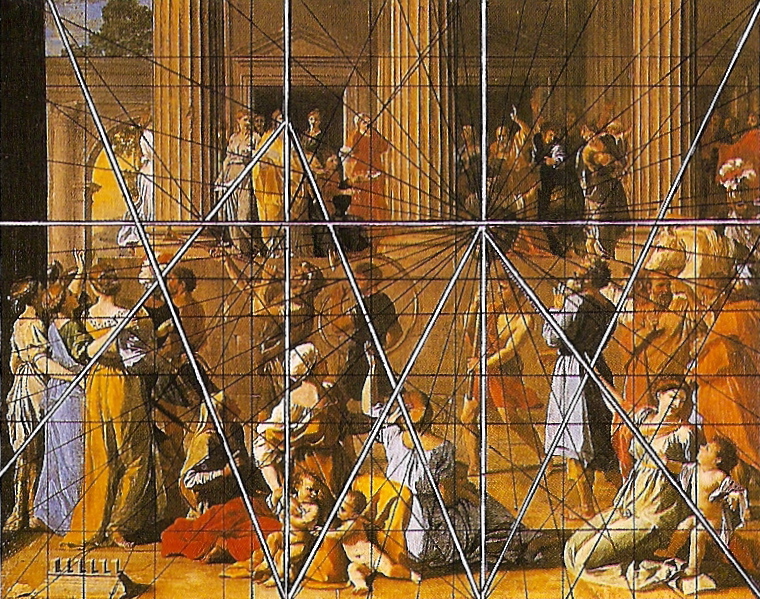
A scientific approach to art is not new. Many artists, most notably those of the Renaissance, approached art with a rigorous scientific mindset. The fifteenth- and sixteenth-century Italian schools of painting, especially in Florence and Rome, were concerned with geometry and the Golden Mean and were epitomized by the works of Leonardo Da Vinci and Raphael. European artistic training and up until the end of the nineteenth century, included classes in geometry and scientific theory. Impressionist and Divisionist artists, though rejecting traditional art, embraced new discoveries in color theory. In the twentieth century, the Futurist art movement applied current scientific understanding to effectively portray speed and movement on a canvas. Rothko was intensely concerned about the affect of color on the brain and was concerned about where his paintings would hang in case they would have an adverse results on the viewer (e.g. he believed that red was good for dining areas). I could think of a number of other examples.
The point is: science and art have been bedfellows for some time. So, it follows, why don’t we use science to futher improve our understanding of art?
In 2004, Dr. Zeki and his colleague Dr. Hideaki Kawabata published a study titled Neural Correlates of Beauty in the April 2004 J Neurophysiol journal of the The American Physiological Society. The study reports on an experiment where ten woman, with at least one college degree, were asked to rate paintings on a scale from 1 to 10, 10 being beautiful and 1 being ugly. (Note that the test controlled for a subjective experience with each painting, allowing personal preference and not scientific judgment to intervene.)
Each woman was placed in an MRI scan and, then, shown the paintings they rated in random order. The brain patterns of the women were mapped to determine whether or not the brain has has beauty or ugliness centers.
The conclusion of the study states:
The results show that the perception of different categories of paintings are associated with distinct and specialized visual areas of the brain, that the orbito-frontal cortex is differently engaged during the perception of beautiful and ugly stimuli, regardless of the category of painting, and that the perception of stimuli as beautiful or ugly mobilizes the motor cortext differentially.
(A PDF of the the full, published study, along with other studies by Dr. Zeki, can be found on the Wellcome Institute’s website: neuroesthetics.org/research.php.)
In other words, setting aside a personal interpretation of beauty, the brain has established neuro-pathways that are triggered when looking at a beautiful or ugly work of art.
As the field of Neuroesthetics expands it may eventually influence the art world. As an art historian, I am curious about what makes a work of art or an artist have a lasting impact. To find out art theorist often uses a highly subjective and, therefore, uneasy mix of soft science. Having a more scientific approach to what makes a painting work, would be a welcome tool in my belt.

The effect of this kind of research on working artists could be useful or damaging, depending on the intent of the artist. If an artist wants to learn what affects her work is having on her viewers– and, therefore, understand how to better hone those intended results–it seems very useful to use the ideas supported by neuroethetics. On the other hand, the last thing I would want to purchase it market-tested works of art. Thankfully, this doesn’t seem to be the intent of Dr. Zeki’s work.
Dr. Zeki has a blog, which he regularly updates: profzeki.blogspot.com. As the founder and leaders of the field of Neuroethetics, it is a good place to learn about his latest thinking.
French Academic Drawings with Examples by Ingres (1780-1867)
Three quarters of what constitutes painting is comprised of drawing. If I had to put a sign above my door I would write: ‘School of Drawing,†and I’m sure that I would produce Painters.
-Jean-Auguste-Dominique Ingres

Jean-Auguste-Dominique Ingres, Studies for “The Grand Odalisque,” 1814. Graphite on three sheets of paper, 10 BY 10 1/4IN. (25.4 BY 26.5CM.). Département des Arts Graphiques, Musée du Louvre, Paris.
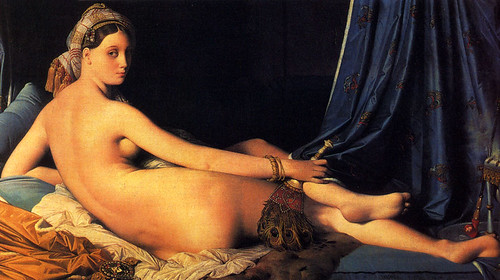
Jean-Auguste-Dominique Ingres, The Grand Odalisque, 1814. Oil on canvas, 35 1/4 BY 63 3/4IN. (89.66 BY 162CM.) Private collection.
Drawing was the fundamental teaching of the French art education system, a model that spread to the rest of the world.
In its original, seventeenth-century coursework, students submitted to a daily regimen beginning with copying modeles de dessin, plaster casts, and individual body parts. After years of practicing from inanimate objects, talented students were allowed to draw directly from nude models and compete for government commissions for work on the merit of their drawings.
Drawings Produced from 1800 to 1850
In the process of their study and work, nineteenth-century artists created specific kinds of drawings with distinct purposes. Because there was no widely recognized market, drawings were not made for the purpose of sale. Instead, the public purchased paintings or prints. However, this did not mean that the drawings were considered to be valueless. In the tradition going back centuries, David and Ingres kept stored and labeled drawings, and sometimes used them for instructional purpose.
Most of the drawings included in this post are by the prime example of academic drawing of the period: Jean Auguste Dominique Ingres (1780-1867). Ingres was the undisputed leader of the École des Beaux-Arts after the death of David. Ingres was David’s star pupil and had been awarded the Prix de Rome from the French Government, allowing him to study directly from classical works in Rome. He returned to Paris in 1841 and dominated teaching at the École.
EDUCATIONAL DRAWINGS
Individual parts of the body, from the plaster cast
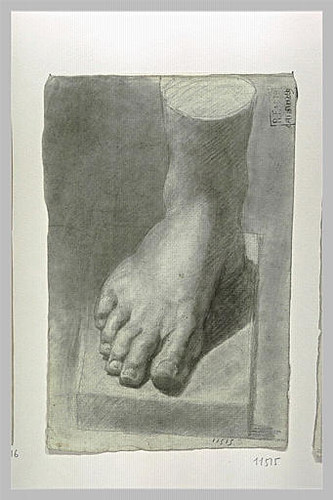
Anonymous study of plaster foot. Musée d’Orsay. Paris, France.
Before students were allowed to work on the human figure, each was required to produce convincing two-dimensional reproductions of plaster casts made from ancient statuary. Greek and Roman works were considered representations of ideal beauty, and were often created using complex mathematical equations in pursuit of the Golden Mean.
The intent of this approach was to firmly establish a foundational concept of the human body in each student’s practice before he or she encountered wide-ranging variation in the natural human figure.
From the Nude
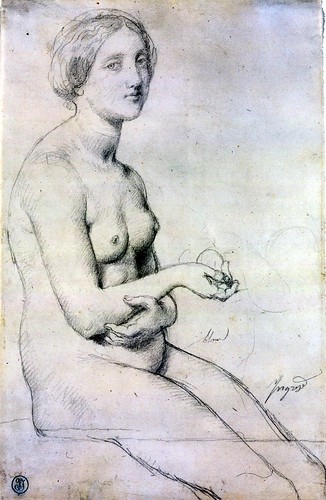
From the early Renaissance to the mid-nineteenth century, mastering the human body was considered the supreme challenge and goal of academic painters.
This foundation was especially necessary for commercial success in France, where the most lucrative commissions came in the form of patriotic history paintings comparing the new French Republic to classical democracies in Greece and Rome.
The live drawing sessions were overseen by the head teacher of the École. In the beginning of the century, David arranged the school’s schedule around live model drawing.
The art critic Etienne-Jean Delécluze described the approach of Jacques-Louis David, who is responsible for the trajectory of the École in the first half of the century:
“in the eaves . . . facing the Pont des Arts . . . the model was posed twice a week, or rather every ten days, at the time. For the first six days the model was posed nude; the last three days, a model for the head only, and the studio was closed on the tenth day.â€
These drawings did not relate to any particular painting, but were understood to assist the painter in his mastery of the human figure.
Years after receiving his first lessons in drawing the nude from David, Ingres was one of the most prominent portrait painters in Europe. In a surviving drawing, we can see that even when working with a fully-clothed sitter, Ingres used his understanding of human anatomy to understand the structure of the body beneath the clothing.
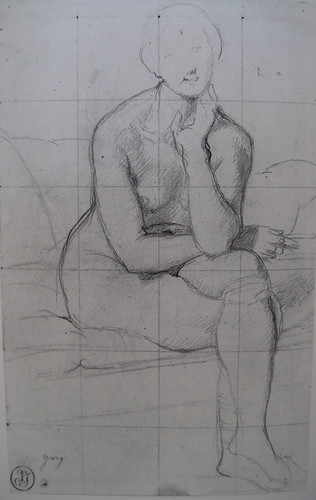
Jean-Auguste-Dominique Ingres. Study for the “Portrait of the Baronne James de Rothschild,†c. 1848. Graphite on paper, 8 BY 5 1/8IN. (20.4 BY 13CM.). Musée Bonnat, Bayonne.
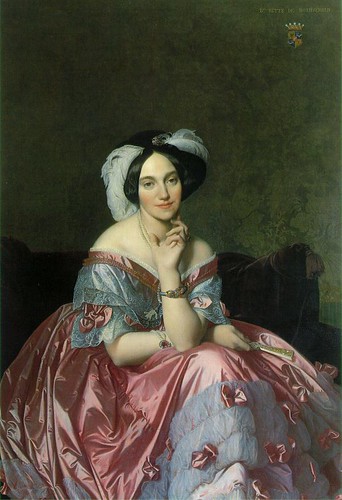
I’m fairly confident that Ingres died not tell the Baronne that he was imagining her in the nude.
PREPARATORY DRAWINGS FOR PAINTINGS
There were, broadly speaking, three classes of drawings created by artists trained in the École in the process of making a painting: the première pensée, the esquisse peinte, and the croquis. Again, Ingres will be used as the example.
The première pensée
Drawings were seen as the beginning of the painting process. An artist’s first idea, or première pensée, would be captured in a rough sketch with the intent of developing composition. Successive drawings would develop the idea found in the original and create a clearer or more thoughtful expression of what had only originally been sketched. Detail such as figures, stance and gestures come into focus.
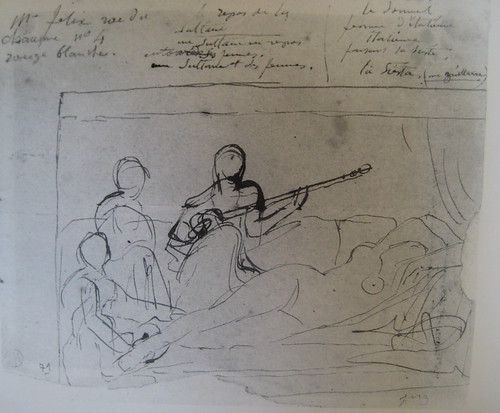
Jean-Auguste-Dominique Ingres, Study for “The Odalisque with a Slave,” 1839. Pen and ink on paper, 6 1/4 by 7 1/4IN. (16 BY 18.5CM.). Musée Ingres, Montauban, France.
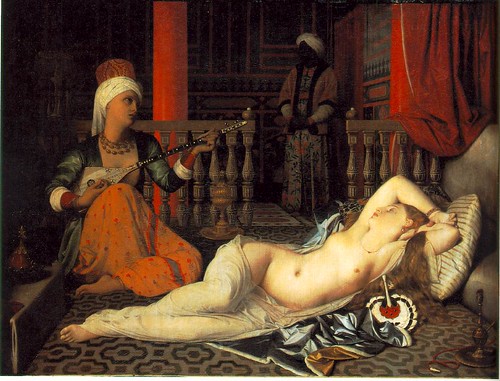
Jean-Auguste-Dominique Ingres, The Odalisque with a Slave. 1839.
The second stage of drawing used by Ingres is referred to as the esquisse peinte and is used as a complete road map for the final painting. Much larger than the première pensée, it was often drawn to the scale of the final painting directly onto the canvas and then painted over by the artist.
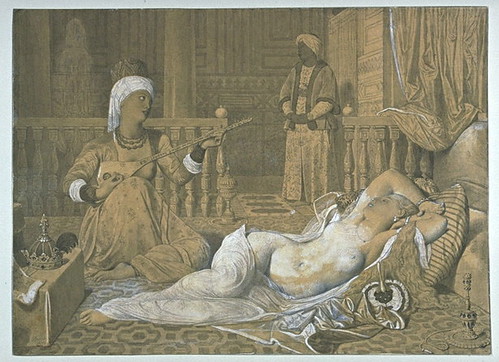
Jean-Auguste-Dominique Ingres, Study for “The Odalisque with a Slave,” 1839. Pen and ink, white pastel, and gouache on paper, 6 1/4 by 7 1/4IN. (34.5 BY 47.5CM.). Louvre. Paris, France.
The croquis
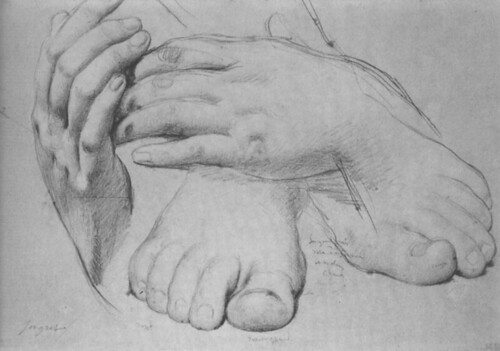
Jean-Auguste-Dominique Ingres, Study of Hands and Feet for “The Golden Age,” (1862), graphite on paper. Louvre, Paris, France.
Throughout the drafting process, areas of the painting that pose particularly difficult challenges (e.g. hands, feet, linen folds, facial expressions) are drawn sometimes multiple times and in multiple positions. In this way the adage of “measure twice, cut once†was applied to painting. In this way the artist could test multiple approaches to individual areas of the painting without jeopardizing the entire work.
Surprised by Alphonse Mucha in Madrid
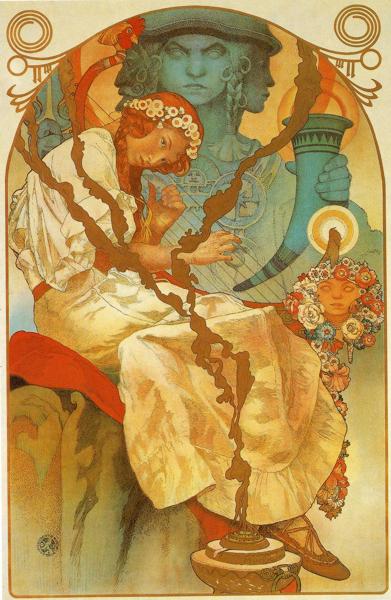
I went to Madrid to continue research on Spanish painters, and left with an obsession for the Czech painter Alphonse Mucha (1860-1939).

Photograph of the CaixaForum building’s vertical garden.
While walking to a cafe next to my hotel, I stumbled onto an exhibition on Mucha. Titled Alphonse Mucha: Seduction, Modernity, and Utopia, the exhibition is a joint effort between CaixaForum and the Mucha Foundation. It will be on show at CaixaForums new building, located across the street from the Prado, until August 31.
The CaixaForum is the cultural wing of the Caixa Bank. Banks in Spain are required by law to use a percentage of their profits for cultural purposes. As a result, many important exhibitions, like this one, have come to Spain in the past few years. As a rule they are free to the public, and are almost always accompanied by beautiful catalogs. Unfortunately, these catalogs, like the one accompanying the Mucha exhibition, are almost never available in stores or online.

Alphonse Mucha was born in Moravia (the modern-day Czech Republic). At the age of 25, he began studies at Academy of Fine Arts in Munich. Two years later, he would move to Paris and study at the prestigious Academie Julien in France.
Eventually, he would become friends with Gauguin and participate in Symbolist art shows with Bonnard, Grasset, Toulouse-Lautrec, Mallarmé and Verlaine. His participation in Symbolism, which has underlying metaphysical and religious beliefs, went hand in hand with his participation in Freemasonry.
Mucha was initiated in the Masonic Lodge of Paris in 1898 and continued to practice Freemasonry until he died, including references to it in many of his works.
One of my favorite moments in the exhibition came from a group of school children visiting at the same time I was. Their teacher asked them: “Does anyone know what a Masonic Lodge is?” The students seemed puzzled and no one was able to answer the question. Lesson: Don’t expect a group of students in a country where 94% of the public is Catholic to know much about Masonry.
Besides being an important Symbolist, Mucha was one of the most influential players in the development of Art Nouveau, for which he is most remembered.
His Work
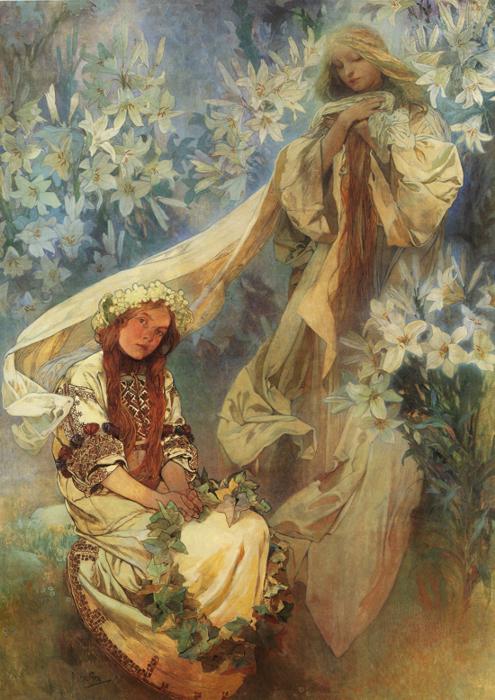
Alphonse Mucha. Madonna of the Lilies. (1905) Oil on canvas. Mucha Museum, Prague

In contrast to the posters, the oils are full of light and use a generous palette. His ability to gradate from one color to another is extraordinary. While looking at The Apotheosis of the Slavs (1926), I thought of late-fifteenth-century paintings by Bellini, where he was just beginning to use oil rather than tempera, egg-based paints. Almost overnight, Bellini was able to make smooth shadows and gradual changes in color that were previously impossible. Mucha seems to crown nearly five hundred years of oil painting with a symphony of color that seamlessly glides from one bright color to another.
The Slav Epic
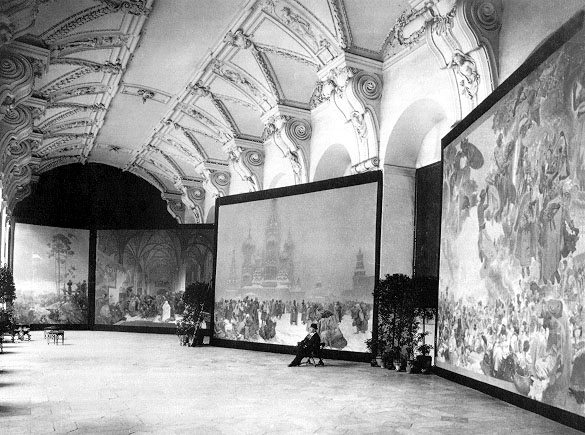
Photograph of Alphonse Mucha at the opening of the Exhibition of The Slav Epic. (1919) Klementinum, Prague.
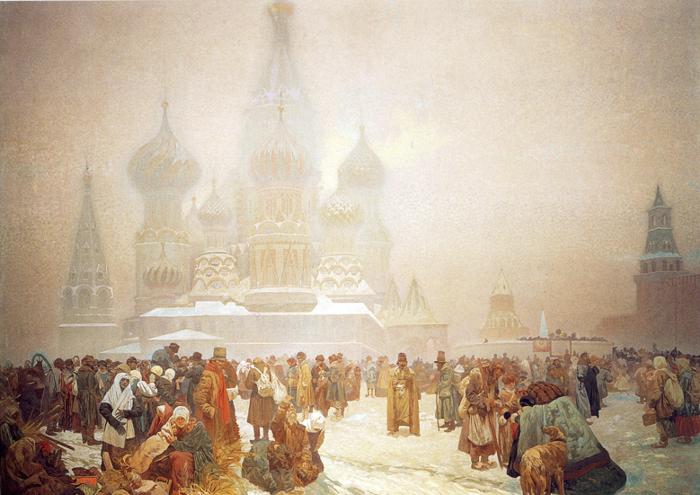
Alphonse Mucha. The Abolition of Serfdom in Russia. (1914) Tempera on canvas. Mucha Museum, Prague
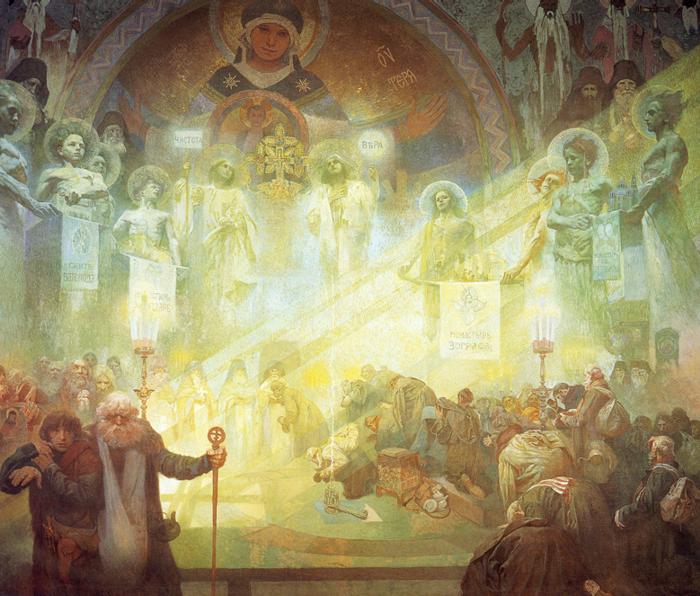
Alphonse Mucha. Holy Mount Athos. (1926) Tempera on canvas. Mucha Museum, Prague
Painting Study by Lord Frederick Leighton
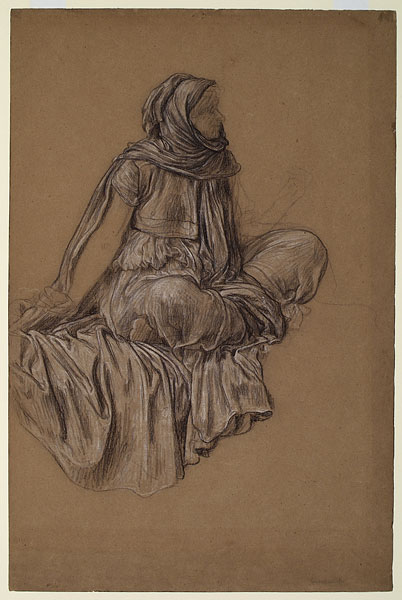
Lord Frederick Leighton, Study for Captive Andromache (1888); White and black chalk on brown paper
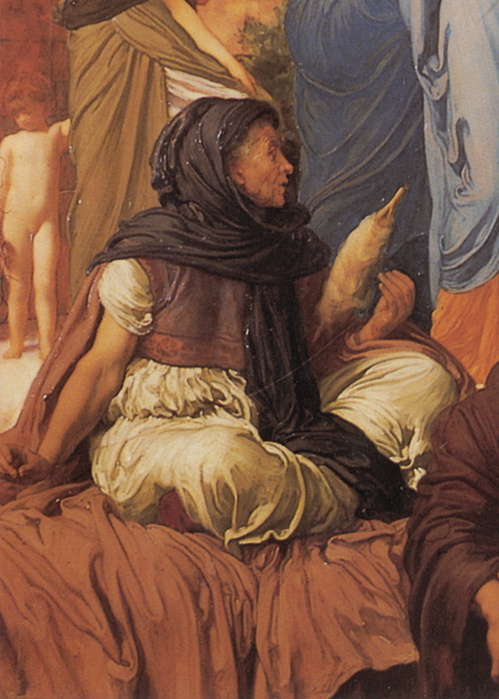
Lord Frederick Leighton, Captive Andromache (1888), DETAIL

Lord Frederick Leighton, Captive Andromache (1888). Click here for a larger image.
I was researching another artist when I stumbled across the website for Leighton House Museum, dedicated to preserving the memory and collection of the painter Lord Frederick Leighton. The Museum has digitized its collection of his drawings.
Leighton was appointed President of the Royal Academy in London in 1878. His highly realistic approach to this sketch reflects the values of the Academy in his day.
As can be seen above, the woman in his sketch is much younger than that appearing in the final version of the painting. The purpose of the sketch was to explore the drapery and not the woman’s features, which accounts for the lack of detail in the face and limbs and the detail in the fabric that faithfully appears in the final work.
—
Are we training artists or publicists?
Disclaimer: This post briefly discusses the work of an artist that some may find offensive.
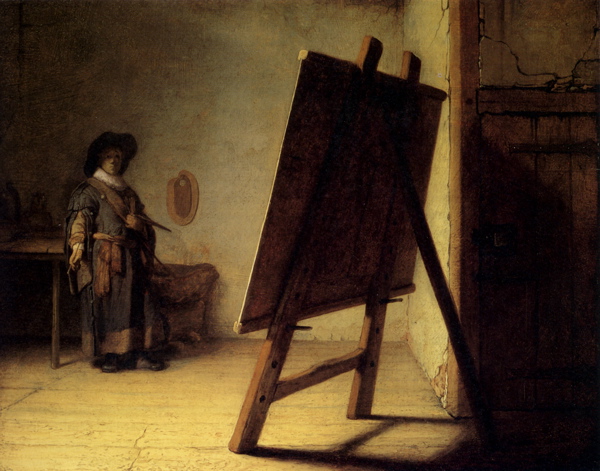
The recent, morally-objectionable work of a Yale University student has some questioning the current state of art education in this and other US universities. It makes me wonder if schools are training artists or public relations experts.
The student, Aliza Shvarts, “preformed repeated self-induced miscarriages” after inseminating herself with sperm from volunteers. The “performance” was part of an undergraduate art project meant to raise questions about abortion, society, and the female body.
The Yale Daily News interviewed Shvart in an article titled “For senior, abortion a medium for art, political discourse.” (Side note: If abortion is considered a “medium,” what else can be considered part of an artist’s toolkit? Car wrecks? Assault? Suicide?) From the article:
The display of Schvarts’ project will feature a large cube suspended from the ceiling of a room in the gallery of Green Hall. Schvarts will wrap hundreds of feet of plastic sheeting around this cube; lined between layers of the sheeting will be the blood from Schvarts’ self-induced miscarriages mixed with Vaseline in order to prevent the blood from drying and to extend the blood throughout the plastic sheeting.
Schvarts will then project recorded videos onto the four sides of the cube. These videos, captured on a VHS camcorder, will show her experiencing miscarriages in her bathrooom tub, she said. Similar videos will be projected onto the walls of the room.
Shvarts is quoted as saying: “I think I am creating a project that lives up to the standard of what art is supposed to be.” She also stated, “I hope it inspires some sort of discourse.”
“It inadvertently raises an entirely different set of questions: How exactly is Yale teaching its undergraduates to make art? Is her project a bizarre aberration or is it within the range of typical student work?“ wrote Michael Lewis in a recent article for the Wall Street Journal, discussing Shvarts’ work.
Lewis, a Professor of Art at Williams College, goes on to explore a series of issues central to how anyone begins to assess art:
It is often said that great achievement requires in one’s formative years two teachers: a stern taskmaster who teaches the rules and an inspirational guru who teaches one to break the rules. But they must come in that order. Childhood training in Bach can prepare one to play free jazz and ballet instruction can prepare one to be a modern dancer, but it does not work the other way around. One cannot be liberated from fetters one has never worn; all one can do is to make pastiches of the liberations of others. And such seems to be the case with Ms. Shvarts.
Amen. Futher on, he writes:
Immaturity, self-importance and a certain confused earnestness will always loom large in student art work. But they will usually grow out of it. What of the schools that teach them? Undergraduate programs in art aspire to the status of professional programs that award MFA degrees, and there is often a sense that they too should encourage the making of sophisticated and challenging art, and as soon as possible. Yale, like most good programs, requires its students to achieve a certain facility in drawing, although nowhere near what it demanded in the 1930s, when aspiring artists spent roughly six hours a day in the studio painting and life drawing, and an additional three on Saturday.
Given the choice of this arduous training or the chance to proceed immediately to the making of art free of all traditional constraints, one can understand why all but a few students would take the latter. But it is not a choice that an undergraduate should be given. In this respect — and perhaps only in this respect — Ms. Shvarts is the victim in this story.
Double Amen.
Two weeks ago, my wife and I had dinner with a professor of art at a top-25 ranked US university. I am not a professor of art nor an artist. I am an art historian accustomed to studying artist studios and schools a hundred years old or older where artists used to train. I wanted to find the answer to a seeming contradiction: how can universities teach art in an climate where anything seems permissible? What standards are used by educators to determine whether or not a student is making progress or if he or she is even good?
In answering my questions, the professor stayed away from terms like “good” and “bad,” preferring to refer to students as being “unique” and “individually inspired.” He summed up the teaching method as making sure students “hit what they are aiming at.” The professor was repulsed by my ideas regarding classical training as being necessary for artistic excellence. He believed such training was optional. In some cases, he considered training as intolerant of and damaging to nascent artistic talent. In other words, unhindered artistic talent is the goal. Consequently, untrained immaturity is confused with unsullied innocence. Not only should artists not be taught, but teaching can be damaging and morally repugnant.
I wondered what Yo-Yo Ma, who is currently part of a large, non-classical orchestra project, would say about squashing his capacity or freedom through rigorous training.
As William F. Buckley, Jr. once said referring to a similarly confusing turn of logic, I wanted to “knock something off the table to make sure that gravity still functioned.”
A culture where standards are absent leads to what I call “the artistic arms race.” When there are no standards for judging what is good or bad (or skilled versus unskilled), art is judged by the attention it receives. Courting controversy becomes the standard method for success. Controversy then equals quality. The skills necessary for creating art are more aligned with Public Relations than with trained artistic talent.
I am not saying that there are no standards in all or even most universities. Dr. Lewis, who wrote the Wall Street Journal article, teaches art at a US university. He obviously has standards.
I know living artists who are extremely gifted and work hard to develop those gifts. I like some of their art and I don’t like others’. This is not a question of producing art that the majority of people like–though that would be nice too. It is not about dumbing down art or lowering standards.
For me, this is about progress. Can art progress without rigor or discipline? Science is progressing, answering questions that it was asking in decades past and coming up with new questions. Is art progressing or is it rotting?
American Artist Interview with the Painter Jacob Collins

Male Figure by Jacob Collins (Graphite and white chalk on paper, 2001) From Jacob Collins’ website.

Thinking Man by Jacob Collins (Oil on canvas, 30 X 20 in., 2004). From Jacob Collins’ website.
Last year, I had the opportunity to spend a weekend with Jacob. His passion is electrifying. With it, he has opened three schools for the training of new artists in traditional academic techiniques, such as rigorous draftsmanship, first from plaster casts and, then, nude models. He is uncompromising in his approach to his own work and instills the same in his own students. The results can be seen in his own work.

Fire Island Sunset by Jacob Collins (Oil, 2004, 24 X 38 in.) Private Collection. Illustrated on the American Artist Magazine website.
Allison Malifronte of American Artist Magazine recently talked with Jacob. The interview pincipally focuses on his latest school, The Hudson River School for Landscape, based on the group of artists from the nineteenth century by the same name. Here is an excerpt from Malifronte’s conversation. (Note “AA” refers to American Artist Magazine, not a twelve-step program.):
AA: If you could offer an aspiring landscape painter one piece of advice, what would it be?
JC: Last year I read Asher B. Durand’s “Letters on Landscape Painting,†and I was struck by the advice he gave to aspiring landscape artists to draw the individual pieces of the landscape for as long as it takes to understand them before putting it all together. He recommended perhaps even years of drawing branches of trees and rocks, outcroppings, and clusters of trees with a sharp pencil, seeing them as the alphabet of the landscape. I was impressed with his analogy that trying to paint a landscape without learning this alphabet was like trying to write a novel without learning the letters and words of language.
(For the full article, click here.)
As lover of art, I appreciate this kind coverage of Jacob Collins. It shows that there is a greater diversity in current art production than glossy magazines and blockbuster contemporary exhibitions would lead many to believe. And, Malifronte’s interview focuses on the craftsmanship of Jacob’s work. Her questions do a wonderful job of capturing what drives his passion on ground level, not just a 10,000-foot view of his work. This is an approach that makes American Artist Magazine such a valuable resource for not only artists, but for art historians, dealers, and collectors of art. (No, they did not pay me to write that.)
As an art historian, it allows me to understand what is happening in the mind of an artist looking back at the nineteenth century that doesn’t survive in remaining nineteenth century journals. I have read Eugene Delacroix’s journals (and others’), and I do not feel that he wrote much of his working method down in a context that we can easily piece it together. This could be because he lived in a culture where much of his approach was ubiquitous and mundane. The shortening of Jacob’s name in the article to “JC” may be most appropriate because he is resurrecting not just the art, but the understanding–and, therefore, the appreciation–of it.
For more paintings by Jacob Collins, I highly suggest visiting his website here. It has a large collection of images of his work. (My only complaint is that there is not more recent work available on it.)
Masters & Pupils: The Artistic Succession from Perugino to Manet (1480-1880)

Cover of the book by Gert-Rudolf Flick
Many would be surprised to learn that Manet, considered by many to be the first artist of the modern period, was the last in a long line of teachers going back to Perugino. In his book Masters& Pupils: The Artistic Succession from Perugino to Manet 1480 to 1880, Gert-Rudolf Flick traces the artistic genealogy of Manet connecting him to Carracci, Raphael and many of the greatest artists in Western history.
From the inside flap:
The line of descent that connects Perugino with Manet is made up of just eighteen artists. Some are household names such as Raphael and David. Others, for example, Horace Le Blanc and Louis Boullogne, have fallen into obscurity. All are connected by a common bond: the belief that art could be taught and learned, and that skill and knowledge would be passed on from an older artist to a younger. With Manet, the succession came to a halt, marking the end of a great tradition but also the beginning of the modern art wold, in which the desirability of teaching art has been thrown into question.
Flick traces the genealogy with an in-depth exploration of each artist in the line–eighteen in all–together with examples of each artist’s work.
These days, we do not talk much about the dynastic traditions carried down from one artist to another. For example, we talk of philosophical connections between Warhol and Banksy, but not where they studied. The idea of training an artist seems counter to the freedom inherent in our conception of “artistic expression.” How can an artist be trained by someone and, then, be expected to create something worthwhile?
The idea that tradition and training stifles an artist’s god-given talent may have begun with Manet. Together with other artists of his day, he had an antagonistic relationship with the art establishment in Paris.
In the last half of the nineteenth century, the annual Paris Salons were the premiere showcase for painters. Over 20,000 people would visit the Salon daily. Artists whose work appeared in the show were much more likely to be commercially successful. For every painting shown in the Salon ten were rejected.
A group of elite people, a mix of government appointees and past winners judged the Salon and accepted or rejected paintings. These judges were often teachers in the Ecole des Beaux-Arts and would reward their own students. It was a system that had tremendous stakes for artists who felt artistic merit was often subject to nepotism and rigid decisions. (For a very entertaining and accurate description of this struggle in the last quarter of the nineteenth century, I suggest reading Ross King’s The Judgment of Paris: The Revolutionary Decade that Gave the World Impressionism.)
It was, I believe, this institutional favoritism–teacher favoring student–in the academic system that led to the ultimate downfall of the master and pupil system. It bred a resentment in Manet’s generation, ultimately resulting a series of artistic movements (e.g. Impressionism, Divisionism, Futurism, etc.) that opposed academic training. By rejecting the system and encouraging others to do the same, Manet laid the foundation for its destruction.
Flick remains even-handed in his approach to the topic; not casting doubt on the idea that artists are born not trained. Reading the book, it is difficult to not come to the conclusion that the system should have been reformed rather than lost.
While it is true that there are many talented artists today, few of them can participate in a system that allows them to instill that talent in another generation. As a result, each generation discovers painting for themselves. This leads to a lot of fresh ideas, but severs them and us from the experience that leads to deeper understanding.
If Newton “stood on the shoulders of Giants,” where do the artists from Manet to today place their feet? That is the question that haunts this book and one that we need to have a serious debate about.
TEFAF Maastricht 2008
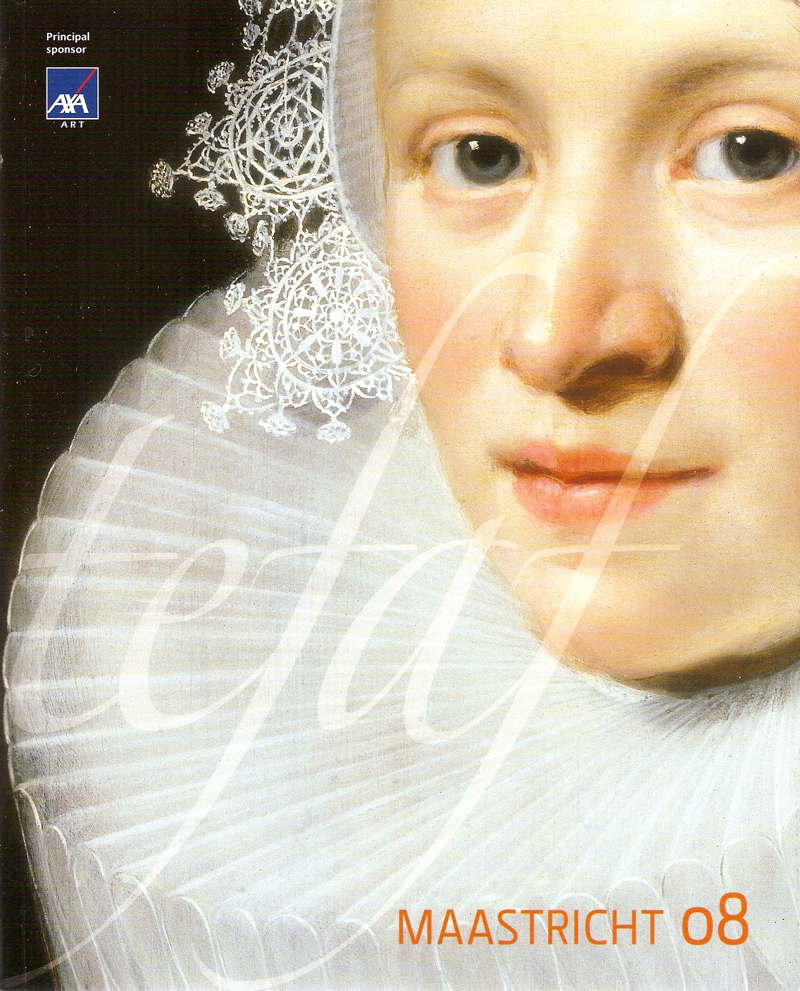
Cover from the guide to TEFAF
Friday, I took the train from London’s St. Pancras International to Maastricht. It was the opening weekend of The European Fine Art Foundation (TEFAF) held in Maastricht in the Netherlands from March 7 to 16, 2008.
Unlike museums with limited budgets, dealers at TEFAF have the cash and motivation to restore paintings. Nearly every painting had a new coat of shiny, barely-dried varnish. On one hand, paintings looked nearly new. On the other hand, some paintings had been through so many iterations of cleaning and varnishing that paint had become dangerously thin, obscuring brushwork and coloring. I often felt I was looking at them through an unfocused lens.

One of the many booths dedicated to Old Masters paintings
It was overwhelming to see so many Old Masters works under one roof. I was especially impressed by Richard L. Feigen & Co. (New York) and Whitfield Fine Art Ltd. (London). I could name a dozen others dealers in the Old Masters paintings wing. I wish I could say the same for nineteenth-century art.
There were myriad Monets and a plethora of Pissaros, but where were the academic painters?! I saw a Gerome, a L’Hermitte, and a Breton, but their colleagues from the Ecole des Beaux-Arts were poorly represented. Those that I saw were overpriced by 50 percent or more compared to my previous experience buying at auctions and from dealers in France and Belgium.
As a buyer who deals principally in nineteenth-century paintings, this was not the best venue. It might have been different if I were looking for Old Masters and Modern works.
Many of the dealers I know and have visited in London were there (e.g. Richard Green with his sons Mathew and Jonathan, The Fine Art Society, Whitford Fine Art.) They had saved their best work for the event. By the time I arrived on Saturday, the Exhibition had already been open for two days and several of the best paintings were already sold. (The early bird gets the worm . . . or Bruegel, Monet, Rembrant, van Huysum, etc.)
Also, TEFAF seems to be more for people who want to see and be seen than for those hunting for a deal. Those of us who have sold art before know that there are some people who buy something if they like it, regardless of price. This has both negative and positive consequences. Inflated prices make current stock more valuable, but they also lead to unrealistic expectations by buyers and sellers
I was surprised to learn from conversations with a few–to remain nameless–dealers that some 30 to 40 percent of their annual revenue comes from sales at Maastricht. So, either I’m missing something or there is a huge advantage to celebrity-level art events.
—
As a city, Maastricht is beautiful. It was too early in the year for tulips, but the town square, restaurants and entertainment overpowered any disappointment from the cold weather. A bit of advice: Book dinner reservations in advance, otherwise you will be eating at the bar.
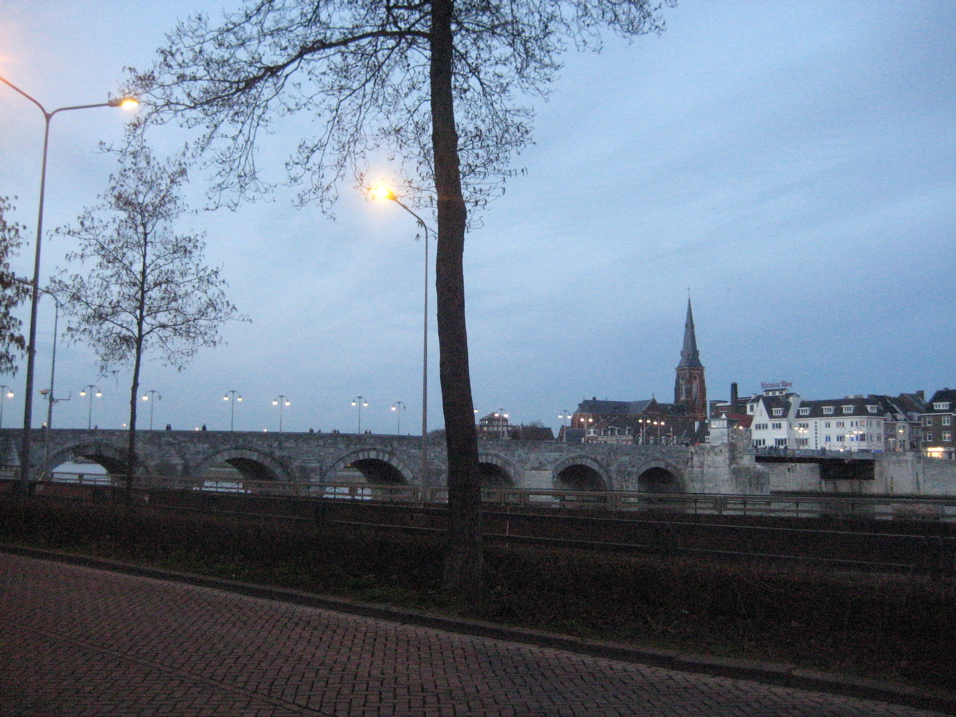
Picture of the “old bridge” downtown Maastricht.