Posts By Micah Christensen
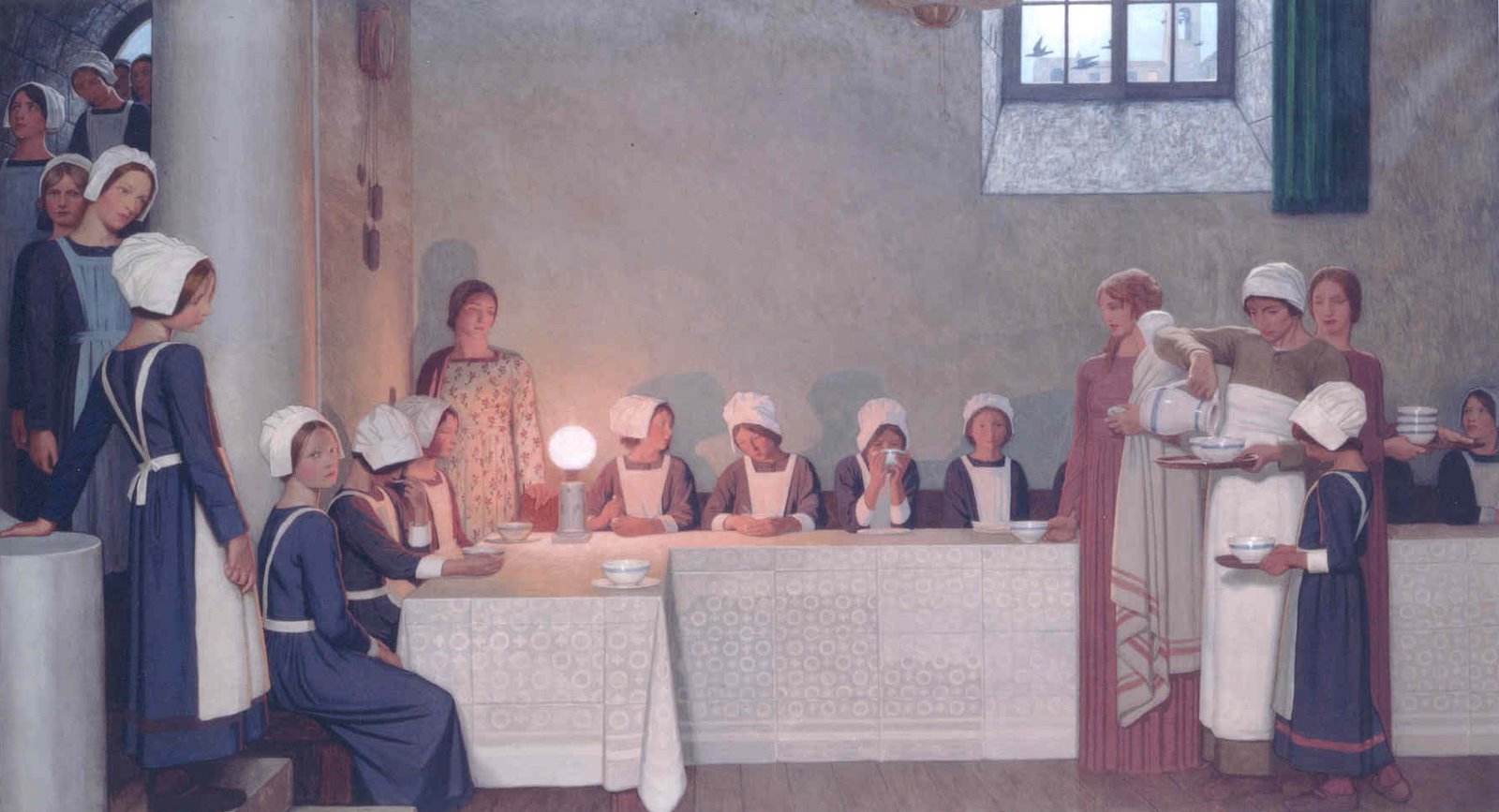
Forgotten Master: Federick Cayley Robinson (British, 1862-1927)
The recent exhibition, Acts of Mercy, at the National Gallery has brought well-deserved attention to Federick Cayley Robinson (British, 1862-1927). Despite his remarkable abilities and relationship with still-celebrated artists, the majority of Robinson’s works are in museum storage or private collections.
Federick Cayley Robinson (British, 1862-1927) Acts of Mercy: Orphans II (c. 1915) Oil on canvas. Wellcome Collection, London.
(Like works reproduced on this blog, these paintings are three dimensional objects. In person the vibrancy of Robinson’s colors and his painterly skills are undeniable and electric.)
Robinson studied at the Academy of St. Johns Wood before being accepted to London’s Royal Academy under Frederic Lord Leighton (British, 1830-1896). He continued to develop his abilities, first at the Academie Julien in France for three years and, then, in Florence.
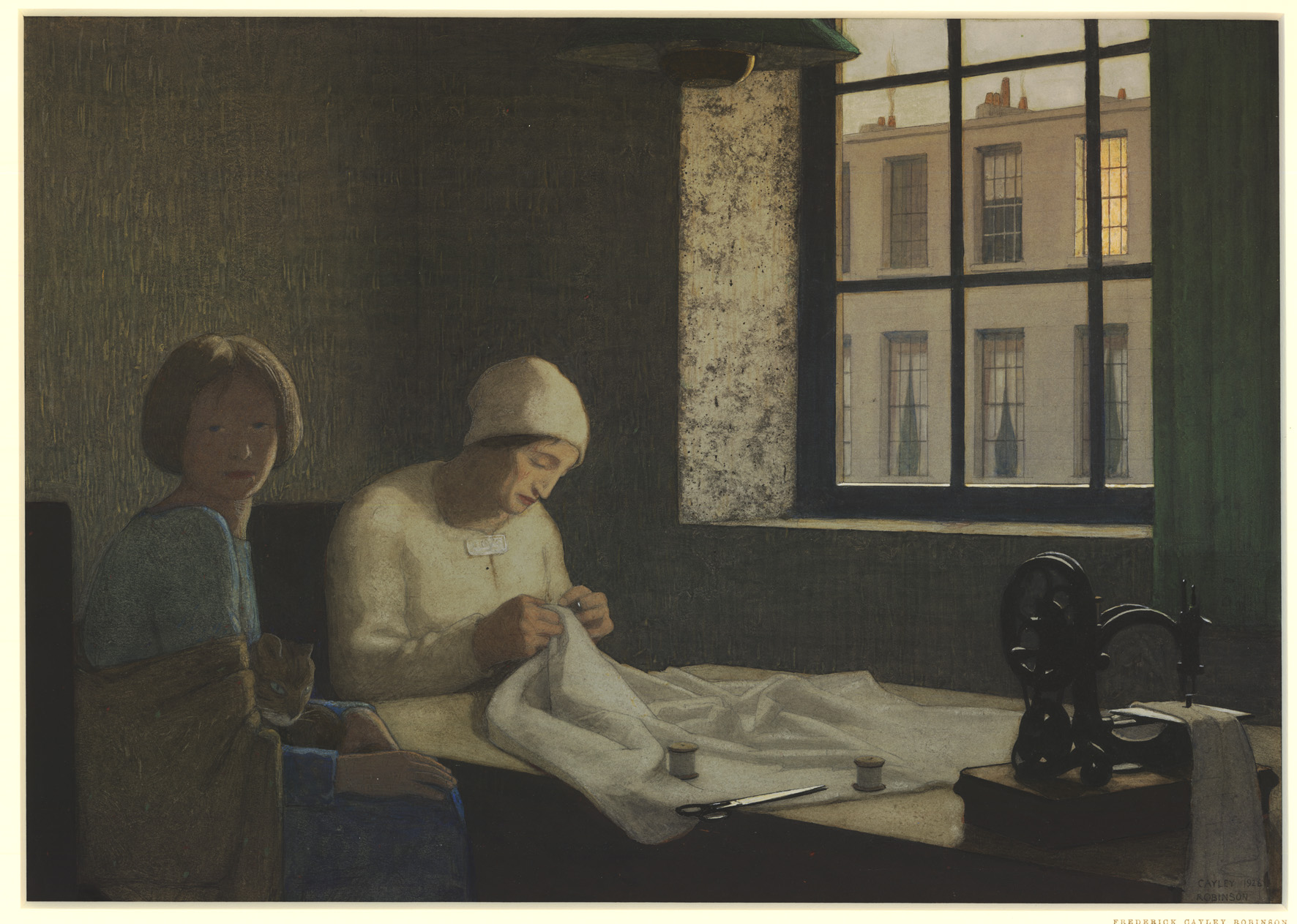
Federick Cayley Robinson (British, 1862-1927) The Old Nurse (1926) Oil on canvas. British Museum, London.
Robinson moved back the UK to take a teaching position at Glasgow University, where he became a friend and collaborator with members of the Glasgow Boys. But, before taking his post, Robinson travelled to Newlyn, England at the peak of Stanhope Forbes’ (British, 1857-1947) career. Like Forbes, Robinson’s work was dominated by fisherman, farmers, and shepherds. But, unlike the Newlyn School, which took inspiration from French Naturalism and Jules Bastien Lepage, in particular, Robinson was heavily influence by the Symbolist Pierre Puvis de Chavannes (French, 1824-1898).
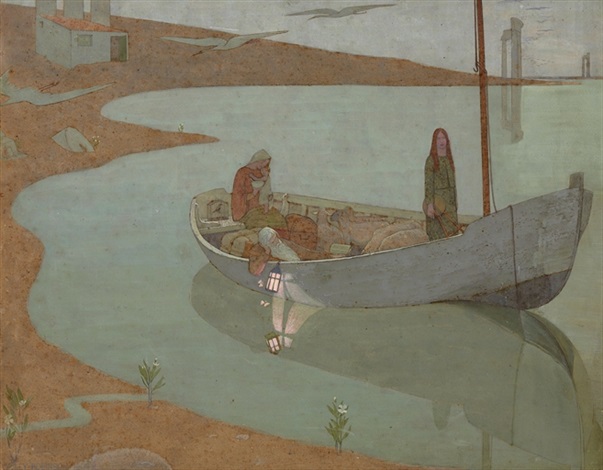
Federick Cayley Robinson (British, 1862-1927) To Pastures New, or Dawn (1904) Watercolor, graphite, and bodycolor on board. 28 by 35 1:2 in.
In To Pastures New, Robinson creates an homage to the French artist by reversing Chanvannes’ composition in The Poor Fisherman.
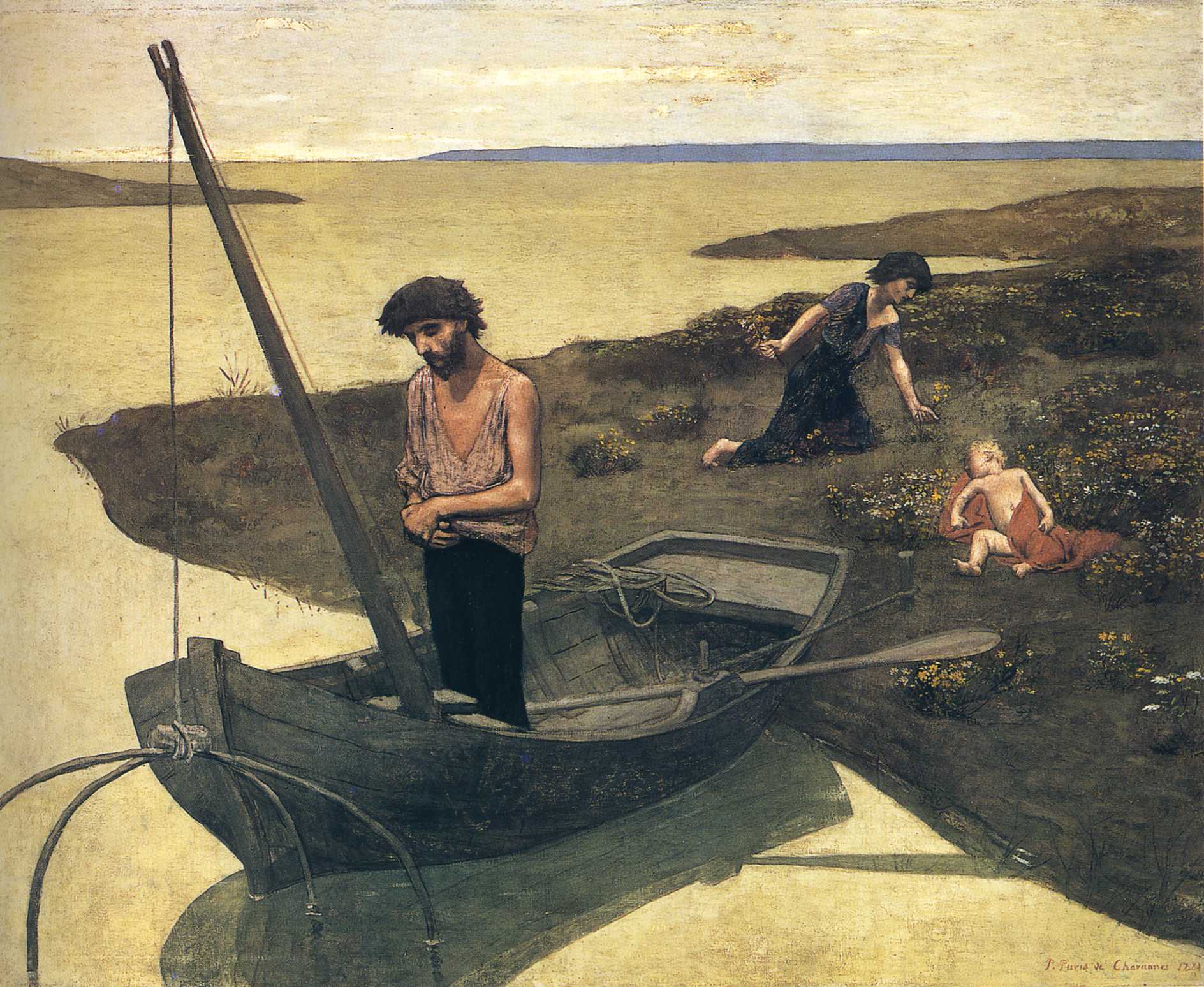
Pierre Puvis de Chavannes (French, 1824-1898) The Poor Fisherman (1881) Oil on canvas 155 by 192.5 cm. Musée d’Orsay, Paris
Robinson’s greatest work was a series of paintings commissioned for the Middlesex Hospital. Spanning more than 15-feet each, the four panels of Acts of Mercy are a tour de force of skill, demonstrating Robinson’s enormous arsenal of skills and classical vocabulary. He combines the sensibilities of a classicist–deriving poses and motifs from greco-roman sculpture and compositions borrowed Giotto’s frescoes–and the subjects from contemporary life. His subjects are orphans and veterans of World War I cared for by the hospital. Aesthetically, it is both contemporary and timeless. A
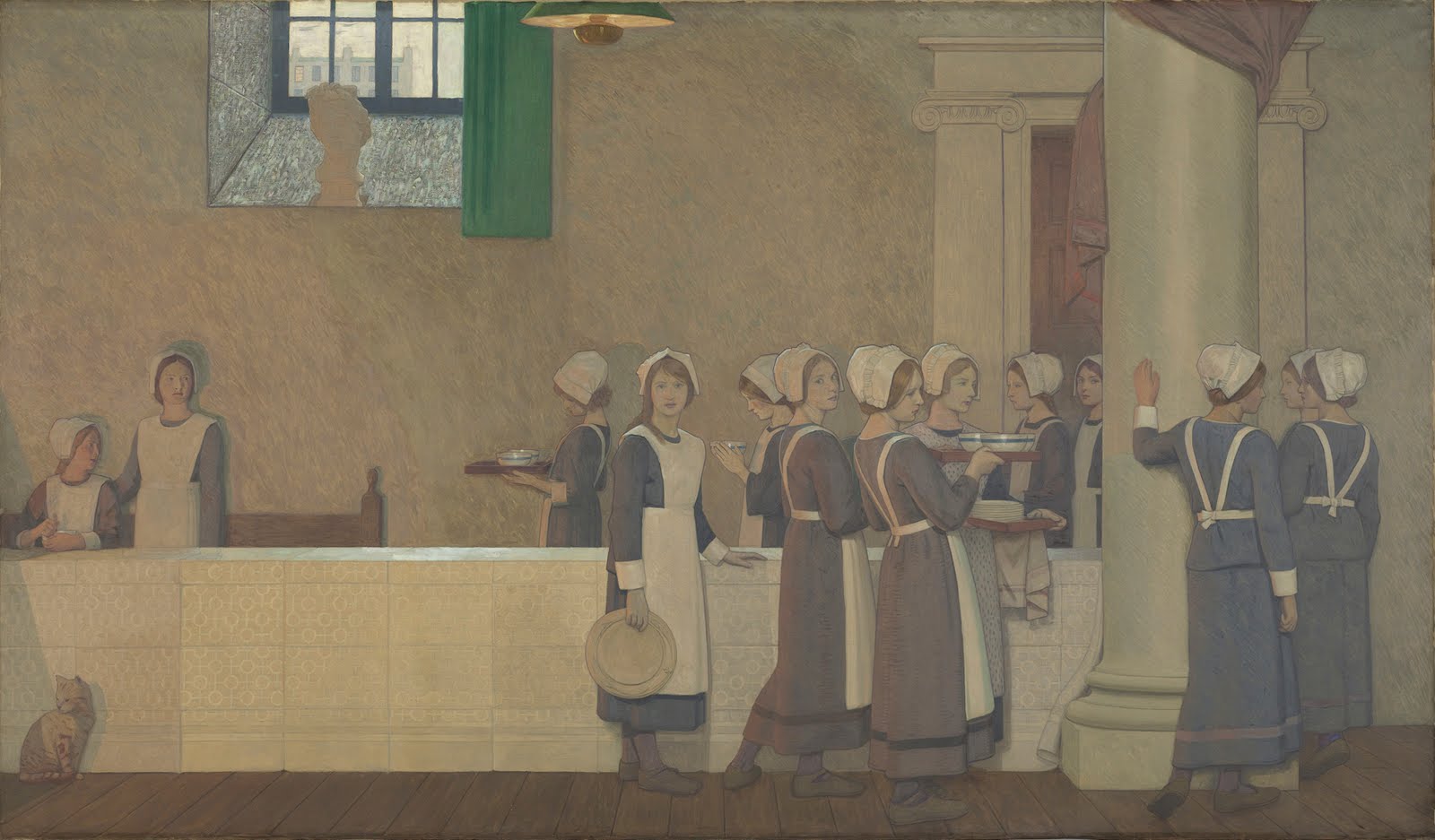
Federick Cayley Robinson (British, 1862-1927) Acts of Mercy, Detail (c. 1915) Oil on canvas. Wellcome Collection, London.
s commentary on charity, Acts of Mercy is, as my friend and mentor Dr. Tom Gretton commented, a masterclass in receiving charity: how it is given and how it is received. Robinson captures a large spectrum of human relationships in this and in all his works I have been able to see. While Middlesex Hospital has been torn down and the show has now ended at the National Gallery, Acts of Mercy has a new home: the Wellcome Collection.

Gordon Lang: A Mentor Passes Away
One of the world’s great experts, Gordon Lang, has died. He passed in his sleep on October 9.
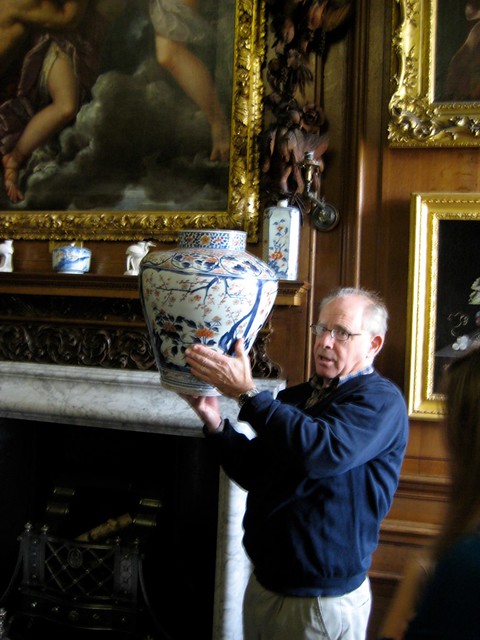
Gordon Lang lecturing at Burghley House
Gordon was one of the world’s foremost authorities of European and Asian ceramics. He dedicated the last and best years of his life to teaching new generations of experts, who are now writers, dealers, curators and directors of museums all over the world. Despite mastering a bewildering array of disciplines (e.g. history, chemistry, anthropology, geography, iconography, engineering), Gordon was remarkably humble; more at home in a pub than a library. He loved nothing more than going sharing a larger with his students.
Born in Scotland and trained as an engineer, Gordon worked in Sotheby’s department of ceramics before taking a teaching post at Sotheby’s Institute of Art. He worked for the auction house at a time when the science of ceramics converged with aesthetic appreciation.The resulting flood of market interest fueled both a new generation of collectors and forgerers. Gordon handled tens of thousands of objects, developing an unmatched, highly-sought-after ability to distinguish wheat from the chaff. His books, Wrestling Boys: Catalogue of the Exhibition of Chinese & Japanese Ceramics from the 16th to the 18th Century in the Collection at Burghley House and The Powell Cotton Collection of Chinese Ceramics, are essential manuals for serious scholars and collectors.
Just before learning about Gordon death, I had sent him an email. I was hoping to see the new ceramics galleries at the Victoria & Albert Museum, followed by dinner. Instead, I met with friends to talk about how generous Gordon had been to all of us.
Forgotten Master: Fanny Fleury (French, 1848-1920)
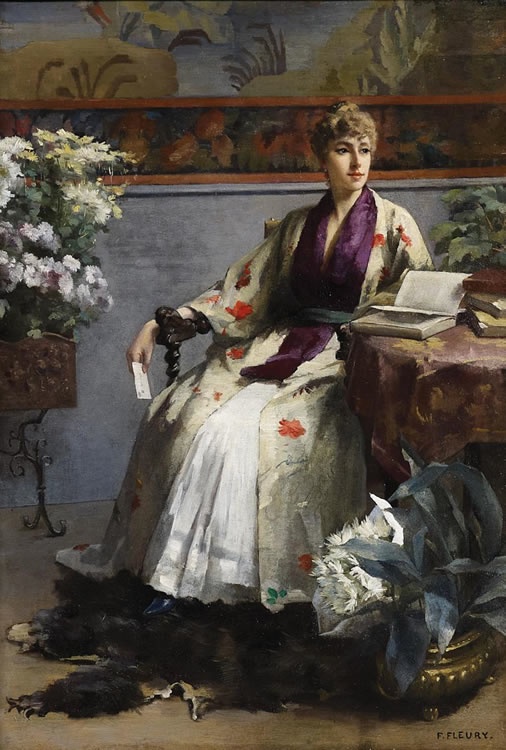
Fanny Fluery (French, 1848-1920) Woman Reading (n.d.) 24 1/4 X 17 1/8 in. Oil on canvas. Private collection.
With art historians earnestly looking for prominent female artists, it is surprising that so little is written about Fanny Fleury (French, 1848-1920). With the exception of Rosa Bonheur (French, 1822-1899), Fleury was perhaps the most successful female exhibitor in the history of the Paris Salon, having works accepted consistently from 1869 to 1882, and in many afterwards. She also exhibited at the Salons of Saint-Etienne and Dijon, and received an honorable mention at the Exposition Universelle of 1889.
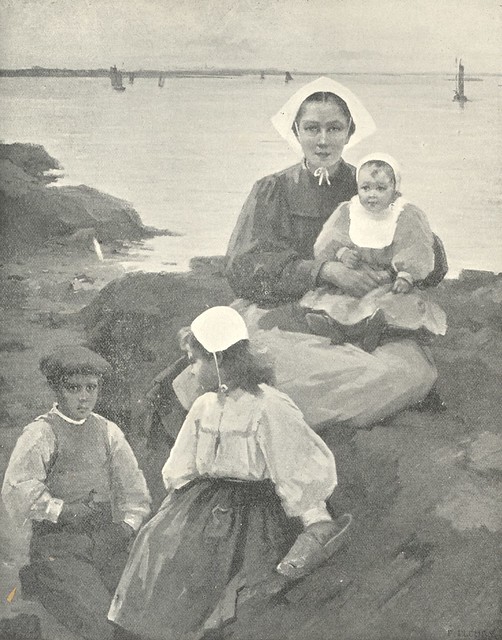
Fanny Fluery (French, 1848-1920) Les Enfents de Jean-Marie (n.d.) Oil on canvas. Unknown Collection. Lithograph reproduction of original.
Fleury’s academic credentials are impeccable. She studied with Jean-Jacques Henner (French, 1829-1905) and was later accepted to the École des Beaux-Arts as a student of Carolus-Duran (French, 1837-1917), where she was a classmate of John Singer Sargent (American, 1856-1925). (Speaking of her work at the 1884 Salon, one critic said Fleury had “equalled her masters,” Henner and Duran.) Highly regarded by her peers, Fluery was elected an Officer of the Academie and an associate of the Société des artistes français.
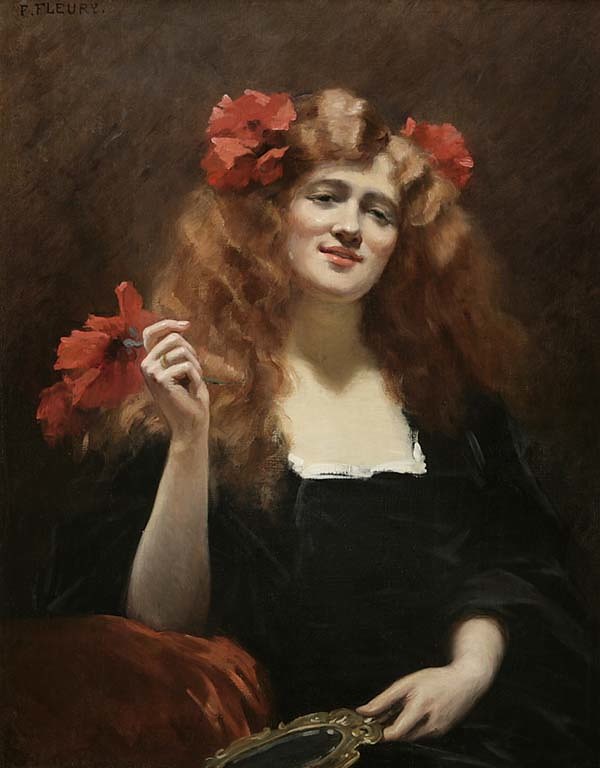
Fanny Fluery (French, 1848-1920) Portrait of an Unknown Woman (n.d.) 32 X 25 3/4 in. Oil on canvas. Private Collection.
Yet, for all her accomplishments in well-documented institutions and events, there is surprisingly little information currently available about the life and work of Fleury. (This is another instance where I am writing about an artists in hopes that it encourages others to contact me with additional information.)
Fleury was born outside Paris in either 1843 or 1848–most sources agree on the latter. It is possible–I stress “possible” for lack of form documentation, yet a great deal of circumstancial evidence–she is the daughter of Joseph Nicolas Robert-Fleury (French, 1797-1890), a successful history painter and on-time director of the École des Beaux-Arts in Paris and Rome; and, his son, the painter Tony Robert-Fleury (French, 1837-1912), who was also successful painter and who replaced Bougeureau as the Director of the Société des artistes français (If anyone can shed additional light, it would be greatly appreciated.) When she married, Fanny Fluery became Fanny Laurent Fleury; but, never included “Laurent” in her signature. So, whether or not there is an actual genetic connection between the three Fluerys, they must have come into contact with one another through the Acadamie.
It has been difficult to piece together a continuum of Fleury’s production with the few works and accounts left to us. It appears that for a time–presumably early in her career–she created a number of still lives.
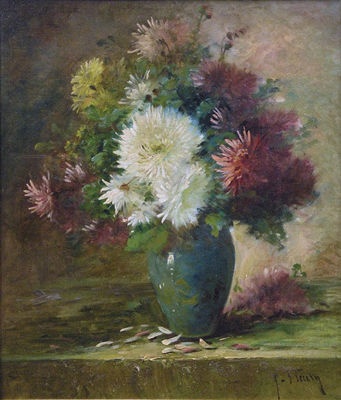
Fanny Fluery (French, 1848-1920) Still Life with Flowers (n.d.) 20 1/2 X 17 1/2 in. Oil on canvas. Private Collection
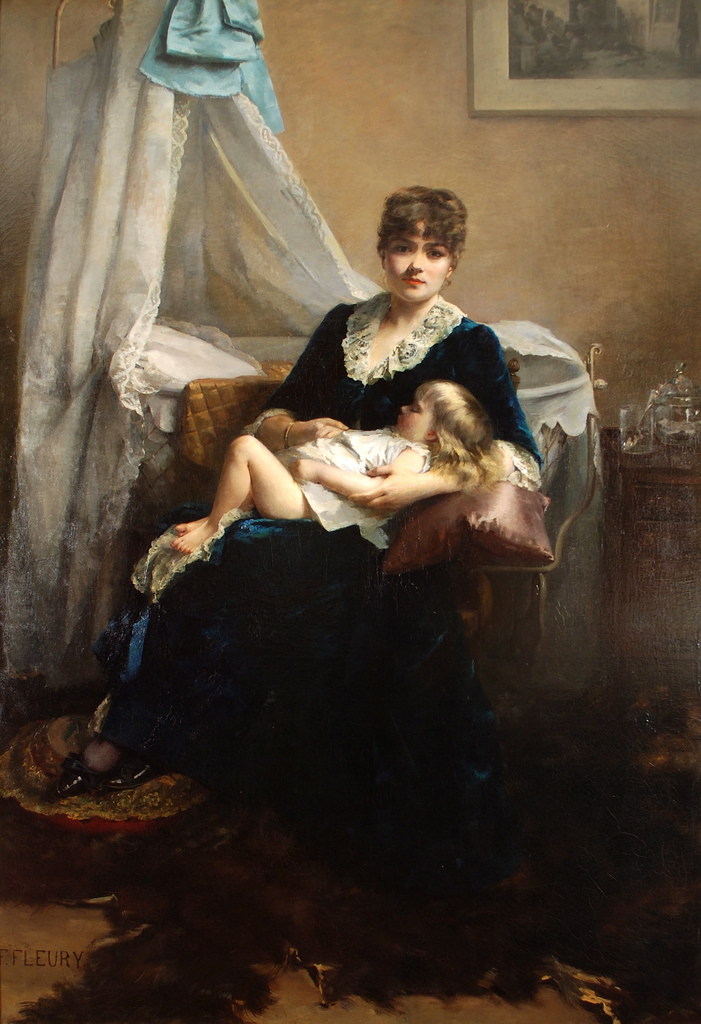
Under Carolus-Duran, Fleury distinguished herself as a portraitist. Her large-scale work Bebe dort (1884) exhibited in the Salon of 1884 along with Madame X by her classmate John Singer Sargent. Both pieces belie the the influence Corolus-Duran, who often combined monumental human figures in contemporary settings.
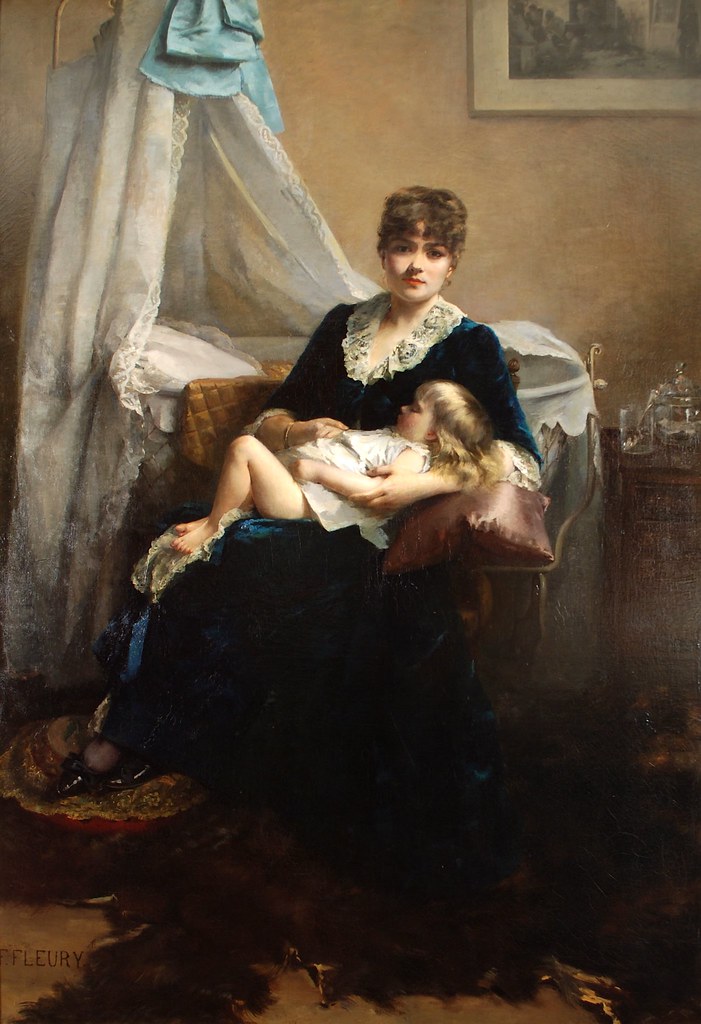
Fanny Fluery (French, 1848-1920) Bebe dort (1884) 83 X 57 in. Oil on canvas. Anthony’s Fine Art, Salt Lake City, UT
In Bebe dort (1884), a mother–perhaps a self-portrait of the artist–cradles her child, sitting together next to a cradle. Behind the figures, on the wall Fluery places a print of a business being ransacked by a mob. No one would imagine that scene actually being hung in a child’s room. It is a clever use of a picture-within-a-picture, used often by Netherlandish painters in the fifteenth and sixteenth centuries, to create greater or multiple meanings within a work. The juxtaposition of the two scenes contrasts security and comfort of home with a threatening world.
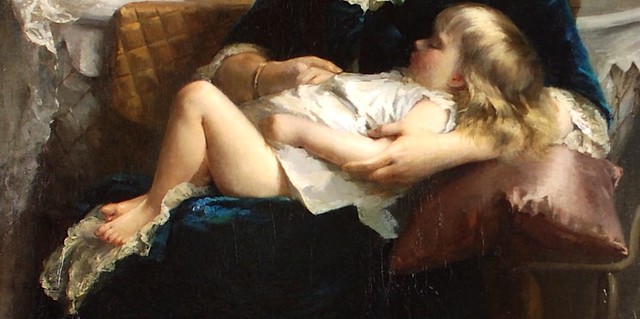
Fanny Fluery (French, 1848-1920) Bebe dort (1884) 83 X 57 in. Oil on canvas. Anthony’s Fine Art, Salt Lake City, UT DETAIL
At some point, Fleury set aside society portraits and dedicated herself to Breton scenes. In 1892, The American Magazine wrote:
Realism has likewise tempted another artists of great talent, Mme. Fanny Fleury. It is to the desolate lands of Lower Brittany that Mmde. Fleury goes for her subjects. She has painted som admirable marine scenes, but excels in depicting types of peasantry . . . every summer she goes to the seacoast, and in some retired cornes, unfrequentd by the tourist, prepares her picture for the next Salon. (The American Magazine, Vol. 34. New York: Frank Leslie Publishing House, 1892; p, 430.)
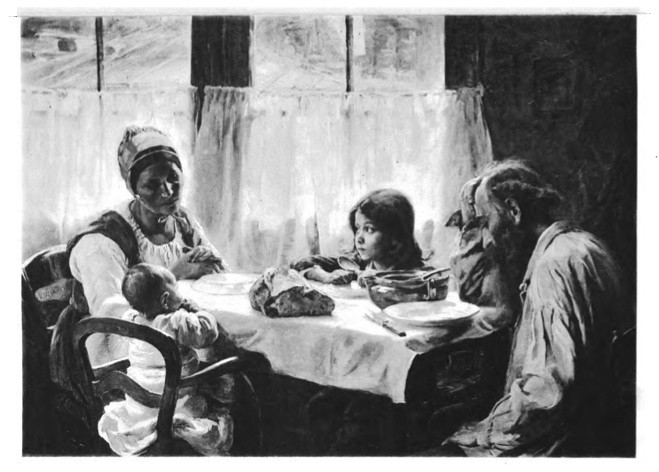
Fanny Fleury (French, 1848-1920) Pour la Chapelle (n.d.) Oil on canvas. Private Collection. Black and white, photograph from Paris-Salon by Louis Enau
The quality of her work combined with her credentials certainly raise questions about the current dearth of readily-available information on Fleury’s life and the location of her works. All signs point to a productive career. From contemporary records, we know that her works were regularly purchased from Salon galleries, and that her works were found in various French and American museum collections–none of which currently list those works in their public inventories.
Whatever the reason for Fanny Fleury’s undeserved, forgotten status, she will only gain prominence as her works are rediscovered.
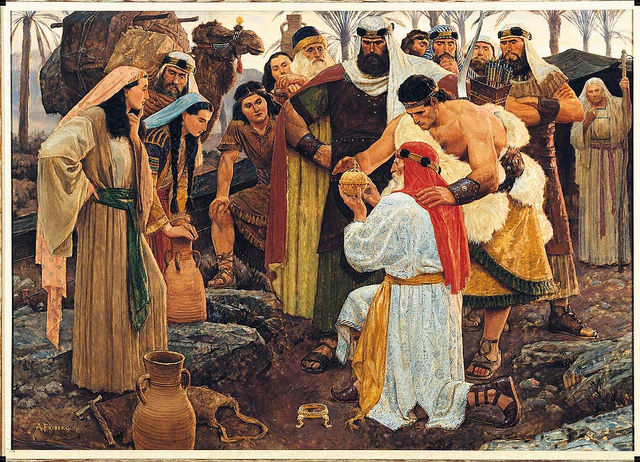
My Evening with the Late Arnold Friberg
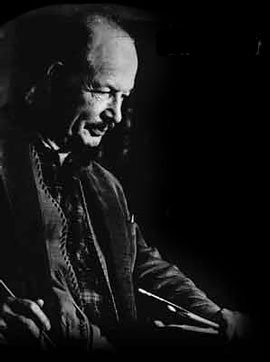
Arnold Friberg (American, December 21, 1913 – July 1, 2010)
Many obituaries have been written since his death four days ago. Rather than repeat the long lists of accomplishments printed in numerous obituaries (NY Times, for example), I’d like to share a personal experience I had with Arnold Friberg five years ago, when he was 91.
My wife and I were invited to have dinner with Arnold and his wife, Heidi, at their home. Heidi cooked. Afterwards, we sat, talked about art, and walked through Arnold’s studio. For a man of any age–let alone 91–Arnold was full of energy. He hopped out of his seat to punctuate a passionate thought about Jean-Auguste Dominique Ingres (French, 1780-1867), whom he felt had been unfairly treated by historical memory. (How appropriate it was when Susan Siegfried’s bookIngres: Painting Reimagined was delivered to my house the same day Friberg died.)

Arnold Friberg (American, December 21, 1913 – July 1, 2010) The Liahona. Oil on canvas.
As we toured his studio, Friberg lifted an original oil painting he had done for a Christmas edition of the Saturday Evening Post. “Unlike my colleagues,” he said “I painted a perfect reindeer.”
“I would look for the perfect antlers on one reindeer, the perfect eyes from another, nose from another; and, then, I combined them. Other artists don’t do that.”
Perhaps knowingly, perhaps not, Friberg’s self-described “perfectionism” was, in practice, akin to the Ideal reached for by Ingres. Friberg was tirelessly detailed. His work often featured elaborate script applied by hand without the use of stencils. Even at his advanced age, Friberg could be found working in his studio, touching and re-touching works, which, in his mind, could always be improved.
We spent several hours looking through his catalogue of works. Any artist would be satisfied to have so many memorable and widely-reproduced works. Yet, Friberg had an air of anxious energy. “I’m happiest when working,” he told me.
Wherever he is now, I’m sure that Arnold Friberg will not sit back and enjoy what will surely be a growing reputation. He is probably sorting through cherubs, looking for which one has the best wings, eyes, lips, etc.
The Spring Salon Catalogue: An Experiment in Art Criticism
Recently, I was asked to judge the annual Springville Museum of Art Spring Salon. The contest has taken place for nearly 90 years, with over 2,000 annual submissions exclusively from full-time artists.
Cover for the First Annual Spring Salon Critical Catalogue. (We based the design on the official catalogue for 1874 Salon for the Société des Artistes Français, also known as the Paris Salon.)
For a full PDF catalogue, click below:
- Full Catalogue LARGE size (30 mb)–featuring higher quality images of each work.
- Full Catalogue, REDUCED size (2 mb)–Due to the reduction, some images my not appear in true color.
I thought it would be fun to create a nineteenth-century-style critical catalogue for the event, in the tradition of the catalogues that used to be made for the Paris Salons. So, I teamed up with a good friend and thoughtful writer, Philipp Malzl, to write on selected works from the contest. Neither of us have worked as critics before. But, we don’t know about any models for the kind of art criticism we would like to see.
Each review is brief–some are a sentence, others three paragraphs. Our intent was to create something readable and entertaining for a large audience–artists and non-artists–and not for an elite audience. At the same time, we wanted to educate by tying contemporary art into a larger tradition that is often ignored or not understood by many contemporary artists and critics who only know art as far back as the beginning of the twentieth century.
I haven’t sent it out to many people yet. This is what I would consider a “preliminary draft.” I wold be very interested in knowing what you think about it.
I don’t know if anyone else is doing anything like this right now, especially for contemporary art in the classical tradition. If this catalogue is truly insightful, I hope it is the first of many.
Reader Question: What’s on my nightstand?
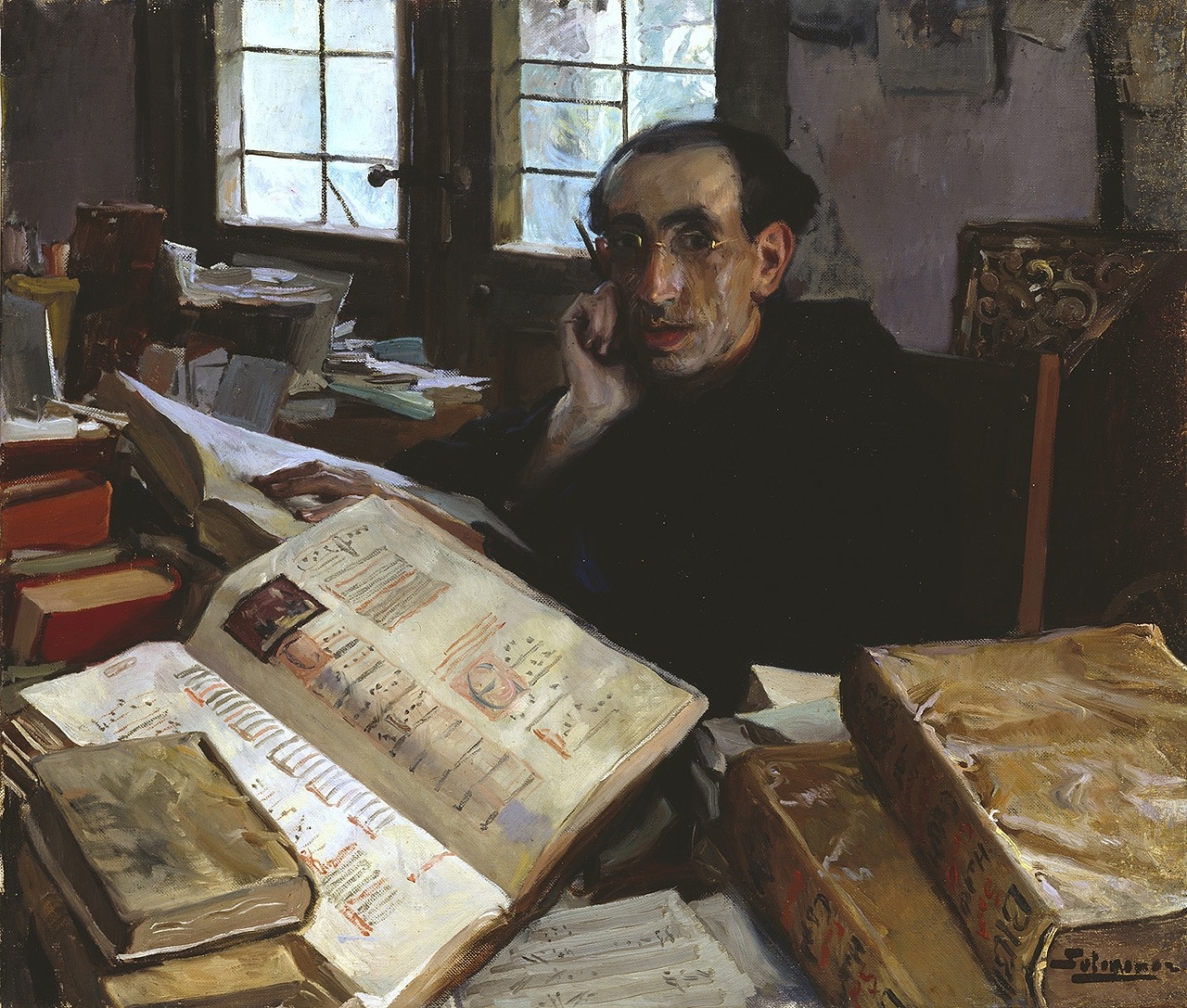
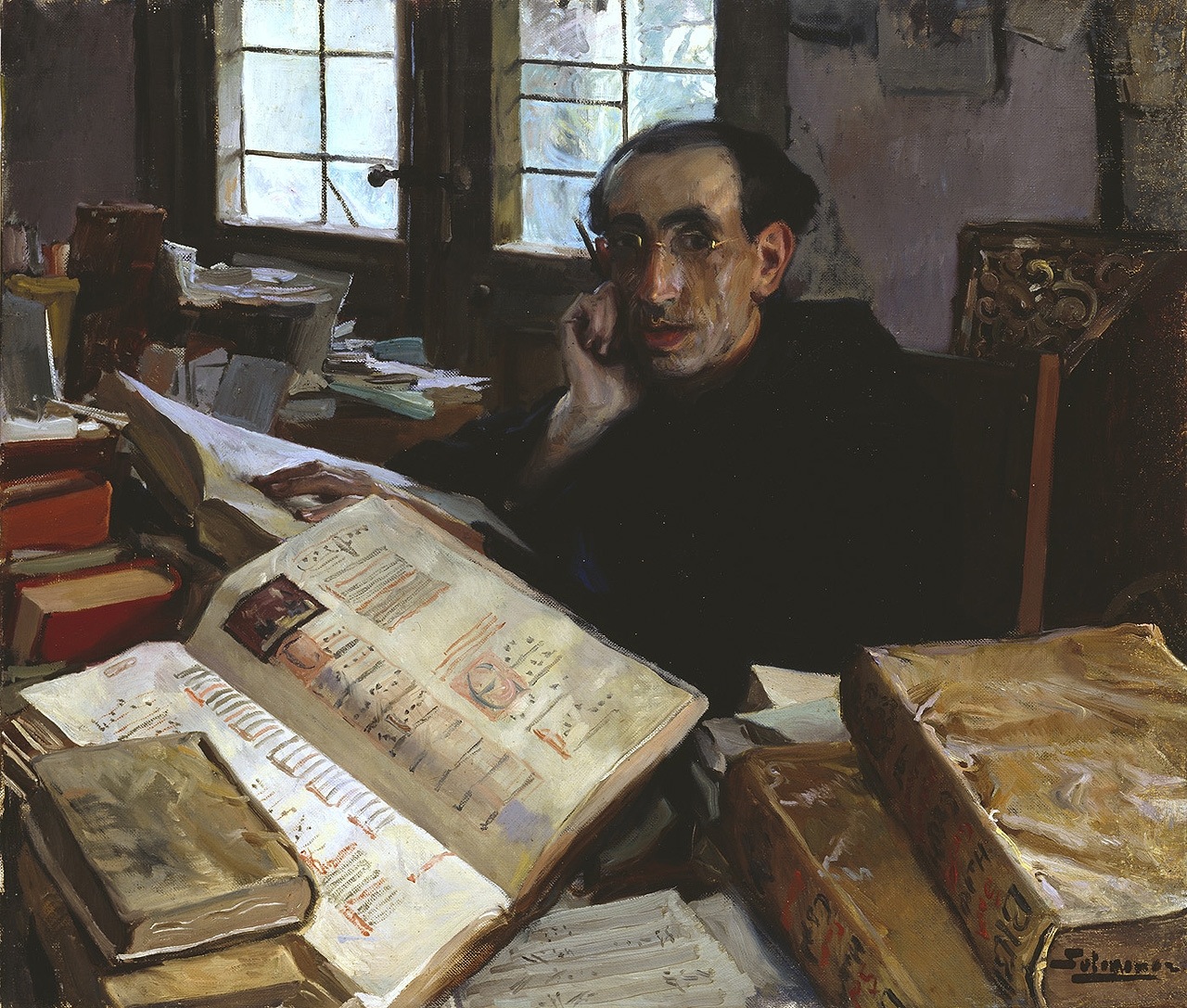
Fernando Álvarez de Sotomayor y Zaragoza (Spanish, 1875-1960) Retrato del padre Villalba (Portrait of Father Villalba) 86 X 100 cm. Museo Nacional del Prado, Madrid.
___
Recently, I received an email from a BeardedRoman reader asking me for list of books on my nightstand. I thought I would post my answer here. And, I would love to know what is on your nightstand too.
I regularly get book recommendations from readers, and I love it. Through their suggestions and my own research projects, over the years I have built a large library. (At last count, I have nearly 1,500 books.) I have books piled by bed and all around my house. No, I have not read all of them–some were only bought for a single, useful chapter. Other I have read multiple times.
The books I have listed below are literally the ones that have been by my bed. I have my finger in every one of them and have been bouncing between them all for weeks. They don’t necessarily relate to any current work I am doing–that’s another pile. These are what I am reading for fun. As I made the list, I was surprised at how many were directly related to art history. (No wonder I am boring at parties.) But, as you can see from the list, my second love is poetry.
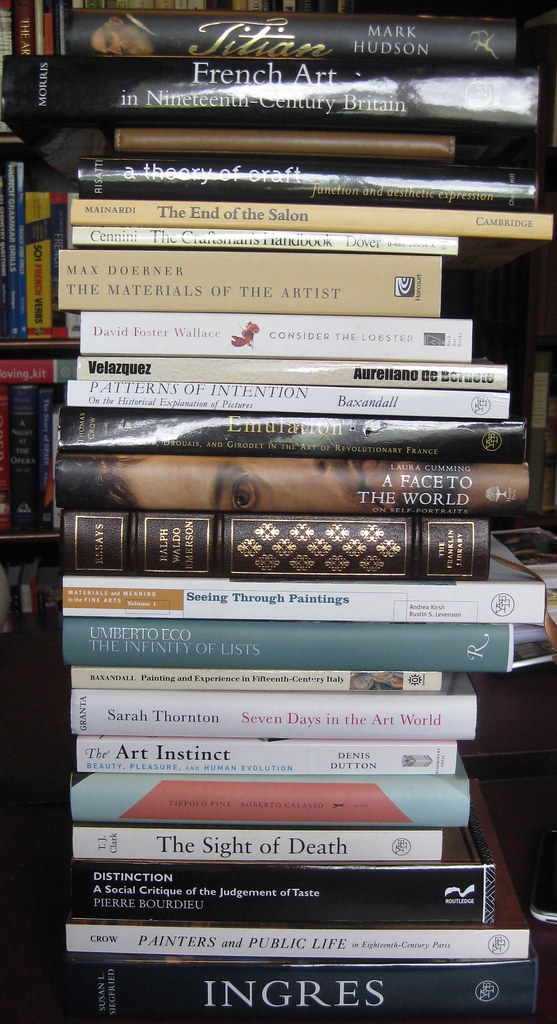
Books on my nightstand. (Or, more accurately, the ones piled around my bed.)
____
After naming the book and the author, I have written a very brief personal impression of each book.
- Titian: The Last Days by Mark Hudson. There are few straight biographies of Titian. Most that I have read are a scholarly studies of the artist’s works combined with political and social commentary that would not be anything like reading the biography of, say, Benjamin Franklin. I’ve learned something about time an place from Hudson’s book; but, overall I have struggled to get through it. Hudson seems to be as interested in talking about himself as he is about Titian.
- French Art in Nineteenth-Century Britain by Edward Morris. This is a great study of the relationship between the French and British at a time when the great international arms race was the arts. France was winning and the British couldn’t help but admire the art it.
- Hopes and Fears for Art by William Morris. Morris was the philosophical and moral leader of the Arts & Crafts movement that was a reaction against industrialization. This is an impassioned lecture he gave in defense of his movement.
- Master of Shadows by Mark Lamster. This biography of Rubens is one of the best books I have read on any subject in a long time. Weaving together Rubens with the political and artistic dramas of his time, it is clear that the artist was as much a diplomat as a painter. I fell in love with Rubens again; both his art and his humanity.
- A Theory of Craft: Function and Aesthetic Expression by Kenneth R. Trapp. Lately, I’ve been obsessed with the role of craftsmanship versus concept in art. Does the way somethings is made matter; or, is it the final product that counts?
- The End of the Salon: Art and the State in the Early Third Republic by Patricia Mainardi. A very good discussion on how one of the most important institutions in the history of art fizzled out.
- The Craftsman’s Handbook (Il Libro dell’Arte) by Cennino d’Andrea Cennini, trans. by Daniel V. Thompson, Jr. Perhaps one of the most widely-read handbooks for artists, this book is a lot of fun to read. Cennini wasn’t always accurate; but, he does give an important insight into the practical considerations of making art in 15th-century Florence.
- The Materials of the Artist and their Use in Painting by Mac Doerner. So much of art history is about social and political history. I am anxious to learn more about the objects and how they were and art made.
- Consider the Lobster and Other Essays by David Foster Wallace. A recommendation from a friend, I cried while reading his essay on Dostoevsky.
- Velázquez by Aureliano de Beruete (Foreword by Léon Bonnat). Bonnat wrote the foreword just after being made Director of the Ecole des Beaux-Arts in Paris. His first sentence: “I was brought up in the worship of Velázquez.”
- Patterns of Intention: On the Historical Explanation of Pictures by Michael Baxandall. Baxandall shatters me with almost every sentence. He has changed the way I’ve thought about paintings. Example: ” . . . to say we ‘explain a picture as covered by a description’ can conveniently be seen as another way of saying that we explain, first, thoughts we have had about the picture, and only secondarily the picture.”
- Emulation: David, Drouais, and Girodet in the Art of Revolutionary France by Thomas Crow. An amazing recreation of the events and journals of three of the most influential painters of the nineteenth-century. Very thoughtful.
- A Face to the World: on Self-Portraits by Laura Cumming. I wish I had written this book! Cumming writes about why artists make self-portraits and why we love looking at them.
- Essays by Ralph Waldo Emerson. I have been reading his essay “The Poet” over and over again. It’s like scripture: each reading gets more meaningful.
- Seeing through Paintings by Andrea Kirsh and Rustin S. Levenson. A chemical analysis by two scientists on how art is made.
- The Infinity of Lists by Umberto Eco. Ever want to know how many demons have ever been named in Western literature? The basic premise of the book is that there is a history of list making in Western literature. From the Bible and Homer to Joyce, the lists say something about our culture. It’s a surprising and entertaining read.
- Painting and Experience in Fifteenth-Century Italy by Michael Baxandall. My favorite quote: “Art was too important for artists.”
- Seven Days in the Art World by Sarah Thornton. This is an mind-blowing, anthropological travelogue of the people who make, buy, and sell modern and contemporary art. Thornton is able to sit down with people and get candid reactions that made we alternatively laugh and want to reach through the page and strangle her interviewees.
- The Art Instinct: Beauty, Pleasure and Human Evolution by Denis Dutton. A discussion on why humans like art.
- Tiepolo Pink by Robert Calasso. Late in his career, Tiepolo did a series of 36 bizarre etchings that are rarely seen or discussed. This is a book about them.
- The Sight of Death: An Experiment in Art Writing by T. J. Clark. For several months, Clark works at the Getty Museum and sees the same paintings by Poussin day after day. This is his journal on impressions he had looking at them. It is amazing! The things he sees, the ideas he has, and the way he looks at these paintings have changed me. I want to be more like Clark. He is as much a poet as art historian.
- Distinction: A Social Critique of the Judgement of Taste by Pierre Bourdieu. While it is a few decades old, Distinction’s basic premise is: your education and birth are the predominant indicators of why you like the music, food, and art you do.
- Painters and Public Life in Eighteenth-Century Paris by Thomas E. Crow. Great study on how artists joined the age of mass media.
- Ingres: Painting Reimagined by Susan L. Siegfried. I just got this, and haven’t read much. But, it promises to be a new and controversial look at Ingres. Siegfried’s goals are to examine in depth Ingres’ history and genre paintings, which are largely ignored or dismissively categorized.
- Ballistics: Poems by Billy Collins. I have all of Collins’ books of poetry.
- Los Versos del Capitan (Captain’s Verses) by Pablo Neruda. I lived in Chile. Reading Neruda lets me slip back there, if only for a little while.
- Death in the Afternoon by Earnest Hemingway. This is a non-fiction book about bullfighting. As a result of studying Spanish painting, I have to know more about it. Bullfights (corridas) and bullfighters (toreros) are just part of the culture. I went to a bull fight last year at Las Ventas in Madrid. Since then, I’ve been trying to understand what happened and how I feel about it.
- Blizzard of One by Mark Strand. I have not even cracked it open yet.
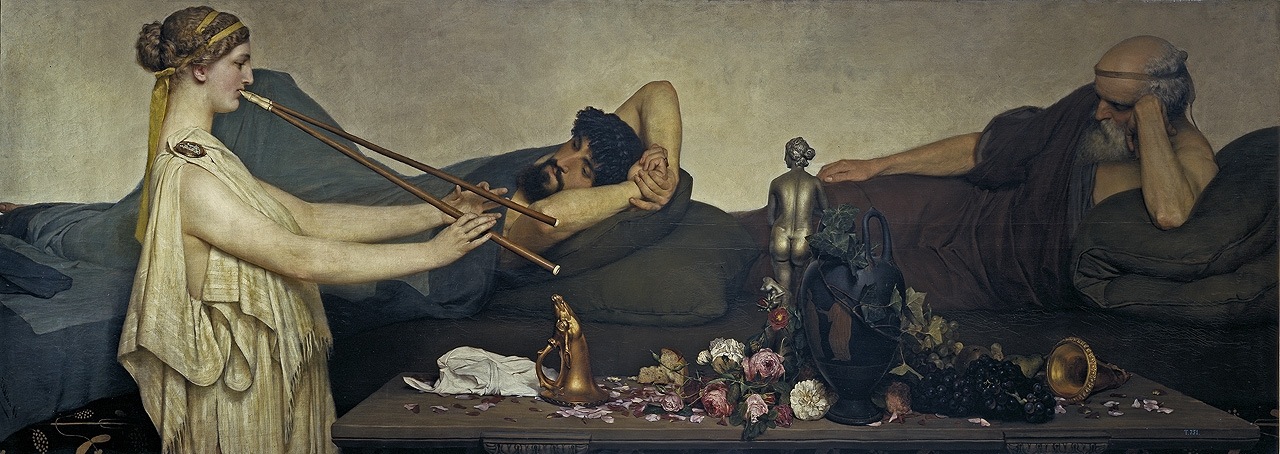
An unpublished work by Sir Lawrence Alma-Tadema
As those of you who follow my tweets (apologies for the shameless Twitter plug) know, I have been traveling for the past three weeks. I was in Spain for eleven days, France for one, and another five in California. To some it might sound like glamorous, Indiana-Jonesing; but, in reality, I spent most days underground in dusty archives looking for undiscovered, art-historical morsels and nights transcribing nineteenth-century handwriting. Along the way, I came across a number of remarkable works of art, some not seen for more than a hundred years. I plan to share some of them.
I begin with A Scene from Pompeii (1868), a previously unpublished and little-known work by Sir Lawrence Alma-Tadema (Dutch and British, 1836-1912).
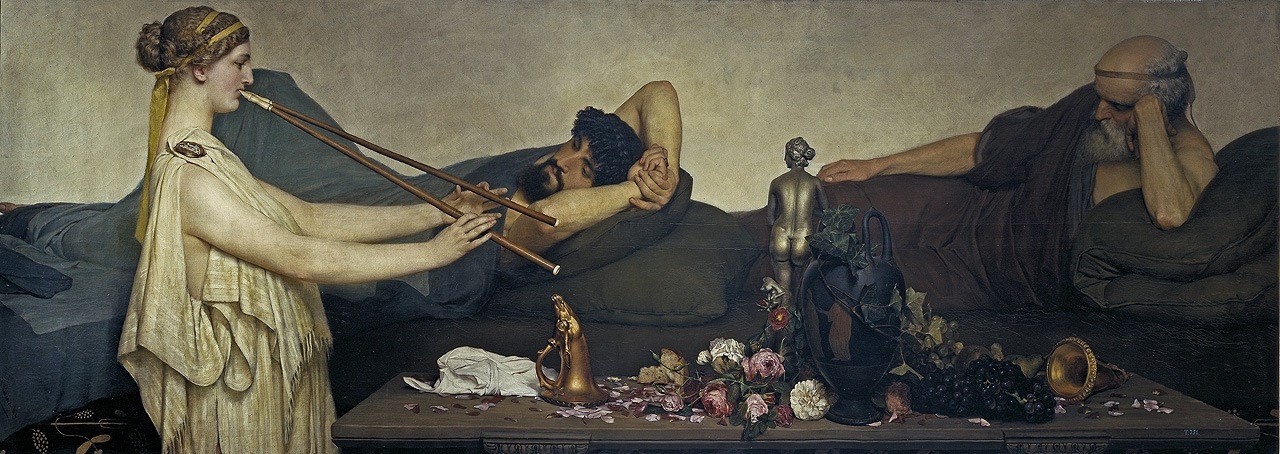
Sir Lawrence Alma-Tadema (Dutch & British, 1836-1912) A Scene from Pompeii (1868) Oil on canvas. 130 X 360 cm. Museo Nacional del Prado, Madrid.
This morning, I spoke with Vern Swanson, a mentor of mine and author of Alma-Tadema’s catalogue raisonné. Dr. Swanson did not include an illustration of the painting in his book–the most definitive on the subject–because A Scene from Pompeii was unavailable until recently. As one of Alma-Tadema’s most ambitious early paintings, it has been in storage at the Museo Nacional del Prado for nearly 100 years. This year A Scene from Pompeii was hung for the first time in the Prado’s new, permanent wing dedicated nineteenth-century painting and sculpture.
Alma-Tadema’s works, famous for Olympian themes that idealized a bygone empire, may seem more at place in France or Great Britain than in Spain. At the Prado, A Scene from Pompeii makes strange bedfellows with a generation of nineteenth-century Spanish artists who sometimes trained in France, but nonetheless venerated classical realists like Diego Velázquez and José de Ribera.
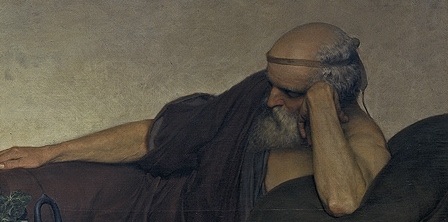
Sir Lawrence Alma-Tadema (Dutch & British, 1836-1912) A Scene from Pompeii (1868) Oil on canvas. 130 X 360 cm. Museo Nacional del Prado, Madrid. Detail.
This painting is one of only a handful of foreign nineteenth-century works in the Prado’s collection. It was donated to the short-lived, Spanish Museo de Arte Moderno in 1887 by Ernesto Gambart, then Spanish Consul to Nice (France). When the Museo de Arte Moderno was absorbed into the Prado a few years later, nearly all of the its collections, including this work by Alma-Tadema, were placed in storage where they have been ever since. Only now, under the leadership of Javier Barón, Director of Nineteenth-Century Painting at the Prado, are these works being fully restored and finally displayed.
A Scene from Pompeii (1868) dates to a happy and prolific period in Alma-Tadema’s life. Five years earlier, he married his first wife, Marie-Pauline Gressin, in Antwerp. Their honeymoon was spent in Florence, Rome, Naples and Pompeii. For the next several years, he absorbed and transmuted his personal experience with the classical tradition into a series of paintings that quoted Greco-Roman architecture and artworks, such as a bronze reproduction of Aphrodite by the Greek sculptor Praxiteles (4th-century BC), in this work.
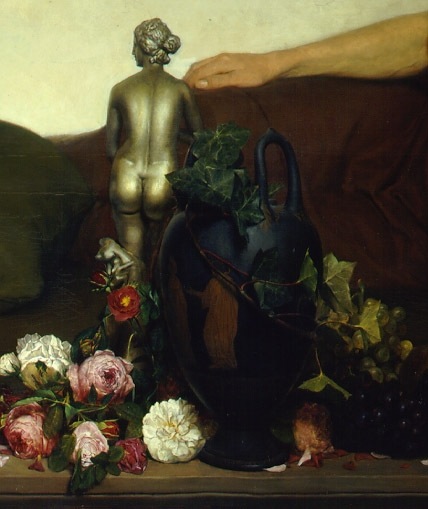
Sir Lawrence Alma-Tadema (Dutch & British, 1836-1912) A Scene from Pompeii (1868) Oil on canvas. 130 X 360 cm. Museo Nacional del Prado, Madrid. Detail.
Alma-Tadema is often remembered for his British works created after the death of his wife in 1869. These exquisitely detailed scenes sometimes feature dozens of figures painted in jewel-like colors. However, before 1869, his works regularly exhibited the same restricted, earth-tone palette of A Scene of Pompeii. While this painting shares the trademark precision Alma-Tadema’s larger oeuvre, its composition is unusual. I am not an expert on Alma-Tadema; but, I am surprised by the Baroque proportions of the figures which, unlike other works by Alma-Tadema, fill the canvas to near capacity.
It is always a pleasure to find new works by an artist as well-known and respected as Sir Alma-Tadema. I am sure that the Prado will have more insightful and important things to say about the painting as the new nineteenth-century wing becomes more public.
Sargent and Velázquez
Note: Right now there are two remarkable exhibitions taking place: The Sacred Made Real, about religious Spanish sculpture, a loan of John Singer Sargent’s painting The Children of Darley Bolt (1882) to the Prado Museum, where it hangs next to Velázquez’s Las Meninas (c. 1656). I know I have written about Eakins and Velázquez before, but I haven’t been able to stop thinking about the Spanish Master’s influence on nineteenth-century artists. For me it is a source of endless curiosity and one of the more unexplored aspects of the period.
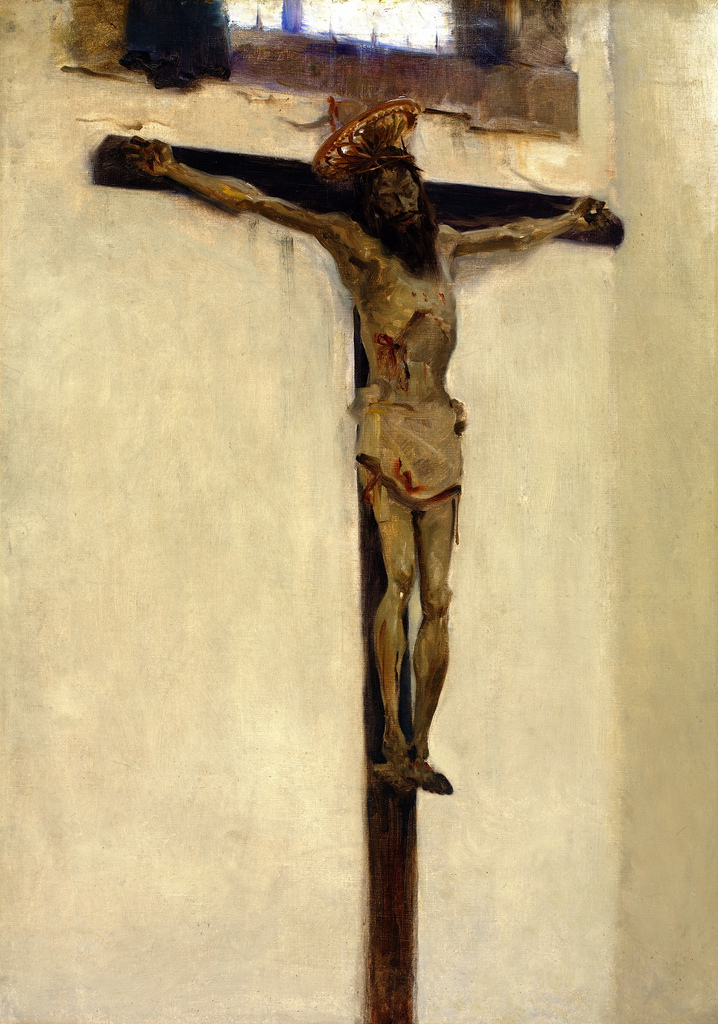
John Singer Sargent (American, 1856-1925 ) Crucifix (1879) Oil on canvas. Private Collection.
When John Singer Sargent travelled to Spain in 1879 his approach to painting fundamentally and irrevocably changed. There his understanding of painting was forever infused by the restrained palette, virtuosic brushwork and reverence for nature learned principally from Diego Velázquez (Spanish, 1599-1660).
Sargent travelled to Spain at a time when France, the center of the international art world, had rediscovered Spanish masters. King Louis-Philippe’s Galerie Espagnole (1835-1853) and the marriage of Emperor Napoleon III to Eugenie Contador, a Grandée of Spain (1853), brought a newfound appreciation to the Spanish Golden Age and its artists that excited a generation of artists working in Paris.
Édouard Manet, Léon Bonnat, Jean-Léon Gêrome, Thomas Eakins, Julian Alden Weir, William Merritt Chase, and many others travelled to Madrid to copy works found almost exclusively in the Prado Museum. Chief among the artists copied by foreigners was Diego Velázquez, considered a new, viable alternative to French classical models that dominated Academic painting.
Sargent was a student at the prestigious and exclusive École des Beaux-Arts, when his instructors Carolus-Duran (French, 1837-1917) and Léon Bonnat (French, 1833-1922) suggested that his development as an artist would improve dramatically from a visit to Spain. Sargent visited the Prado Museum multiple times from October to November in 1879. The official Registry of Copiers records Sargent copying The Crucifixion (c. 1632), Las Meninas (c. 1656), and Las Hilanderas (c. 1644) by Velázquez.
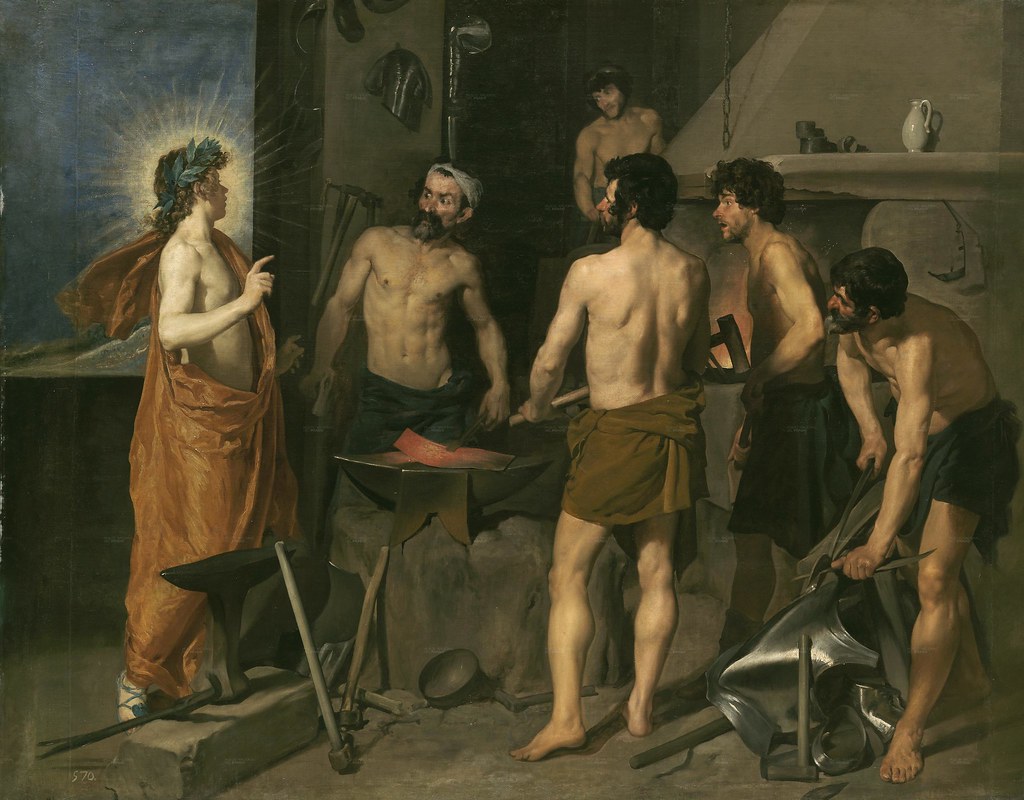
Diego Velázquez (Spanish, 1599-1660) The Forge of Vulcan (1630) Oil on canvas. 230 by 290 cm. Museo Nacional del Prado, Madrid.
As court painter to Philip IV of Spain, Velázquez was employed by the most powerful country on earth. However, unlike many other Baroque painters of his time, whose grandiose works were showcases of extravagant colors, exotic creatures, and obscure subjects,Velázquez’s work features everyday people in everyday settings. Even his few religious and mythological works are notable for not idealizing their subjects.

http://upload.wikimedia.org/wikipedia/commons/f/fd/Nicolas_Poussin_052.jpg
The French discovery of Velázquez came at a time when artists were breaking from a long-standing tradition of Classicism, which shunned Realism in favor of idealized subjects and painterly technique that obscured the artist’s hand. In Paris, Sargent’s education was considered the best in the world. It emphasized compositional formulas based on the Greco-Roman tradition as interpreted by French masters such as Nicolás Poussin (French, 1594-1665) and, later, Jacques-Louis David (French, 1748-1825). Their approach to art required rigorous draftsmanship that often resulted in statuesque, figures in classical landscapes or architecture. This interpretation of classicism was the official style in Europe for nearly 300 years. The rigidity of Academic painting limited the kinds of subjects artists could produce for competition and patronage.
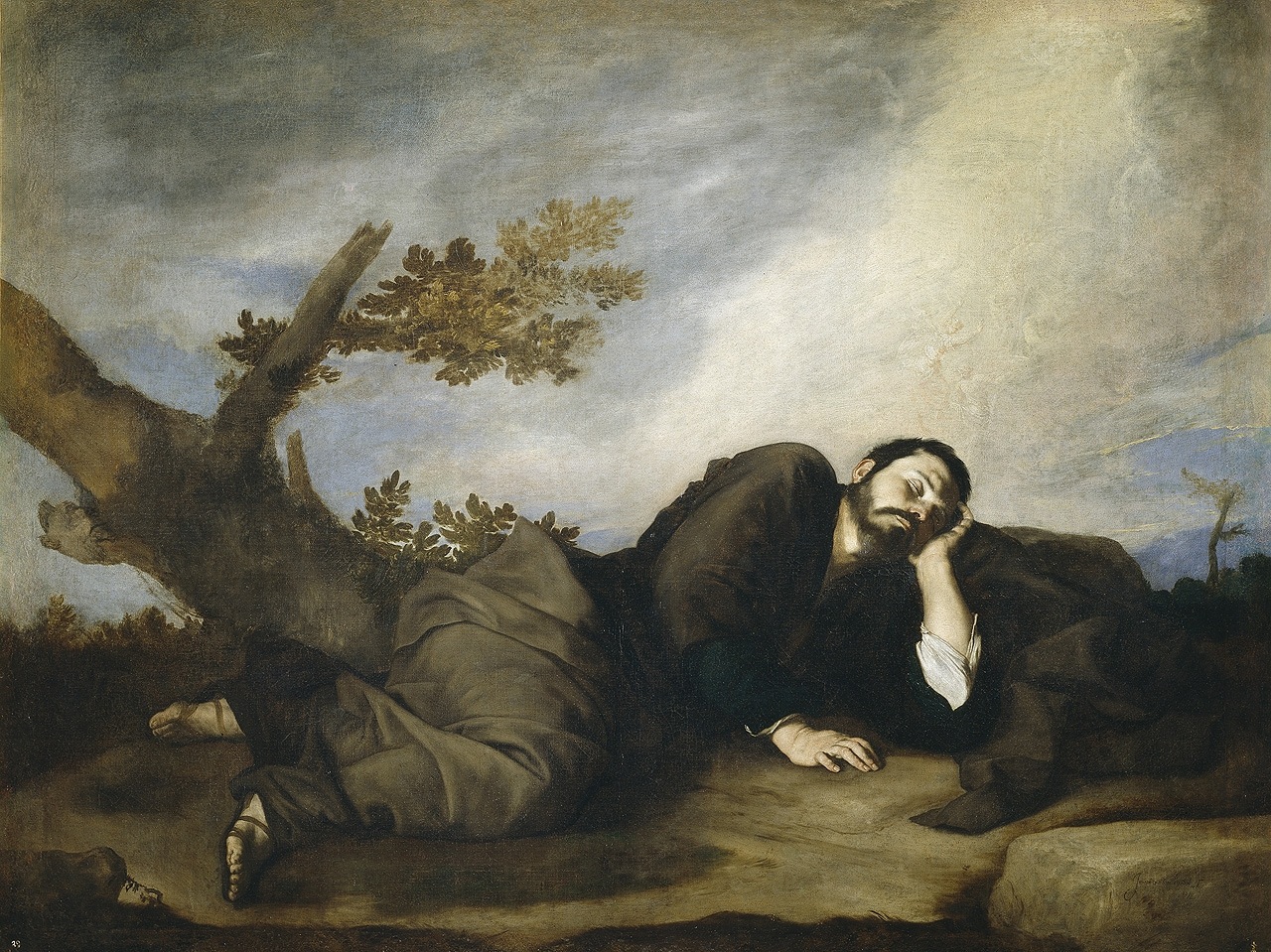
José de Ribera (Spanish, 1591-1652) El sueño de Jacob (1639) Oil on canvas. 179 by 233 cm. Museo Nacional del Prado, Madrid.
When Louis-Philippe opened his Galerie Espagnole in 1835, works by Velázquez, José de Ribera (Spanish, 1591-1652) and Francisco Zurburán (Spanish, 1598-1664) were introduced to the French public for the first time. Working at the same time as the founding fathers of French art, these Spanish artists offered an alternate classicism that emphasized nature.
The study of Velázquez’s work changed a generation of French artists’ approach. Unlike many Academic painter, Velázquez was unafraid to leave distinguishable brushstrokes on his canvases. Thick strokes of paint are clearly visible, demonstrating both his virtuosic skills–capable of reproducing an astonishing array of textures–and making the painting more of a three-dimensional work. His palette is limited, almost exclusively earth tones. When Velázquez did use color, it was muted, rather than garish; and, therefore, subjects appear more lifelike. Whether painting mythological figures, royal portraits, or multi-layered religious narratives, Velázquez captures the natural surroundings and features of his subjects without idealizing them. As a result, he exalts and dignifies the truth while simultaneously making them more approachable.
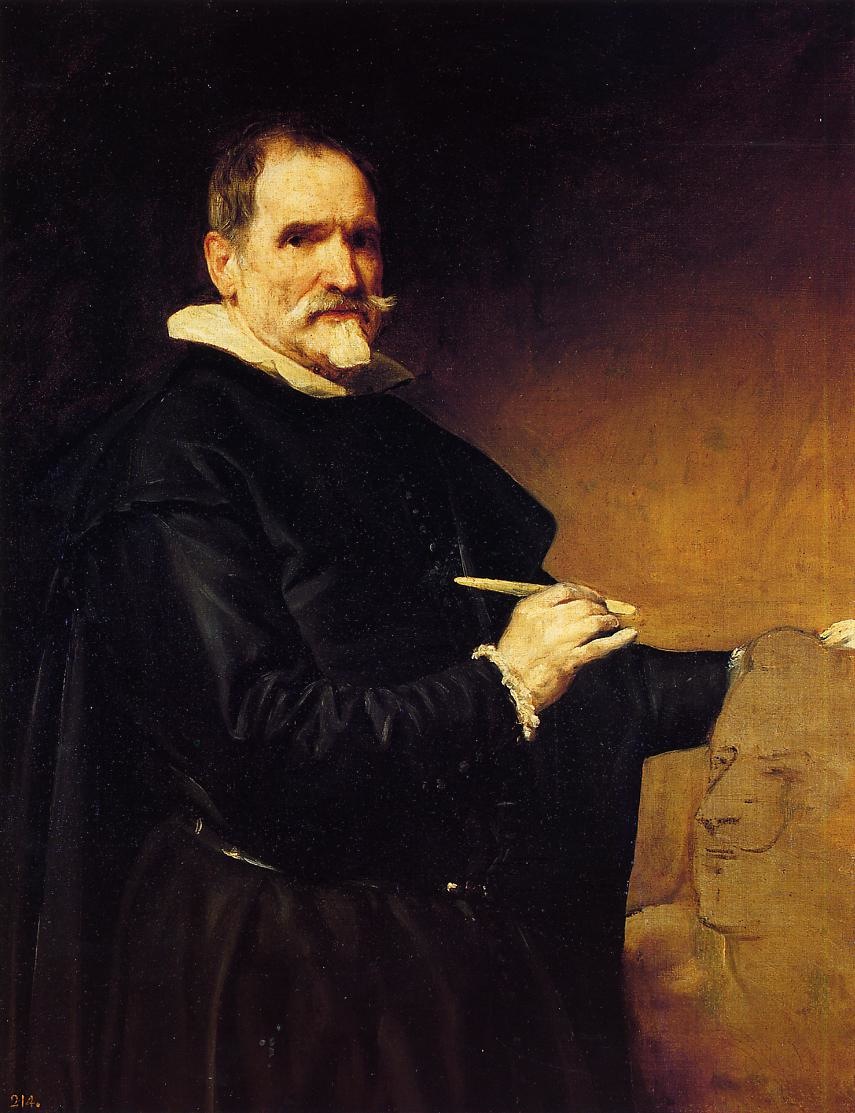
Diego Velázquez (Spanish, 1599-1660) Martínez Montañés ejecutando el busto de Felipe IV (c. 1635) Oil on canvas. Museo Nacional del Prado, Madrid
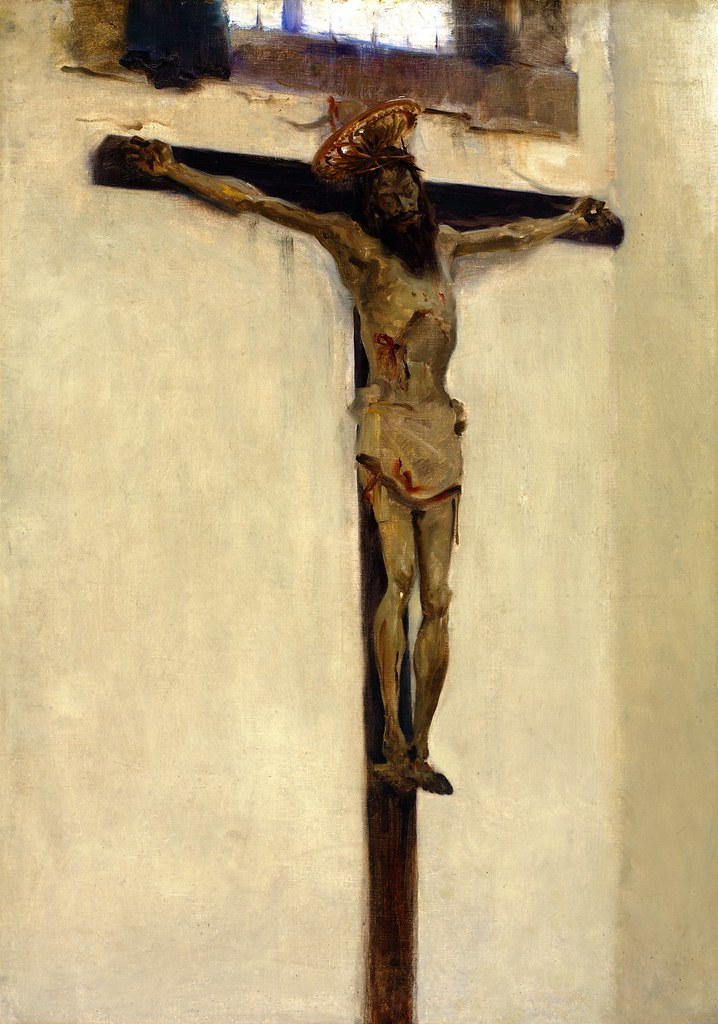
In Crucifixion, Sargent paints one of Velázquez’s most repeated subjects: the crucified Christ. It is important to note that, rather than the actual cricified Christ, both Velázquez and Sargent painted wooden crucifixes. Velázquez was influenced and mentored by the Spanish sculptor Juan Martínez Montañés (1568-1649).
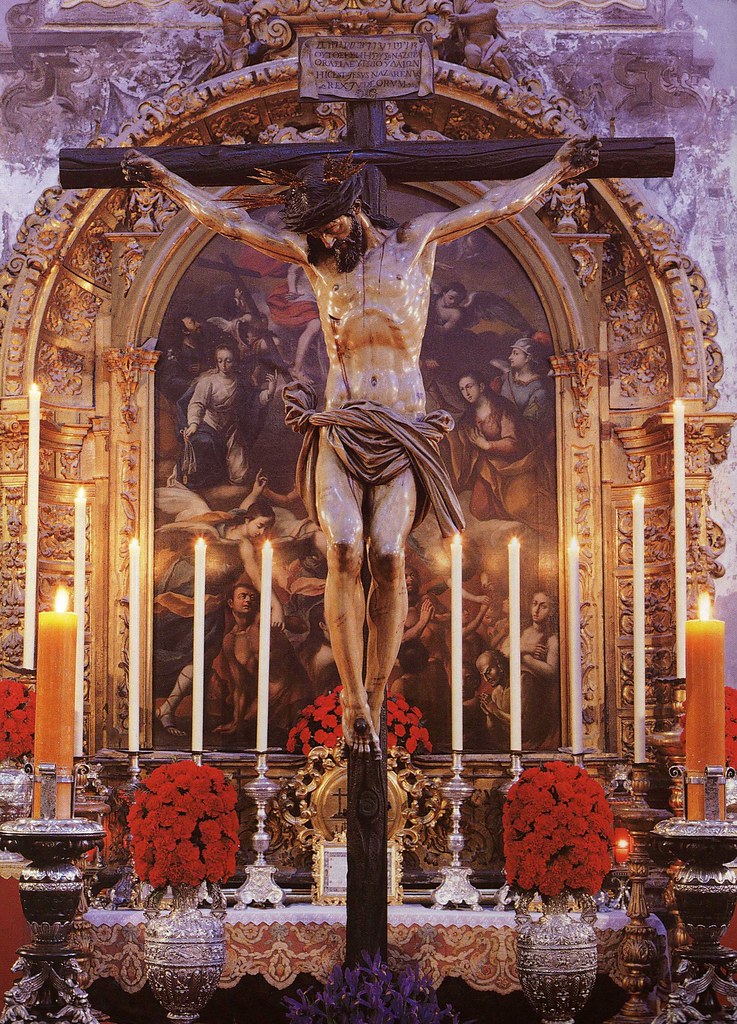
Juan Martínez Montañés (Spanish, 1568-1645( Cristo de la Clemencia o de los Cálices (c. 1604) Seville, Spain
Known as the Michelangelo of wood, Montañés created hundreds of religious sculptures that are still in use in religious festivals. The crucifix in Velázquez’s La venerable madre Jerónima de la Fuente (c. 1620) and Sargent’s Crucifixion are both based on Montañés models.
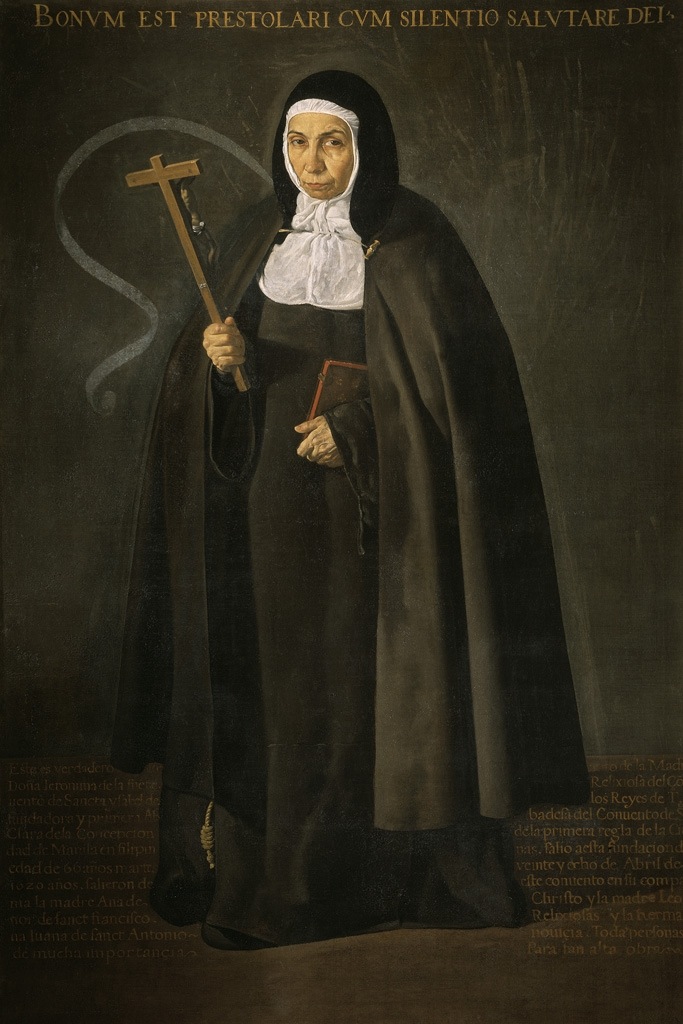
Diego Velázquez (Spanish, 1599-1660) La venerable madre Jerónima de la Fuente (c. 1620) Oil on canvas. 160 by 110 cm. Museo Nacional del Prado, Madrid.
In his Crucifixion, Sargent captures a private moment of meditation on Christ’s sacrifice. The crucifix hangs on a chapel wall while light streams from an upper window.
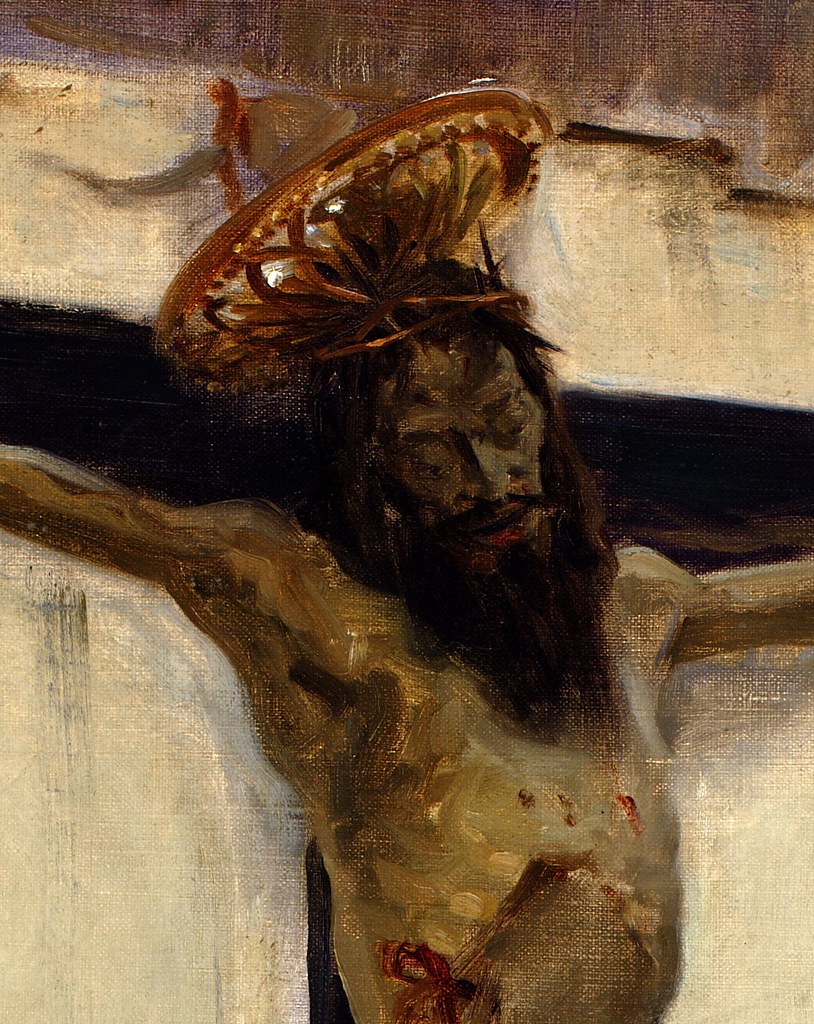
John Singer Sargent (American, 1856-1925 ) Crucifix (1879) Oil on canvas. Private Collection. Detail.
Using a wooden crucifix, rather than a realistic Christ, emphasizes the religious experience of the viewer, rather than Christ’s experience on the cross. This is a meditation on what reflecting on the crucifixion means to the viewer well after the event has taken place. Sargent capitalizes on this reflection by using Velázquez’s technique of broad visible brushstrokes. This allows the mind of the viewers to fill in the details and, therefore, participate in the subject in a way that incites the imagination like no detailed rendition could. Sargent also adopts Velázquez’s use of ochres. The nearly monochrome palette draws greater attention to Sargent’s remarkable brushwork, which like Velázquez, is unabashedly visible, at times broadly defining Christ figure and at others using miniscule strokes.
These hallmarks of Velázquez’s technique were studied and absorbed by Sargent. He transmuted them into his own French education and used the two to become the world’s most sought-after portraitist and, arguably, the greatest American painter of the nineteenth century.
Marie Antoinette (1876) by the Unlikely Lord Ronald Gower
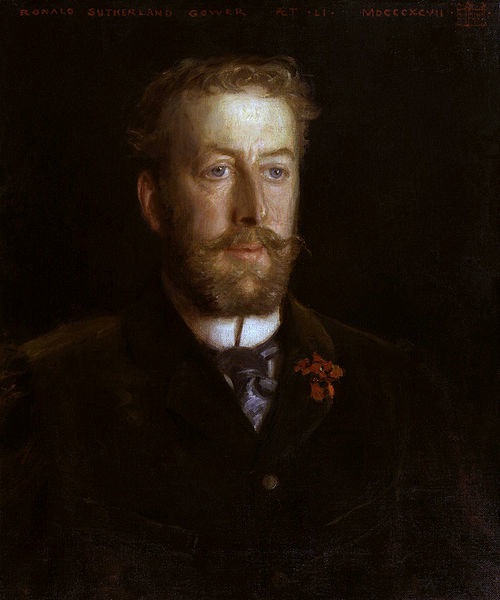
Henry Scott Tuke, R.A. (British, 1858-1929) Lord Ronald Gower (1897) Oil on canvas 24 by 20 in. National Portrait Gallery, London.
The youngest son of the powerful Duke of Sutherland, Lord Ronald Gower (British, 1845-1916) was educated at Eton and Cambridge. He distinguished himself as a popular politician, serving in the British Parliament from 1867-1874. Following his political career, Gower became an unlikely, critically-acclaimed sculptor and an historical writer. In the words of his mother, the Duchess of Sutherland, Gower had “a certain unpractical side of his character.”
Gower’s first serious attempt at sculpting was, ironically, for his mother’s grave in 1868. He collaborated with Matthew Noble (British, 1818-1876) who was hired for a memorial befitting the Duchess. Noble was the son of a stonemason who studied sculpture in London. Chronically ill from childhood, Noble nonetheless exhibited regularly at the Royal Academy’s annual exhibition until he died at the age of 58. Though Gower mentions Noble as a major influence in his artistic development, the ex-politician was largely self-taught.
Untrained and unmotivated by financial gain, Gower was derisively considered a “gentleman sculptor.” Despite all this, his work received international critical and popular praise. Gower’s sculptures were accepted to the Paris Salons of 1880 and 1881, the Paris International Exhibition of 1878, and numerous competitions at the Royal Academy, placed alongside sculptures by Alfred Leighton.
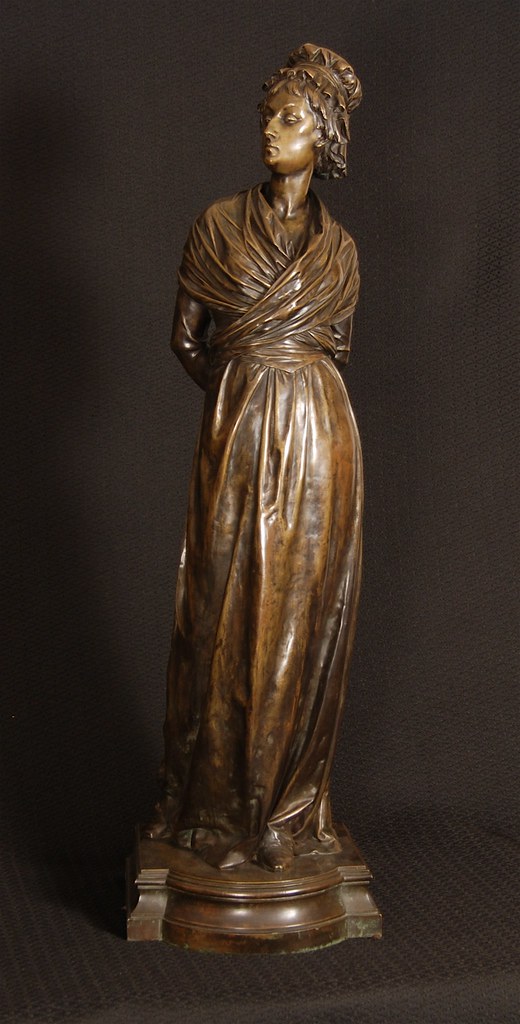
Lord Ronald Gower (British, 1845-1916) Marie Antoinette (1876) Bronze. Height: 46 in. Private National Gallery, London.
The first public sculpture by Lord Gower was Marie Antoinette (1876), completed two years after his retirement from politics. Eight years later, Gower published Marie Antoinette: An Historical Sketch (1885). Both the sculpture and the book were part of a larger late-nineteenth-century reexamination of Marie Antoinette’s reputation. Gower’s works joined a chorus of scholars who asserted that the Queen was a scapegoat of unrestrained revolutionary fervor.
During French Revolution of 1789, angry mobs successfully captured King Louis XVI and Queen Marie Antoinette. The King was quickly executed, while the Queen was kept under arrest, where she reportedly refused to eat or move. In the weeks that followed, révolutionnaires cast Marie Antoinette as the personification of Royal excess and frivolity. Her fate became a national debate. During a two-day show trail, filled with unsubstantiated accusations of gross immorality, Marie Antoinette refused to defend herself, saying “If I have not replied it is because Nature itself refuses to respond to such a charge laid against a mother.” Fearing rising sympathy for the deposed Queen, the Revolutionary Tribunal cut short her trial. A mother of four and 37 years old, Marie Antoinette was publicly and summarily beheaded on October 16, 1789 at 12:15 p.m. The incident was famously captured by Jacques-Louis David, a passionate supporter of the revolution–in his humiliating sketch of the Queen on the platform of the guillotine.
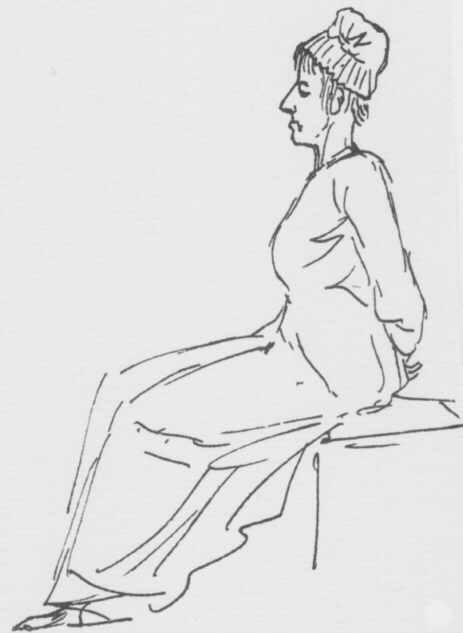
Jaques-Louis David (French, 1748-1825) Marie Antoinette one the Day of Execution (October 16, 1793) Pen and ink on paper. 150 by 100 mm. Musée du Louvre, Paris.
Lord Gower’s sculpture Marie Antoinette (1876) preceded his biography by nine years, indicating the subject had preoccupied him for some time. Gower depicts the deposed Queen being led to the guillotine. With hands tied behind her back and hair shorn to elicit further humiliation, the deposed Queen walks forward, resolutely and unbowed.
The work is not a technical masterpiece. Anatomically it is more stylistic than correct. Like so many of the the artists featured on this blog, there are very few examples of Gower’s work available for public view and almost no images to speak of. However, Gower’s last work, Hamlet (1888) is perhaps his best and most memorable.
In 1883, the city of Stratford-Upon-Avon commissioned Lord Gower to create a memorial to the city’s most famous citizen: William Shakespeare. Gower worked for five years at his own expense. (In his memoirs, Gower claims it cost him an average of £500 per year, which he never charged the city.)
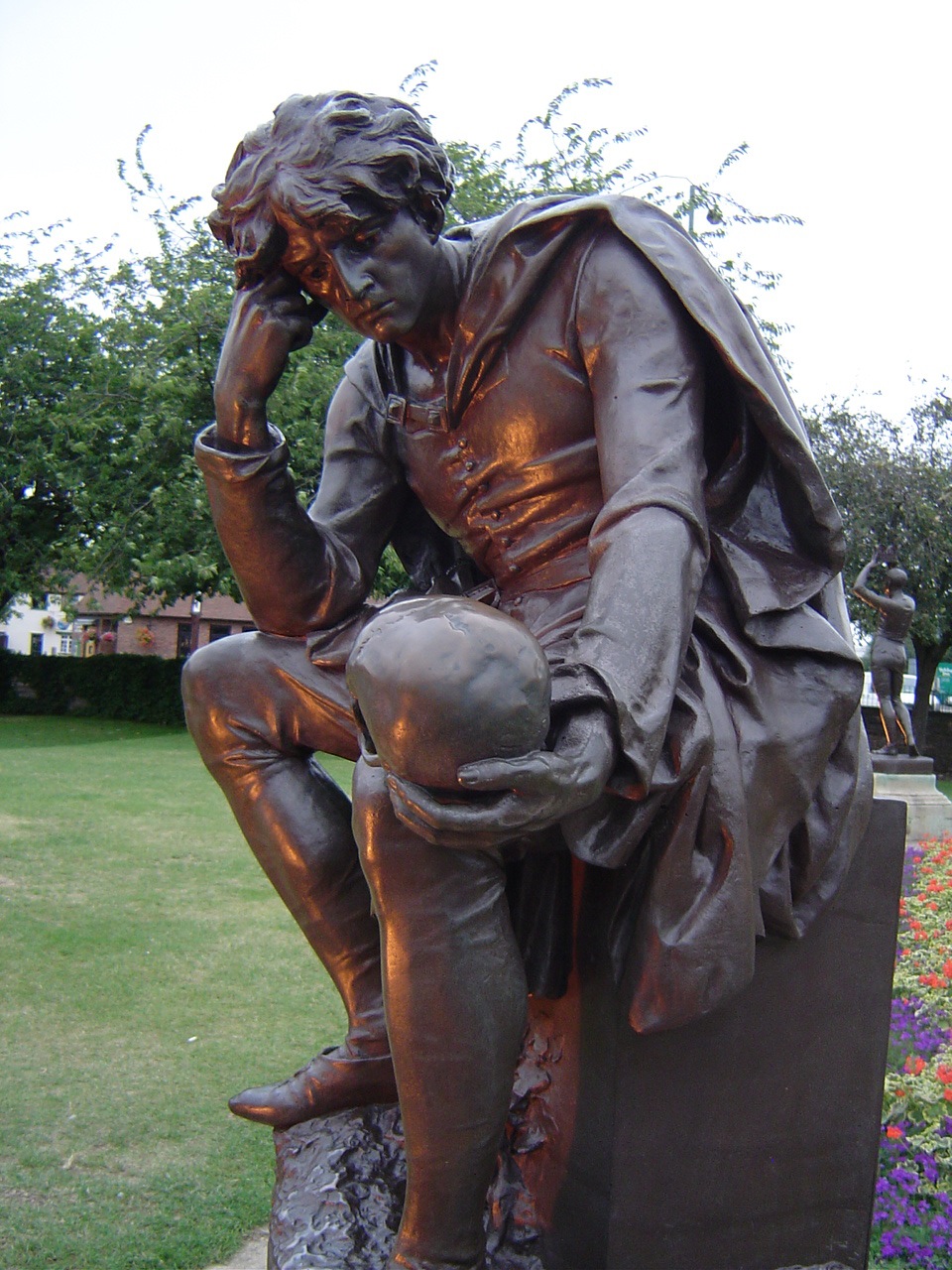
Lord Ronald Gower (British, 1845-1916) Hamlet (1888) Bronze. Life-size. Stratford-upon-Avon, United Kingdom. Photo via Wall Flower Gone Wild, Flickr.
Though he lived another 28 years, Lord Gower declared the monument his last work and never sculpted again.
Forgotten Master: Hugues Merle (French, 1823-1881)

Hugues Merle (French, 1823-1881) Romeo & Juliet (1879) Oil on canvas. 67 X 51 in. Anthony's Fine Art, Salt Lake City, UT, USA.
If you saw the above work and thought “Bougeureau,” you could be forgiven. Hugues Merle (French, 1823-1881) is in many ways a forgotten proto-Bougeureau. Merle and William-Adolphe Bougeureau (1825-1905) knew one another well and, for a time, were represented by the same gallery. Born two years apart, both graduated from the École de Beaux-Arts, were members of the French Academy and regulary exhibited at the annual Paris Salon. Their penchant for mythical, allegorical and literary scenes combined with mastery of the monumental human figure, made them competitors for the same pupils, positions, prizes and patrons. While Merle was only two years Bouguereau’s senior, he died nearly a quarter century earlier. A strong argument could be made–and I may tackle it some day–that had Merle lived to Bouguereau’s age, memory of his work would have not suffered such anonymity.
Two years ago, someone I know bought major work by Hugues Merle–Romeo & Juliette (1879). Since then, Merle has become a pet project that has taken me to France, England, Belgium and the United States in search of primary documents and published materials. There is disappointingly little available on public record. By increasing awareness of his work, its my goal to encourage those who have information relating to Merle to raise their hands and help us all piece together the life and work of an artist to has a lot to offer.
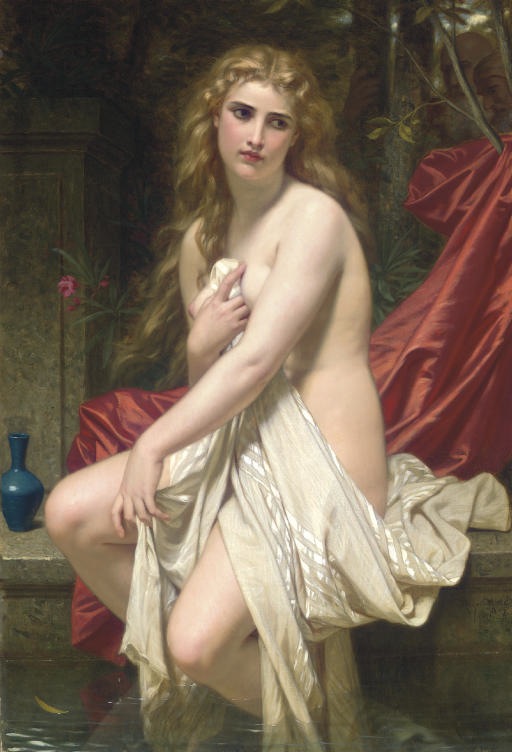
Hugues Merle (French, 1823-1881) Susannah at Her Bath (Date Unknown) 51 1/4 X 35 1/2 in. Private Collection.
There is a precedent for this. Thirty years ago, Damien Bartoli (1947-2009) took up the cause of Bouguereau and worked to produce a catalogue raisonné for the artist. Sadly, Bartoli died last month; but, not before publishing dozens of articles and submitting his final manuscript of Bouguereau’s complete works. (It will be this by the Antique Collectors’ Club in London.) Over the same 30 years, Bougueraeu has experienced a revival. Although it would be hard to establish a causal relationship, since Bartoli picked up his pen Bouguereau has seen a dramatic increase in awareness, appreciation and prices for his work. I’m no Bartoli and Merle is not Bouguereau. But, as Bougeureau’s star continues to rise, I believe it is only a matter of time until Merle’s follows. The two were closely associated in life and deserve to be in death.
Hugues Merle was born in Saint–Marcellin in the region of Isère (i.e. Southeast France). Little is know about his family or upbringing. As a community, Isère was politlcally charge, known for strong Protestant roots and nearly uniform support for the Empire. Early in his career, Merle painting a number of pro-Empire works that may be a reflection of his origins.
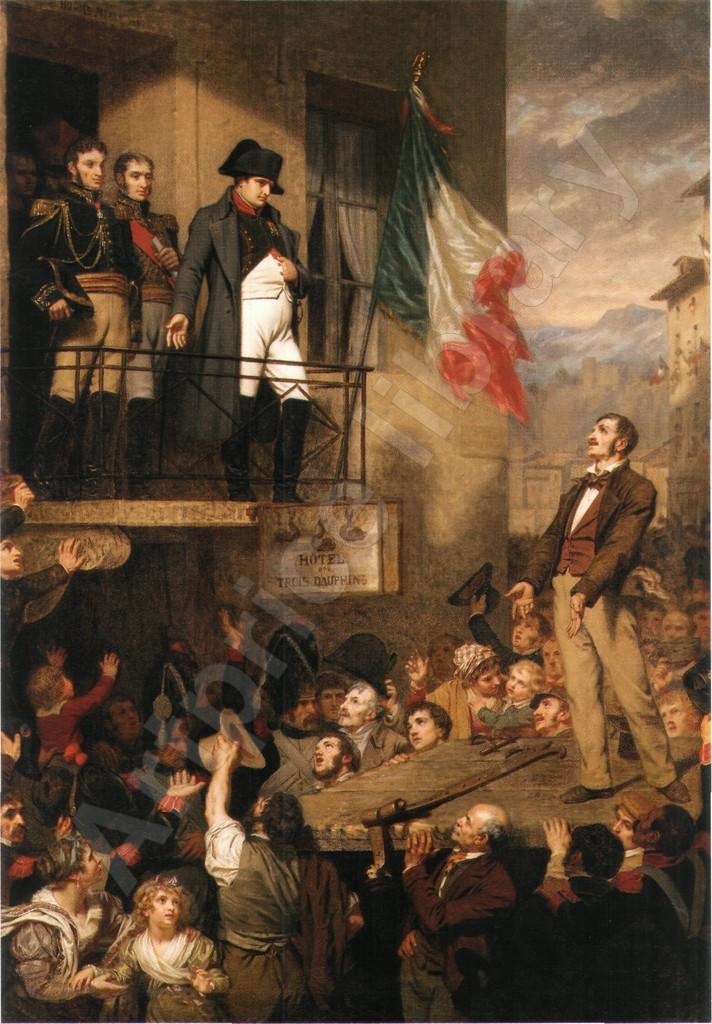
Hugues Merle (French, 1823-1881) The Eagle's Flight (1857) Oil on canvas 51 X 35 1/2 in. Christies, NY 23 APR 2003
Merle was accepted as a student at the École des Beaux-Arts in Paris, the nation’s most prestigious school for aspiring artists. There he enrolled in the studio of Léon Cogniet (1784-1880). Cogniet had studied at the École under Pierre -Narcisse Guérin, at same time as Eugene Delacroix, Ary Scheffer and Theodore Géricault, with whom he maintained life-long friendships. While he distinguished himself by winning the Prix de Rome in 1817, Cogniet is largely remembered as a teacher. Of him, Baudelaire wrote:
If he does not aspire to the level of genius, his is one of those talents which defy criticism by their very completeness within their own moderation. M. Cogniet is as unacquainted with the reckless flights of fantasty as with the rigid systems of the absolutists. To fuse, to mix and combine, while exercising choice, have always been his role and aim; and he has perfectly fulfilled them.
(Charles Baudelarie. The Mirror of Art, rans. and ed. by Jonathan Mayne. New York: 1956, p. 21)
Cogniet students include some of the century’s most respected painters, including Alfred Dehodencq, Jean-Louis Ernest Messonier, Jules Joseph Lefebvre, Léon Bonnat, Raimundo de Madrazo, and Jean Paul Laurens. As a teacher, Cogniet advocated vigorous and rough sketching above meticulous, time-consuming preparation. This became what Albert Boime described as “the sauce Cogniet [that] became a popular epithet to describe the technique of his disciples.” (Art and the Academy, p. 104). This resulted in a fluid naturalism in Cogniet’s own work, which influenced Merle’s approach during the the 1840s and 1850s.
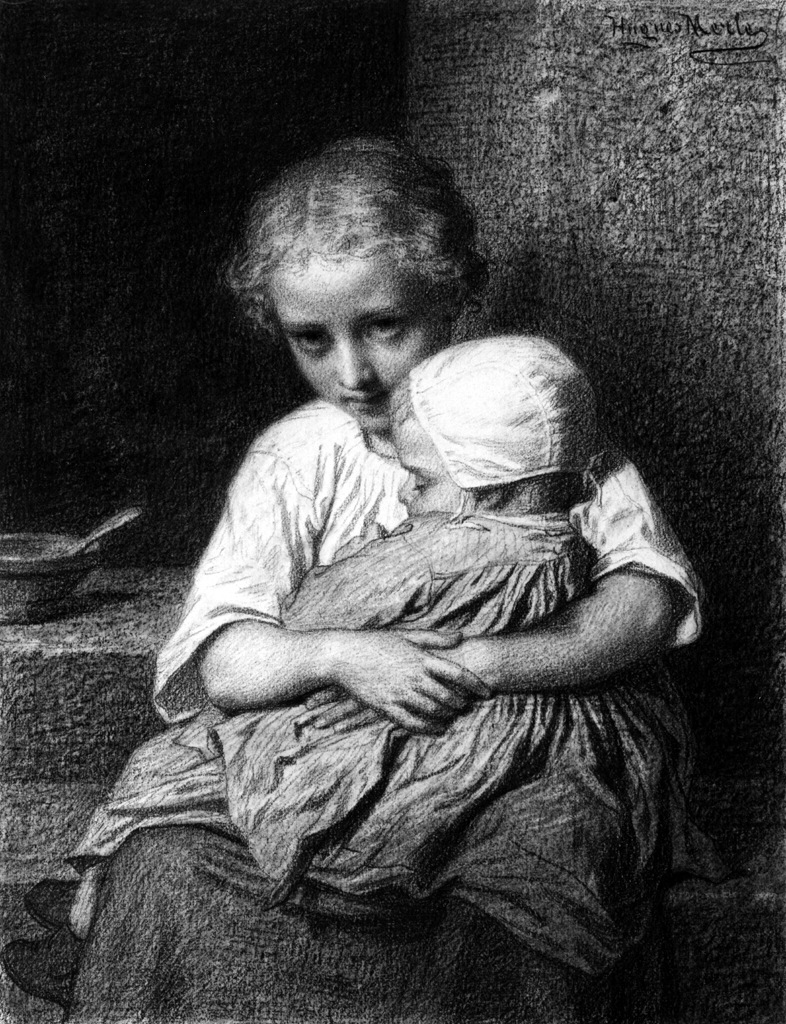
Hugues Merle (French, 1823-1881) The Good Sister (1862) Watercolor on paper. 8 X 5.75 Walter Art Museum, MD, USA.
Having seen nearly 200 of Merle’s works (I have no idea how many he painted yet), ranging from the early 1840s to his death in 1881, I would divide his ouvre into roughly three periods:
- Multifigural History Painting (1840s and 1850s)
- Genre Scenes (1850s and 1860s)
- Monumental Romantic Figures (1860s t0 1881)
1. MULTI-FIGURAL HISTORY PAINTING (1840s and 1850s)
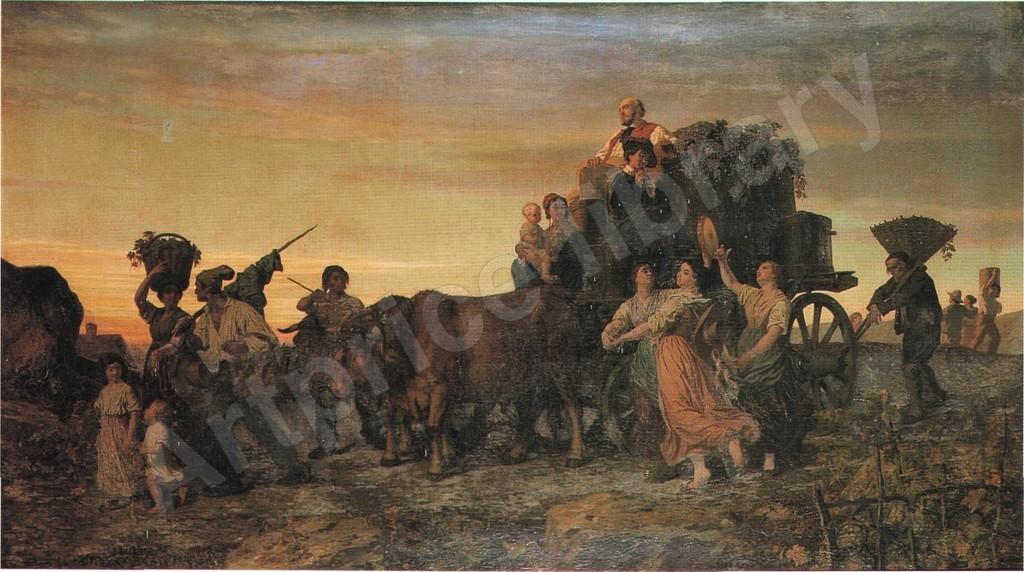
Hugues Merle (French, 1823-1881) Vendangeurs dauphinois dans les environs de Saint-Marcellin (1850) Oil on canvas 42 1/2 X 75 1/2 in. Piasa Auctions, Paris 14 DEC 2001
It is no surprise that works from early in Merle’s career have more in common with Cogniet’s work than his latter works. They are politically-charged or mythological history paintings–the kind that students at the École were trained to produce. Like Cogniet, many of these works are romantic in coloring and stroke. The brushwork is loose and the palette is warm.
2. GENRE SCENES (1850s and 1860s)
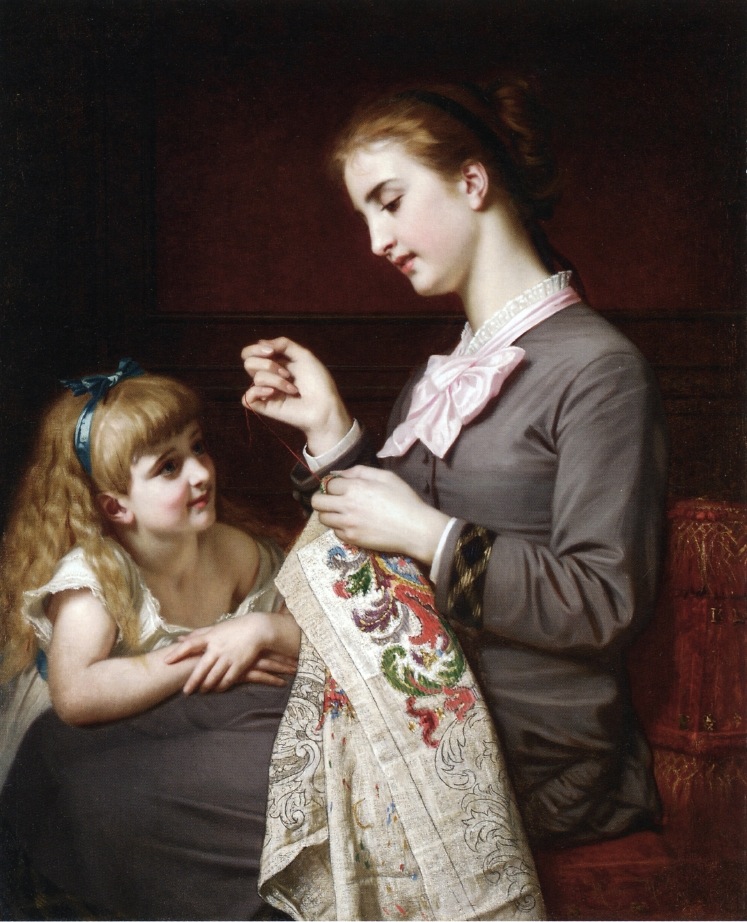
Hugues Merle (French, 1823-1881) The Embroidery Lesson (Date Unknown) Oil on canvas 39 1/4 X 31 5/8 in.
It is my guess that once he had established his academic credibility, Merle had to make a transition into becoming a commercial success. In mid-nineteenth Paris, this meant appealing to the bourgeoisie. Rather than mythological or heroic scenes that appealed to aristocratic tastes or political agendas, the easy sell to the upwardly mobile French middle classes was domestic family life and narratives lionizing traditional French values. Merle painted pictures of mothers and daughters, family gatherings, country scenes and home interiors. According to one source, it during this period Bougeureau and Merle had the same picture dealer, and that dealer encouraged Bougeureau to take up Merle’s successful theme of familial grieving.
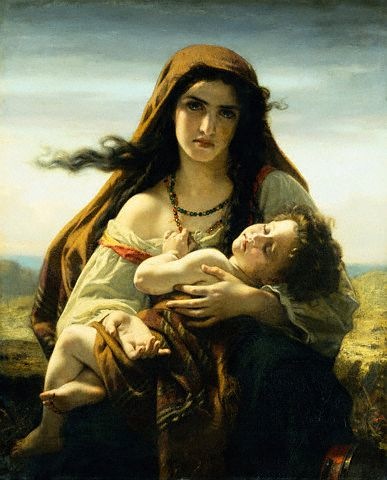
Hugues Merle (French, 1823-1881) The Widow (Date Unknown) Oil on Canvas. Private Collection
In this era, Merle developed his own technical approach that distanced him from Cogniet. He replaced warm colors with a high-contrast, jewel-like palette. His paintings became sparsely populated and the remaining figures grew in proportion to fill the canvas. As the figures grew, they became more idealized with an emphasis on line over color.
3. MONUMENTAL ROMANTIC FIGURES (1860s t0 1881)
Merle’s critical successes in the Salons of the 1860s led gave him international recognition. Like many others, Salon prizes resulted in a lucrative business of painting portraits Brits and Americans. But, it was Merle’s work as an interpreter of major literary romantic figures that set him apart.
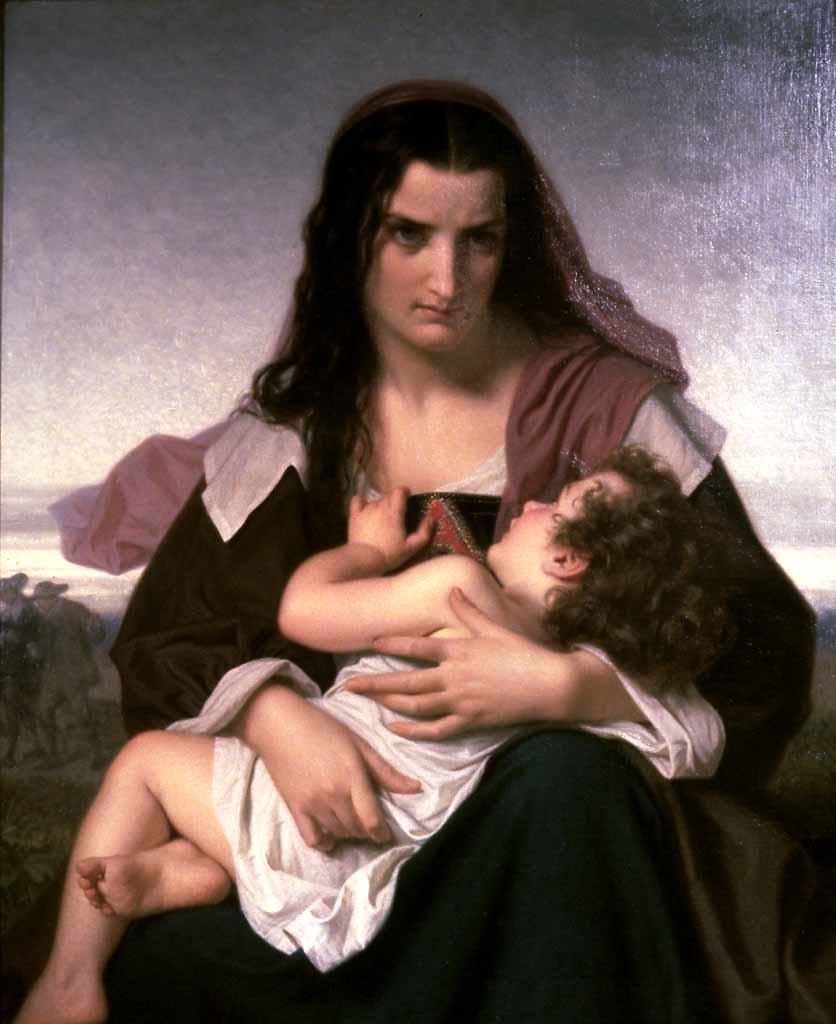
Hugues Merle (1823-1881) The Scarlet Letter (1861) Oil on canvas. 39 5/16 x 31 15/16 in. Walters Art Museum, MD, USA.
Upon seeing a photo of Merle’s interpretation of the Scarlett Letter, Nathaniel Hawthorne is purported to have said: “It is the most true representation of my work I have ever seen.” Merle painted a number of biblical and literary figures, especially romantic couples, including Tristan & Isolde, Benedick & Beatrice, and Romeo & Juliet. These figures were painted as large as life. They dominated the canvas. Merle removed all unnecessary narrative devices, relying on his audience’s familiarity with the subjects.
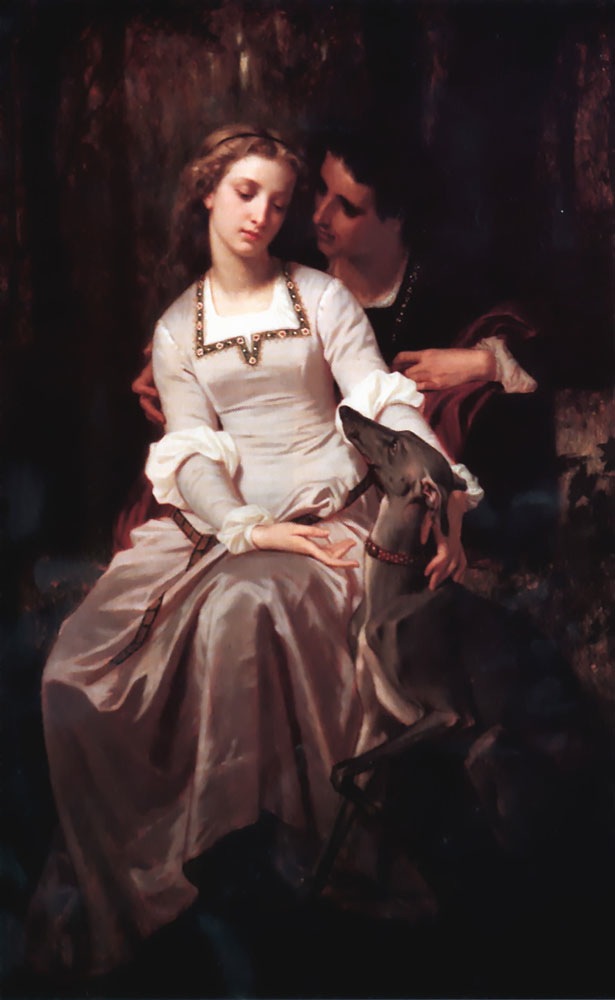
Hugues Merle (French, 1823-1881) Tristan and Isolde (1870) Oil on canvas. Private Collection.
In 1865, François-Victor Hugo (Victor Hugo’s son) had translated the complete works of Shakespeare into French. For the next fifteen years, the French poured over and re-interpreted the Bard’s narratives in ballets, operas, sculptures, and paintings. Merle’s Romeo & Juliette depicts the couple’s first meeting in Act I, Scene V. Here Romeo steals a “pilgrim’s kiss” from Juliet who coyly responds “You kiss by the book.”
The increased sophistication of Merle’s subjects was rising mastery of the human form. While his treatment of the clothed figure indicate his skill level, it is in nude that we are able to see an artist’s true mastery of the figure. Bougeureau’s female nudes leave us in awe of his skill and ensure his immortality. There are accounts of several painting of nude figures by Hugues Merle that have not surfaced in the art market. For me, this is a major omission in his ouvre and one that will continue to dog him if he is to regain stature.