Bernarda Fink: Great Talent and Taste
I’d like to think that Bernarda Fink has both good taste in music and painting and, therefore, is responsible for choosing the cover for her 2003 album Antonín Dvorák: Lieder.
The painting featured on the cover a pastel and charcoal drawing on paper by the artist Adolf von Menzel (Polish/German, 1815-1905), recently featured on this blog.
Adolf von Menzel (Polish/German, 1815-1905). The Artist’s Sister. Pastel and charcoal on paper.
Fink’s newly-released album, Brahms: Lieder is one of the freshest, most thoughtful recital albums I have heard in some time.
Fink was born in Argentina to Slovakian immigrants. She was raised and trained in Buenos Aires and now lives in Paris, where she is married to the French Ambassador to Slovakia.
Fink’s diction is crisp, but not distracting. Her passion is complimented by a beautiful phrasing that lifts the text to a level of emotion that makes it difficult to listen to while doing anything else.
The English pianist, Roger Vignoles, blends his perfomance with Fink beautifully. There is a certain clarity to a duet between piano and voice that cannot be found in any other cobination. It completely bares the qualities of each artist and, therefore, exposes subtleties that are lost when others are added to the equation.
I rarely recommend albums and, even more rarely, buy copies to pass out to friends and families. In this case, I’ve done both.
Finally, A High-end Website for Classical Music Lovers
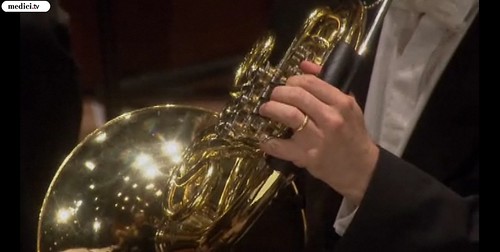
This isn’t your grandparents’ classical music . . . wait, it is. But, now it is accessible in a highly visually and professional format: Medici.tv.
Online broadcasts of classical music and opera are not new. The Metropolitan Opera and websites like ClassicalTV have been podcasting productions for some time. These services have often been limited in scope, focusing on performances from a specific venue, record label, or genre.
In addition these online services are often fee-based and require viewers to be on limited schedules. (For example, wanting to see a production at the Metropolitan Opera in New York featuring José Cura, I had to stay up late in London to watch the online broadcast.)
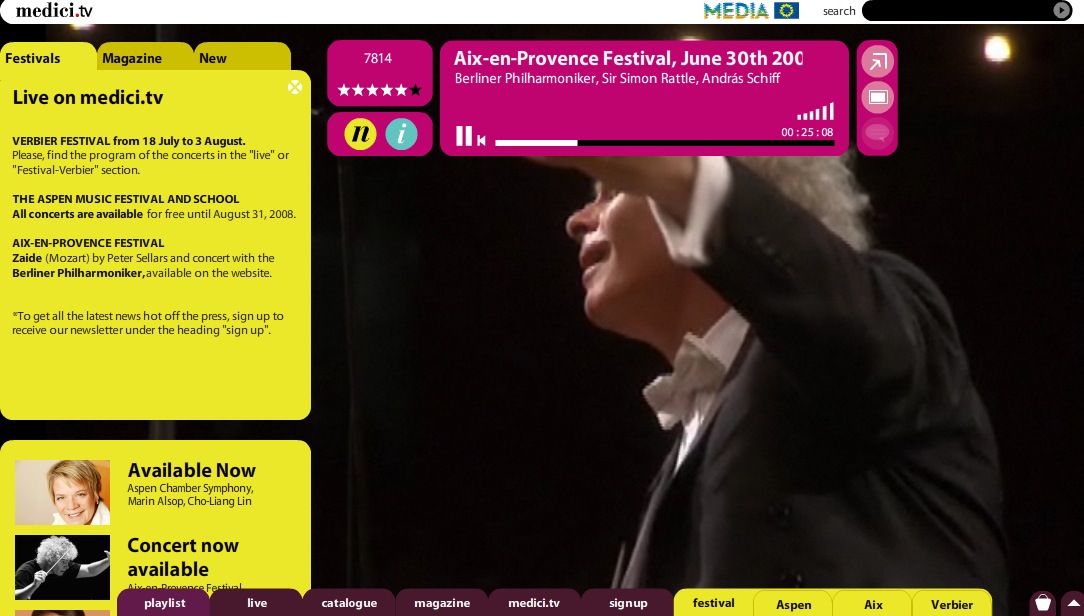
Medici.tv seems to correct many of these issues with a beautifully designed website. Though a subscription to its website gives users access to archives, anyone can go to the Medici.tv’s website and immediately view high-definition, multi-camera-shot footage of world-class performances free of charge.
Over the past three days, I have watched live performances from Music Festivals in Aix-en-Provence, France and Aspen, Colorado, in addition to two operas. (Having two computers will allow you to work on one while streaming performances on the other.)
I’m hooked.
Vox populi, vox Dei?
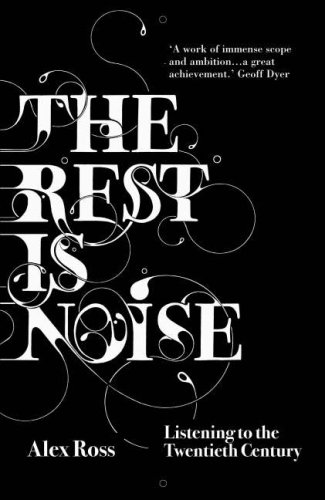
I have been reading The Rest Is Noise by Alex Ross, music critic for the New York Times. It is a stunningly clear way of looking at the story of twentieth century music. (It was nominated for the 2008 Pulitzer Prize.) In it, Ross brings up several arguments that have not been settled. Ross’ discussion of the atonal–as opposed to melodic–music movement has me wondering about whether or not music, and art of the same period that went through a similar rejection of tradition, should be popular or if the arts are mean to be the playground of the few, the elite.
On May 16, 1906 Richard Strauss conducted his opera Salome in the Austrian city of Graz. Kings, composers, and, supposedly, a seventeen-year-old Hitler were present. Salome was a departure from traditional opera. Besides the gruesome, controversial topic (i.e. the beheading of John the Baptist followed by a necrophilic aria sung to his severed head) it was more atonal than melodic. Surprisingly, it was an instant success.
The composer and Strauss’ friend, Gustav Mahler, was there for opening night and the congratulatory parties:
On the train back to Vienna [where he was working as a conductor], Mahler expressed bewilderment over his colleague’s success. He considered Salome a significant and audacious piece–”one of the greatest masterworks of our time,” he later said–and could not understand why the public took an immediate liking to it. Genius and popularity were, he apparently thought, incompatible. Traveling in the same carriage was the Styrian poet and novelist peter Rosegger . . . [He] replied that the voice of the people is the voice of God–Vox populi, vox Dei. Mahler asked whether he meant the voice of the people at the present moment or the voice of the people over time. Nobody seemed to know the answer to that question.
(Ross, Alex. The Rest Is Noise. Fourth Estate: London, 2008. p. 9. Emphasis added)
Mahler’s question has been ringing in my ears since I read it. By asking whether or not the people’s opinion matters, it flies in the face of Strauss’ student, Schoenberg who said: “If it is art, it is not for all . . . and if it is for all, it is not art.”
Schoenberg’s opinion squares with nearly 100 years of art criticism, which has consistently preached a rejection of courting popular appreciation in exchange for deliberately difficult art. If that is what they wanted, they got it. It has led to a popular lack of comprehension and consequently a lack of interest in art.
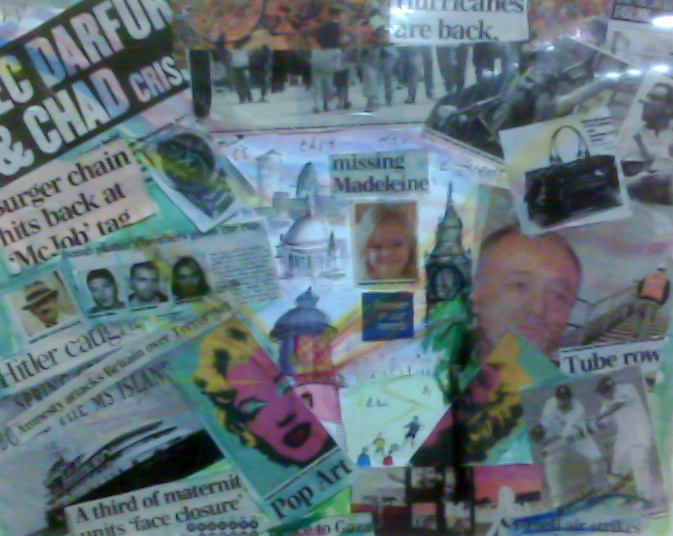
Why Is this Day Different? Michael Brecker as photographed by my camera phone at the Royal Free Hospital, London.
Last week, my wife had minor surgery at the Royal Free Hospital in London. The Hospital had a wall covered in contemporary art being sold for the benefit of various charities. As my wife and I walked by, a woman standing in front of a collage work said to her companion “It’s not really art, is it!? I don’t get it.”
Vox populi.
What did she mean by “not really art”? Without her explanation, I can only guess that she meant that Michelangelo’s David by comparison would be art. David exhibits obvious above-average skill to create. On the second statement, “I don’t get it,” she suggests that comprehensibility would help he appreciate it.
The above piece doesn’t seem, on the surface, to meet the first of her supposed requirements. (Regardless of the work involved, collage art will never been seen as something requiring extraordinary skill.)
As for subject, it is unspecific in that it could be interpreted many ways depending on individual perspective. Its lack of specificity is a barrier to comprehension. The lack of comprehension in collage art has been deliberate since the beginning.
It has been nearly 100 years since Picasso and Braque introduced collage. At the time, Picasso commented to Braque in a letter that “if it was understood, it was boring.”
When talking about the people and their perspective of art, a central issue is comprehensibility. Debussy argued that music should be deliberately difficult in order to deter the passing interests of lesser minds.
My friends who collect and love contemporary art are tired of me talking about the deliberate, or even accidental, obfuscation of subject and lack of specificity in collage art and its sister movements. They think 100 years has settled the issue. But, I have to remind them that it has only been 100 years. “One hundred years?!” is the usual reaction. (As if art were subject to the same product cycle as the next model of Apple’s iPhone.) Prices are only one indication of the value of art.
Ars longa. Vita brevis.
Photographing People at the Opera
Bill Henson, Untitled 5/59, 1990-91
Bill Henson, Untitled 29/77, 1990-1991
Looking at these and the other images from the Paris Opera Project, I am surprised by their strong sense of narrative. Yes, they are beautifully composed, but it is knowing the story that makes it possible to appreciate the technical artistry in Henson’s work.
Recently, I had a conversation with a friend who is trained as a figure painter. Over the past few years he has worked almost exclusively in landscapes. Now he sells more paintings with trees and sky than with people in them. I asked him the obvious question: Why aren’t there people in your paintings anymore? Isn’t that what you do best?
He replied that it is increasingly difficult nowadays to find narratives to paint that can be understood and appreciated by a large number of people. According to him, our society has become so diverse that no one story can be easily or, even, successfully shared. (If I didn’t know he was a painter, I would have thought he was an advertising executive lamenting the diminishing audiences for network television commercials.)
There are two issues here: first, whether or not paintings can or should appeal to a large audience (i.e. Vox populi est vox dei); second, whether or not there are still universal narratives.
I will not deal with the first issue in this post. (Later I plan on posting on an argument between Strauss and Mahler who discussed the same issue, but in regards to classical music.) As for the second issue, according to the New York Times critic, Alex Ross, more Americans attended an Opera last year than Football and Basketball games combined. Bill Henson’s work proves that there are narratives that can maintain their strength while being shared with a large audience.
Even if you have never seen an opera, if you have ever been to a ballet, musical, or movie theater, you can relate. The result is not only the ability to connect with the painter on an emotion level (i.e. one of the fundamental purposes of art), but it allows the viewer to then explore the technical ability of the Henson without having to continually question what he is depicting.
I first learned about Henson’s work on the the Photoshelter website. There they include additional photos and a brief interview with Henson.
The Golden Age of Ballet: Videos on YouTube
Someone, legally or not, has placed the entire documentary A Dancer’s Life online at the video sharing site YouTube. A Dancers Life is a documentary of dance classes at the American Ballet Theater during what some would consider the Golden Age of ballet in the early 1970s. The documentary includes footage with the well-known dancers and instructors Rudolf Nureyev, Natalia Makarova, and Fernando Bujones, among many other luminaries that we sorely miss on today’s ballet stages.
Below, I have posted the complete documentary, as posted by the user named EUCLID1423 on YouTube. (If you cannot see the videos below, it is most likely because you have a slow connection to the internet. In that case, go directly to EUCLID1423.)
A Dancer’s Life: Part Two
A Dancer’s Life: Part Three
A Dancer’s Life: Part Four
Opera of the Week: Elektra by Richard Strauss
Orestes (middle) killing their step-father Aegisth
from University of Texas.
This is a killer opera. And by that, I mean that a lot of people are killed and we are supposed to be happy about it.
Elektra is the daughter of Agammemnon from Greek Mythology. Agammemnon is was the leader of the Greeks at the battle of Troy. He fought and won. Instead of welcoming him home with well-deserved applause–or even a hardy “good job”–his wife Clytemnestra stabbed him to death while he was bathing. Clytemnestra didn’t work alone. She had the help of her lover Aegisth. With Agammemnon dead, they became the new rulers of the Greek kingdom Mycenae. That’s the pre-story for the opera.
The opera begins with Elektra, the eldest daughter of Agammemnon, complaining about the new family situation. She is followed by Clytemnestra complaining to everyone about how she can’t sleep because of the nightmares she has had since murdering her husband. She thinks she’ll feel better after killing someone else as a sacrifice to the gods. But, before Clytemnestra can do it, Elektra works with her brother Orestes to kill her and their step-dad. The opera ends with Elektra happily dancing on Agammemnon’s grave. Who knew death could be so satisfying?
Elektra was first performed in Dresden on Januabry 25, 1909. With music by Richard Strauss and a libretto by the Austrian poet Hugo von Hofmannsthal, the opera became a standard part of opera-house repertoire almost immediately.
Elektra is a one-act opera, lasting little more than an hour. The version I watched was performed by the Vienna State Opera in 1989 and conducted by Claudio Abbado. It was so dreary that I felt like taking a shower afterwards.
Most of the time, the music and singing maintined a high-pitched and pounding tone that kept my nerves on end, which was appropriate for the story. (The music elicited so much emotion that I felt as though I was complicit in participating in or, at least, witnessing the murders.) The only sweet moment–and it was very sweet–was the reunion of Elektra and her brother Orestes potrayed in a duet just before they kill Clytmnestra and Aegisth. I’ve rarely heard the love between siblings so well portrayed in literature, poetry, music, film, or drama.
Online, I found a recording of by the German Soprano Ricarda Merbeth singing in the role of Chrysotemis, the sister of Elektra, from the opera. It is indicative of the emotional style of the rest of the opera.
Opera of the Week: Parsifal by Richard Wagner
Parsifal is about the struggle between good and evil–one that lasts about four hours. Good wins, and by the end of the opera I was beaten
King Amfortas (of whom a painting was featured earlier on this blog) is the guardian of the Holy Grail along with his Grail Knights. In addition to the Grail, he owns the spear that pieced Christ’s side while he hung on the cross. Amfortas loses the the spear to the evil King Klingsor, who used the temptress Kundry to seduce him. Wounded by the spear he lost, Amfortas is doomed to live with the wound until an “innocent fool” (a.k.a. Parsifal) returns the spear, kills Klingsor, and heals Amfortas. By the end of the opera, Parsifal does all he is supposed to and, as a bonus, has his feet washed by Kundry who annoints his feet with oil and dries it with her hair.
In his book A Night at the Opera, Sir Denis Forman, former Deputy Chairman of the Royal Opera House at Covent Garden, wrote the following about Parsifal:
“Even today there are probably some devout Christians who can find in Parsifal a sublime experience, but for most of us it is a bit of a pill. It is not so much that we resent Wagner’s hipocrisy in lecturing us on the virtues of innocence and purity of heart . . . it is because it is so staggeringly pretentious. Wagner sets himself up as a sort of musical Pope who has produced a work pretty well as important as the Crucifiction itself.”
A Night at the Opera, p. 501
He’s not wrong.
I was once told that in order to enjoy opera it would be necessary to suspend belief. In that way, one can accept someone singing after having been mortally wounded. It’s an adult fantasyland. However, Wagner requires more. He doesn’t just want suspension of belief, he wants total surrender. He wants you to believe in the greatness of what he is doing. I have a hard time being moved by him. Maybe it is the pretension. Maybe it’s because I can’t get over the fact that Wagner was not a paragon of virtue.
Wagner wrote both the music and libretto for Parsifal. It was first performed on July 26, 1882 in Festspielhaus, Bayreuth, Germany, some 35 years after he had started writing it. By the 1920s, it was a staple of Opera houses all over the world.
I watched a recording of Parsifal performed by the Metropolitan Opera in 1993. It is some of of the best singing, acting, and set designing I have ever seen in an opera. Wagner’s work seems to lend itslef to great performances, full of pomp and ceremony. It was beautiful. And, despite all my belly aching, this recording is worth watching.
Opera of the Week: Xerxes (a.k.a. Serses) by George Frideric Handel

Considered opera seria,Xerxes does have some comic relief from the character Ariodate, who plays the role of the wise servant to not-so-wise royals.
I watched a wonderful staging of the opera recorded in 1997 in London. It starred Ann Murray in the role of Xerxes and the countertenor Christopher Robson as his brother. (At the closing curtain, the recorded audience clapped harder for him than anyone else.)
The Countertenor Effect
In Handel’s day, countertenors were considered superstars. Operas were written for them, and many young men were castrated with the goal of joining a castratti caste. (Castratti is Italian for “the castrated ones.”)
Today, the social pressure to be a counter tenor doesn’t exist, and, as a result, there is a dearth of men who can actually sing these roles well. Now many women fills the men’s role, in what are called “pant roles.” There were three altos playing pant roles in this recording of Xerxes and one genuine countertenor. I have a hard time watching women play men, because I can’t seem to forget that they are women. (It’s like nudity. I’ve been told that many stage directors avoid nudity, even when the script requires it, because it tends to distract the audience from what is actually happening.) I also have a hard time watching countertenors because their voices seems so different from the others that are on stage. Watching a woman seduce another woman and watching a man sing opera with little vibratto are equally foreign to me.
In case you are curious, here is a list of a few living countertenors, with images and links to their homepages. (Each has recording samples online.):
Opera of the Week: Iris by Pietro Mascagni

This is a depressingly beautiful opera by Pietro Mascagni. In a setence, the opera tells the story of a poor girl kidnapped by a wealthy pervert and a brothel owner who drive her to suicide. It could be the official opera of the sex trade and would be just as cheery.
Iris is the young, unfortunate girl who is kidnapped. She lives for the simple pleasures of life. After being kidnapped by Kyoto and Osaka (the brother owner and pervert, respectively), she has the following exchange with Osaka while he tries to seduce her:
IRIS: I want my Father!
OSAKA: I will give you clothes and money!
IRIS: I want my cottage!
OSAKA: Palaces you shall have!
IRIS: I want my garden!
OSAKA: Immense fields that you can plant
All in flowers!
IRIS: But there are not my flowers!
Good for you Iris!
In the end, she falls into a deep pit and dies.
The structure of the opera is worth noting. There are three acts, each stars with an overture that is accompanied by a text to be read by the opera. The first act has three different overtures and two text to be read with them.
The version I heard was sung by Placido Domingo and Ilona Tokody. Both were impeccable. It is worth a couple hours for those who love opera.
50 Greatest Operas
While visiting the Salt Lake Public Library–I make a weekly trip–I noticed they had printed a list of the 50 greatest operas that was originally compiled in the book Opera for Dummies. The book was written by David Pogue (CBS Correspondent and New York Times Columnist) and Scott Speck (Musical Director of the Mobile Symphony).

I don’t agree with everything on the list because I’m not a big fan of German opera. (I’ve heard all the arguments for Wagner and Strauss, and I have enormous respect for them. Their work just doesn’t elicit an emotional response in me.)
Here is the list in alphabetical order:
- The Abduction from Seraglio by Wolfgang Amadeus Mozart
- Aida by Giuseppe Verdi
- Ariadne and Naxos by Richard Strauss
- Un Ballo in Maschera by Giuseppe Verdi
- The Barber of Seville by Gioacchino Rossini
- Bluebeard’s Castle by Bela Bartok
- La Boheme by Giacomo Puccini
- Boris Godunov by Modest Petrovich Mussorgsky
- Carmen by Georges Bizet
- Cavalleria Rusticana by Pietro Mascagni
- Cosi Fan Tutte by Wolfgang Amadeus Mozart
- Don Giovanni by Wolfgang Amadeus Mozart
- Don Pasquale by Gaetano Donizetti
- Elektra by Richard Strauss
- L’Elisir d’Amore by Gaetano Donizetti
- Eugene Onegin by Peter Ilich Tchaikovsky
- Falstaff by Giuseppe Verdi
- Faust by Charles Gounod
- Fidelio by Ludwig van Beethovern
- Die Fledermaus by Johann Strauss
- Der Fliegende Hollander by Richard Wagner
- La Forza del Destino by Giuseppe Verdi
- Der Freischutz by Carl Maria von Weber
- Gianni Schicchi by Giacomo Puccini
- Lohengrin by Richard Wagner
- Lucia d’Lammermoor by Gaetano Donizetti
- Madame Butterfly by Giacomo Puccini
- Die Zauberflote by Wolfgang Amadeus Mozart
- Die Meistersinger von Nurnberg by Richard Wagner
- Le Nozze di Figaro by Wolfgana Amadeus Mozart
- Otello by Giuseppi Verdi
- Pagliacci by Ruggiero Leoncavallo
- Parsifal by Richard Wagner
- Peter Grimes by Benjamin Britten
- Porgy and Bess by George Gershwin
- Rigoletto by Giuseppe Verdi
- Der Ring des Nibelungen by Richard Wagner
- Das Rheingold by Richard Wagner
- Die Walkure by Richard Wagner
- Siegfried by Richard Wagner
- Gotterdammerung by Richard Wagner
- Romeo et Juliette by Charles Gounod
- Der Rosenkavalier by Richard Strauss
- Les Contes d’Hoffman by Jacques Offenbach
- Tannhauser by Richard Wagner
- Tosca by Giacomo Puccini
- La Traviata by Giuseppe Verdi
- Tristan und Isolde by Richard Wagner
- Il Trovatore by Giuseppe Verdi
- Turandot by Giacomo Puccini
Some obvious operas that I think are missing from th list:
- Rusalka by Antonin Dvorak
- Billy Budd by Benjamin Britten
- Thais by Jules Massenet
- Pelleas et Melisande by Claude Debussy
- L’Incoronazione di Poppea by Claudio Monteverdi
- Samson et Dalila by Camille Sainte-Saens
- Dido and Aeneas by Henry Purcell
Every Autodidact’s Dream: World Lecture Hall

Their website says it best:
“ Welcome to World Lecture Hall, your entry point to free online course materials from around the world. Please browse, search, learn and enjoy.”
Enjoy!? I typed in “art history” and got the following results (the beginning of 30 pages worth of the same):
| Frontier Heritage Tom Bacig | University of Minnesota at Duluth | May, 2000 |
|
| History and heritage of the North American frontier in music, art, literature and film. | |
|
Design and Persuasion Miodrag Mitrasinovic | University of Texas at Austin | May, 2000 |
| Semiotics of design. | |
|
Design and Persuasion Miodrag Mitrasinovic | University of Texas at Austin | May, 2000 |
| Semiotics of design. | |
|
Art History Survey I Marleen Hoover | San Antonio College | November, 2001 |
| Art History Survey I explores art from its beginnings in the Paleolithic era to the early Gothic era. Non-western art is thoroughly integrated into this course, completely delivered over the Internet. | |
|
Western Art Since 1500 Andrea Pappas | University of Southern California | December, 2001 |
| Painting, sculpture, architecture and photography in Europe and the United States from the Counter-Reformation to the present. Freshman-level. | |
It allows for searching in various language and by type of media (e.g. audio, video, lecture notes, assignments).
I’m smitten.
Opera of the Week: L’Heure Espagnole (The Spanish Hour) by Maurice Ravel
Who says opera can’t be fun?! Only about 45 minutes long, this is one of the funniest operas I have ever heard. L’Heure Espagnole (The Spanish Hour), by Maurice Ravel and libretto by Franc Nohain (Maurice Ravel’s pen name), premiered in Paris in 1911. It is the story of the unfaithful wife of clock maker in Toledo, Spain. The wife reminds her husband to check the town’s clocks, as is his duty every Thursday. Meanwhile, she arranges for visits from three of her lovers. She spends the hour her husband is gone hiding her lovers from her husband and from each other. In the end, they come out of their clocks and the lovers, along with her husband, pretend that nothing strange is happening.
This is one of two operas Ravel wrote L’Heure Espagnole was written for adults, while his second opera, L’Enfant et les sortileges, was written for children. Not many recordings are available for either opera. I listened to a production by the Orchestra National de la R.T.F released in 1997.

Opera of the Week: L’Amico Fritz by Pietro Mascagni
Absolutely delightful! L’Amico Fritz is my new favorite opera. (And I mean that quite seriously.) This opera has a wonderful story, great characters, meaningful arias, beautiful duets, and an orchestration that matches the vocals. I have no idea why it is not a standard part of the American opera season.
I listened to the 1969 performance starring Pavarotti and Mirella Freni. Recently, it has been re-released by EMI as one of the “great opera recordings of the century.”

You can buy the CD and listen to tracks by clicking here. (I suggest listening to disk 1, songs 6 and 16.)
Pietro Mascagni wrote the opera in 1891. Since then, it has been a staple in Europe, but has lost favor in the US. If you know why, please comment.
Listen to the Oldest Song in the World (Via reddit.com)

Written in Cuniform (the ancient script of the Chaldeans)around 1400 BC, it has been translated and put into midi form by Professor Anne Kilmer of UC Berkley. To hear and read more, go here: http://www.nationwide.net/~amaranth/hurrian.htm
Opera of the Week: La Serva Padrona by Pergolesi

I’m on a quest to listen to all of the operas listed in the 101 Opera Librettos book I picked from the Barnes & Noble discount book section. I I’ve listened to over half. But because the book was published in the early Twentieth Century, many of the librettos is publishes are for operas we no longer listen to. Enter La Serva Padrona.
Written by Pergolesi in 1733 for a soprano, and two bases, it lasts about 45 minutes. And, it’s charming. I found a CD on the Ricordi label (they have a lot of otherwise obscure operas in their catalog) on Amazon.com. (These cheap recordings are great if you already own the libretto and are more interested in more interesting voices than some of the big names.) I highly recommend it. And, I highly recommend that a college or regional opera bring this back into the mainstream.


