Tabernacle Frames: From Sacred to Secular
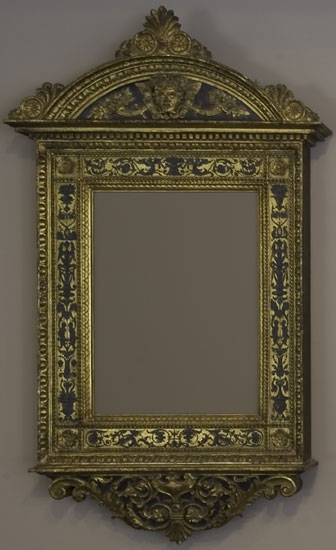
In a continuing series on painting frames, I would like to focus on a particular style: the tabernacle frame.
According to researchers at that National Gallery in Washington, the tabernacle frame grew out of devotional paintings. The architectural nature of the frame was meant to imitate the shape of a cathedral or church. As a result, the tabernacle frame was a portable religious site that could be put in a home or other private place of worship.
Like a church building, the make up of the frame consists of a plinth at the base and two columns surmounted by an entablature.
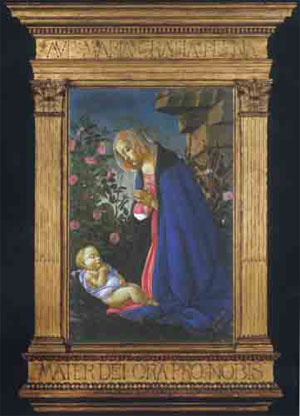
The earliest surviving examples of wooden tabernacle frames are from fifteenth-century Italy, where they were used in religious paintings, especially those featuring the Virgin and Christ Child.
(Some conservators, like those at the National Gallery in London, insist that Italian, pre-nineteenth-century frames should only be put on images with the Virgin and Christ Child.)
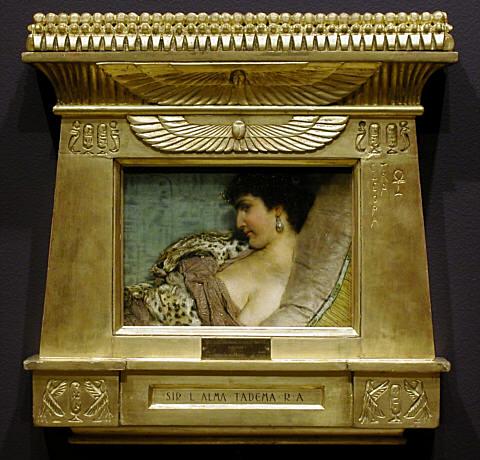
Though commissioned by collectors for older works, the tabernacle frame was rarely seen or used on contemporary paintings until the “Olympian painters” of Great Britain, especially Frederick Lord Leighton and Lawrence Alma-Tadema, began using them on their own paintings.
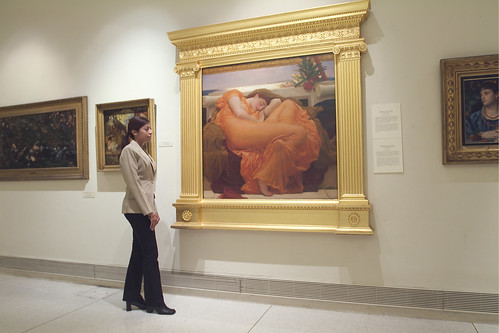
Leighton and Tadema separated the tabernacle frame from its religious context and used it to depict non-traditional scene. Both Leighton and Tadema often designed their own frames, and created unique approaches to the Greco-Roman architecture, especially Tadema, who chose Egyptian themes for many of his works and created frames to match.
It’s Been Framed: Looking More Earnestly at the Picture Frame
Gustave Leonhard de Jonge (French, 1829-1893) Widow in Mourning. Oil on canvas. Private collection.
In viewing or buying a painting it is easy to overlook its frame. The right frame with the right painting can make an enormous difference, just as the wrong frame on a painting can distract from what would be considered a great work.
Gustave Courbet (French, 1828-1885) Boskage. Oil on canvas. Private collection.
To my frustration, when paintings are photographed, their frames are almost always omitted. This is despite efforts by the artist to design or pair a painting with a frame to create a complete work of art. Whistler, Seurat, and Alma-Tadema, all went to great effort to design and, sometimes, make their own frames. As a result, their frames can be considered part of the overall work and, consequently, the painting without the frame considered incomplete.
Henry Bouvet (French, 1859-1945) The Artist’s Wife Reading. Oil on canvas. Private collection.
The connoisseurship of frames has become increasingly important, with auctions and collections dedicated specifically to period and rare frames. The art collector Samuel H. Kress (American, 1863-1955) bequeathed a large collection of painting and an even larger collection of frames to the National Gallery in Washington, DC. He often bought frames without a painting, seeing them as works of art in their own right.
Pierre Charles Comte (French, b. 1823) Reception of the Boy King. Oil on panel. Private collection.
In an effort to bring more attention to frames and to learn more about them myself, I would like to dedicated a few posts over the coming weeks to specific kinds of frames.


