Posts in Category: Exhibitions

Eight Works from the 102nd Spring Salon
Each year since 1924, the Springville Museum of Art (Springville, Utah) has hosted a contemporary art competition called the Spring Salon. Artists from around the country, including John Carlsen, Norman Rockwell, Emile Gruppe, and Maynard Dixon have participated. The contest still receives submissions from all over; but, the majority are from the unusually artistically dense Intermountain West (i.e. Idaho, Wyoming, Utah, and Arizona). There is no barrier to entry. Everything submitted — regardless of medium, style, size, or subject — is considered by (usually) two professionals, usually taken from different disciplines. (This year, the judges were the art administrator and scholar Felicia Baca, currently serving as the Executive Director of the Salt Lake City Arts Council, and Bryan Mark Taylor, the world-renown painter and inventor.) The result is one of the most consistently dynamic contests I have seen anywhere.
What follows is not an exhaustive review of the Spring Salon. (That would be a monumental task.) Instead, I have eight works which stayed with me well after leaving the Museum.
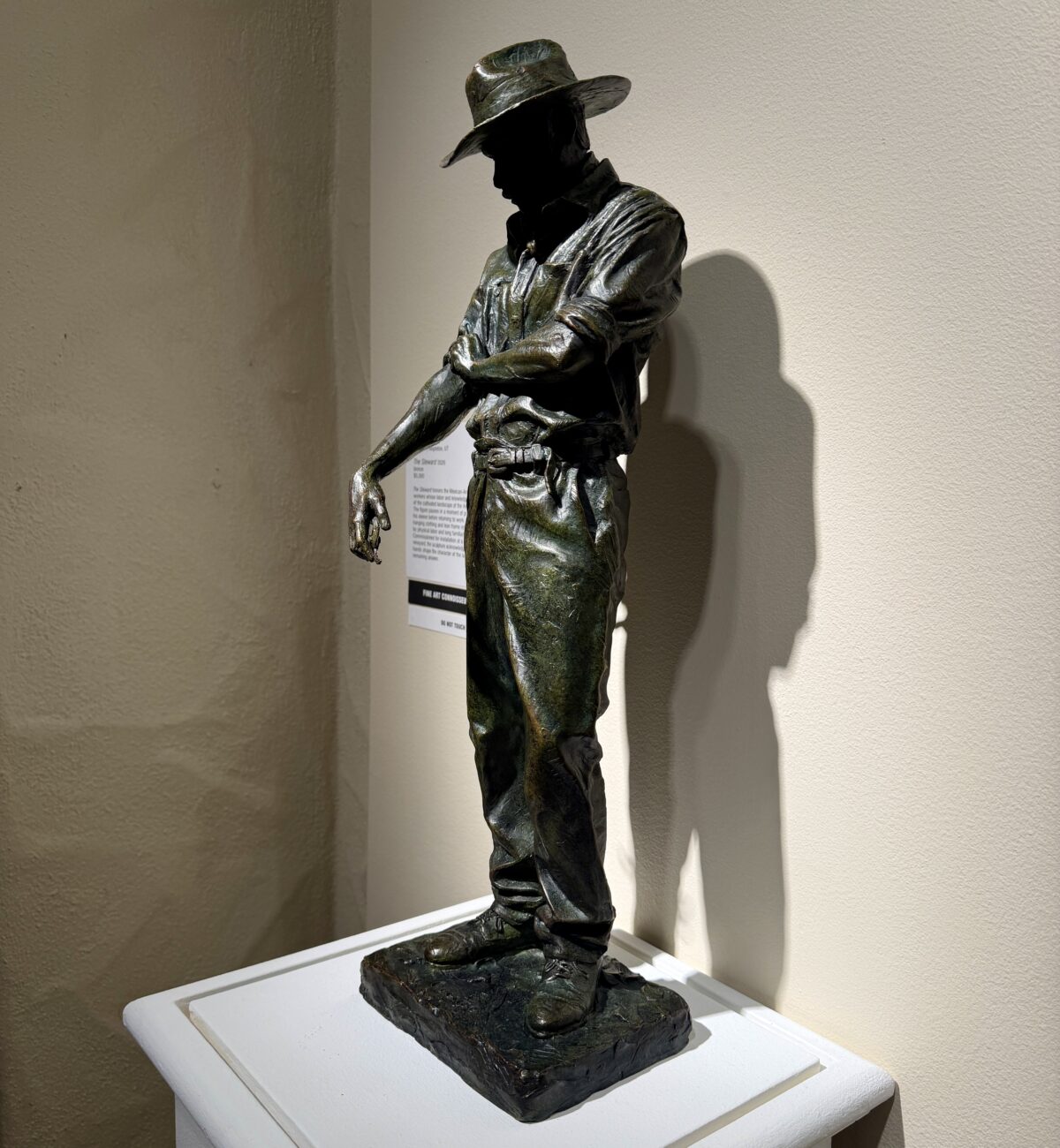
Eric Overton’s The Steward (2026) was commissioned for a Northern California vineyard to honor the contributions of Mexican-American farmworkers. Overton came to sculpture as a physician and photographer, which speaks to his understanding of anatomy. The downward gaze and obscuring hat create an anonymity that make this figure an effective everyman. It is reminiscent of Paul Dalou’s Grand Paysan (c. 1899), even down to the gesture of the rolled up sleeve. Despite the similarities, Overton has created something original in its stance and gesture that conjure a sense of strength that made the sculpture feel almost monumental in scale, despite being less than three feet high. More than that, it projects a dignity and humanity that is a true honor to its subject.
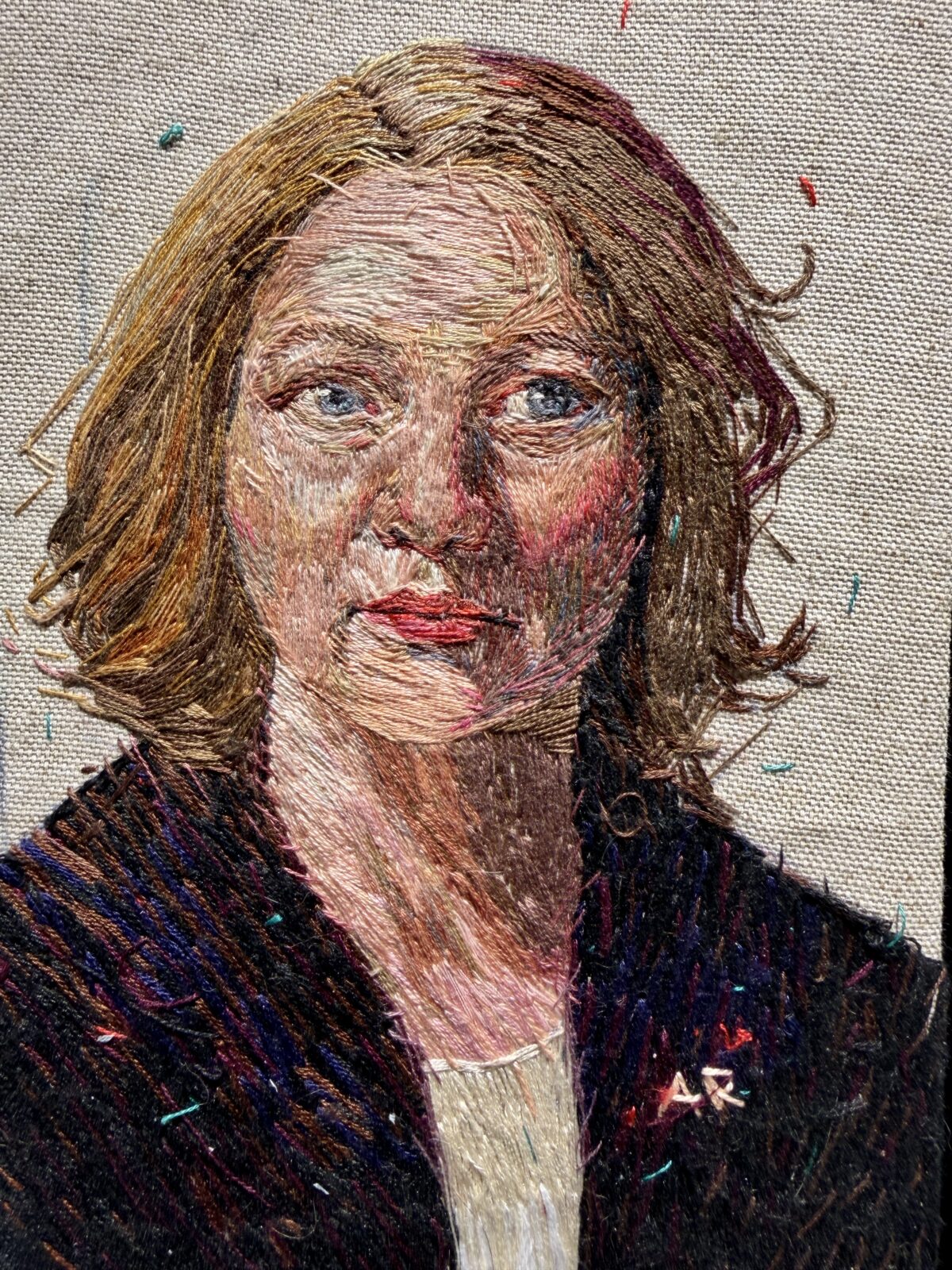
Azalea Rees works in a dizzying array of media. This diminutive self portrait — the product of what must have been countless hours of embroidery — is unlike anything I have ever seen. It transforms the medium into something new and expressive.
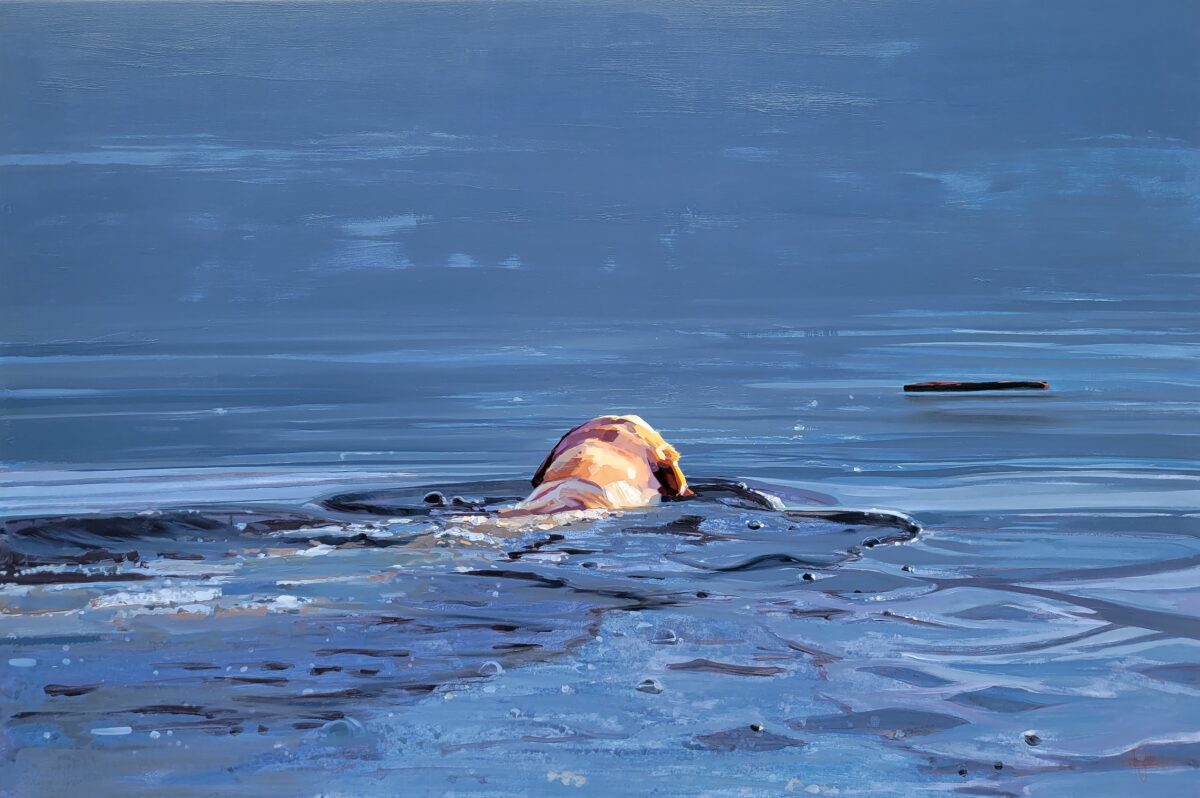
In seventeenth-century Holland, a group of artists known as a the Haarlem Tonalists dedicated themselves to painting their native, overcast landscape in a palette of colors so restricted that sometimes their works only had two or their colors. Consistently one of the greatest magicians of oil painting I know, here Cristall Harper takes her formidable arsenal of skills to a level that could rival Jan van Goyen. Whereas van Goyen works were limited to value transitions on (mostly) a single plane, Harper has established a deep field of vision with the subtlest control of stroke, value, and saturation. Wow.
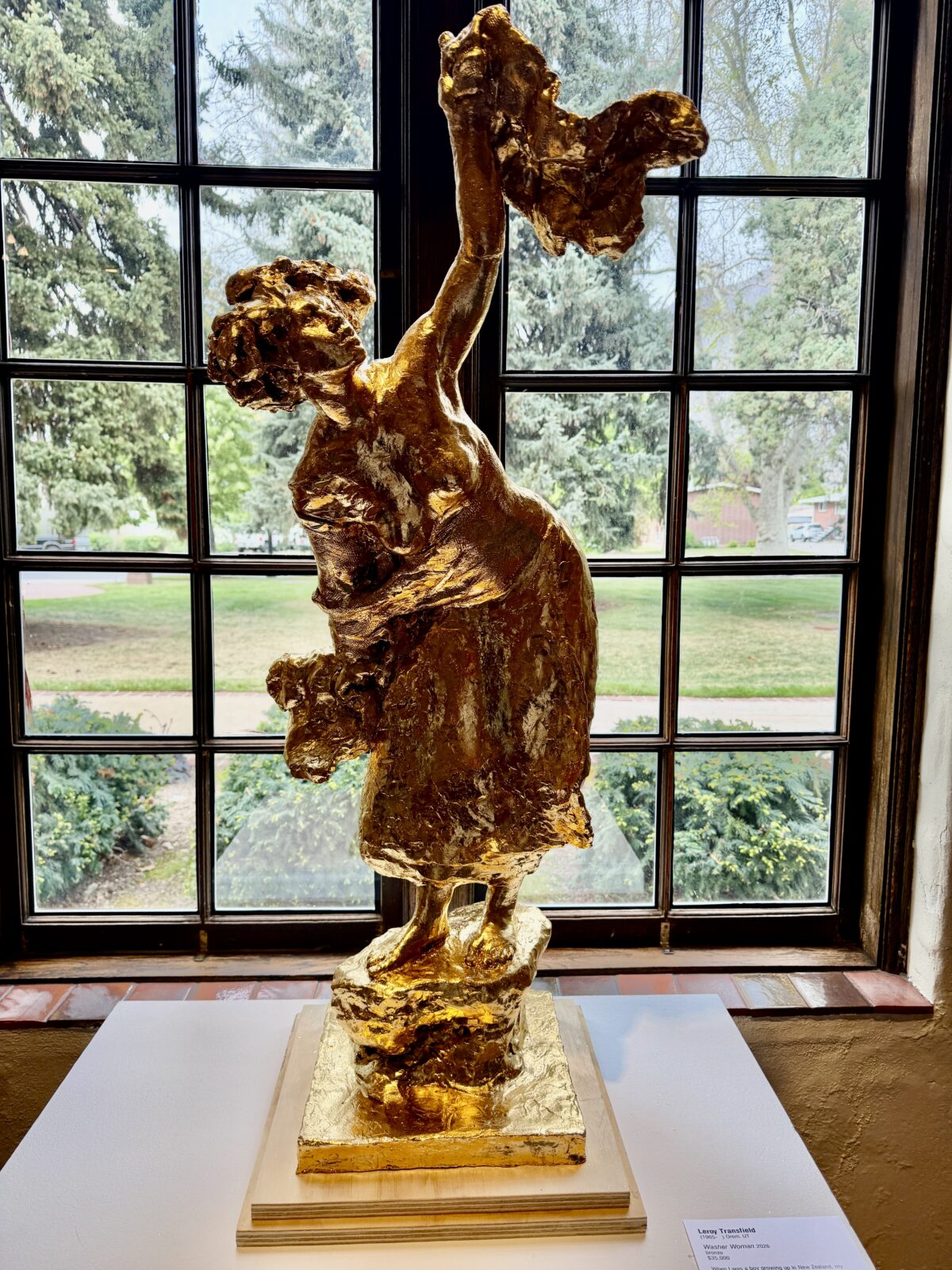
Leroy Transfield has been one of the most consistently surprising sculptors in a region saturated with them. Classically trained, Transfield retains in his sculptures a discipline of anatomy and gravity that cannot be attained without deep knowledge of the human form. Yet, his composition and gesture are never staid, but always fresh and tailored to the narrative of his work, which he details here:
“When I was a boy growing up in New Zealand, my mum and every other household hung their washing on a line. This simple task of hanging out clothes to be dried and cleaned is a banner of every mothers’ hope for her family.” —Leroy Transfield
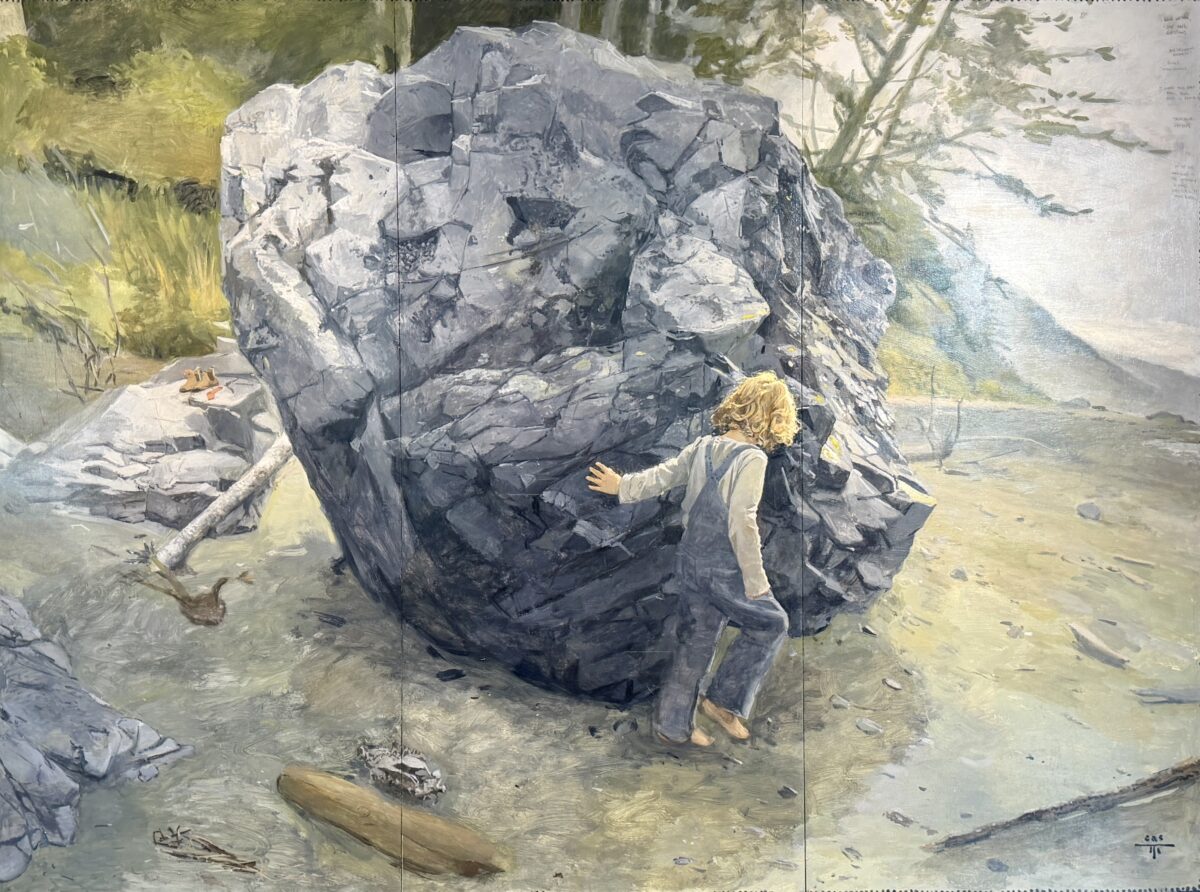
My photo of Finding the Way Around (2025) by Colby Sanford does little communicate the monumental scale of this three-panel work. Years ago, I remember a professor of mine distinguishing German and Italian opera by saying “One is about the battles between gods and men, the other is about everyday life — both about the epic struggles of good and evil.” Over the years, Sanford has become increasingly ambitious in mining his personal life to make beautiful, heroic images of everyday life. Despite the intensely personal nature of his works, Sanford’s images feel universal.
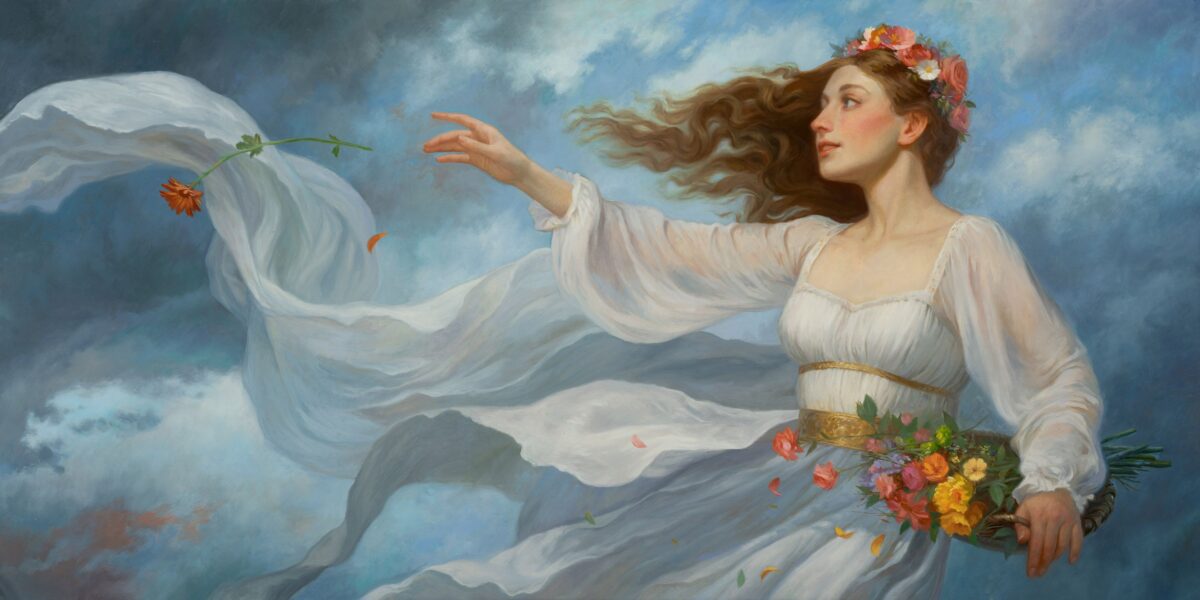
Howard Lyon is one of the few regional artists with a truly international reputation. That career has been made of many kinds of genres, including photography, illustration, fantasy, and religious painting; but always informed his study of Old Masters. A few years, ago Howard Lyon won the Salon’s top prize for his remarkable painting After the Dance. That painting seemed to trigger a new direction, where Lyon is making increasingly sophisticated works that are based in mythology and draw on the aesthetics of artists like Frederic Leighton, Albert Moore, Lawrence Alma-Tadema, and John William Waterhouse. This work, Zephyr Flirting with Flora (2025) is catnip for an art historian like me. A painting of the God of the West Wind playfully tossing about the clothing of the Goddess of Flowers
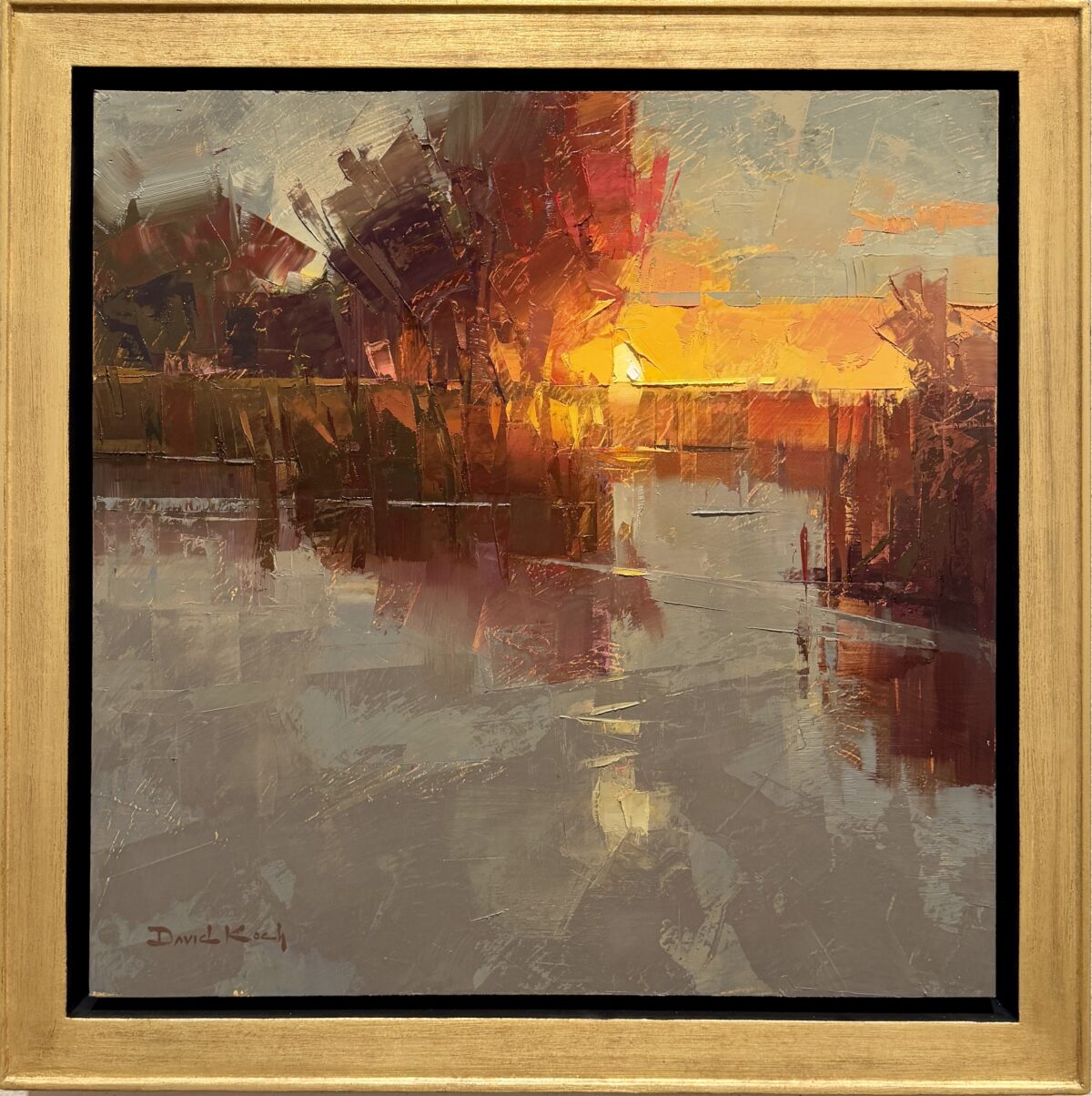
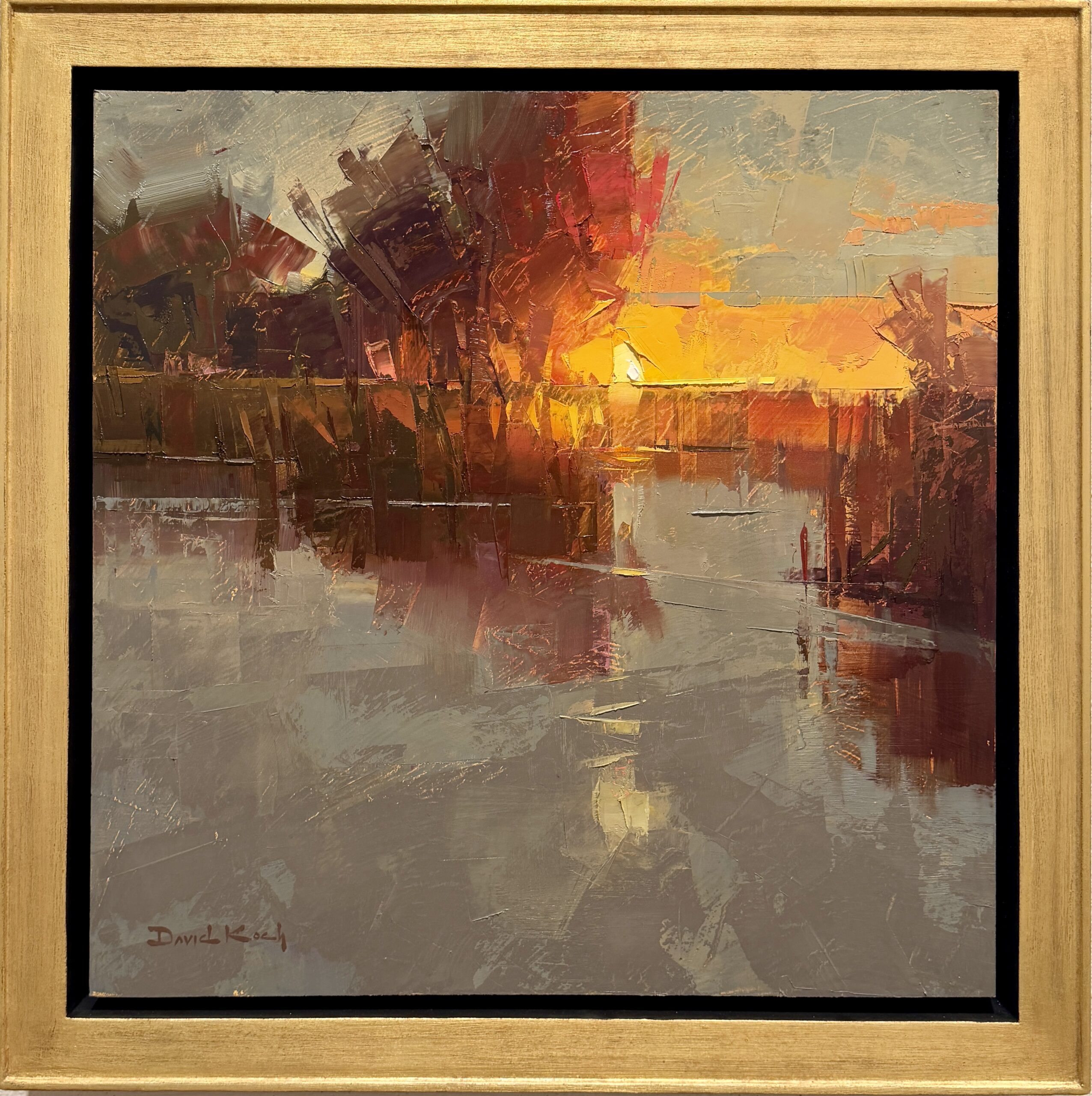
For me, this small painting hung at waist level down a Museum hall, is one of the great revelations of the entire contest. (I’m not throwing shade on the Museum, which has the herculean task of hanging hundreds of artists’ works and attempting to make all of them happy; an impossible task.) In 2007 the economics scholar David Galenson published the book Old Masters and Young Geniuses, where he theorized that artists fall into two general categories: those who spend a lifetime developing a mature and effective skillset and young innovators that often hit on a new approaches that, despite their inexperience, have lasting effects on art. (Personally, I think that there are plenty of artists that can be both young and skilled, and mature and innovative.) I mention this because contests tend to celebrate “the new” and not always recognize the iterative, long-term accomplishments of experienced artists whose work we are accustomed to see. David Koch is a perennial participant and multiple award winner of the Spring Salon. This work shows Koch’s skills honed to an extraordinary level: the application of paint conjuring both the ever-changing water’s surface and a series of diagonals that draw the eye from the bottom left to to the setting sun, the very limited palette that nevertheless creates a beautiful contrast of light effects, and the overall balance of abstraction and naturalism…I am in love with this work. In a region teeming with world-class landscape painters, David Koch is one of the great and consistent masters.
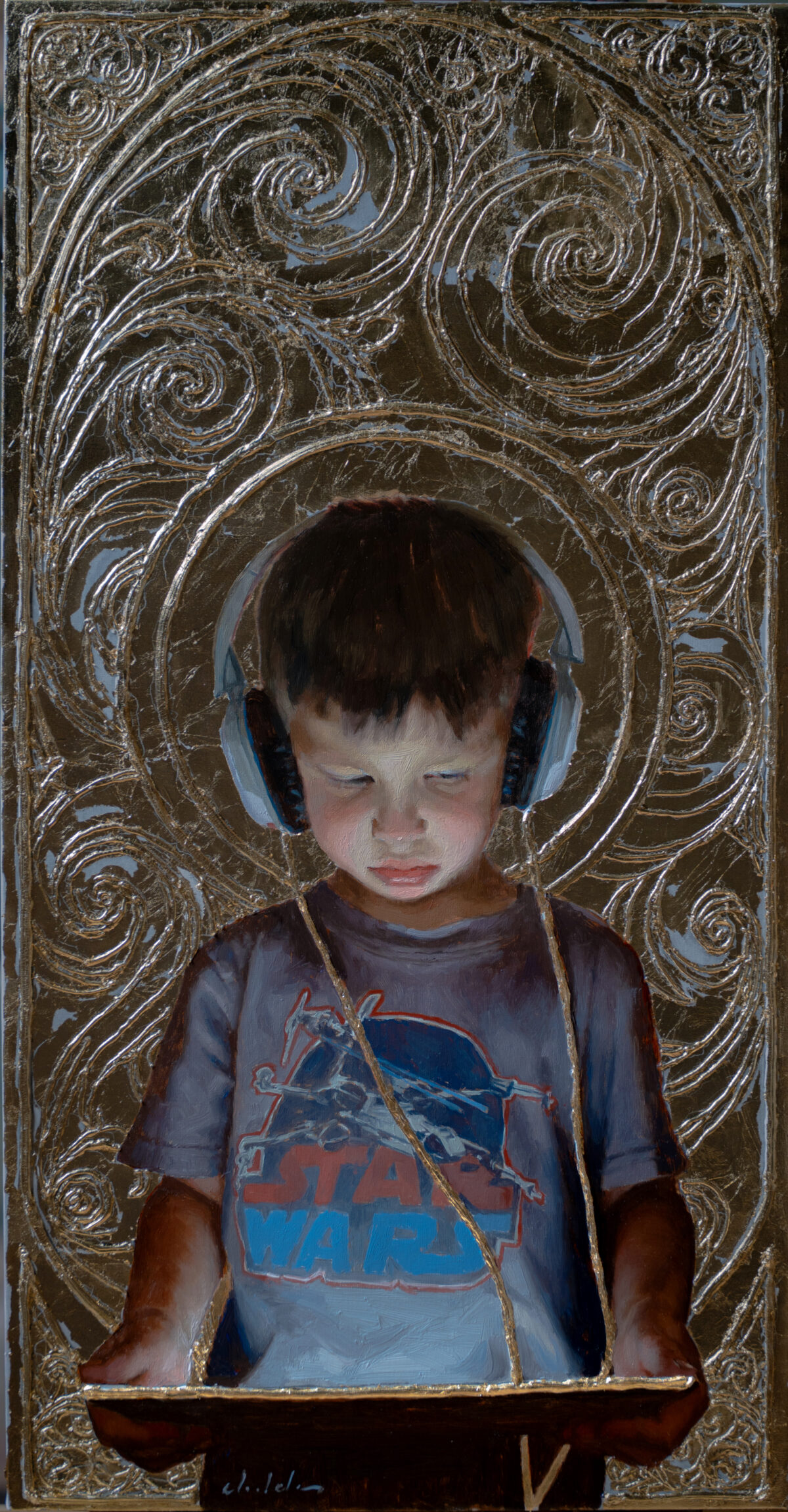
Who else, other than Casey Childs, could take a parent’s nightmare of children on screens and turn it into a hallowed moment?! Of the painting, he wrote:
“The title Young Padawan, inspired by Star Wards, frames this moment as part of a larger idea of learning and becoming. Like a student training in the ways of the Force, he is focused, curious, and completed immersed. The gold patterns surrounding him echo a sense of reverence elevating this everyday experience into something timeless.” —Casey Childs
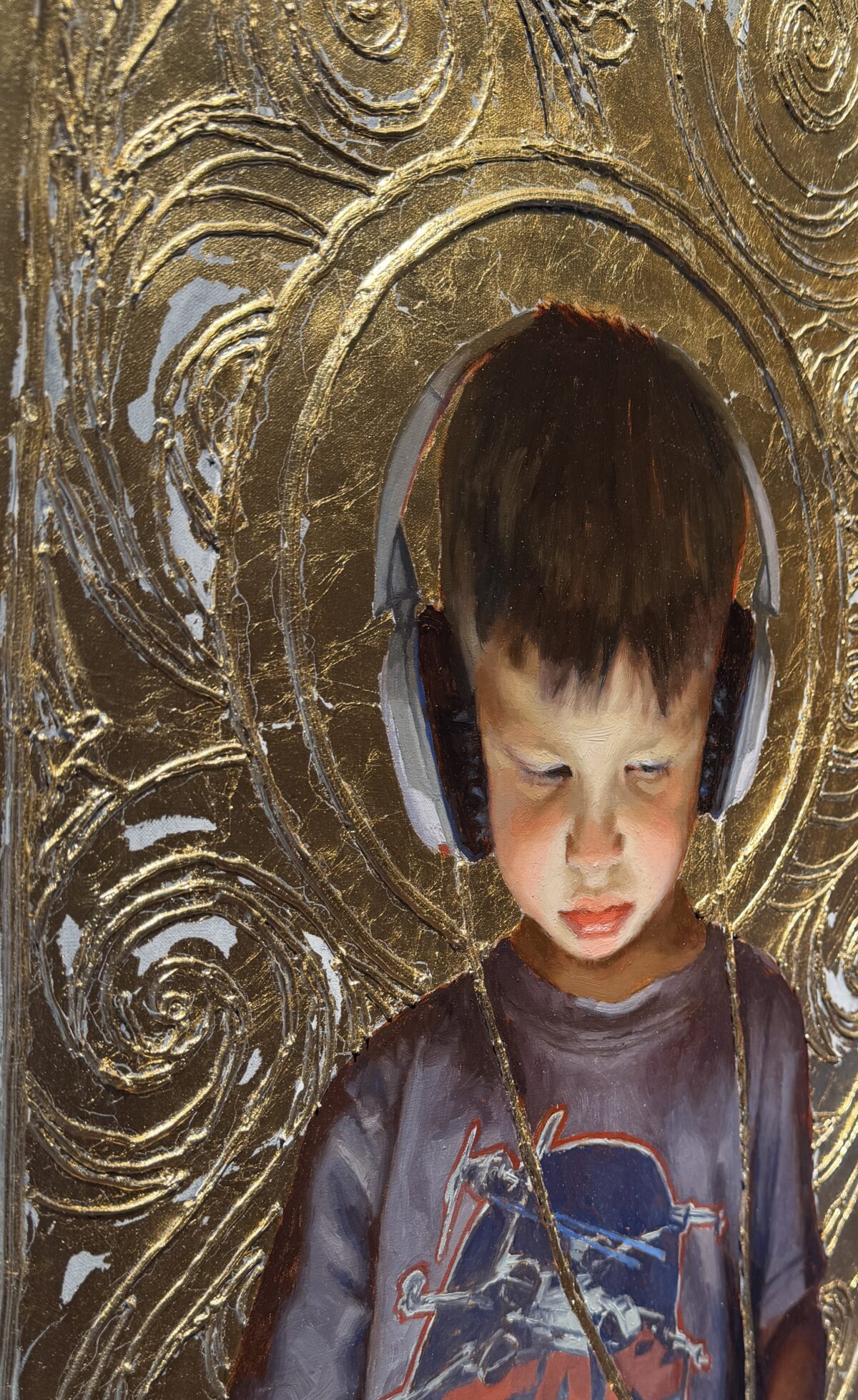
Part of what makes this work special, is a the raised surface of the work that reflects the light in unpredictable ways. Personally, I would love to see this work hung like an icon and lit by flickering candlelight.
It is this kind of inventiveness, meaningful insight, and sensitive observation, which go beyond just painting what is in front of the artist, that has made Casey Childs one of the world’s most admired portrait painters.

A Critical Obsession: How and why those who dismiss Victorian art should take another look
Yesterday, Waldemar Januszcak, art critic for The Sunday Times, wrote a scathing review of “A Victorian Obsession,” an exhibition of 52 paintings by Frederick Leighton, Lawrence Alma-Tadema, and Albert Moore, among others, on show at the Leighton House Museum. Subtitling his review “Droopy damsels in distress take center stage . . .” Mr. Januszczak belittles and dismisses the works as “nonsense,” “divorced from reality,” and “grotesque.” This is not the first time Mr. Januszcak has written dismissively about nineteenth-century academic art and artists. (He wrote similarly negative reviews of recent exhibitions on John William Waterhouse.) And, this isn’t an angry response to his article, where I feign injury on behalf of a genre of art I happen to like. Rather, I feel that Mr. Januszczak repeated a standard approach to Victorian art — one that constantly sees it only in opposition to Impressionism and Modernism — that needs to be retired, because it misses the point. Whether or not we like them, these works say a great deal about the culture that produced them.

Lawrence Alma-Tadema (1836 – 1912) The Roses of Heliogabalus (1881) Oil on canvas. 52 x 84 1/8 in. Simón Pérez Collection.
The occasion of Januszcak’s article is a loan of 52 works owned by Juan Antonio Pérez Simón, a Spanish Civil War émigre raised in Mexico, to the Leighton House Museum. Mr. Pérez has been collecting the works over the past twenty years; a period accompanied by increased values for the works at auctions, scholarly publications, and museum exhibitions. Long held in private collections, many works from Pérez’s collection have not been seen in public, let alone as a group. This collection does not represent the bulk or, arguably, the best of these artists’ oeuvres. Many more can be found at the Victoria & Albert Museum, Tate Britain, and the Bristol Museum of Art.
Reading Januszcak’s review, my first instinct was knee-jerkingly defensive. He talks about the absurdity of the subject matter. He draws a comparison between the brief, meteoric success of Leighton and Alma-Tadema and the seemingly unsustainable trends in contemporary art.
If I were a nouveau riche Russian with a Kensington house full of stuff brought at Frieze, I would instruct my chauffeur to take me immediately to Christie’s, where I would start selling as if there were no tomorrow.
(One almost wonders if Mr. Januszcak just finished watching Bertold Bretcht’s “Seven Deadly Sins of the Petite Bourgeoisie,” and it spilled over to the review.)
Apologists often defend Leighton and Alma-Tadema on technical grounds: “Can’t you see these artists were educated, thoughtful . . . a true craftsman!?” But, that isn’t a winning argument. After all, Waldemar Januszczak understands quality. He has done several, thoughtful series on Old Masters. But, like many critics, he has an inherent disdain for the artistic period between the late-eighteenth-century and avant-garde movements of the last half of the nineteenth century. He writes:
. . . Leighton was just a year older than Manet. But while Manet was ushering in the impressionist revolution, in 1871 Leighton was imagining four Greek nymphs on a beach gathering pebbles in their floatiest robes.”
He makes Leighton sound convincingly backward. But, there is another point of view.
Having spent the past decade researching mid-nineteenth-century works of art, artists, and arts education, I am clearly biased. (I have also felt isolated and frustrated by my art-historical colleagues who would gladly write another book on Picasso’s treatment of cuticles.) But, I also feel that summarily ridiculing these works from our present point of view (e.g. comparing Leighton to Manet) misses an opportunity to discuss context in which the works were made. You don’t have to like these works. However, you should realize they are magnificent commentaries — often unintentional — on the aspirations of of the British Empire at its height. The art, with all its classical imagery and idealistic affectations, is a manifestation of the ideals of those industrialists in Bristol, Liverpool, and London who saw their generation as the latest claimant to the glories of the Roman Empire.
.png)
Lawrence Alma-Tadema (1836 – 1912) The Roses of Heliogabalus, detail (1881) Oil on canvas. 52 x 84 1/8 in. Simón Pérez Collection.
Januszczak rightly points out the ridiculousness of Alma-Tadema’s work The Roses of Heliogabalus (1888), which imagines the moment the obscure Roman ruler showered and suffocated a crowd with flower petals. Alma-Tadema, Leighton and Moore are often referred to as Olympian painters, for conjuring these kinds of scenes, where attractive British women and men are dressed in vaguely classical costumes, and placed in meticulously-created and improbably grandiose settings. They are meant to be unrealistic. They are physical manifestations of the aspirations held by a generation of Belle-Époque Brits. It’s also one held by many — wealthy or not — today. Weren’t many of these nouveau riche and landed gentry funded by siphoning off colonial resources? The ridiculousness of the Alma-Tadema’s work does not come from the quality or subject of the painting. It is from the lack of embarrassment of riches by those audiences that related to it. (Is the fat old man in the background a Victorian banker? Is that the 99% drowning in mortgage debt?) I don’t know if Alma-Tadema intended it as social commentary. Whether or not he appealed to the elite by illustrating their fantasies or subtly criticized them, it is still a commentary on the times.
For me, Olympian works of art are less comparable to those showing at the Frieze Art Fair than to Apple products. Januszczak rightly points out that original oil paintings were purchased by contemporary industrialists for enormous sums. But, he fails to say that artists like Leighton made most of their money in the reproductions of their works — prints in popular journals that were torn out, framed, and hung in many households. This blows a hole in the theory that these artists were painting solely for the monied, elitist few. Like having the latest iPhone, a Leighton print hanging on your wall probably did little to actually increase quality of life or help humanity. But, it was what marketers today would call an “aspirational lifestyle purchase.” These works are a remarkable insight to the British Empire and its people — at least those in the UK. Bringing up Manet and the avant garde brings us back to a conversation that has been played out ( I can see Roger Fry’s angry ghost saying: “These artists were out of touch with Modernity!”) Manet had nothing to do with it. Januszczak wants to fold this work into a standard narrative from the playbook of art historians and critics without really thinking about what made these works truly popular.
I also agree with Januszczak that the great interest some people have in these paintings is puzzling. Akin to Januszczak’s quick dismissal, they love these paintings without considering them. The fact that they are becoming popular again — even inspiring custom luxury room scents (More here) as Januszczak points out — is another opportunity to examine what these Olympian painters distilled in their own era, in the desires of a Spanish billionaire, and the many people who see this art today and love it.

Caravaggio and His Legacy in Los Angeles . . . errr what you doing here?
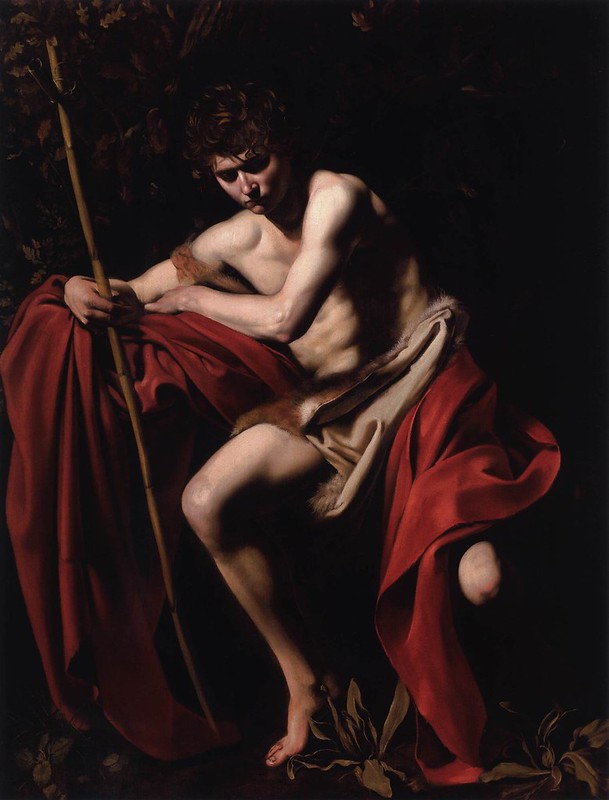
Michelangelo Merisi da Caravaggio (1573 – 1610) St John the Baptist (c. 1604). Oil on canvas. 172 × 104 cm. Nelson-Atkins Museum, Kansas City, Missouri
Does Baroque art burn more calories than other genres? What did that couple in leather pants say about Mary Magdalene looking hot? Was Luca Giordan0 the first street artist? Is linseed oil more environmentally friendly than egg tempura?
These are questions that naturally occur when seeing a Caravaggist exhibition in LA. I’m kidding . . . sort of.
In the past two days, I have visited the Los Angeles Museum of Art twice to see Bodies and Shadows: Caravaggio and His Legacy ( 11 Nov 2012 – 10 Feb 2013). It is a remarkable exhibition, for eight works by Michelangelo Caravaggio on view and even more for the large body of Baroque works on load from over a dozen international institutions. (Whether or not you are able to attend, the exhibition catalogue has good illustrations–at a reasonable price–of the remarkable gathering of works at the show.)
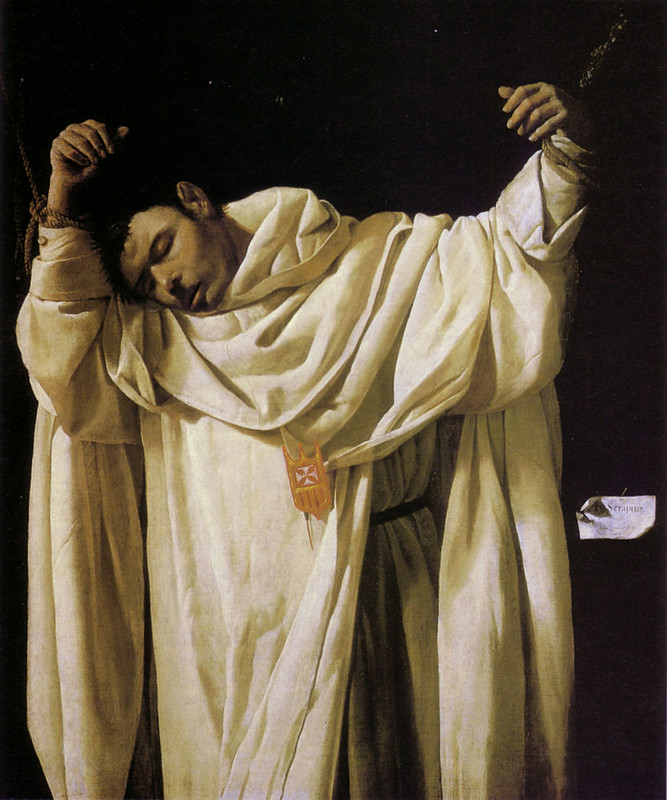
Francisco Zurbarán. (Francisco de Zurbarán (1594-1664) Saint Serapion (1628) Oil on canvas.
I’ve heard a lot of bellyaching about there “only” being eight Caravaggio’s. Hogwash. There are at least two dozen paintings that, alone, would be worth the price of admission.

Martín Rico y Ortega: My Article in Fine Art Connoisseur

La Torre de las Damas en la Alhambra de Granada, Martín Rico y Ortega, 1871, Oil on canvas.
The January/February edition of Fine Art Connoisseur magazine carries an article I wrote about seeing the Prado’s exhibition, El Paisajista: Martín Rico y Ortega (1833-1908).
Assessing a “new” Leonardo da Vinci: Don’t talk to art historians about art
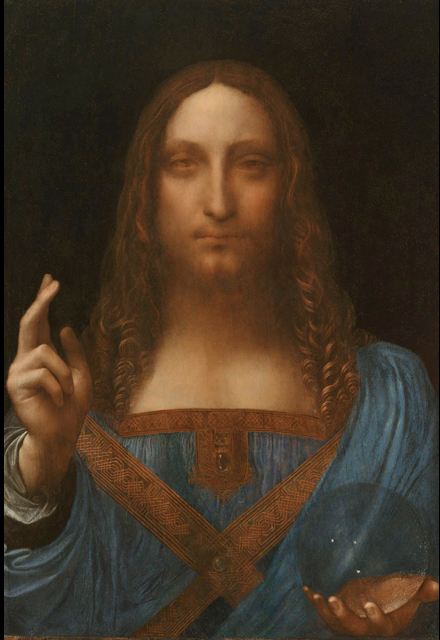
Leonardo da Vinci (1452-1519) Salvator Mundi (c. 1500) Oil on walnut panel. Private collection.
Next month, the National Gallery of London will display a “previously-unknown work by Leonardo da Vinci.” Called Salvator Mundi (i.e. “Savior of the World”), the painting has been compared to surviving, fragmented preparatory drawings and undisputed paintings by da Vinci. As a result, many scholars believe it should be counted among a handful of paintings by the artist. Others doubt. The portrait of Christ will be on display in the exhibition Leonardo da Vinci: Painter at the Court of Milan, opening on November 9 in London, for everyone to compare and opine.
Anticipating certain and divisive scrutiny, Nicholas Penny, the Director of the National Gallery, says he is “pretty sure” it is by da Vinci. He was interviewed by The Sunday Times(London) for a feature in the paper’s magazine titled “Leonardo? Convince Me.”:
“It is a very weird picture.” . . . It shares something, he says, with Leonardo’s portraits The Lady with the Ermine and the Mona Lisa. “They respond, but hold something back. You can’t think about them except in relationship to the viewer. They imply a narrative of which you are a part. That was not true of portraiture before Leonardo. The Salvator Mundi radiates intense presence. But because it’s Leonardo you do wonder if you’re going mad–and you certainly want people whose opinions you respect to look at it.” He pauses. “People can judge for themselves.” (Sunday Times Magazine. 9 OCT 2011.)
Before becoming Director, Mr. Penny was the Clore Curator of Renaissance Art at the National Gallery for ten years. He is a serious scholar; an expert. But, his advice here is nonsense. We may never be able to decisively attribute the painting to da Vinci–it has been over 500 years. But, we can certainly do better than stand in front of it to experience “radiated presence”–whatever that means–or take comfort in an “implied narrative.” It is the kind of non-methodical, relativistic drivel that has made art history and art historians completely irrelevant to public debate in our evidence-based era.
I don’t think Mr. Penny’s advice in this interview is the basis for his opinions; but, he has been trained by a hundred years of art historical practice to talk to the public about art in an imprecise and unhelpful way. The Salvator Mundi painting has been through a host of scientific tests, including carbon dating and comparative chemical testing of pigments used in undisputed da Vinci paintings; and, a series of comparative stylistic studies, such as analysis of stroke and process. These are not the kind of tools available to average museum-goers who Mr. Penny invites to “judge for themselves.” If he were a lawyer, we would expect him to say “Here is the compelling evidence for and against . . . therefore I am pretty sure it is attributable to da Vinci.” not: “I’m pretty sure . . . It’s weird . . . ask someone else.” It is a sign of our times that a trained scholar and Director of one of the world’s great museums would tell people to look at and interpret a Renaissance painting as though it were a 1960s drip painting. It is evidence of the public death of a way of talking about art called the “Morellian Method.”
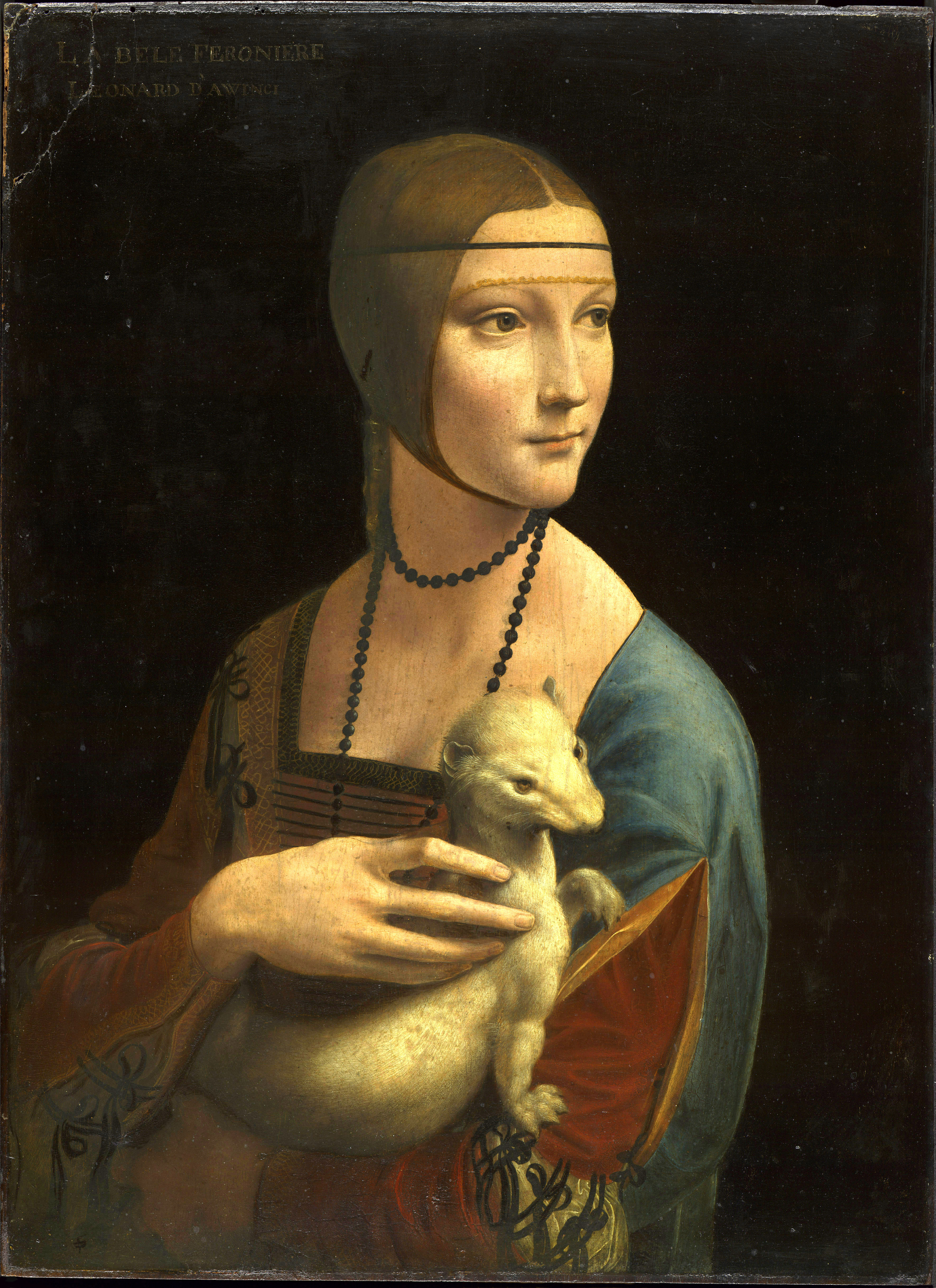
Leonardo da Vinci (1452-1519) Lady with an Ermine (1485) Oil on wood panel. 54 by 39 cm. Czartoryski Museum, Kraków.
Giovanni Morelli (1816-1891) was a trained doctor who had a love of art. During his lifetime, royal and national museums sprung up throughout Europe. Many Old-Master works were placed on public display for the first time, leading to an international public dialogue on art not seen before or since. Competing for attention, these collections–sometimes of dubious origins– were often overzealous and sloppy in attributing works of art to marquee names. Paintings labelled “da Vinci” have since been downgraded to “School of da Vinci” or “Unknown Florentine Artist.” At the time, art historians, critics and collectors were anxious to divide up painters into similar Schools (e.g. Spanish, French, Neopolitan) by observations of subject, palette and, even, size. Morelli had a different approach. He suggested that the same rigorous scientific methods used in medicine (e.g. dissection and observation) be applied to the observation of paintings. In particular, Morelli believed that an artist was best known by the minute and inconsequential parts of a painting: leaves on trees, fingernails, dirt. Artists didn’t reveal themselves in the big things; but, in the mundane areas of their art that were not subject to constant reinvention. He wrote detailed treatises on the varied hand gestures of particular painters, contrasting them with others. Over time, he was considered a kind of Sherlock Holmes of painting.Though some of his attributions were incorrect, Morelli’s object-based method pre-dated many scientific tools that his nineteenth-century philosophy would have embraced.

School of Leonardo da Vinci. Bacchus (c. 1510) Oil on walnut panel transferred to canvas. 177 by 115 cm. Musée du Louvre, Paris.
By the early twentieth century, paintings were interpreted differently. Art was considered mostly through philosophical arguments alone, not craftsmanship combined with philosophy. Morelli was not relevant to Dadaists or Pop Artists. But, it was my belief that thos, like Mr. Penny, who continued to study art in the Classical Tradition, would retain the rigor and language of a scientific method in order to understand, preserve and teach the public about these works. I think Mr. Penny has a deep understanding–many years beyond technical possibilities of Morelli’s era–but his comments appear to indicate his lack of belief public capacity or interest to see paintings in a rigorous way. Maybe that is just my implied narrative.
Van Gogh in the Vatican
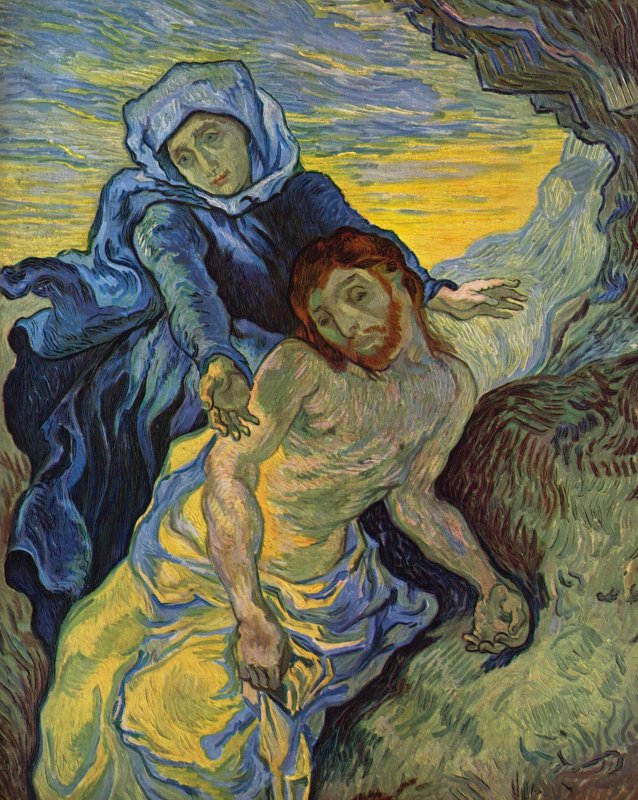
Vincent Van Gogh (Dutch, 1853 – 1890) Pietà (c. 1880) Oil on canvas. 73 x 60 cm. Vatican Museums, Vatican City.
We do not usually associate the two; but, there it is: a Van Gogh hanging somewhere between one of the world’s largest collections of antiquities and the Sistine Chapel.
More than four million people visited the Vatican Museums last year. I was was one of them. For those who have not made their own pilgrimage, it is difficult to describe the vast, Byzantine compound that holds the Catholic Church’s collections. With objects as diverse as Egyptian artefacts and Sevres porcelains, the “museum” is divided into several exhibitions, conjoined with palaces that make up the Pope’s apartments. Together, they are nearly impossible to see it all in a single day or, even, week. And, if you are like me, mentally exhaustion sets in after an hour. So, it is understandable that most tourists make their way directly to the brightest stars in the collection (e.g. Raphael’s frescoes, Laocoön), without seeing what in other museums would be show stoppers.
The Vatican has a sizable collection of modern and contemporary religious art. These works range from mid-nineteenth-century artists to today and are hung in a series of dimly-lit, basement rooms leading to the Pope’s apartments. Visitors are given the choice of a short cut directly to the Sistine Chapel or a fifteen-minute walk through the rooms where the Modern Collection hangs, sometimes unlabeled. Most choose the direct route. Even those who take the long way end up rushing past works by Auguste Rodin, Pablo Picasso, Salvador Dalí, Giacomo Balla, Otto Dix and many, many others.
It was there I saw Pietà by Vincent Van Gogh. I cannot stop thinking about it. This post is an attempt to figure out why.
I am not nor have I ever been obsessed with Van Gogh. Of course, like many, I feel admiration for his singular way of seeing the world. I feel a shock every time I see one of his works in person. His sculptural use of oil paint and familiar colors combined with acrobatic compositions, makes common places, people and things members of alternate realities. His debilitating solitude, tortured genius and early death make him a rock star of art. (Back in the 90s, two posters, one of Kurt Cobain and the other of Van Gogh, hung above my roomate’s desk.)
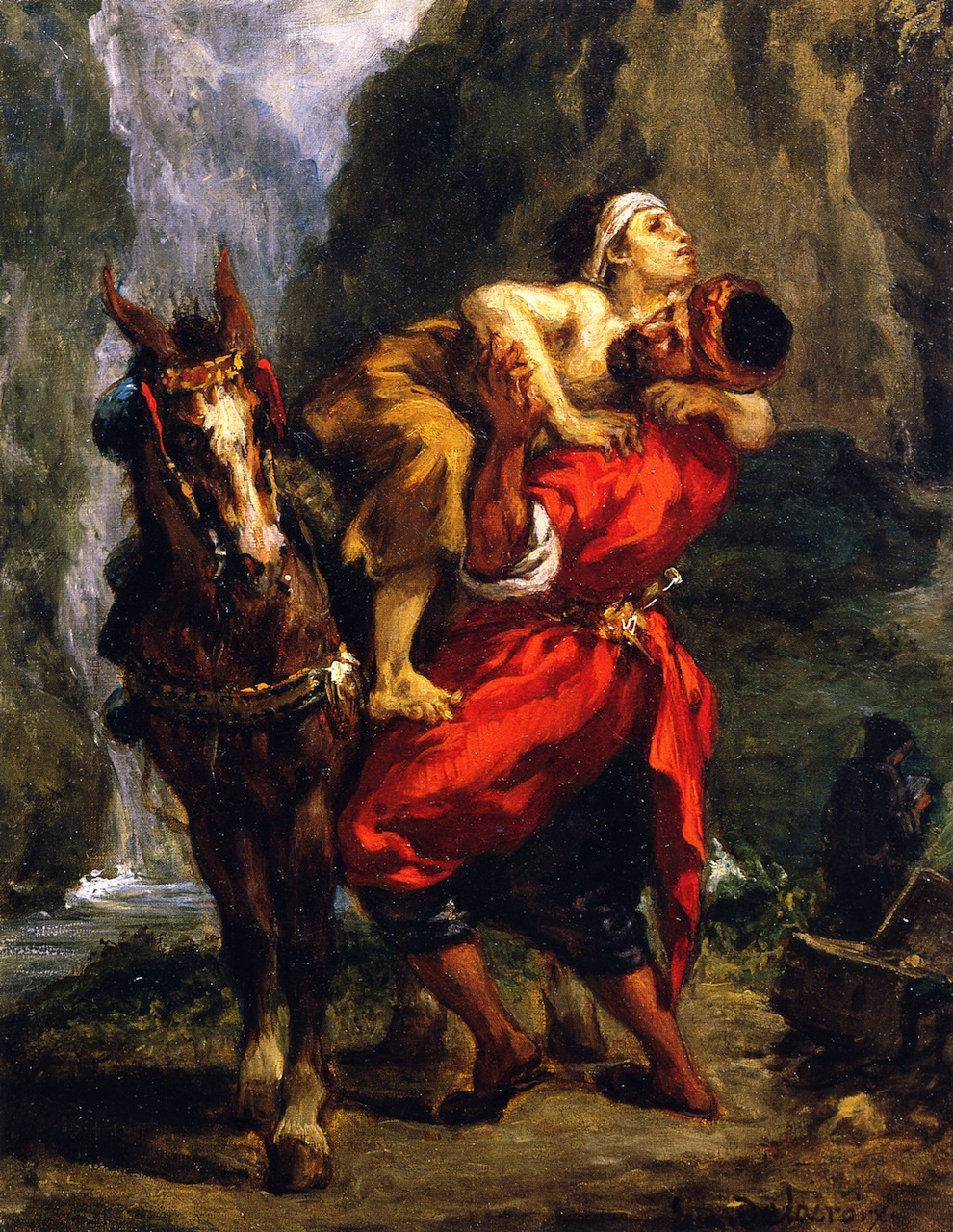
Eugène Delacroix (French, 1798-1863) The Good Samaritan (c. 1848) Oil on canvas. Private Collection.
Some scholars believe that Van Gogh’s Pietà, showing the dead, tortured body of Christ after the Crucifixion, is actually a self-portrait. (Note the red beard.) While in the Hospital of Saint-Rémy, housed in an old monastery,Van Gogh wrote his brother Theo: “I am not indifferent, and pious thoughts often console me in my suffering.” In any case, religious works by Van Gogh are rare. The Pietà is one of two biblical paintings he copied from Delacroix.
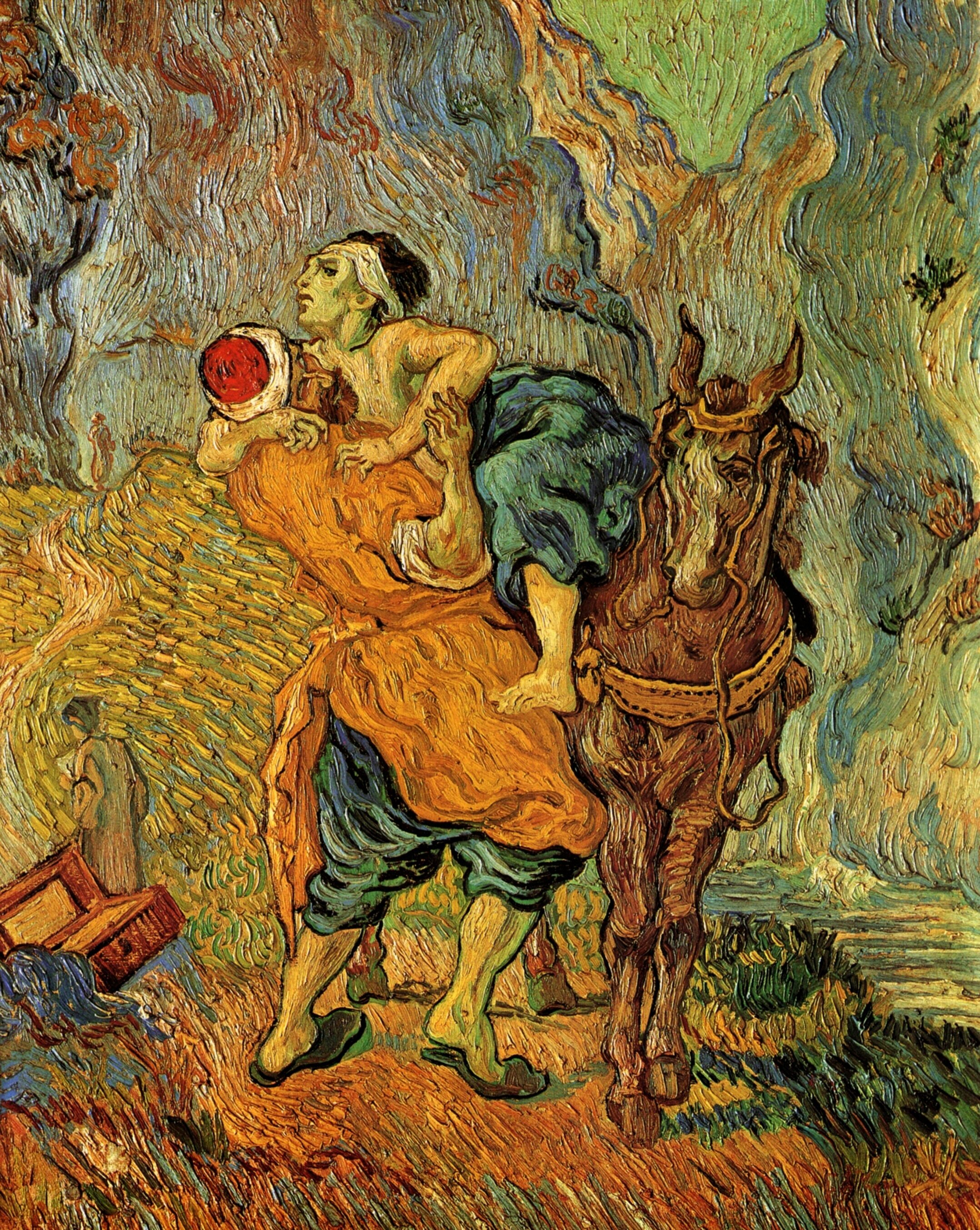
Vincent Van Gogh (1853-1890) The Good Samaritan, after Delacroix. Oil on canvas.
Van Gogh hugely admired Delacroix, mentioning him more than 95 times in personal letters. In particular, he admired Delacroix’s use of bold and vibrant color.
Writing to his brother about Delacroix’s Pietà, which he had in the form of a lithograph, Van Gogh wrote:
The Delacroix lithograph La Pietà, as well as several others, fell into my oils and paints and was damaged. This upset me terribly, and I am now busy making a painting of it, as you will see.
We do not know if he was referring the painting in the Vatican or the other version, hanging in Van Gogh Museum, which some believe to be made late. The Vatican Museum of Modern Art did not purchase its painting. Like many other works, Pietà was a gift from a member of the Church, who donated it his diocese in New York sometime mid-century. Of the two versions, the Vatican’s is much smaller. It is also darker, which is, perhaps, more a result of not being as well cleaned. But, the darker hues, combined with the dim lighting, in my opinion, imbue the work with greater pathos.
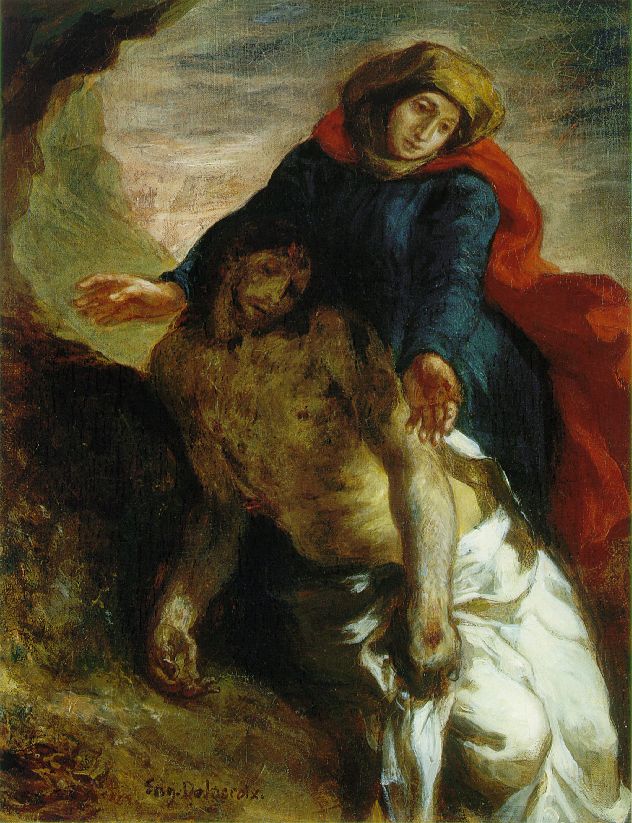
Eugène Delacroix (French, 1798-1863) Pietà (c. 1850) Oil on canvas. Nasjonalgalleriet, Oslo.
We should all be aware by now that most paintings we see in museums were never meant to be hung in a public space, let alone under modern, high-voltage lighting. While I do not know the original context for the work–if there even was a context–the overlooked space on the way to the Sistine Chapel seems a fitting.
Visiting Lisbon’s Museu Nacional de Arte Antiga

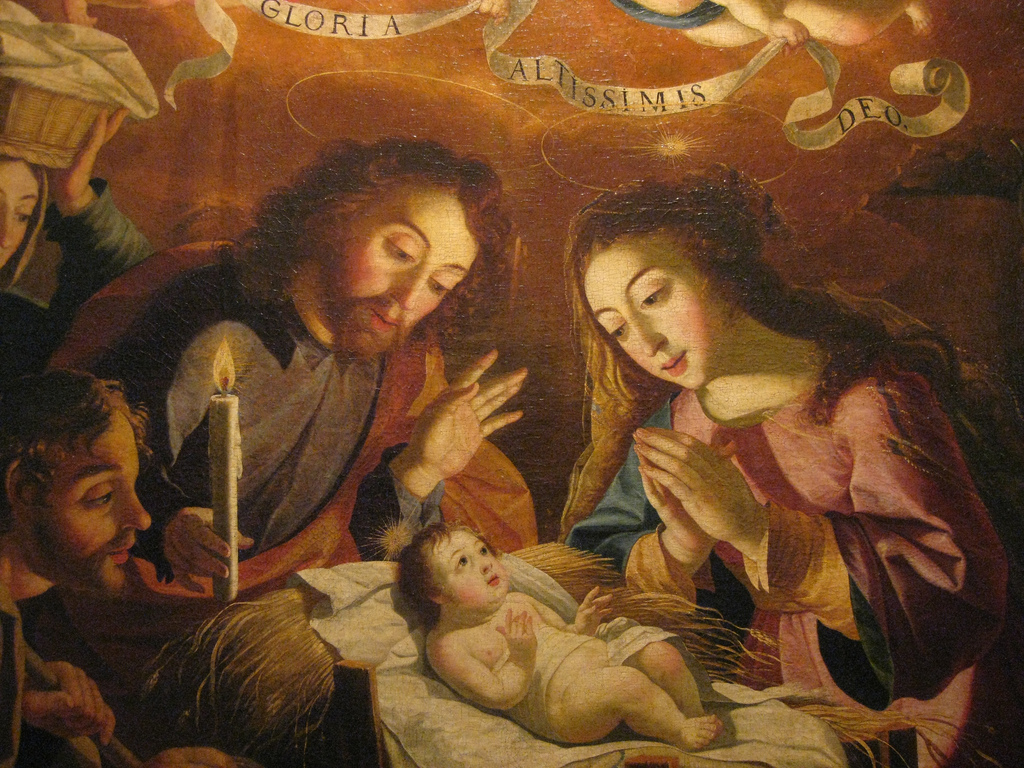
Josefa d’Obidos (Portuguese, 1630-1684) Adoracão dos Pastores OR Adoration of the Shepherds (1669) Oil on canvas. Museum of Ancient Art, Lisbon. (Detail)
With only 36 hours in Lisbon, there was little time to explore Portugal’s capital. I wanted to visit the city’s most well-known art museum. So, when I asked a cab driver to take me to the Museum of Fine Art, I was taken to the Museu Nacional de Arte Antiga. (Roughly translated as the “National Museum of Ancient Art,” the term “ancient” in Portuguese does not have exactly the same meaning in English, which would imply anything from pre-historic to, perhaps, the birth of Christ.)

Unknown Portuguese sculptor. Saint Gabriel (c. 1675) Polychrome statue. Museum of Ancient Art, Lisbon.
The Museum’s collection represents works from the Middle Ages to the mid-nineteenth century. While it is not the only museum of fine art or necessarily the best, it was where I was taken. And, I am forever grateful to the cabbie who took me there.

Hieronymus Bosch (Flemish, 1450-1516) Triptych of the Temptations of St. Anthony Abbot with the Betrayal of Christ and the Way to Calvary (c. 1500) Oil on panel. Museum of Ancient Art, Lisbon.
Not surprisingly, the preponderance of the collection corresponds to the period when Portugal was among the world’s superpowers. It is dominated by masters from the fifteen to seventeenth centuries, when Portugal was made rich discovering and trading with much of the world.

Antonio Pereda y Salgado (Portuguese, 1608-1678) Still life with vegetables and kitchen utensils (1651) Oil on canvas. Museum of Ancient Art, Lisbon. (Detail)
Many of us can name Spanish artists from the same period (e.g. Velázquez, El Greco). But, even though the Portuguese shared the Iberian Peninsula, their artists do not have anywhere near the same esteem or recognition.

Clemente Sanchez (Portuguese, Seventeenth Century) Sao Sebastião or Saint Sebastian (c. 1620) Oil on canvas. Museum of Ancient Art, Lisbon.

Clemente Sanchez (Portuguese, Seventeenth Century) Sao Sebastião or Saint Sebastian (c. 1620) Oil on canvas. Museum of Ancient Art, Lisbon. (Detail)
For example, the artist Clemente Sanchez (Portuguese, Seventeenth Century) demonstrates a remarkable level of training, on par with any artists of the period. Yet, I am unable to find his biography or any work by him online. In Saint Sebastian (c. 1620), Sanchez shows a remarkable arsenal of skills; and, more importantly, represents a different approach that combines both the naturalism of Velázquez and the classical ideal of Poussin, who were both working at the same time. If his work truly represents a unique, Portuguese approach to art, it is worth publishing to a wide audience.

Pieter Brueghel, The Younger (Flemish, a. 1564-1637) Acts of Mercy (c. 1625) Oil on panel. Museum of Ancient Art, Lisbon.
In addition to showcasing regional talent, the Museum features works that cannot be seen any where else by well-known, canonical Flemish, Dutch, Spanish, and Italian artists. The Portuguese were obviously aware of and collecting these artist like any other major European nation. (Even though the Museum has recently undergone a significant renovation, it has not yet put these works online.)
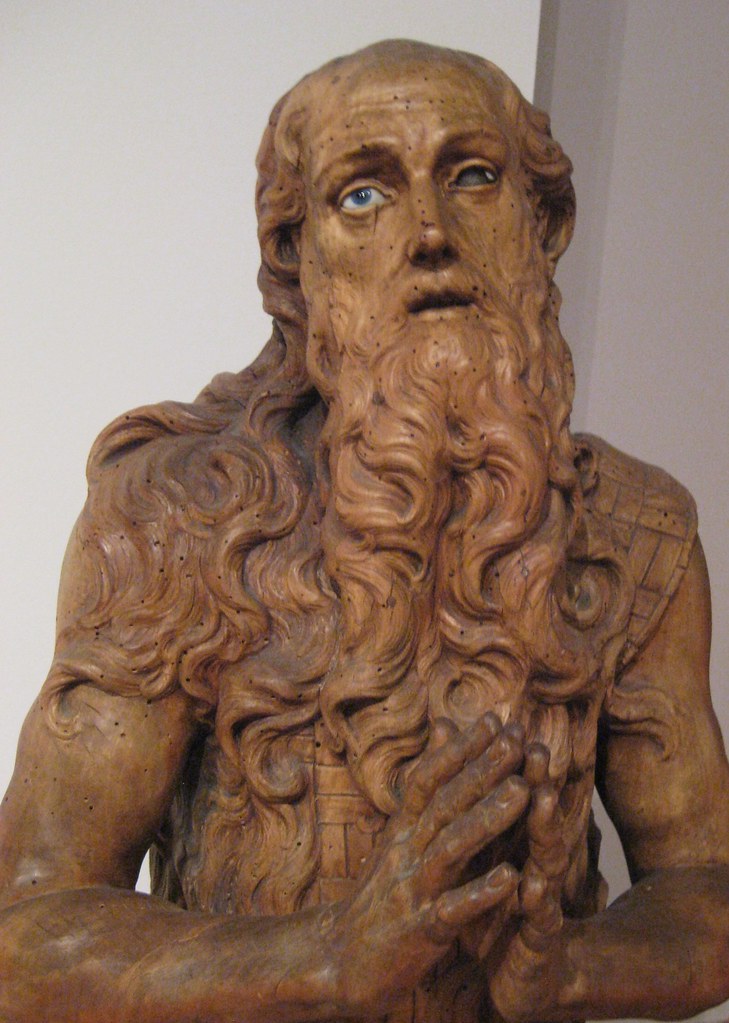
Unknown Portuguese sculptor (Eighteenth Century) Santo Onofre or Saint Onuphrius (Eighteenth century) Wood and glass. Museum of Ancient Art, Lisbon.
On the Wednesday afternoon I visited, there were more guards than visitors. As a result, I had the Museum to myself. Each work of art was mine alone. If you are in Lisbon, it may not be in your tourist guidebook; but, for art lovers, it offers the opportunity to discover remarkable, no-where-else-to-be-seen artworks and level of intimacy with them that is usually reserved for the royalty that commissioned them. (To see all the images I took, visit my Flickr photo set here.)
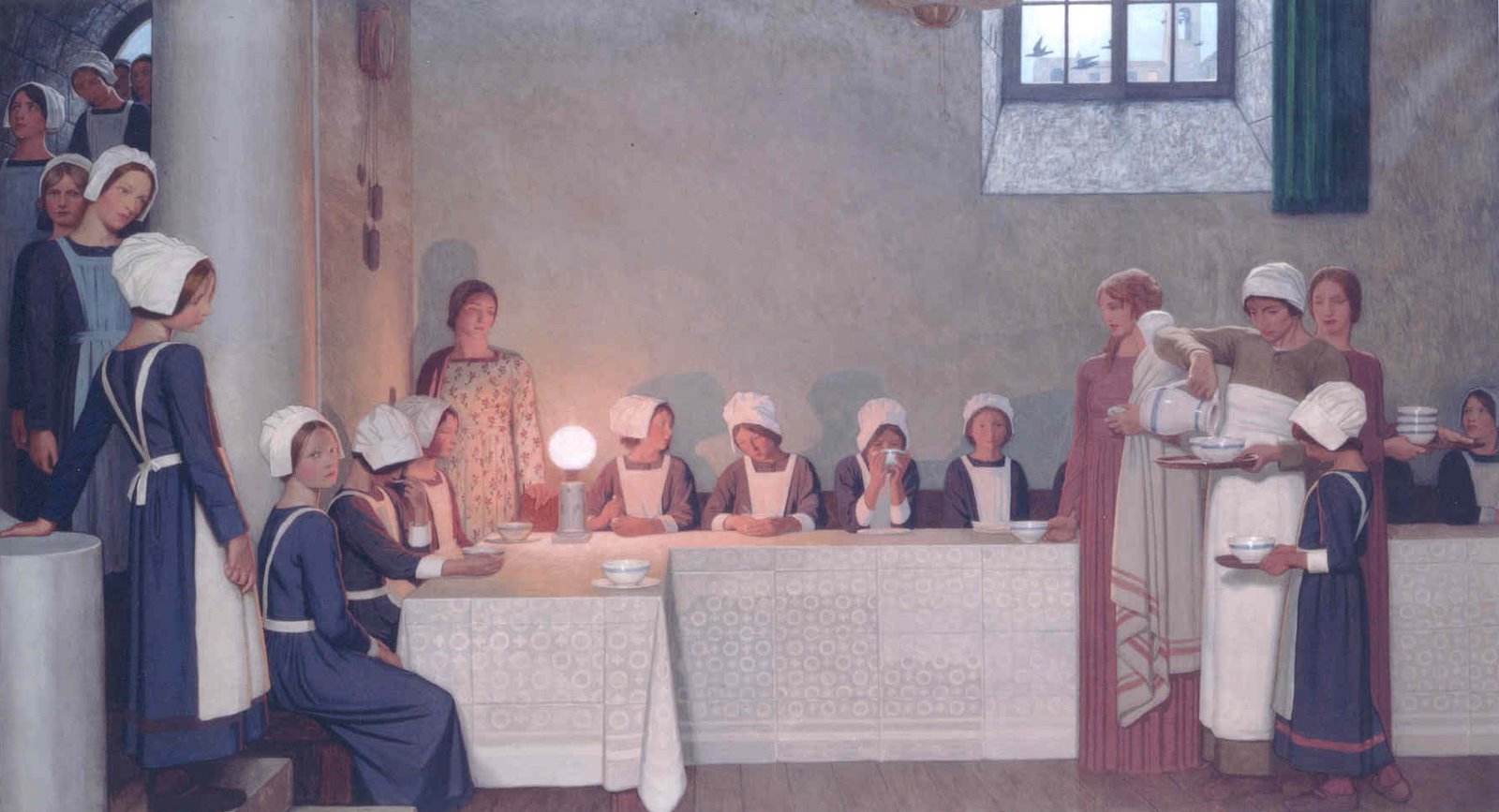
Forgotten Master: Federick Cayley Robinson (British, 1862-1927)
The recent exhibition, Acts of Mercy, at the National Gallery has brought well-deserved attention to Federick Cayley Robinson (British, 1862-1927). Despite his remarkable abilities and relationship with still-celebrated artists, the majority of Robinson’s works are in museum storage or private collections.
Federick Cayley Robinson (British, 1862-1927) Acts of Mercy: Orphans II (c. 1915) Oil on canvas. Wellcome Collection, London.
(Like works reproduced on this blog, these paintings are three dimensional objects. In person the vibrancy of Robinson’s colors and his painterly skills are undeniable and electric.)
Robinson studied at the Academy of St. Johns Wood before being accepted to London’s Royal Academy under Frederic Lord Leighton (British, 1830-1896). He continued to develop his abilities, first at the Academie Julien in France for three years and, then, in Florence.
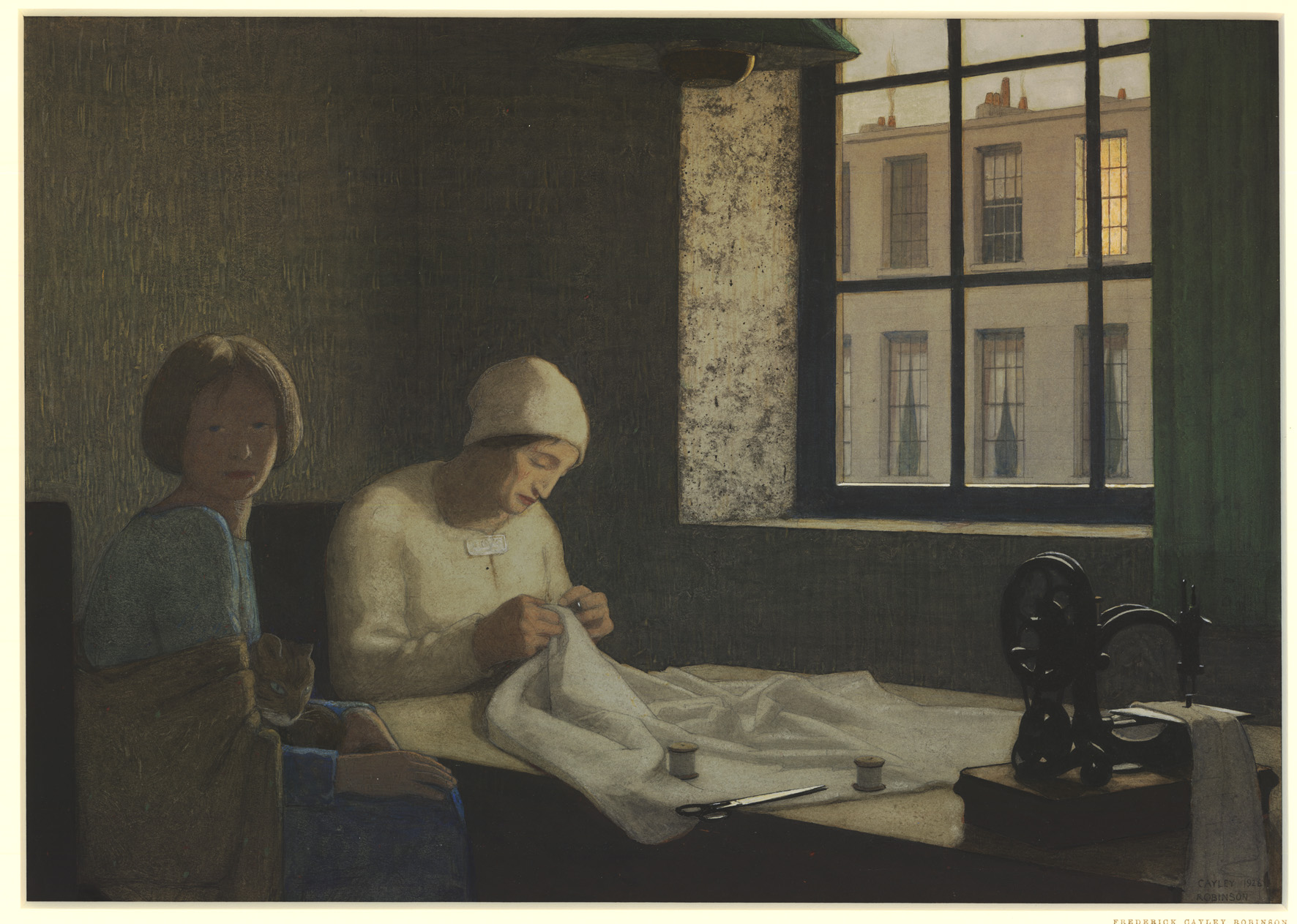
Federick Cayley Robinson (British, 1862-1927) The Old Nurse (1926) Oil on canvas. British Museum, London.
Robinson moved back the UK to take a teaching position at Glasgow University, where he became a friend and collaborator with members of the Glasgow Boys. But, before taking his post, Robinson travelled to Newlyn, England at the peak of Stanhope Forbes’ (British, 1857-1947) career. Like Forbes, Robinson’s work was dominated by fisherman, farmers, and shepherds. But, unlike the Newlyn School, which took inspiration from French Naturalism and Jules Bastien Lepage, in particular, Robinson was heavily influence by the Symbolist Pierre Puvis de Chavannes (French, 1824-1898).
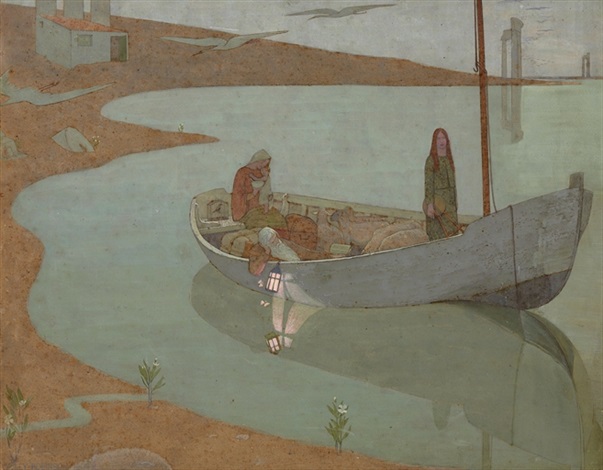
Federick Cayley Robinson (British, 1862-1927) To Pastures New, or Dawn (1904) Watercolor, graphite, and bodycolor on board. 28 by 35 1:2 in.
In To Pastures New, Robinson creates an homage to the French artist by reversing Chanvannes’ composition in The Poor Fisherman.
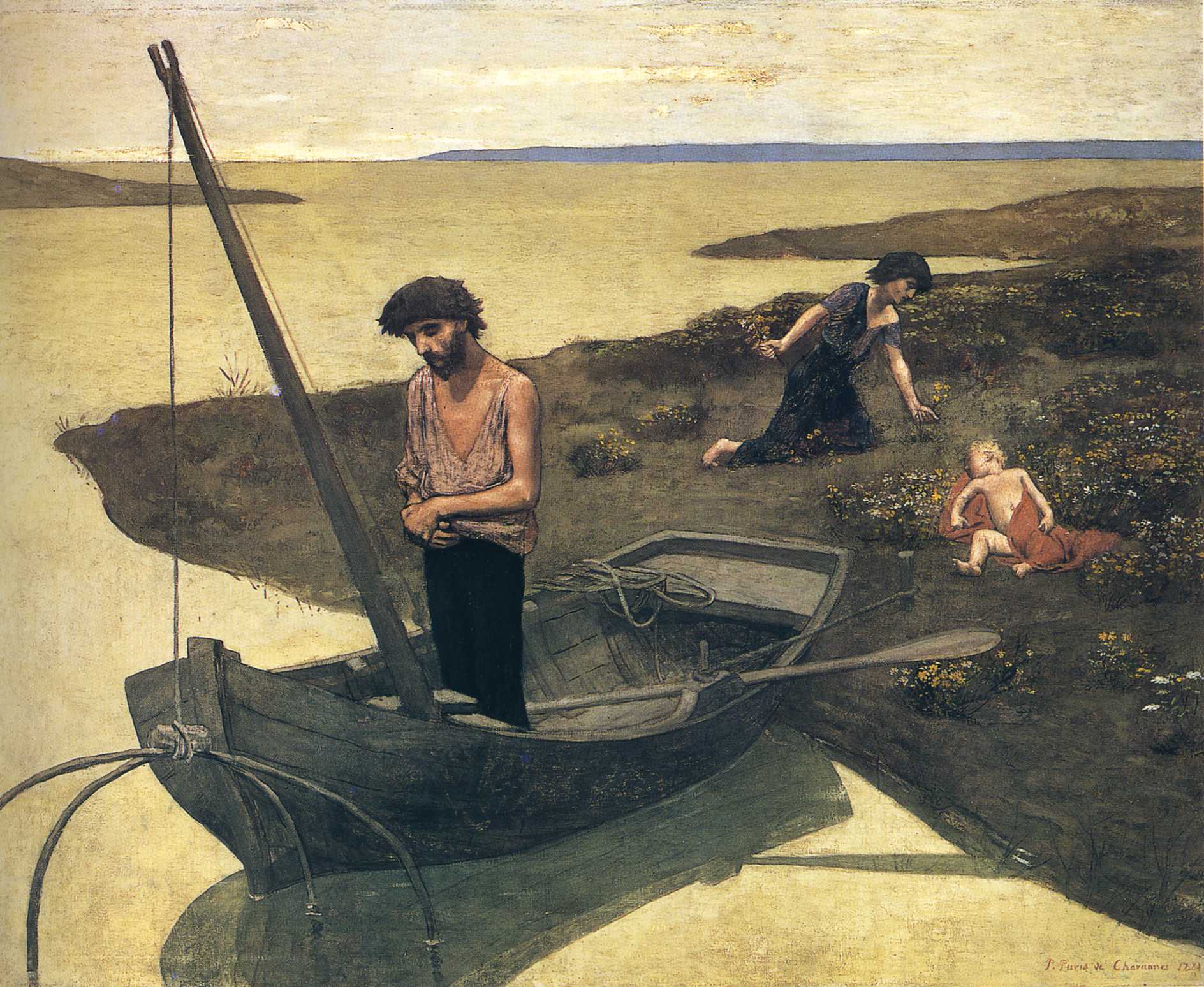
Pierre Puvis de Chavannes (French, 1824-1898) The Poor Fisherman (1881) Oil on canvas 155 by 192.5 cm. Musée d’Orsay, Paris
Robinson’s greatest work was a series of paintings commissioned for the Middlesex Hospital. Spanning more than 15-feet each, the four panels of Acts of Mercy are a tour de force of skill, demonstrating Robinson’s enormous arsenal of skills and classical vocabulary. He combines the sensibilities of a classicist–deriving poses and motifs from greco-roman sculpture and compositions borrowed Giotto’s frescoes–and the subjects from contemporary life. His subjects are orphans and veterans of World War I cared for by the hospital. Aesthetically, it is both contemporary and timeless. A
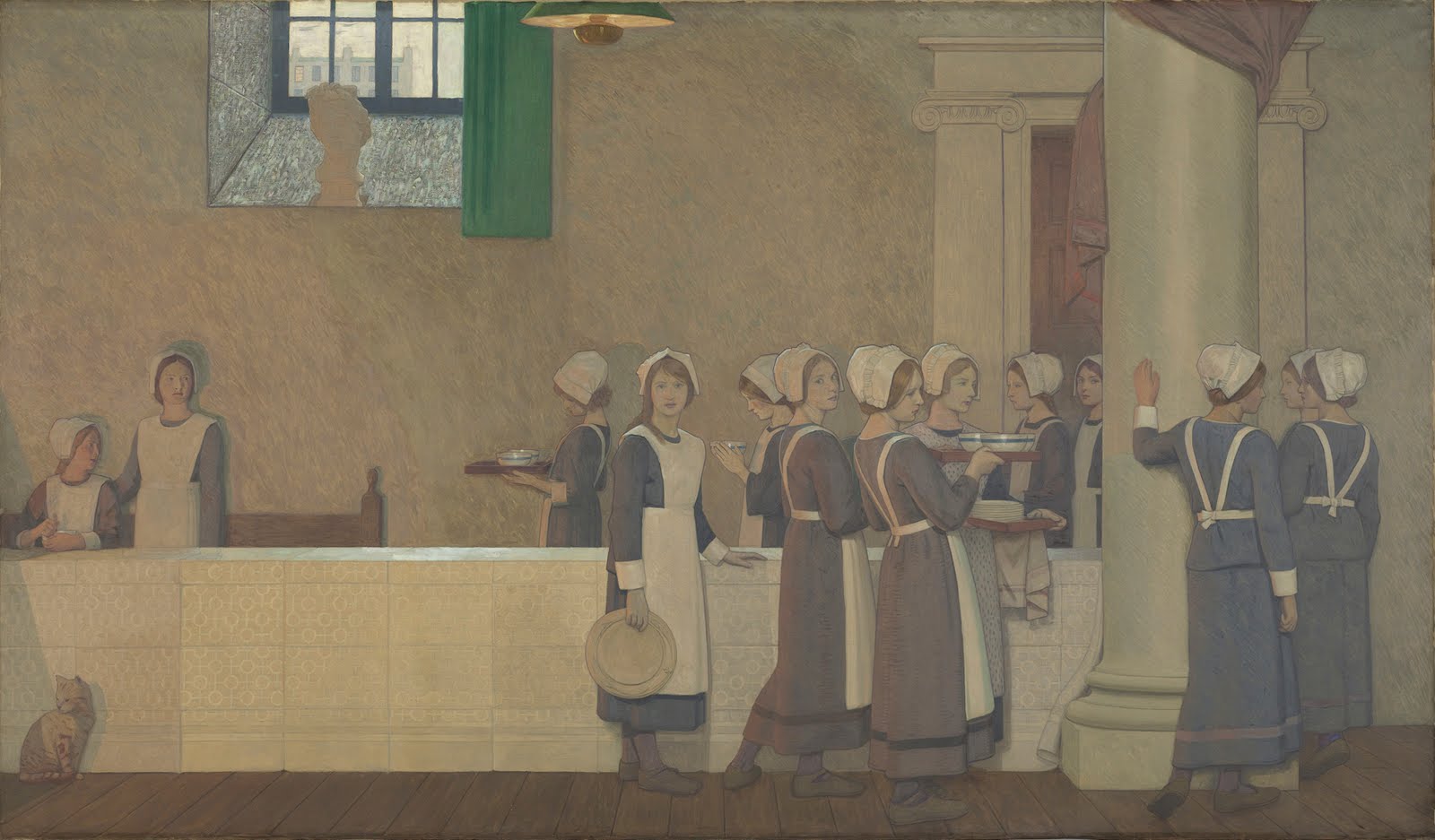
Federick Cayley Robinson (British, 1862-1927) Acts of Mercy, Detail (c. 1915) Oil on canvas. Wellcome Collection, London.
s commentary on charity, Acts of Mercy is, as my friend and mentor Dr. Tom Gretton commented, a masterclass in receiving charity: how it is given and how it is received. Robinson captures a large spectrum of human relationships in this and in all his works I have been able to see. While Middlesex Hospital has been torn down and the show has now ended at the National Gallery, Acts of Mercy has a new home: the Wellcome Collection.
Picasso in London: “Not a Slave to the Canon”
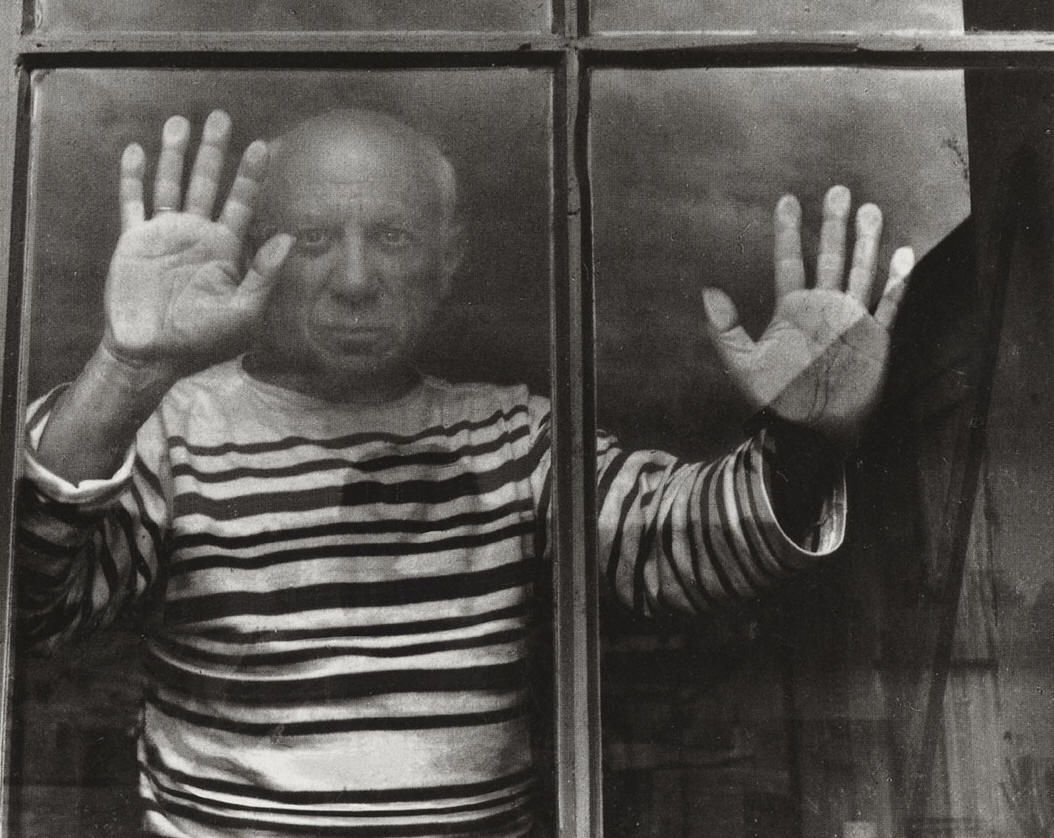
Photograph of Pablo Picasso (c. 1955)
After seeing The Raft of the Medusa by Eugène Delacroix (French, 1798-1863) Théodore Géricault (French, 1791-1824), a friend recorded Picasso saying: “That bastard! He was good.”
The exhibition, Picasso: Challenging the Past, currently on show at the National Gallery in London, is a well-documented testament to the artist’s admiration for artists that he made posthumous collaborators in his work, among them Goya, Velázquez, Poussin, Ingres, and El Greco.
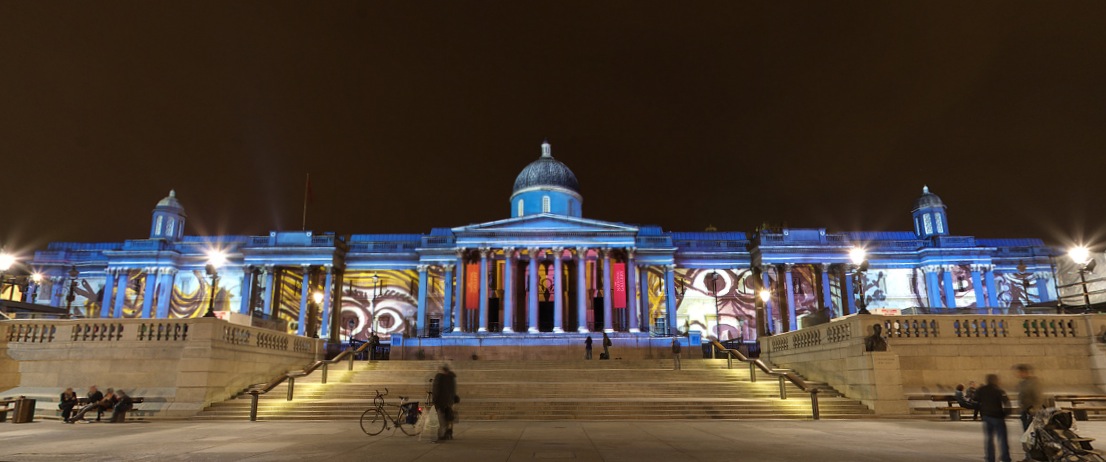
Tom Mills. Picasso: Challenging the Past at the National Gallery. (February 2009) From a 360-degree photograph. Click photograph to go to original on www.360cities.net.
Lest visitors think that Pablo Picasso (Spanish, 1881-1973) had betrayed or diluted his innovative impulses, the introductory paragraph to the exhibition–boldly written on the wall near the entry–states “he certainly was not a slave to the canon.” Thus, a confusing tone was set, turning up throughout the exhibition, that simultaneously attempted to admire Picasso’s admiration for “traditional” artists while, in some cases, denying them admiration.
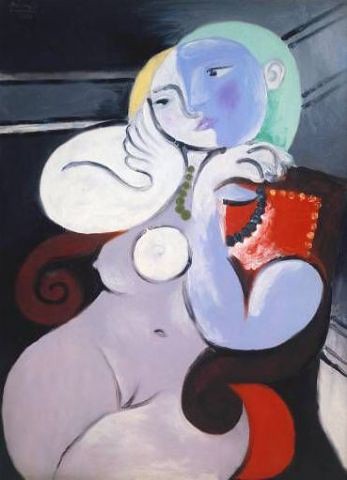
Pablo Picasso (Spanish, 1881-1973) Nude Woman in a Red Armchair (1932) Oil on Canvas. 130 by 97 cm. Tate Museum, UK.
An example was the exhibition’s treatment of Ingres. Making a comparison between the National Gallery’s Portrait of Madame Paul-Sigisbert Moitessier by Jean Auguste Dominique Ingres (French, 1780-1867) to Picasso’s Nude Woman in a Red Armchair, the exhibition claimed that Ingres, like Picasso “idealized eroticism,” and that “the more one looks at Ingres, the less plausible his work seems.” According to the film accompanying the exhibition, Ingres’ arms and fingers appear to have no bones, and figures seem dramatically out of distortion, as if they were anticipating Picasso’s work. It seemed like revisionism. (See my previous post on Ingres’ careful attention to the human figure.) It was as though Ingres could not be appreciated on his own terms, but only on Picasso’s.

Jean August Dominique Ingres (French, 1780-1867) Portrait of Madame Paul-Sigisbert Moitessier (1856) Oil on canvas. 120 by 92.1 cm. National Gallery, London
Seeing Picasso’s works, I don’t necessarily think that he would have shared this perspective. There is no denying the copious amounts of time he spent reworking Diego Velázquez’s (Spanish, 1599-1660) Las Meninas or the Rape of the Sabines by Nicolas Poussin (French, 1594-1665). This is what makes Picasso great: his simultaneous departure from and use of classical themes. As I walked through the exhibition I was remineded of F. Scott Fitzgerald’s comment: “The test of a first-rate intelligence is the ability to hold two opposed ideas in the mind at the same time, and still retain the ability to function.” Despite the startling variety of his output–one piece reflects his classical training, another is nearly completely abstract, a work full of color, and another nearly void of spectrum–Picasso confidently comes across in each painting.
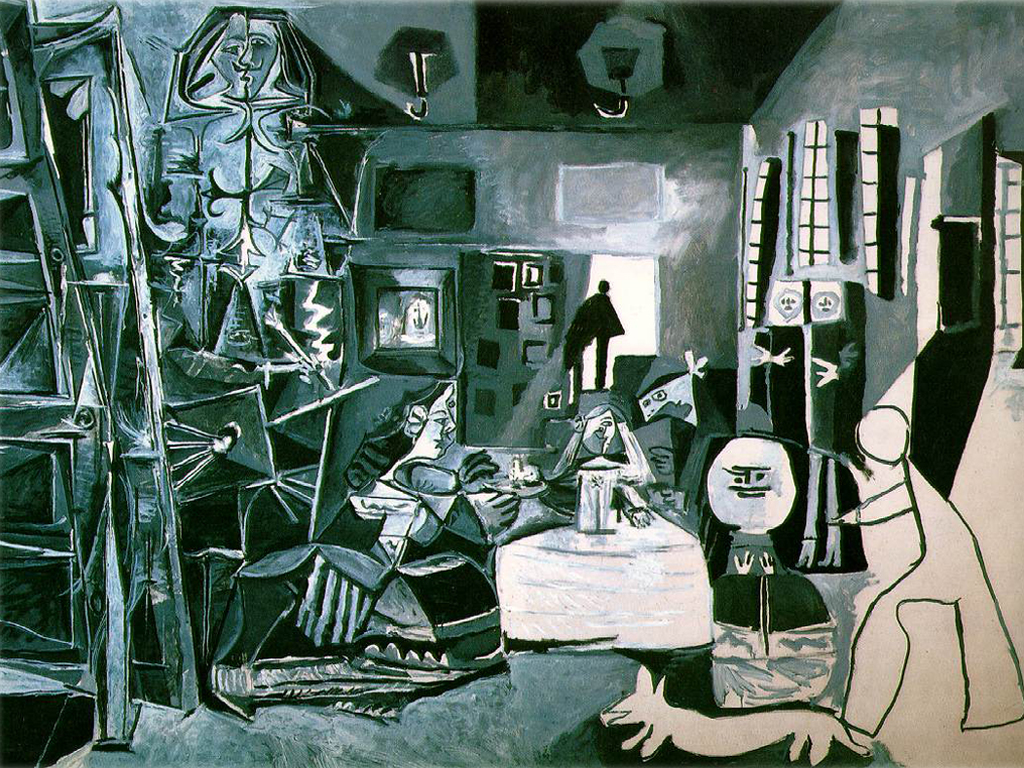
Pablo Picasso (Spanish, 1881-1973) Las Meninas, after Diego Velázquez (1957) Oil on canvas. Picasso Museum, Spain.
The exhibition seemed organized for those who already love and acknowledge Picasso as part of the canon. As such, it was, at first, difficult for me–someone who still struggles to relate to his works–to approach. However, the more I looked directly at the works, the more approachable they became. Despite the exhibition’s sometimes revisionist treatment of “the canon,” it was an ideal primer to his oeuvre. Deciphering Picasso’s translation of Las Meninas by Velázquez, for example, kept me occupied for at least 30 minutes and provided numerous insights into Picasso’s pictoral devices. It was a Rosetta Stone for Picasso.
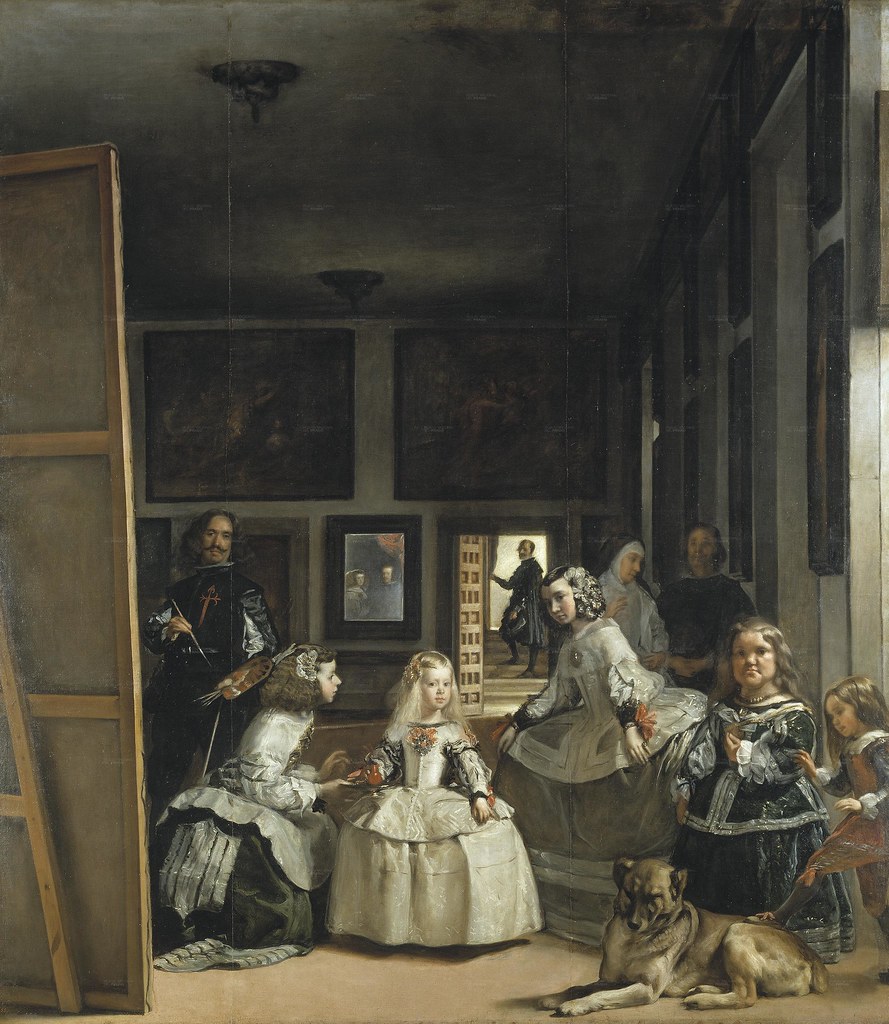
Diego Velázquez (Spanish, 1599-1660) Las Meninas (The Maids of Honor) or the Royal Family (1656-57) Oil on canvas. Museo del Prado, Madrid, Spain
A mentor of mine is fond of saying that “art is very personal.” Personally, Picasso is a shock to my natural inclinations. However, I admire his genius and, with the help of this exhibition, found myself thinking: “That bastard! He was good.”
Bearded Roman in Madrid
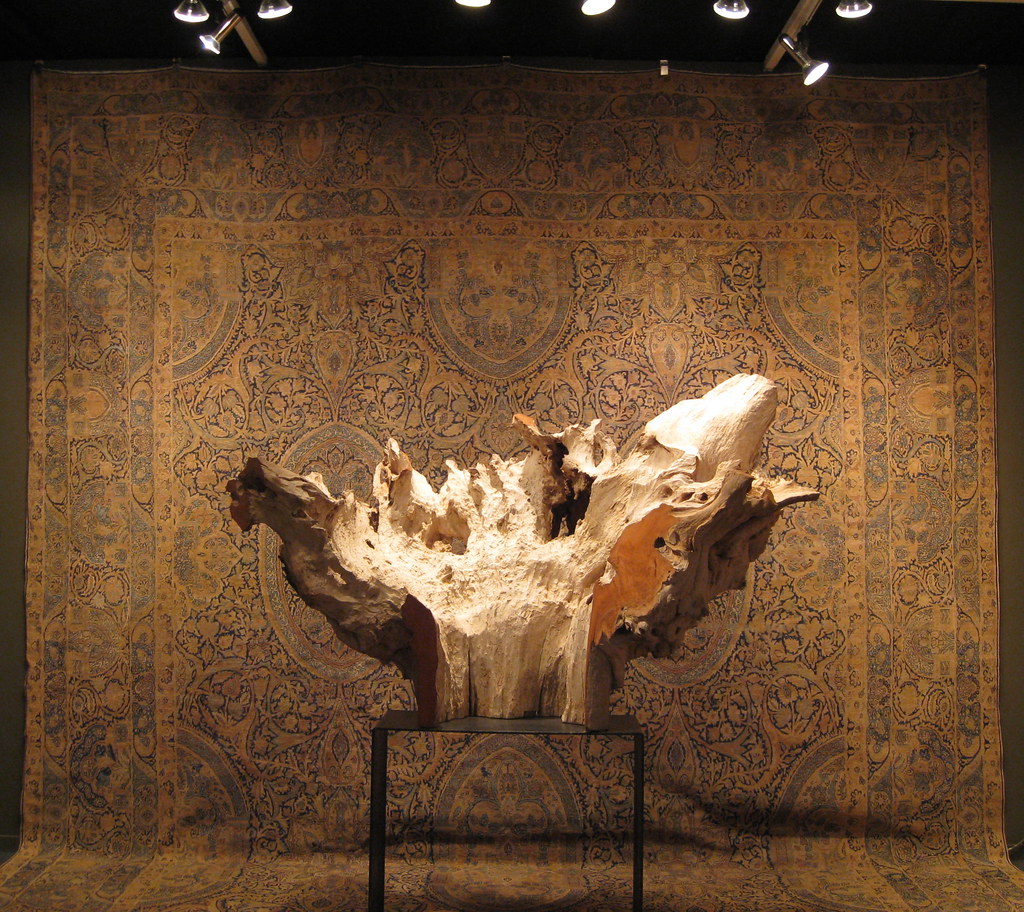
Photo of upturned tree trunk placed with 18th-century Persian rug. Seen at Feriarte Madrid
This week and next, I’m in Madrid, where a number of impressive exhibitions and fairs are taking place, including:
- The 32nd Annual Feriarte: One of Europe’s largest Fine & Decorative Art Fairs.
- Rembrandt, History Painter: An exhibition of painter’s narrative works the Prado Museum.
- Between Gods & Men: A rare look at two major ancient sculpture collections, from Dresden and Madrid, on show at the Prado Museum.
- Sorolla Museum in Madrid: My report on a visit to the home and private studio of the Valencian painter who befriended Zorn and Sargent.
- El Escorial: The country palace of Spain’s Hapsburg Royalty, which contains major works from their collection
All this coming over the next week in a series of posts.