Posts in Category: museums

A Critical Obsession: How and why those who dismiss Victorian art should take another look
Yesterday, Waldemar Januszcak, art critic for The Sunday Times, wrote a scathing review of “A Victorian Obsession,” an exhibition of 52 paintings by Frederick Leighton, Lawrence Alma-Tadema, and Albert Moore, among others, on show at the Leighton House Museum. Subtitling his review “Droopy damsels in distress take center stage . . .” Mr. Januszczak belittles and dismisses the works as “nonsense,” “divorced from reality,” and “grotesque.” This is not the first time Mr. Januszcak has written dismissively about nineteenth-century academic art and artists. (He wrote similarly negative reviews of recent exhibitions on John William Waterhouse.) And, this isn’t an angry response to his article, where I feign injury on behalf of a genre of art I happen to like. Rather, I feel that Mr. Januszczak repeated a standard approach to Victorian art — one that constantly sees it only in opposition to Impressionism and Modernism — that needs to be retired, because it misses the point. Whether or not we like them, these works say a great deal about the culture that produced them.

Lawrence Alma-Tadema (1836 – 1912) The Roses of Heliogabalus (1881) Oil on canvas. 52 x 84 1/8 in. Simón Pérez Collection.
The occasion of Januszcak’s article is a loan of 52 works owned by Juan Antonio Pérez Simón, a Spanish Civil War émigre raised in Mexico, to the Leighton House Museum. Mr. Pérez has been collecting the works over the past twenty years; a period accompanied by increased values for the works at auctions, scholarly publications, and museum exhibitions. Long held in private collections, many works from Pérez’s collection have not been seen in public, let alone as a group. This collection does not represent the bulk or, arguably, the best of these artists’ oeuvres. Many more can be found at the Victoria & Albert Museum, Tate Britain, and the Bristol Museum of Art.
Reading Januszcak’s review, my first instinct was knee-jerkingly defensive. He talks about the absurdity of the subject matter. He draws a comparison between the brief, meteoric success of Leighton and Alma-Tadema and the seemingly unsustainable trends in contemporary art.
If I were a nouveau riche Russian with a Kensington house full of stuff brought at Frieze, I would instruct my chauffeur to take me immediately to Christie’s, where I would start selling as if there were no tomorrow.
(One almost wonders if Mr. Januszcak just finished watching Bertold Bretcht’s “Seven Deadly Sins of the Petite Bourgeoisie,” and it spilled over to the review.)
Apologists often defend Leighton and Alma-Tadema on technical grounds: “Can’t you see these artists were educated, thoughtful . . . a true craftsman!?” But, that isn’t a winning argument. After all, Waldemar Januszczak understands quality. He has done several, thoughtful series on Old Masters. But, like many critics, he has an inherent disdain for the artistic period between the late-eighteenth-century and avant-garde movements of the last half of the nineteenth century. He writes:
. . . Leighton was just a year older than Manet. But while Manet was ushering in the impressionist revolution, in 1871 Leighton was imagining four Greek nymphs on a beach gathering pebbles in their floatiest robes.”
He makes Leighton sound convincingly backward. But, there is another point of view.
Having spent the past decade researching mid-nineteenth-century works of art, artists, and arts education, I am clearly biased. (I have also felt isolated and frustrated by my art-historical colleagues who would gladly write another book on Picasso’s treatment of cuticles.) But, I also feel that summarily ridiculing these works from our present point of view (e.g. comparing Leighton to Manet) misses an opportunity to discuss context in which the works were made. You don’t have to like these works. However, you should realize they are magnificent commentaries — often unintentional — on the aspirations of of the British Empire at its height. The art, with all its classical imagery and idealistic affectations, is a manifestation of the ideals of those industrialists in Bristol, Liverpool, and London who saw their generation as the latest claimant to the glories of the Roman Empire.
.png)
Lawrence Alma-Tadema (1836 – 1912) The Roses of Heliogabalus, detail (1881) Oil on canvas. 52 x 84 1/8 in. Simón Pérez Collection.
Januszczak rightly points out the ridiculousness of Alma-Tadema’s work The Roses of Heliogabalus (1888), which imagines the moment the obscure Roman ruler showered and suffocated a crowd with flower petals. Alma-Tadema, Leighton and Moore are often referred to as Olympian painters, for conjuring these kinds of scenes, where attractive British women and men are dressed in vaguely classical costumes, and placed in meticulously-created and improbably grandiose settings. They are meant to be unrealistic. They are physical manifestations of the aspirations held by a generation of Belle-Époque Brits. It’s also one held by many — wealthy or not — today. Weren’t many of these nouveau riche and landed gentry funded by siphoning off colonial resources? The ridiculousness of the Alma-Tadema’s work does not come from the quality or subject of the painting. It is from the lack of embarrassment of riches by those audiences that related to it. (Is the fat old man in the background a Victorian banker? Is that the 99% drowning in mortgage debt?) I don’t know if Alma-Tadema intended it as social commentary. Whether or not he appealed to the elite by illustrating their fantasies or subtly criticized them, it is still a commentary on the times.
For me, Olympian works of art are less comparable to those showing at the Frieze Art Fair than to Apple products. Januszczak rightly points out that original oil paintings were purchased by contemporary industrialists for enormous sums. But, he fails to say that artists like Leighton made most of their money in the reproductions of their works — prints in popular journals that were torn out, framed, and hung in many households. This blows a hole in the theory that these artists were painting solely for the monied, elitist few. Like having the latest iPhone, a Leighton print hanging on your wall probably did little to actually increase quality of life or help humanity. But, it was what marketers today would call an “aspirational lifestyle purchase.” These works are a remarkable insight to the British Empire and its people — at least those in the UK. Bringing up Manet and the avant garde brings us back to a conversation that has been played out ( I can see Roger Fry’s angry ghost saying: “These artists were out of touch with Modernity!”) Manet had nothing to do with it. Januszczak wants to fold this work into a standard narrative from the playbook of art historians and critics without really thinking about what made these works truly popular.
I also agree with Januszczak that the great interest some people have in these paintings is puzzling. Akin to Januszczak’s quick dismissal, they love these paintings without considering them. The fact that they are becoming popular again — even inspiring custom luxury room scents (More here) as Januszczak points out — is another opportunity to examine what these Olympian painters distilled in their own era, in the desires of a Spanish billionaire, and the many people who see this art today and love it.

Shuffling at Tate Britain: New rooms and old friends
I’m in London just in time to see changes made to Tate Britain, and share a few snapshots from my visit.
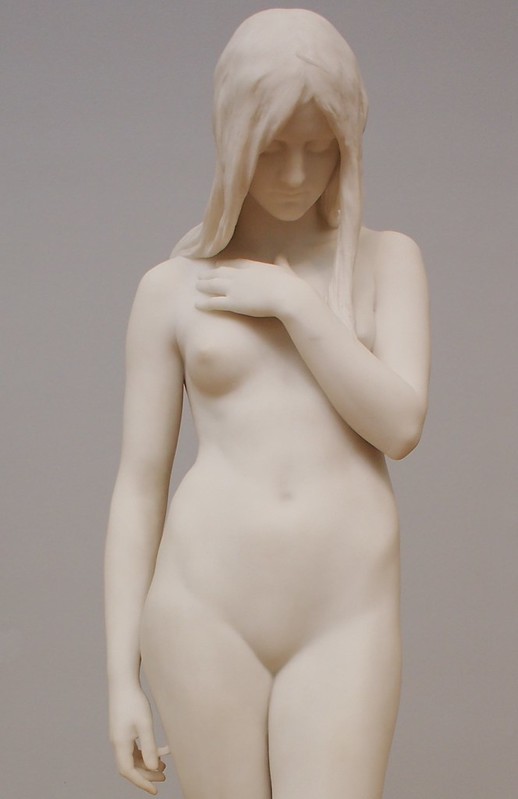
Thomas BROCK (1847-1922) Eve (1900). Tate Britain, London.
The Museum’s collections have been rearranged and expanded. (Learn more here.) Works, such as Eve (1900) by Thomas Brock (1847-1922), have been taken from other museums — Eve was formerkly in the sculpture gallery at the Victoria & Albert Museum, where it stood on a very high pedestal — and put within the context of contemporaneous works.
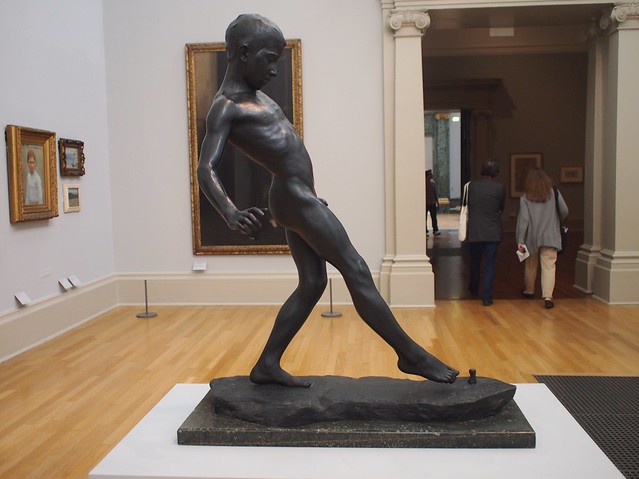
William GOSCOMBE JOHN (1860-1952) A Boy at Play (c. 1895) Bronze. Tate Britain, London.
With all works in chronological order, the Museum a visual feast of 500 years of British art. However, about seventy percent of eye-level wall space is given to art created in the last ninety years. One has to wonder why one of the museum’s most popular paintings, The Lady of Shallot by J.W. Waterhouse is hanging some ten feet above a row of paintings, while cavernous space is given to “sound art” and “visual projections.”
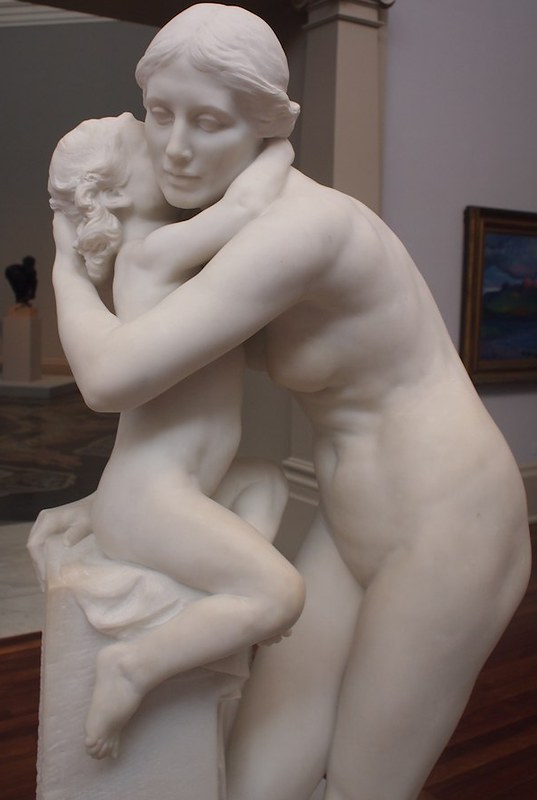
Hamo THORNYCROFT (1850-1925) The Kiss (1916) Marble. Tate Britain, London.
There, I’ve shared my nineteenth-century, figurative-art bias.
Now I can say without reservation that the Tate Britain is better than ever. Go see the paintings . . . and the sculptures!! Oh, the sculptures! They are worth visiting a thousand times.

Martín Rico y Ortega: My Article in Fine Art Connoisseur

La Torre de las Damas en la Alhambra de Granada, Martín Rico y Ortega, 1871, Oil on canvas.
The January/February edition of Fine Art Connoisseur magazine carries an article I wrote about seeing the Prado’s exhibition, El Paisajista: Martín Rico y Ortega (1833-1908).
Assessing a “new” Leonardo da Vinci: Don’t talk to art historians about art
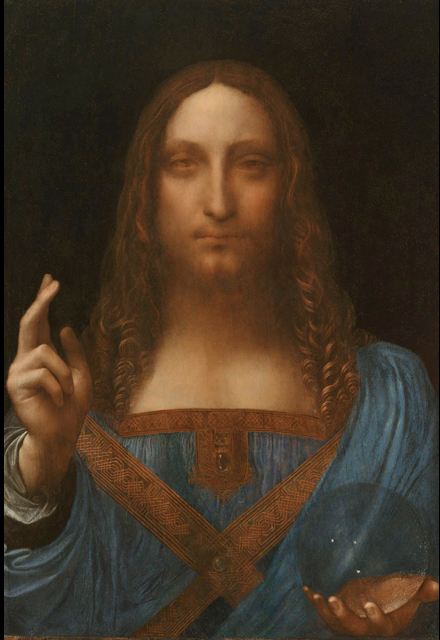
Leonardo da Vinci (1452-1519) Salvator Mundi (c. 1500) Oil on walnut panel. Private collection.
Next month, the National Gallery of London will display a “previously-unknown work by Leonardo da Vinci.” Called Salvator Mundi (i.e. “Savior of the World”), the painting has been compared to surviving, fragmented preparatory drawings and undisputed paintings by da Vinci. As a result, many scholars believe it should be counted among a handful of paintings by the artist. Others doubt. The portrait of Christ will be on display in the exhibition Leonardo da Vinci: Painter at the Court of Milan, opening on November 9 in London, for everyone to compare and opine.
Anticipating certain and divisive scrutiny, Nicholas Penny, the Director of the National Gallery, says he is “pretty sure” it is by da Vinci. He was interviewed by The Sunday Times(London) for a feature in the paper’s magazine titled “Leonardo? Convince Me.”:
“It is a very weird picture.” . . . It shares something, he says, with Leonardo’s portraits The Lady with the Ermine and the Mona Lisa. “They respond, but hold something back. You can’t think about them except in relationship to the viewer. They imply a narrative of which you are a part. That was not true of portraiture before Leonardo. The Salvator Mundi radiates intense presence. But because it’s Leonardo you do wonder if you’re going mad–and you certainly want people whose opinions you respect to look at it.” He pauses. “People can judge for themselves.” (Sunday Times Magazine. 9 OCT 2011.)
Before becoming Director, Mr. Penny was the Clore Curator of Renaissance Art at the National Gallery for ten years. He is a serious scholar; an expert. But, his advice here is nonsense. We may never be able to decisively attribute the painting to da Vinci–it has been over 500 years. But, we can certainly do better than stand in front of it to experience “radiated presence”–whatever that means–or take comfort in an “implied narrative.” It is the kind of non-methodical, relativistic drivel that has made art history and art historians completely irrelevant to public debate in our evidence-based era.
I don’t think Mr. Penny’s advice in this interview is the basis for his opinions; but, he has been trained by a hundred years of art historical practice to talk to the public about art in an imprecise and unhelpful way. The Salvator Mundi painting has been through a host of scientific tests, including carbon dating and comparative chemical testing of pigments used in undisputed da Vinci paintings; and, a series of comparative stylistic studies, such as analysis of stroke and process. These are not the kind of tools available to average museum-goers who Mr. Penny invites to “judge for themselves.” If he were a lawyer, we would expect him to say “Here is the compelling evidence for and against . . . therefore I am pretty sure it is attributable to da Vinci.” not: “I’m pretty sure . . . It’s weird . . . ask someone else.” It is a sign of our times that a trained scholar and Director of one of the world’s great museums would tell people to look at and interpret a Renaissance painting as though it were a 1960s drip painting. It is evidence of the public death of a way of talking about art called the “Morellian Method.”
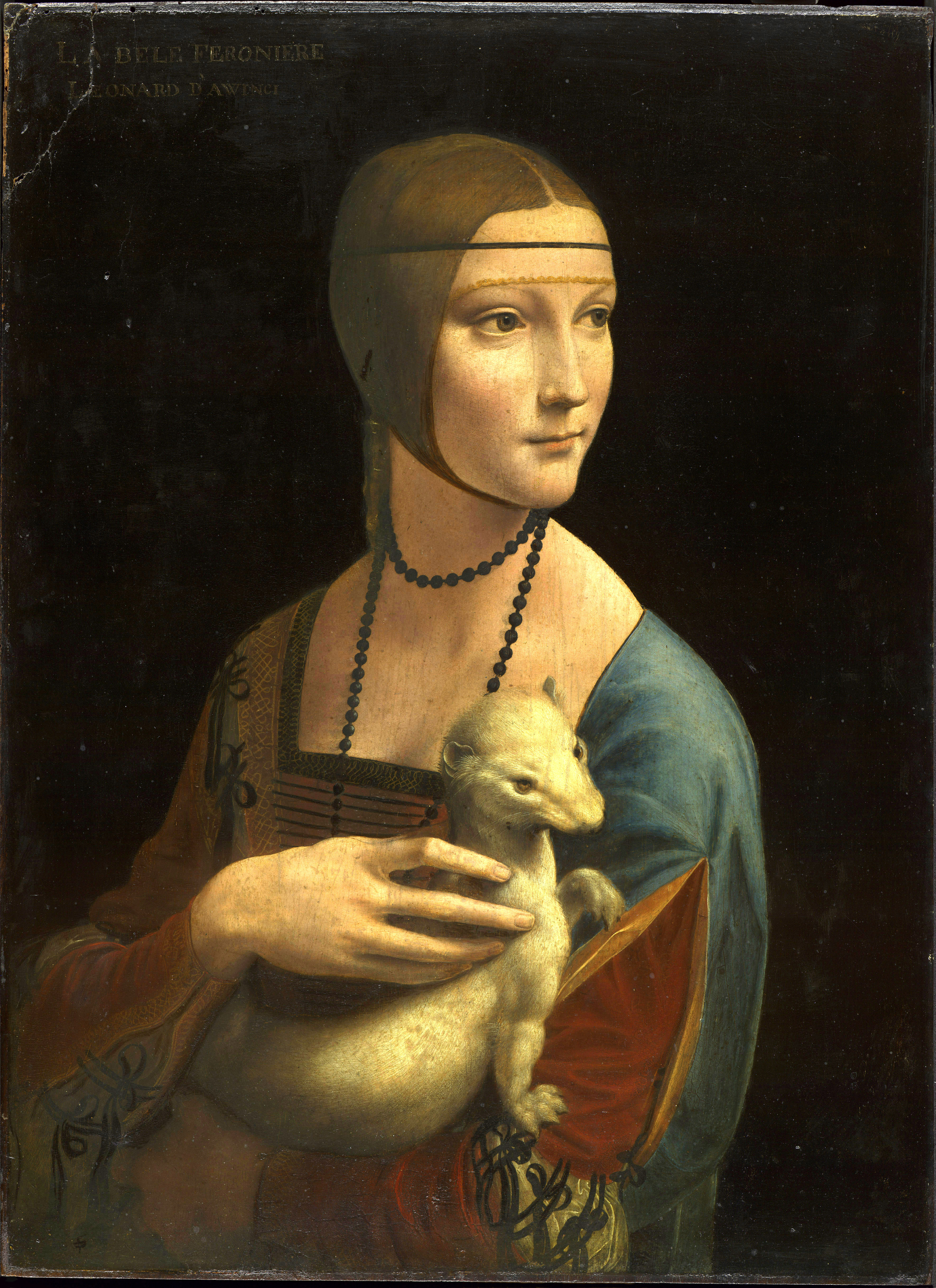
Leonardo da Vinci (1452-1519) Lady with an Ermine (1485) Oil on wood panel. 54 by 39 cm. Czartoryski Museum, Kraków.
Giovanni Morelli (1816-1891) was a trained doctor who had a love of art. During his lifetime, royal and national museums sprung up throughout Europe. Many Old-Master works were placed on public display for the first time, leading to an international public dialogue on art not seen before or since. Competing for attention, these collections–sometimes of dubious origins– were often overzealous and sloppy in attributing works of art to marquee names. Paintings labelled “da Vinci” have since been downgraded to “School of da Vinci” or “Unknown Florentine Artist.” At the time, art historians, critics and collectors were anxious to divide up painters into similar Schools (e.g. Spanish, French, Neopolitan) by observations of subject, palette and, even, size. Morelli had a different approach. He suggested that the same rigorous scientific methods used in medicine (e.g. dissection and observation) be applied to the observation of paintings. In particular, Morelli believed that an artist was best known by the minute and inconsequential parts of a painting: leaves on trees, fingernails, dirt. Artists didn’t reveal themselves in the big things; but, in the mundane areas of their art that were not subject to constant reinvention. He wrote detailed treatises on the varied hand gestures of particular painters, contrasting them with others. Over time, he was considered a kind of Sherlock Holmes of painting.Though some of his attributions were incorrect, Morelli’s object-based method pre-dated many scientific tools that his nineteenth-century philosophy would have embraced.

School of Leonardo da Vinci. Bacchus (c. 1510) Oil on walnut panel transferred to canvas. 177 by 115 cm. Musée du Louvre, Paris.
By the early twentieth century, paintings were interpreted differently. Art was considered mostly through philosophical arguments alone, not craftsmanship combined with philosophy. Morelli was not relevant to Dadaists or Pop Artists. But, it was my belief that thos, like Mr. Penny, who continued to study art in the Classical Tradition, would retain the rigor and language of a scientific method in order to understand, preserve and teach the public about these works. I think Mr. Penny has a deep understanding–many years beyond technical possibilities of Morelli’s era–but his comments appear to indicate his lack of belief public capacity or interest to see paintings in a rigorous way. Maybe that is just my implied narrative.
Real Basílica de San Francisco el Grande in Madrid
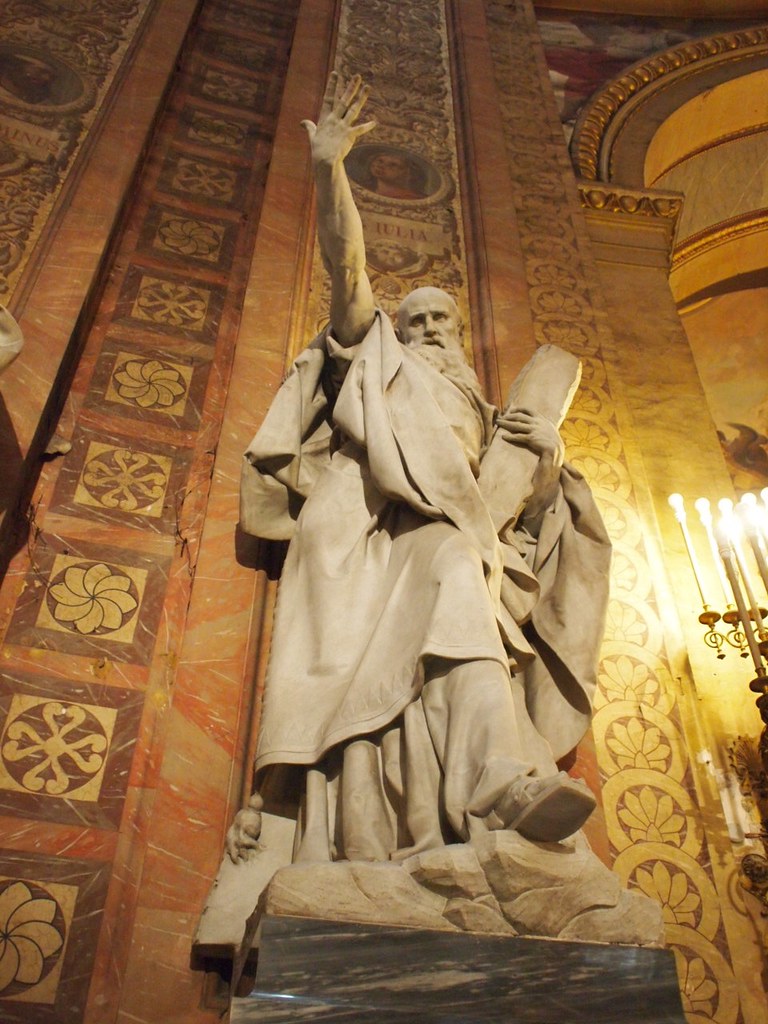
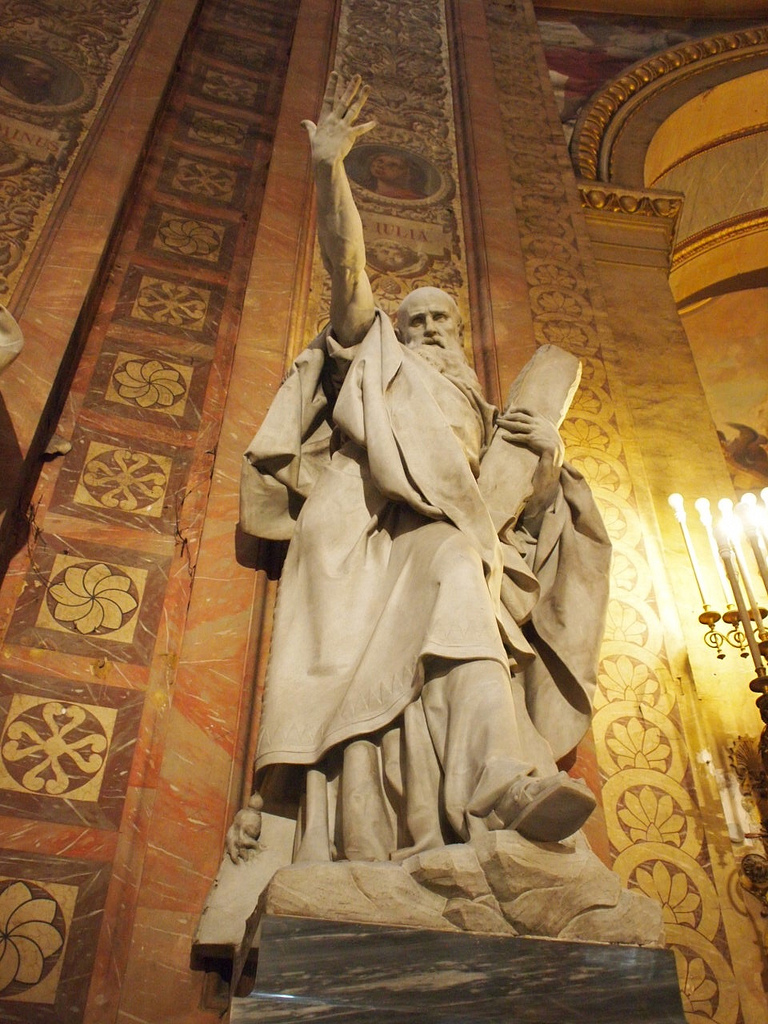
Ricardo Bellver (Madrid, 1845-1924) San Andres (Saint Andrew) Marble. Basilica de San Francisco el Grande, Madrid.
Located a short walk from the Royal Palace, the Basilica de San Francisco el Grande is not on most tourists’ itineraries. It should be. Even when tourist visit, it is to see the Capilla de San Bernardo (Chapel of Saint Bernard) where a large painting by Francisco de Goya y Lucientes (Spanish, 1746-1828) hangs. Goya’s work is worth seeing; but, it is hardly the most impressive in the Basilica.The site for the building was chosen in 1214 by none other than Francis of Asisi (1182-1226). It became the capital’s hub for religious Royal and national events. Several weddings by Bourbon rulers took place there. However, after invading French troops used the Basilica as a military barracks, the building fell into disuse. (Both because of the cost of restoration and its association with the French.) During the last quarter of the nineteenth century, the Spanish government commissioned the country’s best native artists and architects to retore the Basilica. (By the way, a basilica is different from a Cathedral or church in many ways. For one, a Cathedral is dedicated to a particular saint. Basilica’s are dedicated to the Virgin. They also represent different hierarchies within the Catholic Church. A priest says Mass in a church, a Bishop in a Cathedral and the Pope in a basilica.)
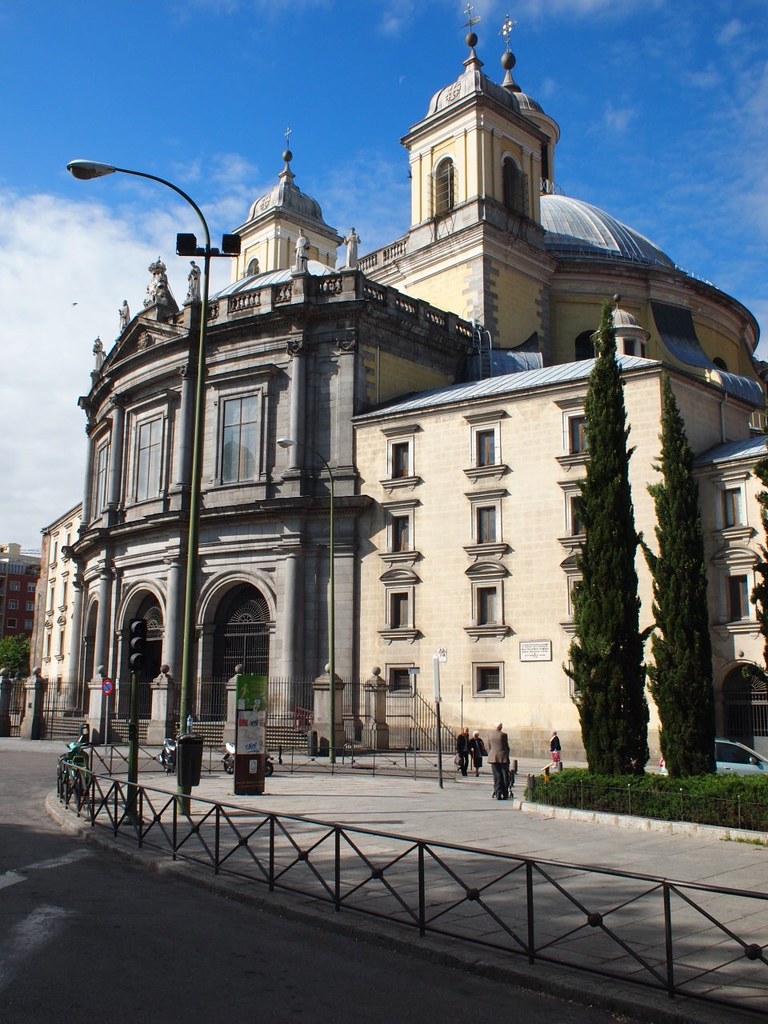
Real Basilica de San Francisco el Grande (Royal Basilica of Saint Francis the Great) Madrid, Spain.
The Basilica’s principal dome–one of the largest in the world–was painted by Casto Plasencia Mayor (). Plasencia had studied in Rome, where he did extensive studies of Raphael’s frescoes in the Pope’s apartments. He also drew inspiration from the eighteenth-century frescoes done by Tiepolo for the Royal Palace, just down the street.
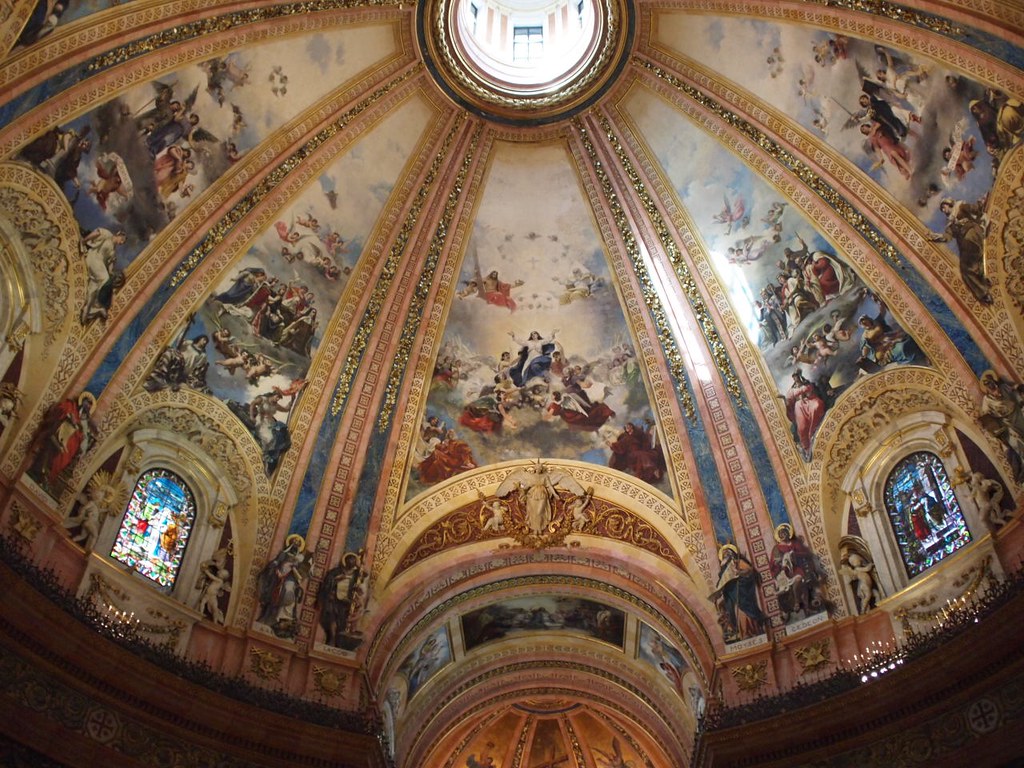
Casto Plasencia Mayor (Spanish, 1846-1890) Cupola for the Basilica de San Francisco el Grande, Madrid
There are six chapels, each dedicated to a different saint and featuring epic-sized paintings. However, my favorite works in the Basilica, by far, are the twelve sculptures along the perimeter of the cupola, representing the original twelve apostles in larger-than-life carera marble. These were done by artists whose names are now forgotten and whose other works are almost all gathering dust in the basement of national and regional museums. (Please excuse my poor photographs. The light conditions in the Basilica are not great.)
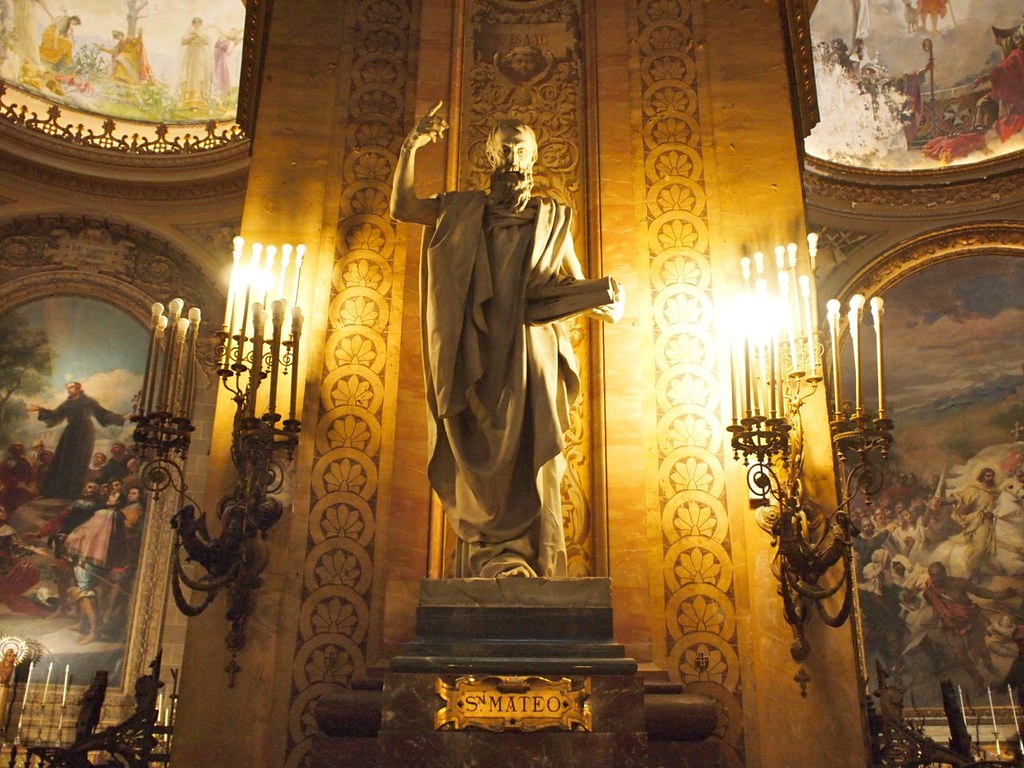
Ricardo Bellver (Spanish, 1845-1924) San Mateo (Saint Matthew) Marble. Basilica de San Francisco el Grande, Madrid.
The Basilica and its artists deserve a great deal more attention. (I hope to write an extensive paper, perhaps a book, on it someday.) For more images, go to this album.
Van Gogh in the Vatican
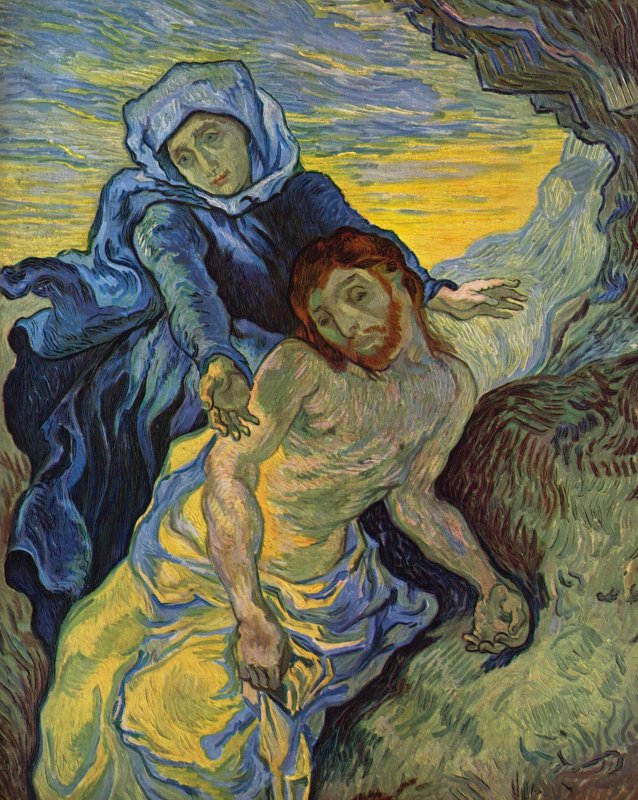
Vincent Van Gogh (Dutch, 1853 – 1890) Pietà (c. 1880) Oil on canvas. 73 x 60 cm. Vatican Museums, Vatican City.
We do not usually associate the two; but, there it is: a Van Gogh hanging somewhere between one of the world’s largest collections of antiquities and the Sistine Chapel.
More than four million people visited the Vatican Museums last year. I was was one of them. For those who have not made their own pilgrimage, it is difficult to describe the vast, Byzantine compound that holds the Catholic Church’s collections. With objects as diverse as Egyptian artefacts and Sevres porcelains, the “museum” is divided into several exhibitions, conjoined with palaces that make up the Pope’s apartments. Together, they are nearly impossible to see it all in a single day or, even, week. And, if you are like me, mentally exhaustion sets in after an hour. So, it is understandable that most tourists make their way directly to the brightest stars in the collection (e.g. Raphael’s frescoes, Laocoön), without seeing what in other museums would be show stoppers.
The Vatican has a sizable collection of modern and contemporary religious art. These works range from mid-nineteenth-century artists to today and are hung in a series of dimly-lit, basement rooms leading to the Pope’s apartments. Visitors are given the choice of a short cut directly to the Sistine Chapel or a fifteen-minute walk through the rooms where the Modern Collection hangs, sometimes unlabeled. Most choose the direct route. Even those who take the long way end up rushing past works by Auguste Rodin, Pablo Picasso, Salvador Dalí, Giacomo Balla, Otto Dix and many, many others.
It was there I saw Pietà by Vincent Van Gogh. I cannot stop thinking about it. This post is an attempt to figure out why.
I am not nor have I ever been obsessed with Van Gogh. Of course, like many, I feel admiration for his singular way of seeing the world. I feel a shock every time I see one of his works in person. His sculptural use of oil paint and familiar colors combined with acrobatic compositions, makes common places, people and things members of alternate realities. His debilitating solitude, tortured genius and early death make him a rock star of art. (Back in the 90s, two posters, one of Kurt Cobain and the other of Van Gogh, hung above my roomate’s desk.)
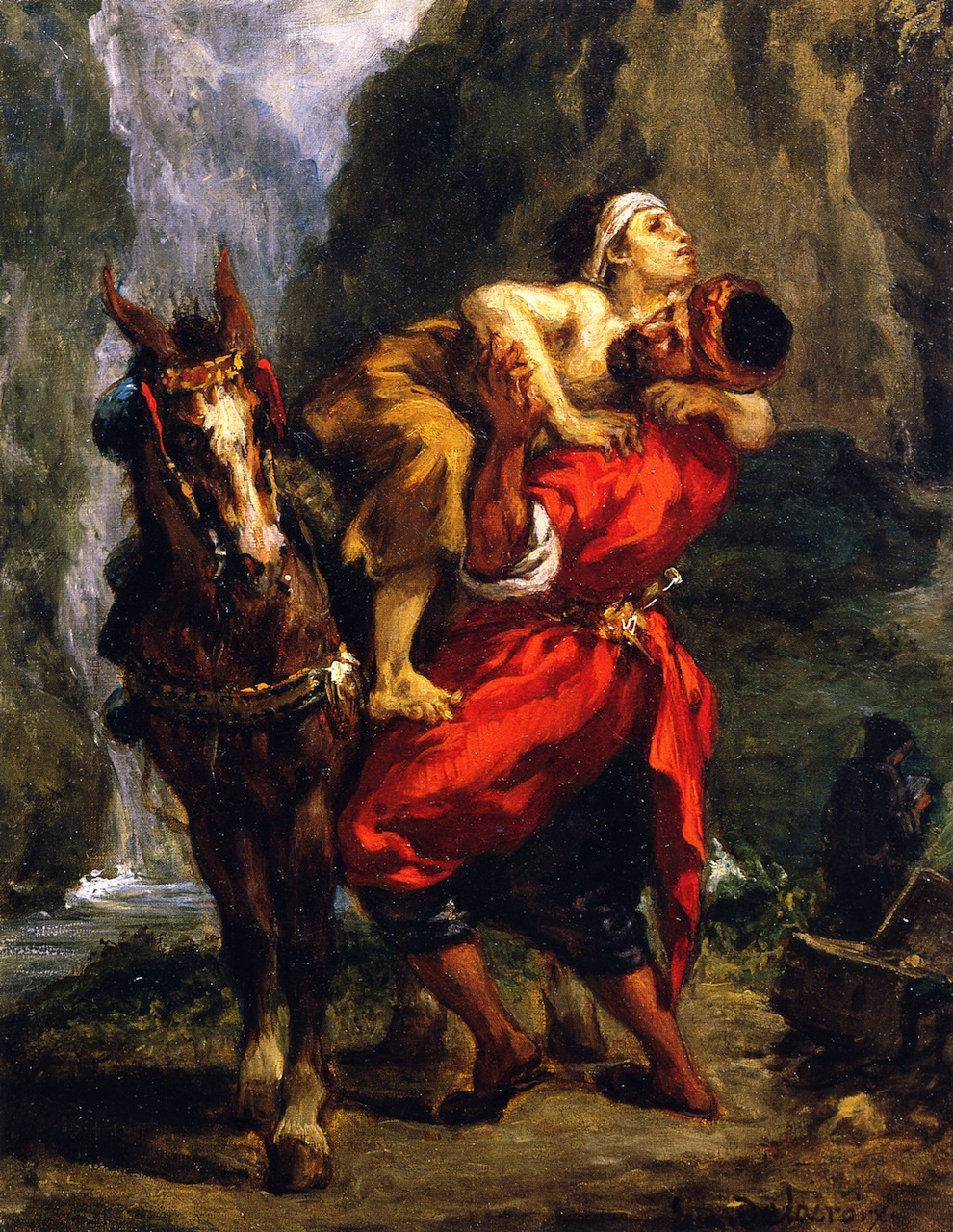
Eugène Delacroix (French, 1798-1863) The Good Samaritan (c. 1848) Oil on canvas. Private Collection.
Some scholars believe that Van Gogh’s Pietà, showing the dead, tortured body of Christ after the Crucifixion, is actually a self-portrait. (Note the red beard.) While in the Hospital of Saint-Rémy, housed in an old monastery,Van Gogh wrote his brother Theo: “I am not indifferent, and pious thoughts often console me in my suffering.” In any case, religious works by Van Gogh are rare. The Pietà is one of two biblical paintings he copied from Delacroix.
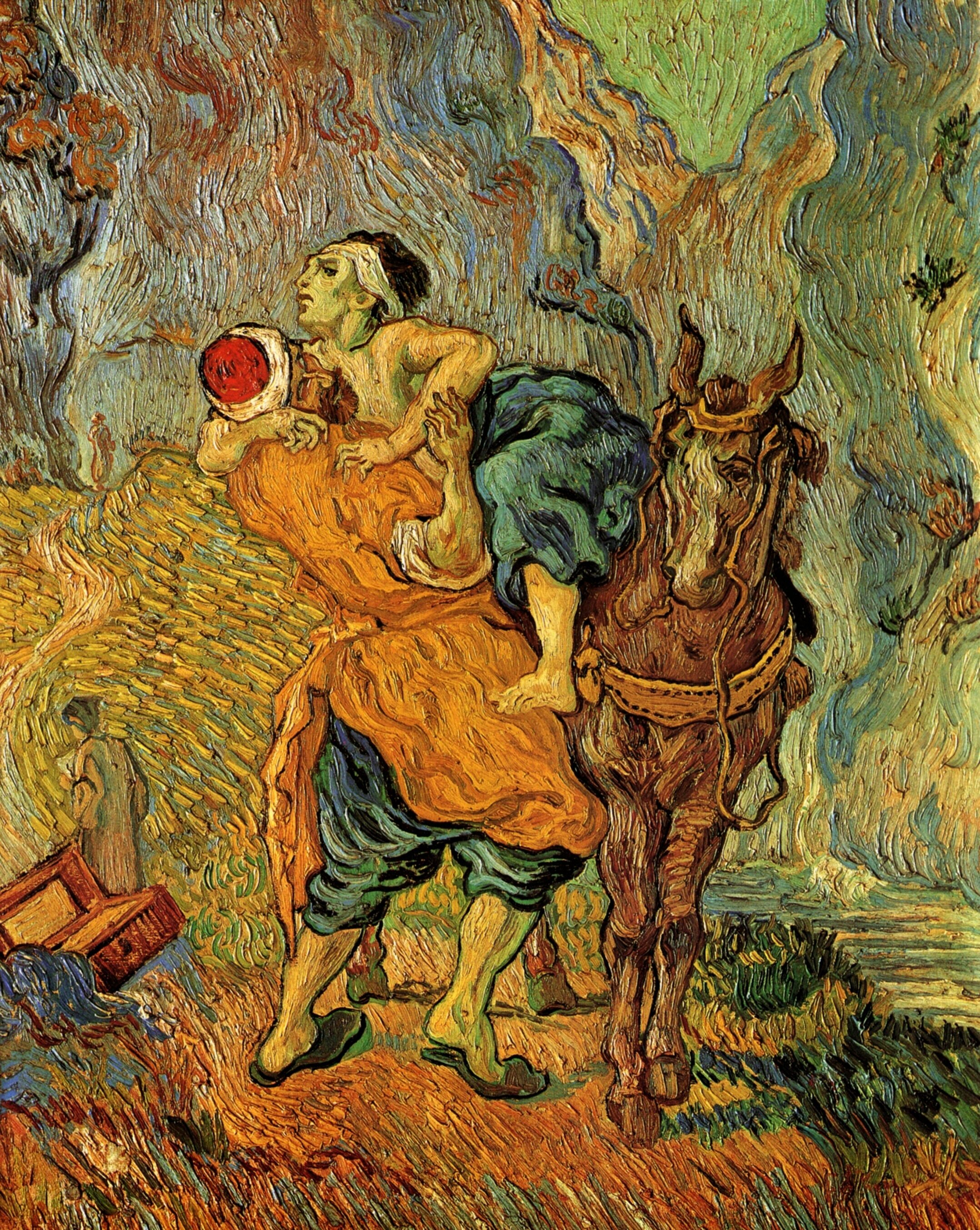
Vincent Van Gogh (1853-1890) The Good Samaritan, after Delacroix. Oil on canvas.
Van Gogh hugely admired Delacroix, mentioning him more than 95 times in personal letters. In particular, he admired Delacroix’s use of bold and vibrant color.
Writing to his brother about Delacroix’s Pietà, which he had in the form of a lithograph, Van Gogh wrote:
The Delacroix lithograph La Pietà, as well as several others, fell into my oils and paints and was damaged. This upset me terribly, and I am now busy making a painting of it, as you will see.
We do not know if he was referring the painting in the Vatican or the other version, hanging in Van Gogh Museum, which some believe to be made late. The Vatican Museum of Modern Art did not purchase its painting. Like many other works, Pietà was a gift from a member of the Church, who donated it his diocese in New York sometime mid-century. Of the two versions, the Vatican’s is much smaller. It is also darker, which is, perhaps, more a result of not being as well cleaned. But, the darker hues, combined with the dim lighting, in my opinion, imbue the work with greater pathos.
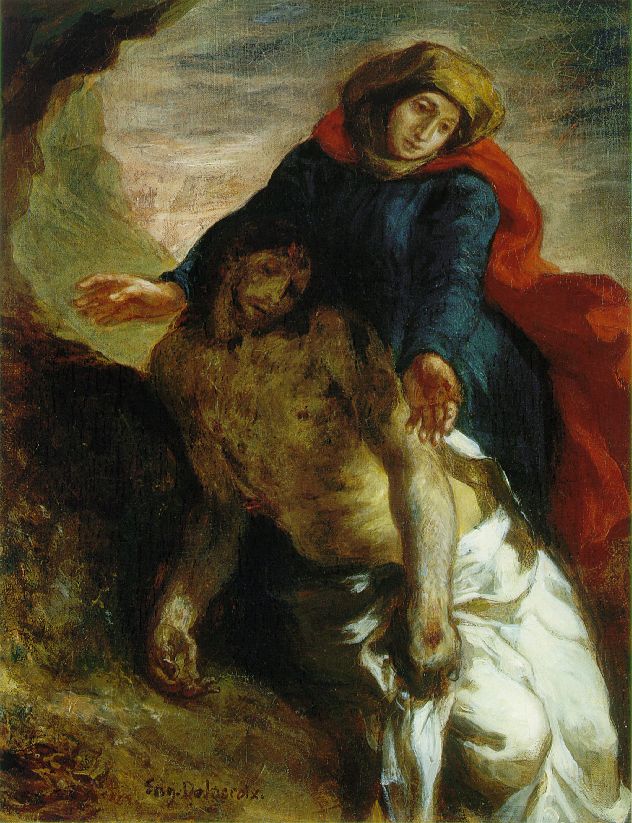
Eugène Delacroix (French, 1798-1863) Pietà (c. 1850) Oil on canvas. Nasjonalgalleriet, Oslo.
We should all be aware by now that most paintings we see in museums were never meant to be hung in a public space, let alone under modern, high-voltage lighting. While I do not know the original context for the work–if there even was a context–the overlooked space on the way to the Sistine Chapel seems a fitting.
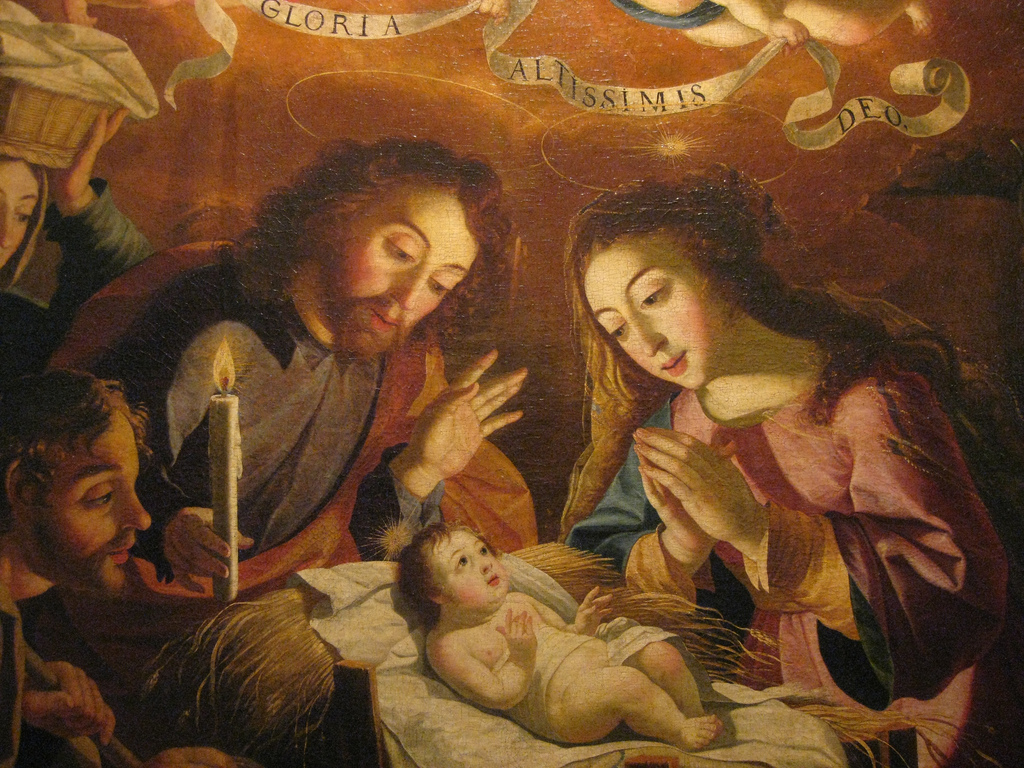
Visiting Lisbon’s Museu Nacional de Arte Antiga

Josefa d’Obidos (Portuguese, 1630-1684) Adoracão dos Pastores OR Adoration of the Shepherds (1669) Oil on canvas. Museum of Ancient Art, Lisbon. (Detail)
With only 36 hours in Lisbon, there was little time to explore Portugal’s capital. I wanted to visit the city’s most well-known art museum. So, when I asked a cab driver to take me to the Museum of Fine Art, I was taken to the Museu Nacional de Arte Antiga. (Roughly translated as the “National Museum of Ancient Art,” the term “ancient” in Portuguese does not have exactly the same meaning in English, which would imply anything from pre-historic to, perhaps, the birth of Christ.)

Unknown Portuguese sculptor. Saint Gabriel (c. 1675) Polychrome statue. Museum of Ancient Art, Lisbon.
The Museum’s collection represents works from the Middle Ages to the mid-nineteenth century. While it is not the only museum of fine art or necessarily the best, it was where I was taken. And, I am forever grateful to the cabbie who took me there.

Hieronymus Bosch (Flemish, 1450-1516) Triptych of the Temptations of St. Anthony Abbot with the Betrayal of Christ and the Way to Calvary (c. 1500) Oil on panel. Museum of Ancient Art, Lisbon.
Not surprisingly, the preponderance of the collection corresponds to the period when Portugal was among the world’s superpowers. It is dominated by masters from the fifteen to seventeenth centuries, when Portugal was made rich discovering and trading with much of the world.

Antonio Pereda y Salgado (Portuguese, 1608-1678) Still life with vegetables and kitchen utensils (1651) Oil on canvas. Museum of Ancient Art, Lisbon. (Detail)
Many of us can name Spanish artists from the same period (e.g. Velázquez, El Greco). But, even though the Portuguese shared the Iberian Peninsula, their artists do not have anywhere near the same esteem or recognition.

Clemente Sanchez (Portuguese, Seventeenth Century) Sao Sebastião or Saint Sebastian (c. 1620) Oil on canvas. Museum of Ancient Art, Lisbon.

Clemente Sanchez (Portuguese, Seventeenth Century) Sao Sebastião or Saint Sebastian (c. 1620) Oil on canvas. Museum of Ancient Art, Lisbon. (Detail)
For example, the artist Clemente Sanchez (Portuguese, Seventeenth Century) demonstrates a remarkable level of training, on par with any artists of the period. Yet, I am unable to find his biography or any work by him online. In Saint Sebastian (c. 1620), Sanchez shows a remarkable arsenal of skills; and, more importantly, represents a different approach that combines both the naturalism of Velázquez and the classical ideal of Poussin, who were both working at the same time. If his work truly represents a unique, Portuguese approach to art, it is worth publishing to a wide audience.

Pieter Brueghel, The Younger (Flemish, a. 1564-1637) Acts of Mercy (c. 1625) Oil on panel. Museum of Ancient Art, Lisbon.
In addition to showcasing regional talent, the Museum features works that cannot be seen any where else by well-known, canonical Flemish, Dutch, Spanish, and Italian artists. The Portuguese were obviously aware of and collecting these artist like any other major European nation. (Even though the Museum has recently undergone a significant renovation, it has not yet put these works online.)
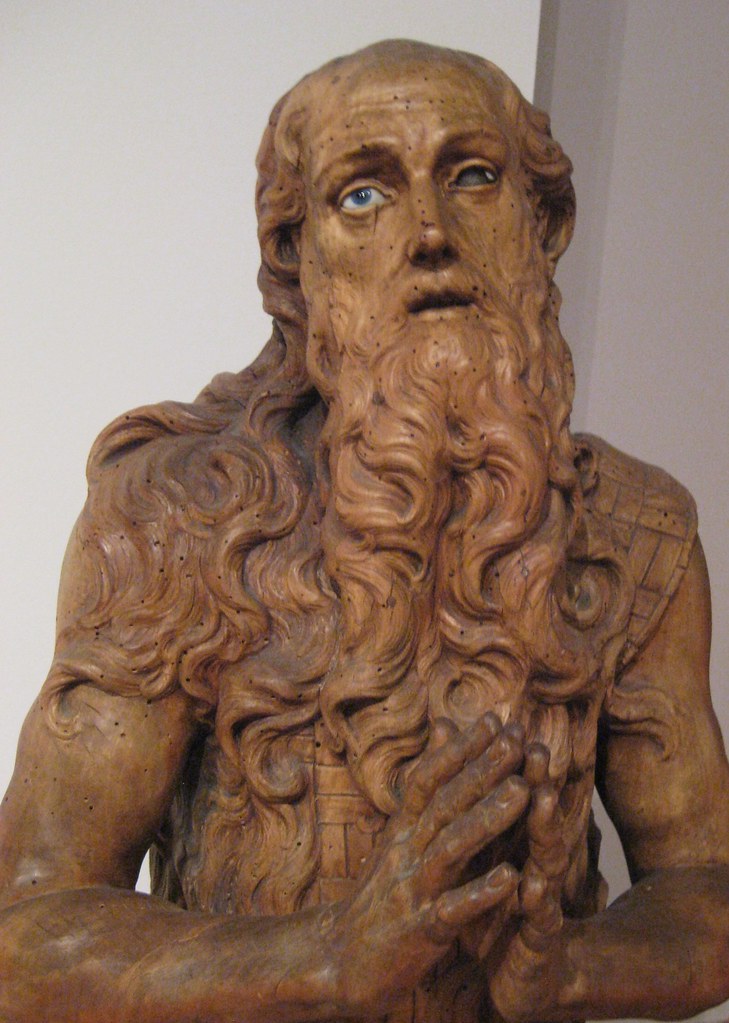
Unknown Portuguese sculptor (Eighteenth Century) Santo Onofre or Saint Onuphrius (Eighteenth century) Wood and glass. Museum of Ancient Art, Lisbon.
On the Wednesday afternoon I visited, there were more guards than visitors. As a result, I had the Museum to myself. Each work of art was mine alone. If you are in Lisbon, it may not be in your tourist guidebook; but, for art lovers, it offers the opportunity to discover remarkable, no-where-else-to-be-seen artworks and level of intimacy with them that is usually reserved for the royalty that commissioned them. (To see all the images I took, visit my Flickr photo set here.)
An unpublished work by Sir Lawrence Alma-Tadema
As those of you who follow my tweets (apologies for the shameless Twitter plug) know, I have been traveling for the past three weeks. I was in Spain for eleven days, France for one, and another five in California. To some it might sound like glamorous, Indiana-Jonesing; but, in reality, I spent most days underground in dusty archives looking for undiscovered, art-historical morsels and nights transcribing nineteenth-century handwriting. Along the way, I came across a number of remarkable works of art, some not seen for more than a hundred years. I plan to share some of them.
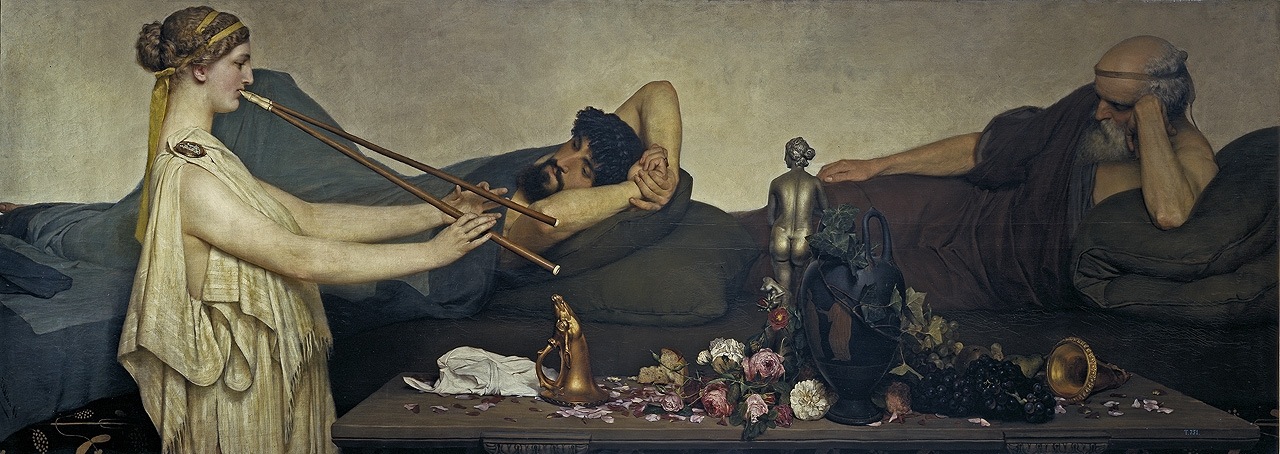
I begin with A Scene from Pompeii (1868), a previously unpublished and little-known work by Sir Lawrence Alma-Tadema (Dutch and British, 1836-1912).
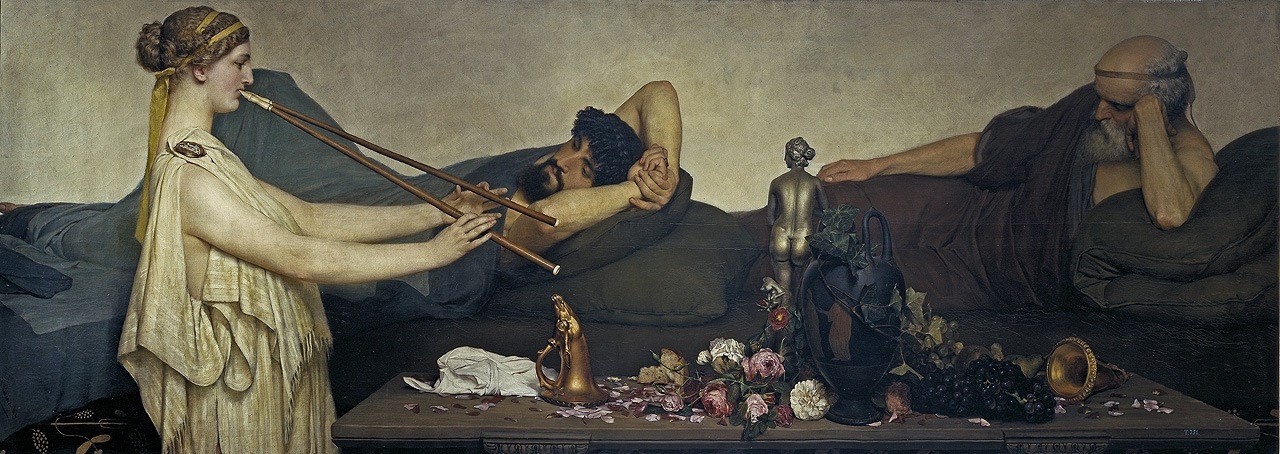
Sir Lawrence Alma-Tadema (Dutch & British, 1836-1912) A Scene from Pompeii (1868) Oil on canvas. 130 X 360 cm. Museo Nacional del Prado, Madrid.
This morning, I spoke with Vern Swanson, a mentor of mine and author of Alma-Tadema’s catalogue raisonné. Dr. Swanson did not include an illustration of the painting in his book–the most definitive on the subject–because A Scene from Pompeii was unavailable until recently. As one of Alma-Tadema’s most ambitious early paintings, it has been in storage at the Museo Nacional del Prado for nearly 100 years. This year A Scene from Pompeii was hung for the first time in the Prado’s new, permanent wing dedicated nineteenth-century painting and sculpture.
Alma-Tadema’s works, famous for Olympian themes that idealized a bygone empire, may seem more at place in France or Great Britain than in Spain. At the Prado, A Scene from Pompeii makes strange bedfellows with a generation of nineteenth-century Spanish artists who sometimes trained in France, but nonetheless venerated classical realists like Diego Velázquez and José de Ribera.
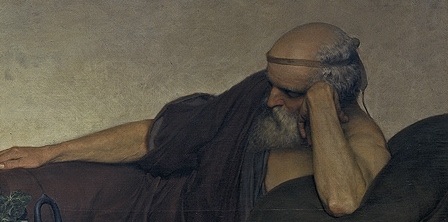
Sir Lawrence Alma-Tadema (Dutch & British, 1836-1912) A Scene from Pompeii (1868) Oil on canvas. 130 X 360 cm. Museo Nacional del Prado, Madrid. Detail.
This painting is one of only a handful of foreign nineteenth-century works in the Prado’s collection. It was donated to the short-lived, Spanish Museo de Arte Moderno in 1887 by Ernesto Gambart, then Spanish Consul to Nice (France). When the Museo de Arte Moderno was absorbed into the Prado a few years later, nearly all of the its collections, including this work by Alma-Tadema, were placed in storage where they have been ever since. Only now, under the leadership of Javier Barón, Director of Nineteenth-Century Painting at the Prado, are these works being fully restored and finally displayed.
A Scene from Pompeii (1868) dates to a happy and prolific period in Alma-Tadema’s life. Five years earlier, he married his first wife, Marie-Pauline Gressin, in Antwerp. Their honeymoon was spent in Florence, Rome, Naples and Pompeii. For the next several years, he absorbed and transmuted his personal experience with the classical tradition into a series of paintings that quoted Greco-Roman architecture and artworks, such as a bronze reproduction of Aphrodite by the Greek sculptor Praxiteles (4th-century BC), in this work.
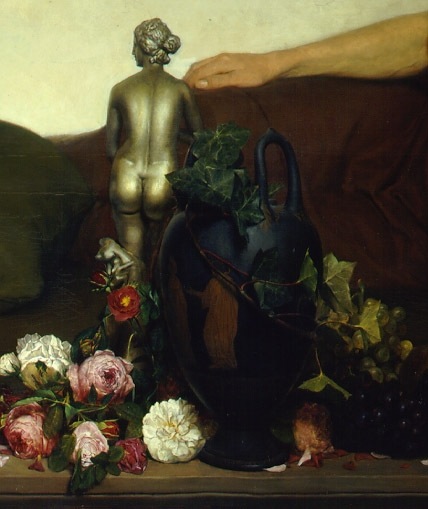
Sir Lawrence Alma-Tadema (Dutch & British, 1836-1912) A Scene from Pompeii (1868) Oil on canvas. 130 X 360 cm. Museo Nacional del Prado, Madrid. Detail.
Alma-Tadema is often remembered for his British works created after the death of his wife in 1869. These exquisitely detailed scenes sometimes feature dozens of figures painted in jewel-like colors. However, before 1869, his works regularly exhibited the same restricted, earth-tone palette of A Scene of Pompeii. While this painting shares the trademark precision Alma-Tadema’s larger oeuvre, its composition is unusual. I am not an expert on Alma-Tadema; but, I am surprised by the Baroque proportions of the figures which, unlike other works by Alma-Tadema, fill the canvas to near capacity.
It is always a pleasure to find new works by an artist as well-known and respected as Sir Alma-Tadema. I am sure that the Prado will have more insightful and important things to say about the painting as the new nineteenth-century wing becomes more public.
Artist Portraits: A New, Online Resource
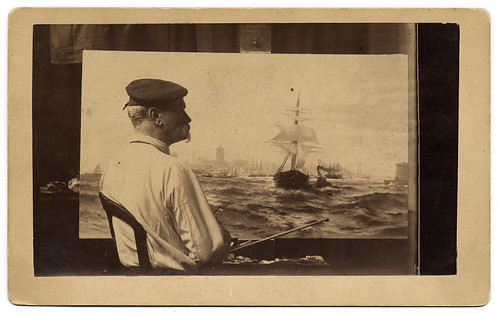
Edward Moran (American, 1829-1901). Seated in a side pose in front of a work in progress. Photographer unknown. (c. 1870)
A new and exciting historical photography source is now online. (Yes, I used “historical” and “exciting” in the same sentence.) Called “The Commons,” it is a collaboration between the Library of Congress, Smithsonian, Flickr.com and several historical societies to digitize historical photographs and make them available online.
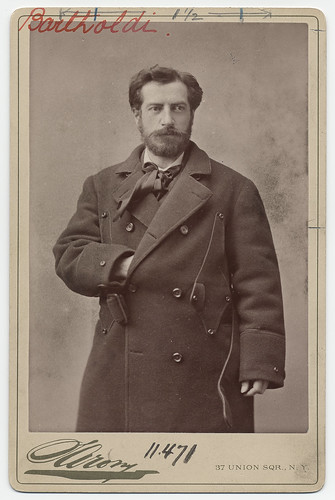
Frederick Auguste Bartholdi (French, 1834-1904). Mounted portrait of Bartholdi in coat with hand inside lapel. (1880)
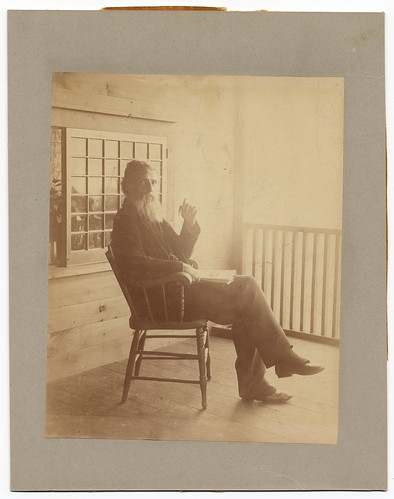
While looking through the collection, I stumbled upon an area of The Commons dedicated to late-nineteenth-century portraits of painters. Most photos are studio portraits of American artists. Some are candid shots of artists working in their studios or en plein aire.
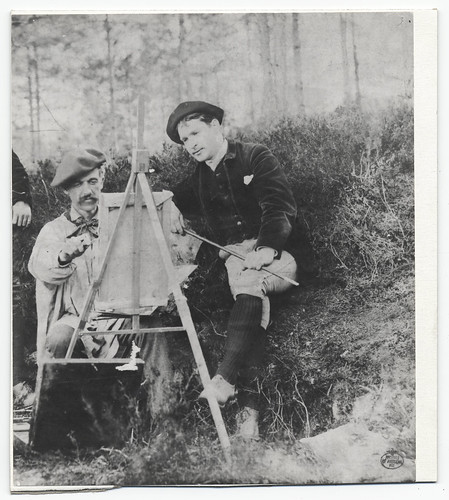
Theodore Robinson (American, 1852-1896) Robinson seated on a bank, with an unidentified artist, painting. (1872)
There is something unnerving and almost ironic about photographs of painters. For me, it’s like seeing a picture of a well-known radio host for the first time (e.g. Terry Gross from Fresh Air), or like seeing one of my high school teachers in the supermarket. My image of them is thrust out of the compartment I placed them in and into reality.
The Poetry of Silence: Vihelm Hammershøi at the Royal Academy in London

Vilhelm Hammershøi (1864-1916) was born in Copenhagen, Denmark. The exhibition, Vilhelm Hammershøi: The Poetry of Silence, at the Royal Academy in London displays more than 60 of Hammershøi’s works and runs until September 7. (It will then travel to Tokyo.)
Hammershøi received training at the Royal Danish Academy of Fine Arts, and produced a number of landscapes early in his career. After graduating he submitted a number of portraits to the Royal Academy’s annual exhibition, but was regularly rejected.
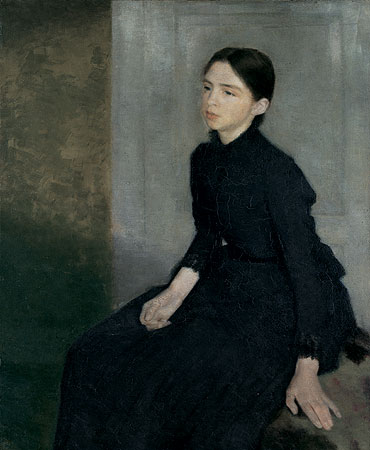
Portrait of the Artist’s Sister (1887) Oil on Canvas.
Instead of challenging the system, beginning in the 1890s Hammershøi began painting interior scenes of his home that usually featured his wife, Ida. These paintings were generally sold directly to patrons and only occasionally on public view.
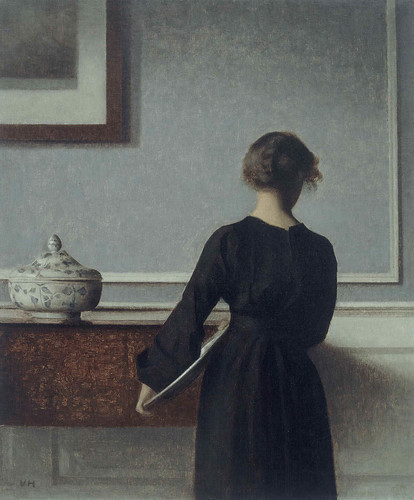
Vilhelm Hammershøi. Interior with Young Woman seen from the Back (c.1903–04) Oil on canvas. Randers Kunstmuseum.
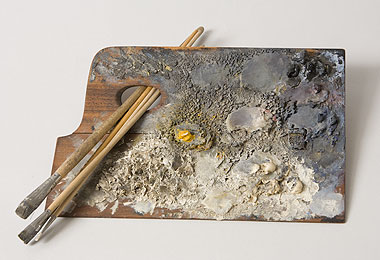
Vilhelm Hammershoi’s Palette.
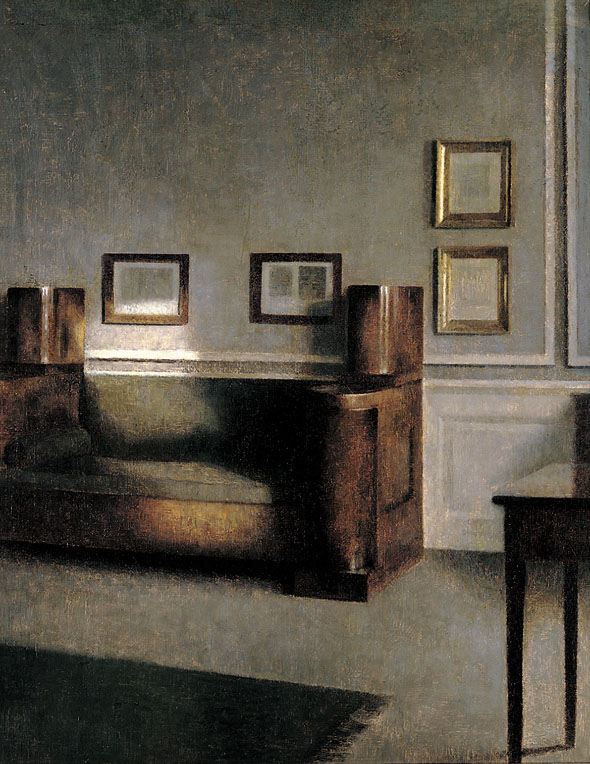
Vilhelm Hammershøi. Sonnige Stube (1905) Oil on canvas, 49.7 x 40 CM. Nationalgalerie Berlin.
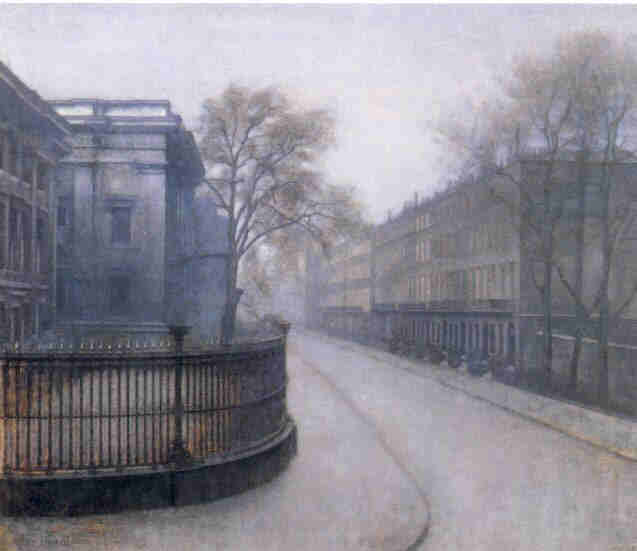
Vilhelm Hammershøi. The British Museum (c. 1905-1906). Oil on Canvas.
Thinking of the title of the exhibition, The Poetry of Silence, I was reminded of a poem titled Silence by Billy Collins:
There is the sudden silence of the crowd
above a motionless player on the field,
and the silence of the orchid.
The silence of the falling vase
before it strikes the floor
the silence of the belt when it is not striking the child.
. . .
The silence before I wrote a word
and the poorer silence now.
(Excerpt from Silence by Billy Collins. The Trouble with Poetry and Other Poems.)
For an antidote to the ever-busy lifestyle we all lead, I highly recommend finding a Hammershøi painting and sitting in silence for a time.