A blog about art in the classical tradition

Uncategorized

Google Books: “Christ before Pilate” by Painter Mihaly Munkacsy

Christ before Pilate by Mihaly Munkacsy. Before finding it on Google Books, I’d never heard of the painting.

By now, you’ve probably read/heard that Google is carrying out a massive book scanning project including dozens of libraries and millions of books. Many of the books it has already scanned are online, and those that are past copyright are available for to view and download in PDF format through books.google.com.

With my love for nineteenth-century art, I have been trolling for illustated books on painting and sculpture. I plan to share some of my findings on this blog for my own records and for anyone who may be passing through.

Today’s find is a book about the painting Christ before Pilate by the Hungarian-born, Paris-trained artist Mihaly Munkacsy. (You can see and download a copy of the book here.) Before my search on Google books, I had never heard of the painting, but it is quite impressive.

Published in in 1887 by Charles M. Kurtz, the book Christ before Pilate was scanned from the University of Michigan’s library. It includes a number of detailed images from the painting. From pages 8 and 9 of the book:

The painting was completed in 1881. The artist had intended to send it to the Salon that year, but a fire in his studio had prevented the painting being ready for the day appointed for the reception of exhibits. The artist solicited a short term grade and was denied and then a private exhibition was determined . . .

“All Paris” flocked to see the picture, and the income from its exhibition rivalled, it is said, that received at the turnstiles of the Palais de l’ Industrie. Later the painting was successfully exhibited in various European cities:–among others, in London, Vienna, Berlin, Stockholm, Buda-Pesth, Amsterdam, Manchester, and Brussels,–more than two millions of persons attending its exhibition in Europe. Last year the painting was brought to America . . . In less than five months from that time the picture was seen by nearly one hundred and fifty thousand persons. [sic.]

It makes me long for a painting (and painter) that can go on a similar tour today.

  • Share/Bookmark

Deaccessioning: When Museums Trade Old for New
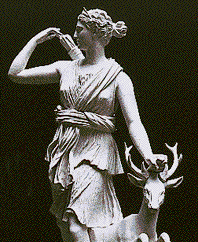
Artemis and Stag

de-ac-ces-sion (v. t.)

To remove and sell (a work of art) from a museum’s collection, especially in order to purchase other works of art.

Webster’s Dictionary

Recently, the Albright-Knox Art Gallery, the principal museum of Buffalo, New York, decided to sell a number of important art works in its permanent collection with the intent of “acquiring and exhibiting art of the present.”

Among the works that will be “traded up” are:

1. Artemis and Stage, a greco-roman statue

2. An ancient Chinese Bronze (there are only a handful in the world)

3 A life-size, Tenth-century statue of the god Shiva, that a Sotheby’s specialist told the Associated Press is “the most important Indian sculpture ever to appear on the market.”

In addition, many paintings by old masters will be auctioned off.

Tom L. Freudenheim, a former Museum Director and a current member of the Association of Art Museum Directors (AAMD), grew up in Buffalo. He wrote an article published in the Wall Street Journal condemning the move by the Art Gallery to sell its collection:

Museums are devoting more and more resources to acquiring large amounts of contemporary art, work about which the judgment of history — supposedly what museums are all about — is far from settled. Such acquisition policies may be acceptable, but not when done by getting rid of masterpieces whose importance has been validated by time and critical opinion and that provide a context for the work of the present. Ironically, this plan is driven by perceptions about the notably erratic and currently inflated contemporary art market, rather than by any dire financial crisis.

He continues:

The message is, once again, that those entrusted with the sacred task of safeguarding our public patrimony have become as irresponsible as the money-grubbing executives who have given corporate America such a bad name. The works of art in the Albright-Knox Art Gallery don’t belong to the directors or curators, who move in and out of communities as job opportunities present themselves. Nor are they the property of the trustees, who are meant to hold them in trust for the people of Buffalo, but who now show that they cannot be trusted.

It’s hard not to agree with Mr. Freudenheim; however, I took a few minutes to visit the Albright-Knox website for their side of the story, and, while they did not offer any information on the upcoming deaccessioning auction, they did have a mission statement that seemed to support their actions:

The Albright-Knox Art Gallery, one of the nation’s oldest public arts organizations, has a clear and compelling mission to acquire, exhibit, and preserve both modern and contemporary art. It focuses especially on contemporary art, with an active commitment to taking a global and multidisciplinary approach to the presentation, interpretation, and collection of the artistic expressions of our times. In an enriching, dynamic, and vibrant environment that embraces diverse cultures and traditions, the Gallery seeks to serve a broad and far-reaching audience.

To validate that this has always been their policy, I used Archive.org’s Way Back Maching to find out whether or not this is a recent mission statement or long-stated goal. Sure enough, this has always been their statement.

The question then becomes, not “why are they selling these priceless items?” but, with an emphasis on contemporary art, “why did they ever acquire these old, priceless pieces in the first place?”

  • Share/Bookmark

Bringing Paintings to the Internet in New Ways

16-Century Italian Fresco

Santa Marial delle Grazie’s Church, Varallo Sesia (VC) Italy, GAUDENZO FERRARI: Vita di Cristo, painted in fresco, 1513

Many of us who love paintings have wondered if they can be effectively displayed on the internet. “Effective” meaning that paintings maintain their integreity (e.g. impasto, sheen, perspective, etc.). Some of us have resented that paintings ever need to be on the Internet, as if they will not survive otherwise.
If paintings can–and must–have a respectable place on the Internet, how?

An attempt by the company HAL9000 to display a massive 16-Century, Italian fresco does more to effectively show painting on the Internet than I have ever seen.

The enormous fresco depicts 21 scenes from the life of Christ. In Internet language, the painting is 8 billion pixels in size. (By comparison, the average computer screen is about 48,000 pixels.)
By using the navigation on their webpage, it is possible to get within a few centimeters of the painting–just as in real life–and still see the painting clearly. It is a stunning accomplishment, not only for its scope, but for the quality of the images and the ease at which they can be viewed on a computer.

Christ healing the lepers, detail from fresco shown at equivalent of 10.57 cm or about four inches.

According to their website, HAL9000 “prodives tools for works of art restoration and viewing, digital photo compositing and retouching, scientific and macro imaging.”

Despite the quality of HAL9000′s work, purists will resist putting this fresco online because it is seen out of the context of the place it was created.

The same argument could and has been made about museums. None of Raphael’s altar pieces are currently displayed in churches. They are all in museums. Four centuries ago, paintings were created for use in the home or church. As museums came into being, paintings became more and more the object of public exhibition. Now, many prominent artist create work solely for display in museums, something that would have been foreign to Raphael. Performance Art would not have come into being without museums.
Perhaps the next stage in painting is not to resist the Internet, but to embrace it and let it change painting in the same way that museums did, or not.

  • Share/Bookmark

Poem: My Name by Mark Strand

Full Night's Exposure

(Photo of a full night’s exposure of stars in the country of Namibia. Click on image for more details.)

My Name

Once when the lawn was a golden green
and the marbled moonlit trees rose like fresh memorials
in the scented air, and the whole countryside pulsed
with the chirr and murmur of insects, I lay in the grass,
feeling the great distances open above me, and wondered
what I would become and where I would find myself,
and though I barely existed, I felt for an instant
that the vast star-clustered sky was mine, and I heard
my name as if for the first time, heard it the way
one hears the wind or the rain, but faint and far off
as though it belonged not to me but to the silence
from which it had come and to which it would go.

Mark Strand
Man and Camel
Alfred A. Knopf

I found this poem via Poems.com’s Poetry Daily, a wonderful way to discover new poets.

  • Share/Bookmark

Listen to Poetry Recordings Online at the BBC

The BBC Online has gathered recordings of famous British, Irish, and American poets. They call it “Poetry Out Loud.”
Although there are only about two dozen poems are listed on the website, it is a wonderful collection with recordings like Alfred Lord Tennyson reading “The Charge of Light Brigade” n 1890 and a poem recorded by Sylvia Plath just months before her suicide.

Here are some of the poems they have available online (the images and links are taken directly from the “Poetry Out Loud” website)

Lord Tennyson

The Charge of the Light Brigade by Lord Tennyson
Inspired by The Times’ account of a Crimean fiasco. Recorded in 1890.

Ted Hughes

A March Calf by Ted Hughes
The acclaimed Poet Laureate creates intense imagery on the savagery of nature and the animal world.

John Betjeman

Diary of a Church Mouse by Sir John Betjeman
Life in an English church, as seen from an unusual angle.

Sylvia Plath

Lady Lazarus by Sylvia Plath
A disturbing monologue on death, rebirth and survival, written four months before the poet’s suicide.

  • Share/Bookmark

Watch and Listen to Opera online at Opera-mp3

Woman in Black at the Opera
(Woman in Black at the Opera by Mary Cassatt, 1877-1878)


opera-mp3.blogspot.com
describes itself as

“55 websites and yahoo-groups with opera related mp3 files available for download (with a personal bias towards the coloratura soprano voice).”

MP3s can be played on almost any digital audio player. I have downloaded several songs from the links on the website to my iTunes and then burned them on a disc.

Here are a few of my favorite links from Opera-mp3:

Patrizia Ciofi 8 mp3s, currently featuring the Mad Scene from Lucie de Lammermoor, and arias from Rigoletto, Le nozze di Figaro, Tancredi, Le nozze di Teti e di Peleo, Otello, and L’Olimpiade. Also: Ciofi yahoo-group.

Lotte Lehmann – 20 mp3s to download, and many more that can be played within the page: Arias, songs/lieder, and interviews.

Leyla Gencer 7 Verdi arias (in downloadable .rm format), including “Tacea la notte placida…Di tale amor”, “Gualtier Malde…Caro nome”, and “Vieni, t’affretta…Or tutti sorgete”. Take note of the pronunciation of her name. Also: Unnatural Acts of Opera has her complete 1971 Gioconda.

Juan Diego Flórez – [Yahoo-group] 5 mp3s (all uploaded in September 2004). More on JDF. Also video-clips from La fille du regiment and L’Italiana in Algeri.

Stars of Bulgarian Opera A trove of mp3s featuring Bulgarian opera-singers: Anna Tomowa-Sintowa, Boris Christoff, Ghena Dimitrova, Ljuba Welitsch, Nicolai Ghiaurov, Vesselina Kasarova, etc. Also, you can hear how to pronounce all their names.

Tenors Listening Room – Monthly selections of 3 or 4 mp3s. May has Kraus, Sabbatini and Florez singing “A te, o cara”. Part of the Voci di tenore website.

Verdi’s Disco A discography of Verdi’s 28 operas on LP and CD, where for each opera, every one of its musical numbers is represented by an mp3. In some cases, more than one mp3 is given: There are 35 renditions of “Addio del passato”, in which every major Violetta since 1928 can be heard!

  • Share/Bookmark

Painting of the Week: “Celebration of Eid al Fitr in Ghardaïa” Isidorius Van Mens

At the end of the Holy month of Ramadan, Muslims around the world hold the three-day Feast of Eid al Fitr. It marks the end of the holiest month of the Muslim year, and is a time for families and communities to gather.

Islamic law severly restricts the use of representational arts (i.e. people, animals, plants). However, foriegn artists were often allowed to document important events. That is the case with the “Celebration of Eid al Fitr in Ghardaïa” by Isidorius Van Mens. Van Mens (1890-1985) was born into a painting family. (His father was a classmate of Van Gogh.) Isiodorius spent a great deal of his time in what was knows as the “orient” and focused his paintings on local events and people. In this triptych , he documented the Feast of Eid al Fitr he witnesed in Ghardaïa, Algeria sometime between 1920 and 1933.

(click on each panel for a larger image.)

The painting depcts a moment of music and dance in the celebration. Only men are visible. In the center panel, performers and playing to the crowd in the left-hand panel, and the community leader–we suppose is presiding over the celebration–in the right-hand panel.

The painting is large: 35 x 59 in. (left) 124 X 900 in. (center) and 35 x 27 in. (right).

  • Share/Bookmark

Modern Art Trend: Excrement

Roger Kimball, editor of The New Criterion and author of Rape of the Masters, made a post on the Armavirumque Blog today. I thought it was worth citing in its entirety.

Beyond parody, part 87965

[Posted 8:53 AM by Roger Kimball]

“Art is what you can get away with,” quoth Andy Warhol (or maybe it was Marshall McLuhan). Lest you think this is a recent phenomenon, cast your mind back to the early 1960s when Piero Manzoni canned his own excrement and set the price of the resulting “works” to the current price of gold. In 2002, the Tate Museum in London picked up a can of the stuff for £22,300. Manzoni, alas, wasn’t around to savor that triumph since he had managed to drink himself to death at the age of 29 in 1963. Good work, Piero!

Once upon a time, fond parents with questionable taste would have baby’s first bootie bronzed as a memento of Junior’s early months on the planet. Time and fashion move on, however. Today, fond parents of questionable taste are more daring. Consider the pop actor Tom Cruise and his current wife, Katie Holmes. They recently had a baby. What’s a talentless actor with too much money to do to commemorate the event? Bronze the Nikes? Too tame. Let’s get a certified “avant-garde” (i.e., hip, cynical, repellent) artist to do something “transgressive.” Enter Daniel Edwards, the chap who did a life-sized sculpture of another pop icon, Britany Spears, giving birth on a bear skin rug. As a news story reported yesterday, the Cruises have yet to display their child to their adoring puiblic, but “eager fans were given an unusual preview with the chance to see a bronze cast depicting her first solid stool.” Yes, that’s right, Mr. Edwards has come through again, immortalizing 19-week-old Suri Cruise’s first bowel movement in a carapace of bronze. The bronzed excrement is on view briefly at a silly gallery in Brooklyn, New York. It will then be auctioned on eBay with the proceeds going to charity. “A bronzed cast of baby’s first poop can be a meaningful memento for the family,” said the gallery’s director. A “meaningful memento”? God help us. [Update] And here’s a link to the objet d’art on eBay: maybe you can be the lucky bidder?

  • Share/Bookmark

Opera Recital: “Diva on the the Verge” with Julia Migenes

The soprano Julia Migenes performs a very funny version of the “Poison Aria” from Gounod’s Romeo and Juliette.

  • Share/Bookmark


Over the weekend, I read a review in New Yorker Magazine about the Dahesh Museum in Manhattan. From what I know, it is the only museum of art in New York dedicated to Ninteenth-Century Academic Art. (It’s about time.)

In the review, Peter Schjeldahl wrote the following:

“Of course, there are still those who, unamused, believe that art took a wrong turn when realism was abandoned in favor of unlimited formal and expressive liberties. But that point is moot, because avant-gardism didn’t usurp the ground of academic art; popular culture did. Salon audiences became not modernist but only modern, drawn away by the more regularly available satisfactions of photography and magazine illustration. Movies applied the coup de grâce. Modern art arose to invigorate a new, self-selected class impatient with received ideas and unsated by mass fare.”

His article demonstrates a palpable cynicism towards academic art (“received ideas” and “mass fare”) that I often sense when reading reviews by modern critics. A friend of mine, who is the director of a local museum, tells me that one out of every 10,000 art history majors studies Academic Ar. While I don’t know if his numbers are accurate, the sentiment is. Schools are bustling with professors of Comtemporary and Impressionist studies. (Can you name more than 10 Impressionists off-hand?).

I’m glad that Academic Art shows, like the one the Dahesh Museum of Art, are getting some press. Even if the art world offers back-handed compliments in the process of publicizing them. The show reviewed in the New Yorker, Napoleon on the Nile, is dedicated to the French occupation of Egypt. Some paintings are available online.

(Click on the above image to be taken to the exhibit.)

  • Share/Bookmark

Classical Architecture: A Handbook

Today, the Institute of Classical Architecture released their book Classical Architecture: A handbook of the tradition for today. (You can read it online here.)

A Handbook for Classical Architecture

The goal of the book, as stated in its blog, is to make lessons of the past (classical architecture) applicable to today. It was created with grants from a number of institutions, including the National Endowment for the Arts.

  • Share/Bookmark

Columbia University’s Online Service FATHOM

Put together by Columbia Univeristy and with the contributions from a number of prestigious institution, including the Brtish Museum, The Fathom Archive is a great resource for free, college-level courses.

From their own website:

“This archive, provided by Columbia University, offers access to the complete range of free content developed for Fathom by its member institutions. Columbia encourages you to browse this archive of online learning resources, including lectures, articles, interviews, exhibits and free seminars. You can find additional online resources from Columbia University at ci.columbia.edu or cero.columbia.edu and from the members of the Fathom consortium at their own websites.”

  • Share/Bookmark

French Art Blog: Art roman, art gothique, art médiéval

This blog covers art from a particular perid in European history. If you read French, it offers a great perspective.

http://romanes.blogspot.com/

  • Share/Bookmark

Business Wisdom from Ancient Greece: Being Innovative

Greek VaseThat business gains a lot from war tactics has been said ad nauseum. Reading through Thucydides’–a Greek historian’s–account of the Poleponnesian War, we learn a lot about how democratic nations–or companies it could be said–do better than others.

First, some context: The Greeks were made up of thousands of nations that acted as separate nations. They often fought with one another. Three of these nations were the Corintians, the Athenians, and the Lacedaemonians. The Corinthians, were at war with the Athenians, and were losing. They contacted their old allies, the Lacedaemonians, who were not very helpful. So, the Corinthians told the Lacedaemonians, in a letter, why the Athenians were winning:

“The Athenians are addicted to innovations, and their designs are characterized by swiftness alike in their conception and execution; you have a genuis for keeping what you have got, accompanied by a total want of invention, and when forced to act you never go far enough. Again, they are adventurous beyond their power, and daring beyond their judgement, and in danger thay are sanguine; your wont is to attempt less than is justified by your power, to mistrust even what is sanctioned by your judgement, and to fance that from danger there is no release. Further, there is prompitutde on their side against procrastination on yours; they are never at home, you are never from it: for they hope by their absence to extend their acquisitions, you fear by your advance to endanger what you have left behind. They were swift to follow up a success, and slow to recoil from a reverse. Their bodies they spend ungrudgingly in their contry’s cause; their intellect they jealously husband to be employed in her service. A scheme unexecuted is with them a positive loss, a successful enterprise a comparative failure. The deficiency created by the miscarriage of an undertaking is soon filled up by fresh hopes; for they alone are enabled to call a thing hoped for a thing got, by the speed with which they act upon their resolutions. Thus they toil on in trouble and danger all the days of their life, with little opportunity for enjoying, being ever engaged in getting: their only idea of a holiday is to do what the occasion demands, and to them laborius occupation is less of a misfortune than the peace of a quiet life. To describe their character in a word, one might truly say that they were born in the world to take no rest themselves and to give none to others.

“Such is Athens, your antagonist. And yet, Lacedaemonians, you still delay, and fail to see that pease stays longest with those, who are not more careful to use their power justly than to show their determination not to submit to injustice.”

  • Share/Bookmark

The future of Audiobooks: Using new technology to market old products

I’ve copied this post directly from www.notcot.com. It highlights a new product called “audio sticks”

Audio Sticks
Alice Wang first brought us Pet Plus… and it was mind opening and hilarious all at once… AND some are actually going into production!

Well now she has launched Audio Sticks – a project re-evaluating the future of the way people obtain, listen and distribute music. Likening tapes to USB keys – she raises the question of whether these tiny keys will be the future of mixed tapes. The device would have a column of USB slots ready for your music – and the volume and track selection is along the side (see close up below) – and speakers along the side. As well as the packaging and imagery on the keys themselves. Take a look at the other images below.

–> to more images

  • Share/Bookmark

New US Poet Laureate.

Today, the President appointed a new Poet Laureate: Donald Hall. Here is a link to some of his poems: http://www.poemhunter.com/donald-hall/poet-6592/. ( I suggest reading “A Poet at Twenty.” It’s short and sweet.)

Where  Ted Kooser, the former Poet Laureate, was from the Great Plains, Hall is from the Northeast. And you can tell by reading his poems. He talks about Maple trees and with a “proper tone.”

And here is a link to a brief bio: http://www.interviews-with-poets.com/donald-hall/hall-note.html

  • Share/Bookmark

LibriVox: acoustical liberation of books in the public domain

http://www.librivox.org/completed-books

LibriVox makes recordings of classic books and puts them online. While I work, I like to have something on in the background. Here is a list of books I have been listening to from LibriVox:

  • Share/Bookmark

Literature Map: A tool for finding related authors and their books

For someone who works with authors, and is in the process of finding audiences for their book, this is a very helpful tool. It uses data from a number of sources in order to calculate what authors are related by who reads them: http://www.literature-map.com

It would be wonderful to have a similar tool for various products and services (e.g. People who buy at store X also shop at A, B,C, and Y.).

  • Share/Bookmark

Using Capitalism to Help the Homeless

Can we use marked forces to eliminate hard-core homelessness? According to Fortune magazine, we can.

  • Share/Bookmark

Marketing Document Templates and Helps

Whether you are a vetran or are just trying to piece together a marketing strategy, you will find hundreds of helpful documents on Microsoft Office’s website (http://office.microsoft.com/en-us/templates/CT061993431033.aspx). You will also find thousands of templates for business and personal use.

I just downloaded a complete marketing research tactical plan written for Excel. Documents are posted and voted on by users.

  • Share/Bookmark

Children’s Books as Podcasts: old product, new spin

Marketing tactic: old product, new medium.

Storynory.com: a company based in London, is offering podcasts of classic children’s stories like Jack and the Beanstalk and Goldielocks and the Three Bears for free.
What do they sell? Answer: T-shirts.

  • Share/Bookmark

The World’s Smartest Communities 2006

It makes you wonder if these cities are taking measures to tell others about their projects. My research shows that each of these cities has a very talented PR/Marketing partner.

The Smart 21 Communities
The Smart 21 Communities of 2006

The Smart 21 Communities of 2006 – listed below in alphabetical order – came from 10 countries on 4 continents. They ranged in population from some of the world’s smallest towns to its best-known cities.

Community


Country


Population


Adel, Georgia – Involved in wireless broadband deployment to serve a changing community USA 7,500
       
Burlington, Ontario – Building on five years of history with fixed broadband and leveraging it for economic growth. Canada 164,300
       
Cleveland, Ohio – Aiming for impressive transformation of former industrial city through its OneCleveland project. USA 461,000
       
Dubai Internet City – Free trade zone and regional business hub for information technology companies. United Arab Emirates 5,500
Evora – Using digital technologies to leverage traditional strengths in tourism and food production. Portugal 56,500
       
Fredericton, New Brunswick – Development leveraging traditional strengths in forestry, agricultural and petroleum trading and creating new technology clusters. Canada 81,355
       
Gangnam, Seoul – New high-tech district of South Korea’s capital, focusing on e-government and innovative applications. South Korea 550,000
       
Ichikawa - Community near Japan’s largest airport with long history of incremental improvements. Japan 466,430
       
London – Capital of the Great Britain and of the UK government’s digital growth strategy. United Kingdom 7,500,000
       
Manchester - Large-scale, six-year regeneration program for industrial city in Britain’s heartland. United Kingdom 56,474
       
Melbourne – Digital Harbor project designed to jump-start economic growth. Australia 3,100,000
       
Monmouth, Illinois – Small farming community with aggressive re-generation program. USA 9,841
       
Nunavut – Newly created Artic territory developing broadband connectivity to remote regions. Canada 30,000
       
Ottawa-Gatineau, Ontario – Capital region of Canada seeking to build innovation-based economy. Canada 1,145,454
       
Philadelphia, Pennsylvania – Deploying city-owned wireless broadband network throughout the community. USA 1,414,245
       
Spanish Fork, Utah – Community that developed its own broadband network and is launching development programs on this foundation. USA 25,000
       
Sudbury, Ontario – Developed advanced portal for the delivery of community services. Canada 155,000
       
Taipei - Implementing CyberCity Plan to leapfrog economy into the digital age. Taiwan 2,622,472
       
Tianjin – Developing digital industries and applications to build on success as trade port. China 9,800,000
       
Vasteras – Broadband development led by city to open economy to the globe. Sweden 130,000
       
Waterloo, Ontario – Entrepreneurial community seeking to expand benefits of broadband economy to all citizens. Canada 110,000

Source: http://www.intelligentcommunity.org

  • Share/Bookmark

From BoingBoing.net: Stores paint ads on roofs for satellite map services

Stores paint ads on roofs for satellite map services

Some commercial outfits are painting giant ads on their roofs for the benefit of the aerial/satellite photos used by services like Google Earth/Google Maps. Link (via Digg)

posted by Cory Doctorow at 04:14:52 AM permalink | blogs’ comments

  • Share/Bookmark